CORE vs SOL: A Comprehensive Comparison of Two Leading Blockchain Networks


Introduction: CORE vs SOL Investment Comparison
In the cryptocurrency market, the comparison between Core DAO (CORE) and Solana (SOL) is a topic that investors cannot ignore. The two not only show significant differences in market capitalization ranking, application scenarios, and price performance, but also represent different positioning of crypto assets. Core DAO (CORE): Launched as an EVM-compatible L1 blockchain, it has gained market recognition by combining the composability of an EVM chain with the decentralization and security of Bitcoin through its novel Satoshi Plus consensus mechanism. Solana (SOL): Founded at the end of 2017 by former engineers from Qualcomm, Intel, and Dropbox, it has been recognized as a high-performance blockchain protocol that focuses on providing scalability without reducing decentralization or security. This article will conduct a comprehensive analysis of the investment value comparison between CORE and SOL from multiple dimensions including historical price trends, supply mechanisms, market adoption, and technical ecosystems, while attempting to answer the most critical question investors face:
"Which is the better buy right now?"
Comparative Analysis Report: Core DAO (CORE) and Solana (SOL)
I. Price History Comparison and Current Market Status
Historical Price Trends of CORE and SOL
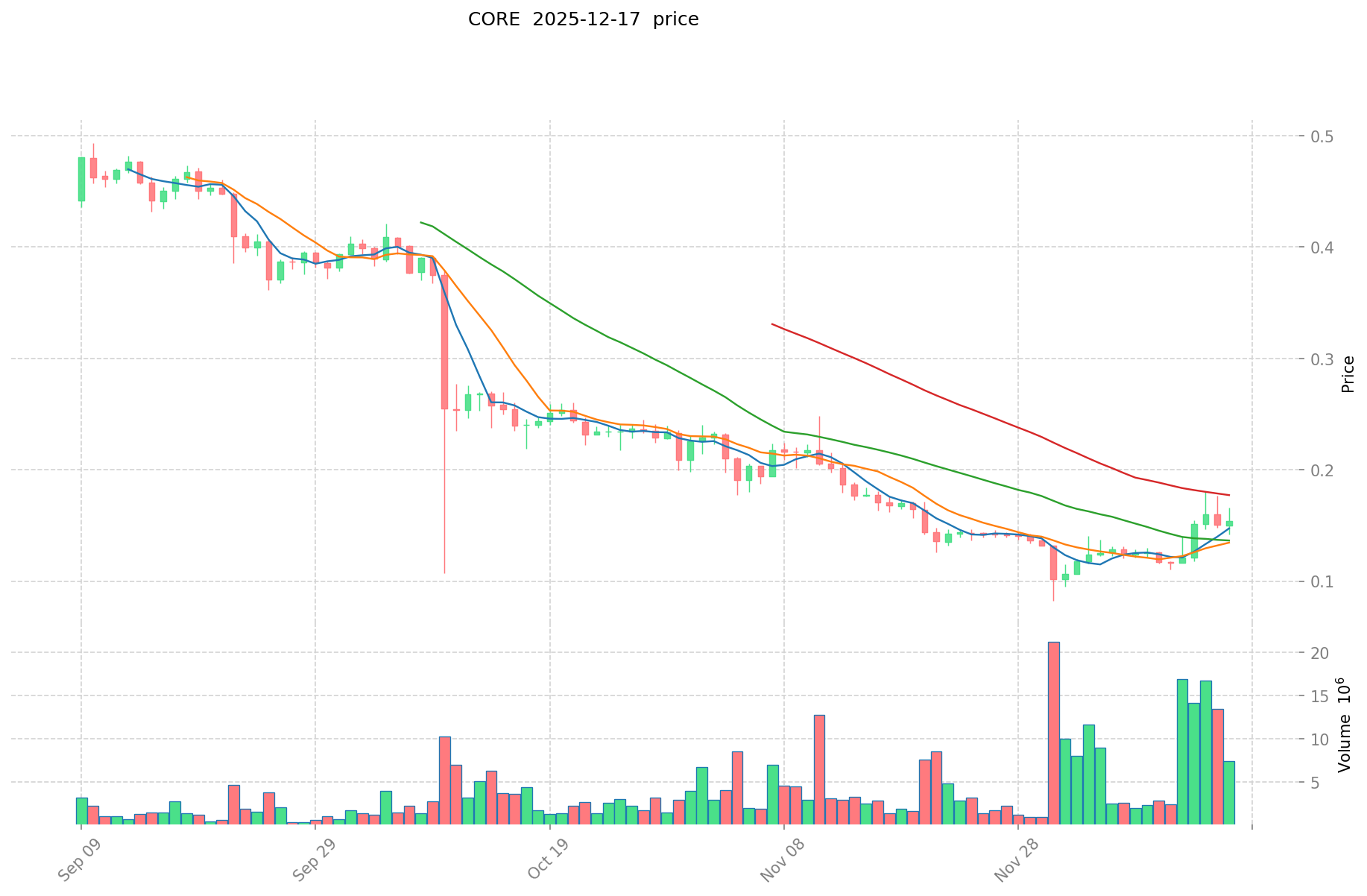
CORE (Core DAO):
- All-Time High (ATH): $6.14 (February 8, 2023)
- All-Time Low (ATL): $0.09046 (December 2, 2025)
- Current Price: $0.1529 (as of December 17, 2025)
- Price Decline from ATH: -97.51%
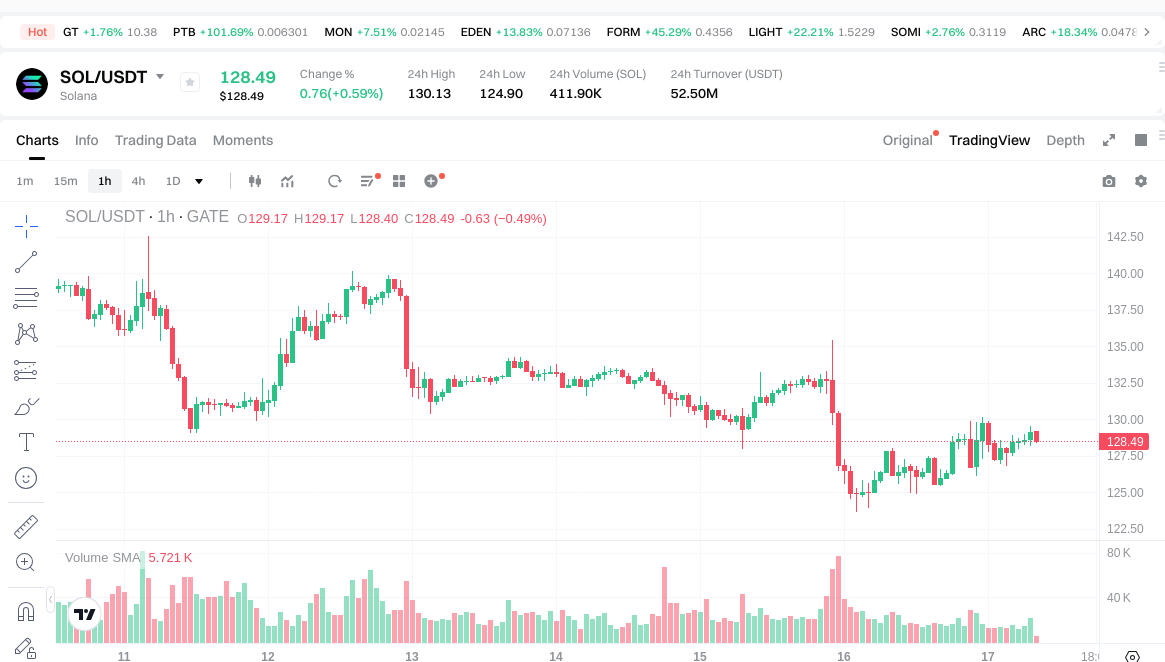
SOL (Solana):
- All-Time High (ATH): $293.31 (January 19, 2025)
- All-Time Low (ATL): $0.500801 (May 12, 2020)
- Current Price: $128.81 (as of December 17, 2025)
- Price Decline from ATH: -56.08%
Comparative Performance Analysis
CORE has experienced significantly steeper losses relative to its all-time high, declining approximately 97.51% since its peak in early 2023. In contrast, SOL, despite a recent peak in January 2025, maintains a decline of 56.08% from that high. This disparity reflects the different market trajectories and investor sentiment toward these two projects.
Current Market Status (December 17, 2025)
| Metric | CORE | SOL |
|---|---|---|
| Current Price | $0.1529 | $128.81 |
| 24-Hour Trading Volume | $1,135,105.85 | $52,358,910.73 |
| Market Capitalization | $321,090,000.00 | $79,387,205,574.52 |
| Market Ranking | #262 | #7 |
| 24-Hour Price Change | +2.06% | +1.11% |
| 7-Day Price Change | +21.04% | -6.7% |
| 30-Day Price Change | -8.95% | -5.74% |
| 1-Year Price Change | -88.64% | -40.37% |
Market Sentiment Index
Crypto Fear & Greed Index: 11 (Extreme Fear)
The current market sentiment indicates extreme fear, suggesting that investors are displaying heightened risk aversion across the crypto market as of December 17, 2025.
II. Project Overview and Technical Architecture
CORE (Core DAO)
Fundamental Characteristics: Core DAO is an EVM-compatible Layer 1 blockchain built as a fork of Geth. The project introduces a novel consensus mechanism called "Satoshi Plus," which combines delegated BTC mining hash power and delegated proof-of-stake (PoS) to secure the network.
Key Features:
- EVM composability and compatibility with Ethereum-based applications
- Integration of Bitcoin's decentralization and security principles
- Hybrid consensus model addressing the blockchain trilemma
- Native token: CORE
Token Supply:
- Total Supply: 2,100,000,000 CORE
- Circulating Supply: 1,020,218,146.06 CORE (48.58% of total supply)
- Circulating Market Value: $155,991,354.53
SOL (Solana)
Fundamental Characteristics: Solana was founded in late 2017 by former engineers from Qualcomm, Intel, and Dropbox. It operates as a high-performance Layer 1 blockchain protocol emphasizing scalability without compromising decentralization or security.
Key Features:
- Proof-of-History (PoH) consensus mechanism combined with Proof-of-Stake (PoS)
- Capability to process up to 65,000 transactions per second
- Low transaction costs and minimal processing times
- Comprehensive smart contract infrastructure
Token Supply:
- Circulating Supply: 562,172,701.99 SOL (91.22% of fully diluted supply)
- Total Supply: 616,312,441.38 SOL
- Maximum Supply: Unlimited (with network burn protocol destroying 50% of transaction fees)
III. Market Capitalization and Liquidity Analysis
Market Cap Comparison
- SOL Market Cap: $79.39 billion (Rank #7)
- CORE Market Cap: $321.09 million (Rank #262)
- Market Cap Ratio (SOL/CORE): Approximately 247:1
SOL commands significantly larger market capitalization, reflecting greater institutional adoption and market confidence. CORE's lower market cap indicates it remains a smaller-cap cryptocurrency with potentially different risk and return profiles.
Trading Volume and Liquidity
24-Hour Trading Volume:
- SOL: $52,358,910.73
- CORE: $1,135,105.85
- Volume Ratio (SOL/CORE): Approximately 46:1
SOL demonstrates substantially higher liquidity, with trading volumes significantly exceeding CORE's. This disparity suggests SOL offers deeper market depth and easier entry/exit points for traders.
Exchange Listings
- CORE: Available on 25 exchanges
- SOL: Available on 78 exchanges
The broader availability of SOL across more exchanges further facilitates market accessibility and trading convenience.
IV. Price Volatility and Performance Metrics
Short-Term Performance (24 Hours)
Both assets showed modest positive price movement within the 24-hour period:
- CORE: +2.06%
- SOL: +1.11%
Medium-Term Performance (7 Days)
Divergent trends emerged over the weekly period:
- CORE: +21.04% (positive momentum)
- SOL: -6.7% (negative momentum)
Intermediate-Term Performance (30 Days)
Both assets experienced declines over the monthly timeframe:
- CORE: -8.95%
- SOL: -5.74%
Long-Term Performance (1 Year)
Extended-period performance reveals substantial losses:
- CORE: -88.64%
- SOL: -40.37%
The one-year comparison demonstrates that CORE has experienced significantly more pronounced depreciation than SOL, reflecting the heightened risks or challenges faced by the Core DAO project relative to Solana's more established market position.
V. Key Observations and Risk Considerations
Market Position Differential
SOL maintains a dominant market position characterized by:
- Substantially larger market capitalization
- Greater trading liquidity across more exchanges
- More extensive institutional adoption
- Higher network activity and developer ecosystem
CORE, as a smaller-cap asset, presents:
- Limited market liquidity
- Narrower exchange availability
- Fewer developer resources
- Greater relative volatility risk
Technical Architecture Considerations
- CORE leverages Bitcoin's security model through its Satoshi Plus consensus, potentially offering enhanced decentralization but with unproven scalability at volume
- SOL utilizes a mature Proof-of-History mechanism with extensive real-world operational data, though historically experiencing network interruptions
Market Sentiment Context
The "Extreme Fear" sentiment indicator (value: 11) suggests current market conditions reflect elevated risk aversion, which typically disadvantages smaller-cap projects more severely than established protocols.
Disclaimer
This report is for informational purposes only and does not constitute investment advice. Cryptocurrency investments carry substantial risk, including potential total loss of capital. Past performance does not guarantee future results. The extreme fear market sentiment and significant price volatility require careful consideration of individual risk tolerance and investment objectives prior to any transaction.
Comparative Analysis Report: CORE vs SOL Investment Value
I. Executive Summary
Core (CORE) and Solana (SOL) represent two distinct approaches to blockchain infrastructure within the cryptocurrency ecosystem. Their investment value is determined by technological innovation, ecosystem growth, tokenomics design, and market positioning. This report provides a detailed comparative analysis of the core factors influencing their investment potential.
II. Core Factors Affecting CORE vs SOL Investment Value
Tokenomics and Supply Mechanism
CORE:
- Circulating Supply: 1,020,146,300 CORE
- Total Issued Supply: 2,093,769,839.04 CORE
- Maximum Supply: 2,100,000,000 CORE
- Current Price: 1.09 CNY (approximately)
- Token price is influenced by supply-demand dynamics, token burning mechanisms, and distribution strategies
SOL:
- SOL serves as the core infrastructure token of the Solana ecosystem
- Price dynamics are influenced by ecosystem growth and institutional adoption rates
📌 Key Observations: Token supply mechanisms directly impact scarcity perception and price cycles. CORE's defined maximum supply of 2.1 billion tokens provides supply predictability, while SOL's tokenomics structure aligns with Solana's network activity and inflation-deflation mechanisms.
Institutional Adoption and Market Application
Institutional Capital Inflow:
- SOL has demonstrated significant institutional interest, with major institutional capital entering the ecosystem and institutional adoption rate accelerating
- CORE received a 50 million USD investment from Bitget (a leading centralized exchange) in April 2023, signaling institutional confidence in ecosystem development
Enterprise Adoption:
- CORE: Focuses on supporting early-stage blockchain projects through the Core DAO ecosystem fund. The project emphasizes decentralized governance and integrates best features from Bitcoin, Ethereum, Solana, and Polygon blockchains
- SOL: Primary focus on high-speed transaction processing and ecosystem DApp development, with broader adoption across decentralized finance and digital asset applications
Market Positioning:
- CORE positions itself as web3 infrastructure emphasizing user-led governance and decentralization
- SOL serves primarily as the native token for Solana's high-performance blockchain
Technological Development and Ecosystem Construction
CORE:
- Mainnet launched on January 14, 2023
- Has processed millions of transactions
- Supports smart contracts and various decentralized applications (DApps)
- Designed to integrate best functionalities from major blockchains (Bitcoin, Ethereum, Solana, Polygon)
- Emphasizes user-led governance and network accessibility
SOL:
- Ecosystem experiencing rapid growth and expansion
- Strong focus on DApp development and blockchain scalability
- Demonstrates momentum in attracting developer and user communities
- Institutional product evolution occurring (including ETF products like BSOL)
Ecosystem Development Comparison:
- CORE: Concentrates on infrastructure interoperability and early-stage project incubation through ecosystem funding
- SOL: Shows strength in DeFi applications, NFT marketplace development, and smart contract utilization with growing institutional product offerings
Market Risk Factors and Considerations
Token Concentration Analysis:
- Whale investor influence and token distribution among top holders affect market integrity and manipulation risk
- Both projects require analysis of token concentration levels
Market Volatility:
- Cryptocurrency price predictions for both assets are inherently speculative in nature and should be treated with caution
- Investors should consider multiple factors including cryptocurrency security, risks, and long-term project viability
Price Factors:
- Factors affecting CORE and SOL pricing include:
- Overall cryptocurrency market trends and fundamentals
- Project information and basic development progress
- Current market capitalization valuation levels
- Current price positioning relative to historical levels
III. Risk Disclosure
Both CORE and SOL investments carry inherent risks and uncertainties. Price predictions should be treated as speculative analysis rather than investment advice. Investment decisions must account for individual risk tolerance, available capital, and comprehensive market analysis. Proper timing of market entry remains critical for achieving reliable returns.
IV. Conclusion
CORE emphasizes infrastructure interoperability and decentralized governance with institutional backing from major exchanges, while SOL demonstrates stronger current market momentum with rapid ecosystem growth and institutional adoption acceleration. Both projects have distinct value propositions aligned with different aspects of blockchain infrastructure development. Investment evaluation requires comprehensive consideration of market conditions, project fundamentals, current valuation levels, and appropriate entry timing relative to individual investment objectives and risk profiles.
III. 2025-2030 Price Forecast: CORE vs SOL
Short-term Forecast (2025)
- CORE: Conservative $0.1216 - $0.152 | Bullish $0.152 - $0.18392
- SOL: Conservative $109.497 - $128.82 | Bullish $128.82 - $175.1952
Mid-term Forecast (2027-2028)
- CORE may enter growth accumulation phase, with projected price range of $0.1656778435 - $0.281425378
- SOL may enter expansion phase, with projected price range of $101.3348784906 - $241.7814644688
- Key drivers: institutional capital inflows, ETF products, ecosystem development
Long-term Forecast (2029-2030)
- CORE: Base case $0.21447337275 - $0.285964497 | Bullish case $0.31773833 - $0.41750816562
- SOL: Base case $209.86488891500976 - $255.932791359768 | Bullish case $302.084606195136 - $314.79733337251464
Disclaimer
This analysis is based on historical data and mathematical models. Cryptocurrency markets are highly volatile and unpredictable. Price forecasts should not be considered as investment advice. Investors should conduct their own research and consult with financial professionals before making investment decisions. Past performance does not guarantee future results.
CORE:
| 年份 | 预测最高价 | 预测平均价格 | 预测最低价 | 涨跌幅 |
|---|---|---|---|---|
| 2025 | 0.18392 | 0.152 | 0.1216 | 0 |
| 2026 | 0.226746 | 0.16796 | 0.1444456 | 9 |
| 2027 | 0.2565589 | 0.197353 | 0.11249121 | 28 |
| 2028 | 0.281425378 | 0.22695595 | 0.1656778435 | 47 |
| 2029 | 0.31773833 | 0.254190664 | 0.18301727808 | 65 |
| 2030 | 0.41750816562 | 0.285964497 | 0.21447337275 | 86 |
SOL:
| 年份 | 预测最高价 | 预测平均价格 | 预测最低价 | 涨跌幅 |
|---|---|---|---|---|
| 2025 | 175.1952 | 128.82 | 109.497 | 0 |
| 2026 | 162.648132 | 152.0076 | 118.565928 | 17 |
| 2027 | 198.23311116 | 157.327866 | 89.67688362 | 21 |
| 2028 | 241.7814644688 | 177.78048858 | 101.3348784906 | 37 |
| 2029 | 302.084606195136 | 209.7809765244 | 153.140112862812 | 62 |
| 2030 | 314.79733337251464 | 255.932791359768 | 209.86488891500976 | 98 |
Comparative Analysis Report: Core DAO (CORE) vs Solana (SOL)
IV. Investment Strategy Comparison: CORE vs SOL
Long-Term vs Short-Term Investment Strategies
CORE: Best suited for investors focusing on infrastructure interoperability potential and early-stage ecosystem participation. The project's emphasis on decentralized governance and Bitcoin security integration appeals to those with a multi-year investment horizon seeking exposure to emerging blockchain infrastructure.
SOL: Better positioned for investors seeking established ecosystem maturity and institutional adoption trends. Solana's proven track record, extensive DApp ecosystem, and institutional product development (including ETF products) make it suitable for those prioritizing market stability and demonstrated network utility.
Risk Management and Asset Allocation
Conservative Investors:
- CORE: 5-10%
- SOL: 35-45%
- Remaining allocation: Stablecoins and established cryptocurrencies (BTC, ETH)
Aggressive Investors:
- CORE: 15-25%
- SOL: 30-40%
- Remaining allocation: Alternative Layer 1 protocols and emerging projects
Hedging Instruments: Stablecoin reserves (USDC, USDT), diversified Layer 1 exposure across multiple blockchain protocols, and consideration of cryptocurrency derivatives for volatility management.
V. Potential Risk Comparison
Market Risk
CORE: Faces significantly higher market concentration risk due to limited exchange availability (25 exchanges vs. SOL's 78), reduced trading liquidity ($1.1M daily volume), and narrower institutional participation. The 97.51% decline from all-time high suggests heightened vulnerability during market downturns and potential for continued volatility.
SOL: While experiencing substantial decline from January 2025 peak (-56.08%), maintains substantially deeper market liquidity and broader institutional adoption. However, exposure to broader cryptocurrency market sentiment remains significant given the current "Extreme Fear" index reading of 11.
Technical Risk
CORE: Satoshi Plus consensus mechanism remains relatively unproven at scale. The hybrid delegated mining and PoS model introduces complexity and potential single-point-of-failure risks if coordination mechanisms between Bitcoin miners and CORE validators fail. Network has processed millions of transactions, but long-term stability under stress conditions requires further validation.
SOL: Historical network interruptions and concerns regarding validator concentration present ongoing technical considerations. However, Proof-of-History consensus demonstrates maturity with extensive real-world operational data. Developer community actively addresses identified vulnerabilities.
Regulatory Risk
Both assets face evolving regulatory frameworks affecting cryptocurrency classification, taxation, and market access. CORE's smaller market capitalization may provide temporary regulatory flexibility but offers less institutional protection. SOL's larger market presence and institutional adoption create both regulatory scrutiny and protective precedent-setting benefits.
VI. Conclusion: Which Is the Better Buy?
📌 Investment Value Summary:
CORE Advantages:
- Novel Satoshi Plus consensus integrating Bitcoin's decentralization principles
- Lower absolute price point enabling larger token quantities for retail investors
- Institutional backing from major exchange platforms (Bitget $50M investment)
- Strong recent weekly performance (+21.04% over 7 days)
- Potential asymmetric upside from depressed valuation levels
- Emphasis on user-led governance and ecosystem inclusivity
SOL Advantages:
- Established market position with 247x larger market capitalization
- Significantly superior liquidity and exchange accessibility (78 listings)
- Proven high-throughput capability (65,000 transactions per second)
- Substantial institutional adoption and ETF product development
- Broader developer ecosystem and mature smart contract infrastructure
- More limited long-term downside given market maturity and acceptance
✅ Investment Recommendations:
Beginner Investors: SOL is the more prudent choice. The established infrastructure, institutional adoption, deeper liquidity, and broader ecosystem provide reduced execution risk and better off-ramps for capital. The risk profile, while still elevated in current market conditions, remains more manageable than CORE's speculative positioning.
Experienced Investors: Consider a diversified approach with 70-80% SOL allocation paired with 20-30% CORE allocation. This strategy captures SOL's stability benefits while maintaining exposure to CORE's potential upside should the project demonstrate accelerated ecosystem development and institutional adoption metrics improvement.
Institutional Investors: SOL represents the only category-appropriate vehicle given current market conditions. Market depth, regulatory clarity, and institutional product infrastructure (ETF offerings) make SOL the suitable institutional exposure. CORE requires substantially larger ecosystem maturation and liquidity development before institutional mandate compatibility.
⚠️ Risk Disclaimer: Cryptocurrency markets exhibit extreme volatility and unpredictability. The current "Extreme Fear" sentiment index (value: 11) signals elevated market-wide risk aversion. Both CORE and SOL investments carry substantial capital loss potential. This analysis does not constitute investment advice. Investors must conduct independent research, assess individual risk tolerance, and consult financial professionals before executing transactions. Past performance provides no guarantee of future results. Price forecasts presented are speculative modeling exercises, not predictive statements. Individual investment decisions must align with personal financial circumstances, investment objectives, and risk capacity. None
Frequently Asked Questions: CORE vs SOL Investment Comparison
I. Price and Market Performance
Q1: Why has CORE experienced a much steeper price decline (-97.51%) compared to SOL (-56.08%)?
A: CORE's dramatic decline reflects its status as a smaller-cap, less-established project with limited market liquidity and exchange availability (25 exchanges vs. SOL's 78). The "Extreme Fear" market sentiment disproportionately affects smaller-cap assets. Additionally, CORE peaked in early 2023 during a different market cycle, whereas SOL's ATH was reached more recently in January 2025. CORE's narrower institutional adoption and unproven consensus mechanism at scale contribute to sharper valuation compression during market downturns.
Q2: What does the current 24-hour price movement (+2.06% for CORE vs +1.11% for SOL) indicate about short-term momentum?
A: While CORE shows slightly stronger 24-hour performance, this single metric should not guide investment decisions. Over the 7-day period, CORE demonstrates +21.04% while SOL shows -6.7%, suggesting CORE may benefit from oversold conditions and technical bounce-back. However, over 30-day and 1-year timeframes, both assets remain negative, with SOL showing greater relative stability. Short-term price movements in extreme fear conditions often reflect technical trading rather than fundamental value shifts.
II. Tokenomics and Valuation
Q3: How do the tokenomics of CORE (2.1 billion maximum supply) compare to SOL's structure, and what does this mean for long-term value?
A: CORE's fixed maximum supply of 2.1 billion tokens mirrors Bitcoin's scarcity model and provides supply predictability. SOL's tokenomics incorporate network burn mechanisms (50% of transaction fees destroyed), creating deflationary pressure. CORE's lower circulating-to-total supply ratio (48.58%) suggests significant dilution potential if locked tokens enter circulation. SOL's higher ratio (91.22%) indicates maturer token distribution. For long-term value appreciation, CORE's Bitcoin-like fixed supply offers theoretical scarcity advantages, while SOL's burn mechanism creates utility-based deflation tied to actual network usage and adoption.
Q4: Should investors be concerned about token concentration and whale manipulation in either project?
A: Both projects require careful analysis of token holder distribution. CORE's smaller market capitalization ($321M) and limited liquidity ($1.1M daily volume) make it more vulnerable to whale manipulation and sudden price swings from large holder transactions. SOL's substantially larger market cap ($79.4B) and deeper liquidity ($52.4M daily volume) provide better protection against individual actor manipulation. For retail investors seeking capital safety, SOL's market structure presents lower manipulation risk. CORE's concentrated holder base could amplify both upside and downside volatility.
III. Technical Architecture and Risk
Q5: Is the Satoshi Plus consensus mechanism of CORE more secure than Solana's Proof-of-History combined with Proof-of-Stake?
A: The Satoshi Plus mechanism theoretically enhances security by incorporating Bitcoin's proven decentralization model through delegated mining hash power. However, it remains relatively unproven at scale compared to Solana's mature Proof-of-History system. SOL has extensive real-world operational data spanning multiple market cycles, despite experiencing historical network interruptions. CORE's hybrid approach introduces complexity—coordination failures between Bitcoin miners and CORE validators could create single-point-of-failure risks. For institutional investors prioritizing proven security frameworks, SOL's established track record and institutional product development (ETF offerings) provide greater assurance than CORE's innovative but unvalidated consensus model.
Q6: What specific technical risks should investors monitor for each project?
A: CORE Risk Factors: Unproven scalability at high transaction volumes, potential validator concentration among delegated mining pools, limited developer ecosystem testing, and emergence of unforeseen Satoshi Plus coordination issues under extreme network stress conditions. SOL Risk Factors: Historical network interruptions suggest potential consensus layer vulnerabilities under load, validator centralization concerns, and exposure to broader Layer 1 protocol competition. Both face regulatory uncertainty regarding cryptocurrency classification. CORE faces additional technical validation risk given its newer architecture, while SOL's risks are primarily operational and regulatory rather than architectural.
IV. Market Adoption and Investment Potential
Q7: Which project shows stronger institutional adoption metrics, and what does this indicate for future growth?
A: SOL demonstrates substantially stronger institutional adoption through multiple ETF product launches, broader institutional capital inflows, 78 exchange listings, and 247x larger market capitalization. CORE received significant institutional backing through Bitget's $50M investment in April 2023, but lacks comparable breadth of institutional product infrastructure. Institutional adoption historically correlates with reduced volatility, deeper liquidity, and regulatory clarity. SOL's established institutional presence provides greater capital stability and lower execution risk. However, CORE's institutional backing demonstrates confidence in the Satoshi Plus model despite current market weakness, offering potential asymmetric upside for patient investors if ecosystem adoption accelerates.
Q8: Based on current market conditions and the "Extreme Fear" sentiment index of 11, which asset presents better risk-adjusted returns for different investor profiles?
A: Beginner/Conservative Investors: SOL is recommended (35-45% allocation maximum). Superior liquidity, institutional adoption, and established ecosystem provide lower execution risk during extreme fear conditions. CORE allocation should be minimal (5-10%) given higher volatility risk. Experienced Investors: Consider diversified 70-80% SOL / 20-30% CORE portfolio capturing SOL's stability while maintaining CORE upside exposure. This structure benefits from SOL's liquid off-ramps during forced selling and CORE's asymmetric recovery potential from depressed valuations. Institutional Investors: SOL remains category-appropriate; CORE requires substantially more market maturation. The extreme fear sentiment disproportionately impacts small-cap assets like CORE, creating forced liquidation dynamics that experienced allocators should avoid. SOL's institutional product infrastructure (ETF products, custodial solutions) remains unavailable for CORE.
Disclaimer: This FAQ analysis is for informational purposes only and does not constitute investment advice. Cryptocurrency investments carry substantial capital loss potential. The current "Extreme Fear" market sentiment (index value: 11) signals elevated systemic risk aversion. Individual investment decisions must reflect personal financial circumstances, risk tolerance, and professional financial consultation. Past performance does not guarantee future results.
Share
Content
Introduction: CORE vs SOL Investment Comparison
I. Price History Comparison and Current Market Status
II. Project Overview and Technical Architecture
III. Market Capitalization and Liquidity Analysis
IV. Price Volatility and Performance Metrics
V. Key Observations and Risk Considerations
Disclaimer
I. Executive Summary
II. Core Factors Affecting CORE vs SOL Investment Value
III. Risk Disclosure
IV. Conclusion
III. 2025-2030 Price Forecast: CORE vs SOL
IV. Investment Strategy Comparison: CORE vs SOL
V. Potential Risk Comparison
VI. Conclusion: Which Is the Better Buy?
I. Price and Market Performance
II. Tokenomics and Valuation
III. Technical Architecture and Risk
IV. Market Adoption and Investment Potential
How to Buy Cryptocurrency


Trending Cryptocurrencies



XZXX: A Comprehensive Guide to the BRC-20 Meme Token in 2025

Bitcoin Fear and Greed Index: Market Sentiment Analysis for 2025
Top Crypto ETFs to Watch in 2025: Navigating the Digital Asset Boom

5 ways to get Bitcoin for free in 2025: Newbie Guide

Bitcoin Market Cap in 2025: Analysis and Trends for Investors

2025 Bitcoin Price Prediction: Trump's Tariffs' Impact on BTC
DRK: Understanding the Controversial Cryptocurrency and Its Market Impact

Infrared Finance LSD: How IR Token Works in DeFi Yield Farming and Liquid Staking
How to Invest in Tokenized US Stocks on Solana With Ondo Finance ETFs

Theoriq (THQ): AI-Driven DeFi Infrastructure for Web3
Bitwise 2026 Crypto Market Forecast: Breaking the Four-Year Cycle