CORE vs ETH: Comparing Scalability Solutions for DeFi Ecosystems


Introduction: Investment Comparison between CORE and ETH
In the cryptocurrency market, the comparison between CORE vs ETH has always been a topic that investors can't avoid. The two not only differ significantly in market cap ranking, application scenarios, and price performance, but also represent different positions in the crypto asset landscape.
Core DAO (CORE): Since its launch, it has gained market recognition for its unique "Satoshi Plus" consensus mechanism that combines delegated BTC mining hash and delegated proof-of-stake.
Ethereum (ETH): Since its inception in 2015, it has been hailed as the platform for smart contracts and decentralized applications (DApps), and is one of the cryptocurrencies with the highest global trading volume and market capitalization.
This article will provide a comprehensive analysis of the investment value comparison between CORE vs ETH, focusing on historical price trends, supply mechanisms, institutional adoption, technological ecosystems, and future predictions, attempting to answer the question that concerns investors the most:
"Which is the better buy right now?"
I. Price History Comparison and Current Market Status
CORE and ETH Historical Price Trends
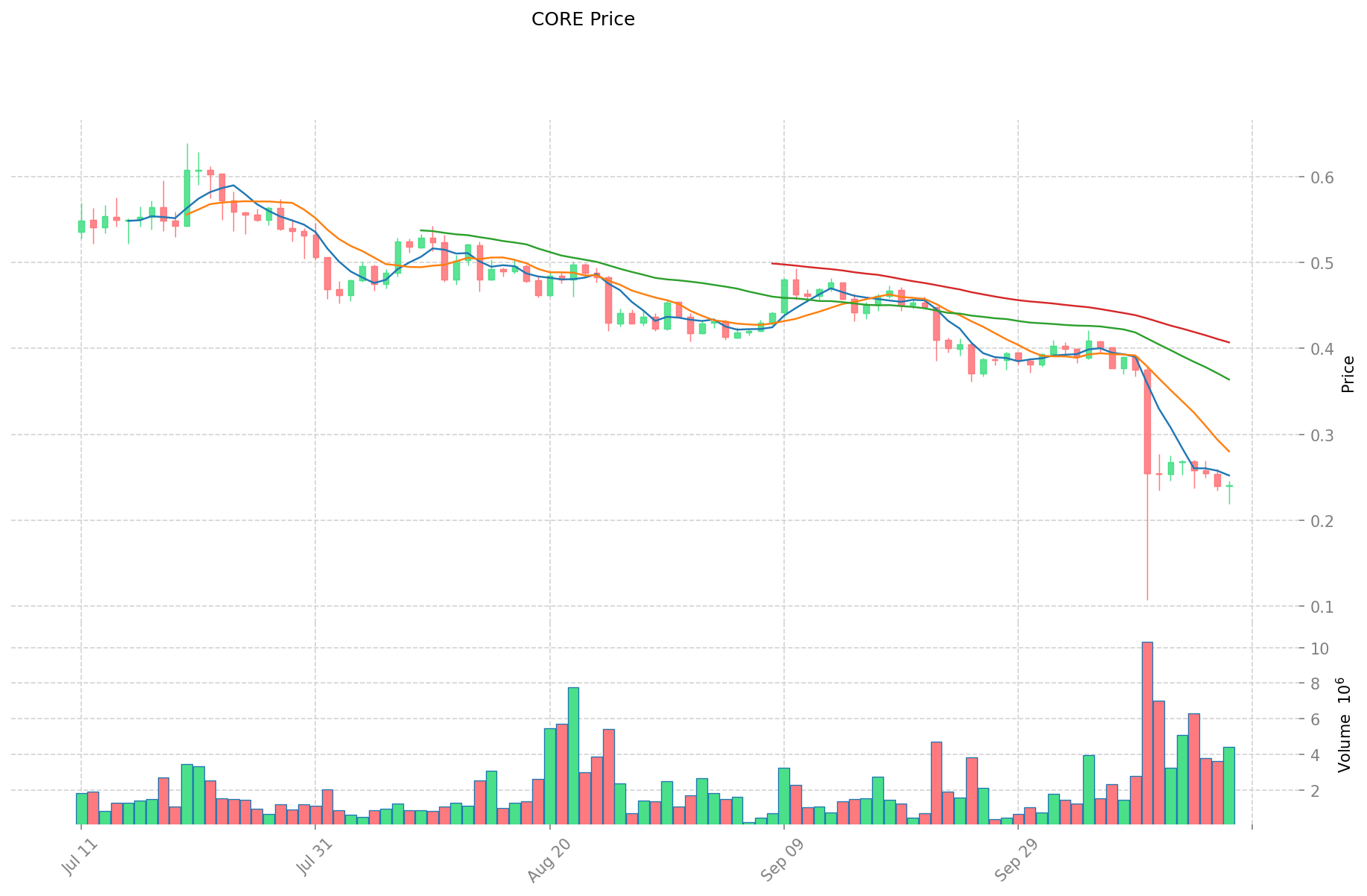
- 2023: CORE reached its all-time high of $14.48 on February 8, 2023.
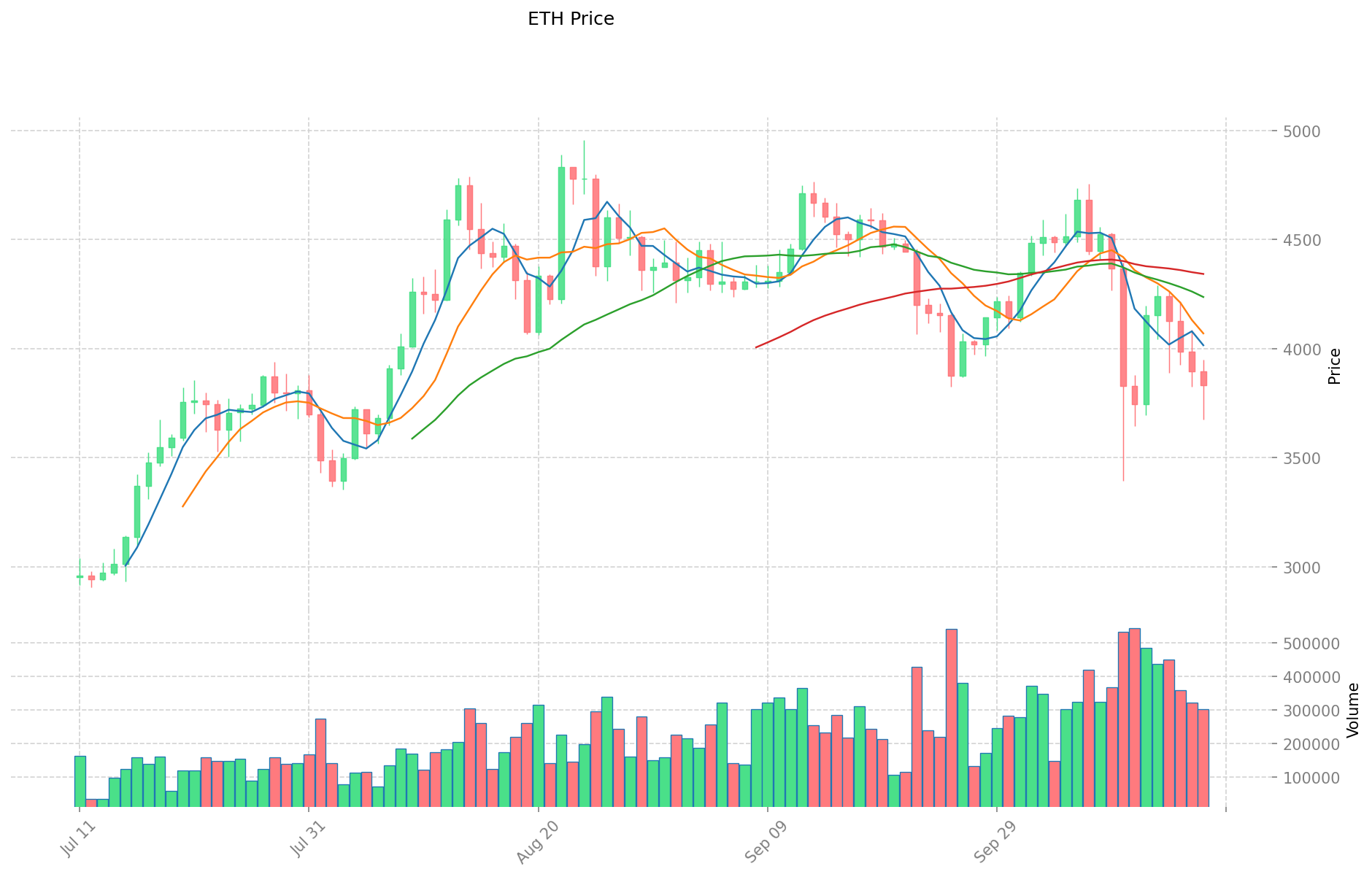
- 2025: ETH achieved a new all-time high of $4,946.05 on August 25, 2025.
- Comparative analysis: In the recent market cycle, CORE has dropped from its high of $14.48 to a current price of $0.2395, while ETH has shown more resilience, maintaining a price of $3,822.01 after reaching its all-time high.
Current Market Situation (2025-10-18)
- CORE current price: $0.2395
- ETH current price: $3,822.01
- 24-hour trading volume: CORE $1,022,130.64 vs ETH $1,144,953,452.62
- Market Sentiment Index (Fear & Greed Index): 22 (Extreme Fear)
Click to view real-time prices:
- Check CORE's current price Market Price
- Check ETH's current price Market Price
II. Key Factors Affecting Investment Value of CORE vs ETH
Supply Mechanism Comparison (Tokenomics)
-
CORE: No fixed supply cap, implements a fee structure where 85% of transaction fees are burned while 15% go to validators
-
ETH: Deflationary model since EIP-1559, where base transaction fees are burned while validators receive tips and block rewards
-
📌 Historical Pattern: Deflationary mechanisms tend to create upward price pressure during high network activity periods, with ETH's burning mechanism potentially creating more scarcity over time compared to CORE's newer model.
Institutional Adoption and Market Applications
- Institutional Holdings: ETH has established institutional adoption through ETFs, custody solutions, and corporate treasury allocations, while CORE is still seeking institutional recognition
- Enterprise Adoption: ETH leads with extensive use in enterprise blockchain solutions, DeFi platforms, and payment systems; CORE offers advantages in cross-chain interoperability but has less proven real-world implementation
- Regulatory Stance: ETH has achieved clearer regulatory standing in many jurisdictions as a commodity rather than a security; CORE's regulatory position remains less defined
Technical Development and Ecosystem Building
- CORE Technical Upgrades: Focus on scalability solutions and cross-chain interoperability while maintaining security
- ETH Technical Development: Advancing through the Surge, Verge, Purge, and Splurge phases following the Merge, emphasizing scalability through L2 solutions and sharding
- Ecosystem Comparison: ETH dominates in DeFi TVL, NFT marketplaces, and dApp development with mature infrastructure; CORE ecosystem is growing but comparatively nascent
Macroeconomic Factors and Market Cycles
- Inflation Performance: ETH has demonstrated some anti-inflationary characteristics due to its deflationary mechanism, while CORE has insufficient historical data to evaluate
- Monetary Policy Impact: Both assets show correlation to broader risk assets, with Federal Reserve policies affecting liquidity conditions and investor risk appetite
- Geopolitical Factors: ETH has established global utility in cross-border transactions across jurisdictions; CORE's cross-chain capability may offer advantages in fragmented regulatory environments
III. 2025-2030 Price Prediction: CORE vs ETH
Short-term Prediction (2025)
- CORE: Conservative $0.16-$0.24 | Optimistic $0.24-$0.29
- ETH: Conservative $2,299-$3,833 | Optimistic $3,833-$4,255
Mid-term Prediction (2027)
- CORE may enter a growth phase, estimated price range $0.25-$0.42
- ETH may enter a consolidation phase, estimated price range $2,361-$4,770
- Key drivers: Institutional capital inflow, ETF, ecosystem development
Long-term Prediction (2030)
- CORE: Base scenario $0.36-$0.40 | Optimistic scenario $0.40-$0.45
- ETH: Base scenario $4,182-$5,808 | Optimistic scenario $5,808-$8,306
Disclaimer
CORE:
| 年份 | 预测最高价 | 预测平均价格 | 预测最低价 | 涨跌幅 |
|---|---|---|---|---|
| 2025 | 0.28764 | 0.2397 | 0.162996 | 0 |
| 2026 | 0.316404 | 0.26367 | 0.2346663 | 10 |
| 2027 | 0.42055365 | 0.290037 | 0.24653145 | 21 |
| 2028 | 0.41569553025 | 0.355295325 | 0.255812634 | 48 |
| 2029 | 0.4240449703875 | 0.385495427625 | 0.2852666164425 | 60 |
| 2030 | 0.453342622887 | 0.40477019900625 | 0.3561977751255 | 69 |
ETH:
| 年份 | 预测最高价 | 预测平均价格 | 预测最低价 | 涨跌幅 |
|---|---|---|---|---|
| 2025 | 4254.7965 | 3833.15 | 2299.89 | 0 |
| 2026 | 5216.7254925 | 4043.97325 | 2830.781275 | 5 |
| 2027 | 4769.2598523875 | 4630.34937125 | 2361.4781793375 | 21 |
| 2028 | 5357.777257473375 | 4699.80461181875 | 3618.8495511004375 | 22 |
| 2029 | 6587.716124386341875 | 5028.7909346460625 | 3168.138288827019375 | 31 |
| 2030 | 8305.802547208169128 | 5808.253529516202187 | 4181.942541251665575 | 51 |
IV. Investment Strategy Comparison: CORE vs ETH
Long-term vs Short-term Investment Strategy
- CORE: Suitable for investors focused on cross-chain interoperability and ecosystem potential
- ETH: Suitable for investors seeking stability and anti-inflationary properties
Risk Management and Asset Allocation
- Conservative investors: CORE: 10% vs ETH: 90%
- Aggressive investors: CORE: 30% vs ETH: 70%
- Hedging tools: Stablecoin allocation, options, cross-currency portfolios
V. Potential Risk Comparison
Market Risk
- CORE: Higher volatility due to lower market cap and liquidity
- ETH: Susceptible to broader crypto market trends and macroeconomic factors
Technical Risk
- CORE: Scalability, network stability
- ETH: Centralization of mining power, security vulnerabilities
Regulatory Risk
- Global regulatory policies have different impacts on both assets
VI. Conclusion: Which Is the Better Buy?
📌 Investment Value Summary:
- CORE advantages: Cross-chain interoperability, potential for growth in a developing ecosystem
- ETH advantages: Established ecosystem, institutional adoption, deflationary mechanism
✅ Investment Advice:
- Novice investors: Consider a small allocation to CORE within a diversified portfolio dominated by ETH
- Experienced investors: Balance allocation based on risk tolerance, with a higher weight towards ETH
- Institutional investors: Focus on ETH for its liquidity and regulatory clarity, monitor CORE for potential future opportunities
⚠️ Risk Warning: The cryptocurrency market is highly volatile. This article does not constitute investment advice. None
VII. FAQ
Q1: What are the main differences between CORE and ETH in terms of investment potential? A: CORE offers potential for growth in cross-chain interoperability and a developing ecosystem, while ETH provides stability, an established ecosystem, institutional adoption, and a deflationary mechanism.
Q2: How do the supply mechanisms of CORE and ETH compare? A: CORE has no fixed supply cap and burns 85% of transaction fees, while ETH implements a deflationary model with base transaction fees being burned and validators receiving tips and block rewards.
Q3: Which cryptocurrency has shown better price performance in recent market cycles? A: ETH has shown more resilience, maintaining a higher price after reaching its all-time high, while CORE has experienced a significant drop from its peak.
Q4: What are the key factors affecting the investment value of CORE and ETH? A: Key factors include supply mechanisms, institutional adoption, market applications, technical development, ecosystem building, and macroeconomic factors.
Q5: How do the long-term price predictions for CORE and ETH compare? A: By 2030, CORE is predicted to reach $0.36-$0.45, while ETH is forecasted to reach $4,182-$8,306 in base and optimistic scenarios respectively.
Q6: What are the recommended investment strategies for CORE and ETH? A: Conservative investors might allocate 10% to CORE and 90% to ETH, while aggressive investors might consider 30% CORE and 70% ETH. Novice investors should focus more on ETH, while experienced investors can balance based on risk tolerance.
Q7: What are the primary risks associated with investing in CORE and ETH? A: CORE faces higher volatility due to lower market cap and liquidity, as well as technical risks related to scalability and network stability. ETH is susceptible to broader crypto market trends, macroeconomic factors, and potential centralization of mining power.
Share
Content
Introduction: Investment Comparison between CORE and ETH
I. Price History Comparison and Current Market Status
II. Key Factors Affecting Investment Value of CORE vs ETH
III. 2025-2030 Price Prediction: CORE vs ETH
IV. Investment Strategy Comparison: CORE vs ETH
V. Potential Risk Comparison
VI. Conclusion: Which Is the Better Buy?
VII. FAQ
How to Buy Cryptocurrency


Trending Cryptocurrencies



2025 POL Price Prediction: Analyzing Potential Growth Factors and Market Trajectories for Polygon's Native Token

2025 OPPrice Prediction: Analyzing Optimism's Long-Term Value Potential in Layer 2 Scaling Solutions
2025 LINEA Price Prediction: Analyzing Market Trends, Technical Developments and Adoption Factors for the Layer 2 Solution

YFII vs OP: A Battle of Yield Farming Protocols in the DeFi Space
Is LightLink (LL) a good investment?: Analyzing the potential of this emerging blockchain platform in the DeFi landscape

Is Arbitrum (ARB) a good investment?: Evaluating the potential of this Layer 2 scaling solution in the evolving crypto landscape
Xenea Daily Quiz Answer December 13, 2025

Guide to Bridging Assets to the Polygon Network

Guide to Integrating Polygon Network with Your Crypto Wallet

Beginner's Guide to Secure Digital Asset Storage with BEP2

Guide to Bridging Assets to Polygon PoS Network