Square
Following
Hot
News
Notifications
Profile
Share your thoughts
placeholder
Article
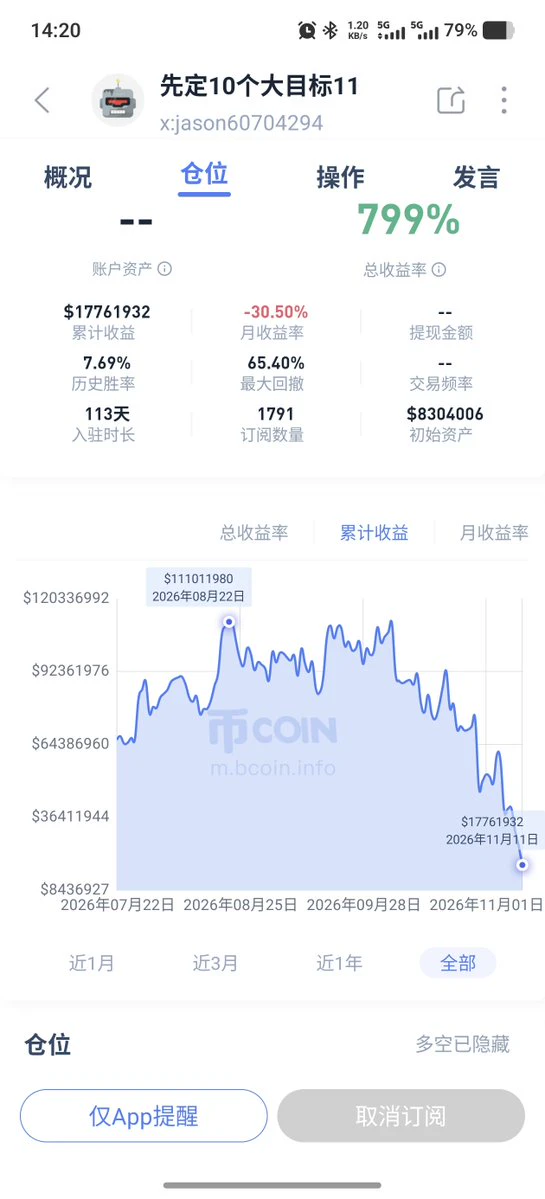
On August 22, the large target account still had $110 million in assets
By November 11, only $17 million was left...
Roughly speaking, it lost $100 million over these past few months
Longs really have it rough
post-image
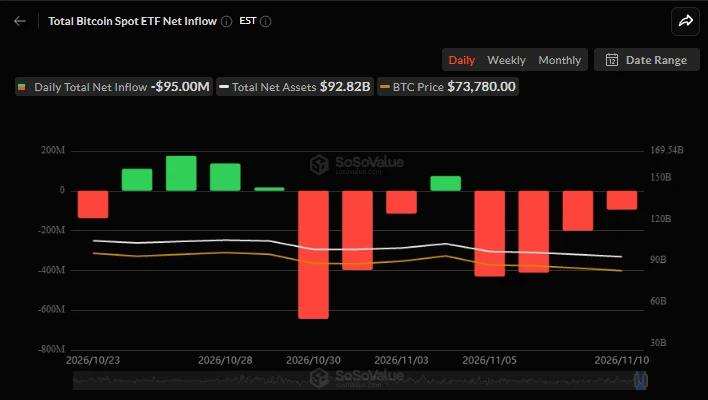
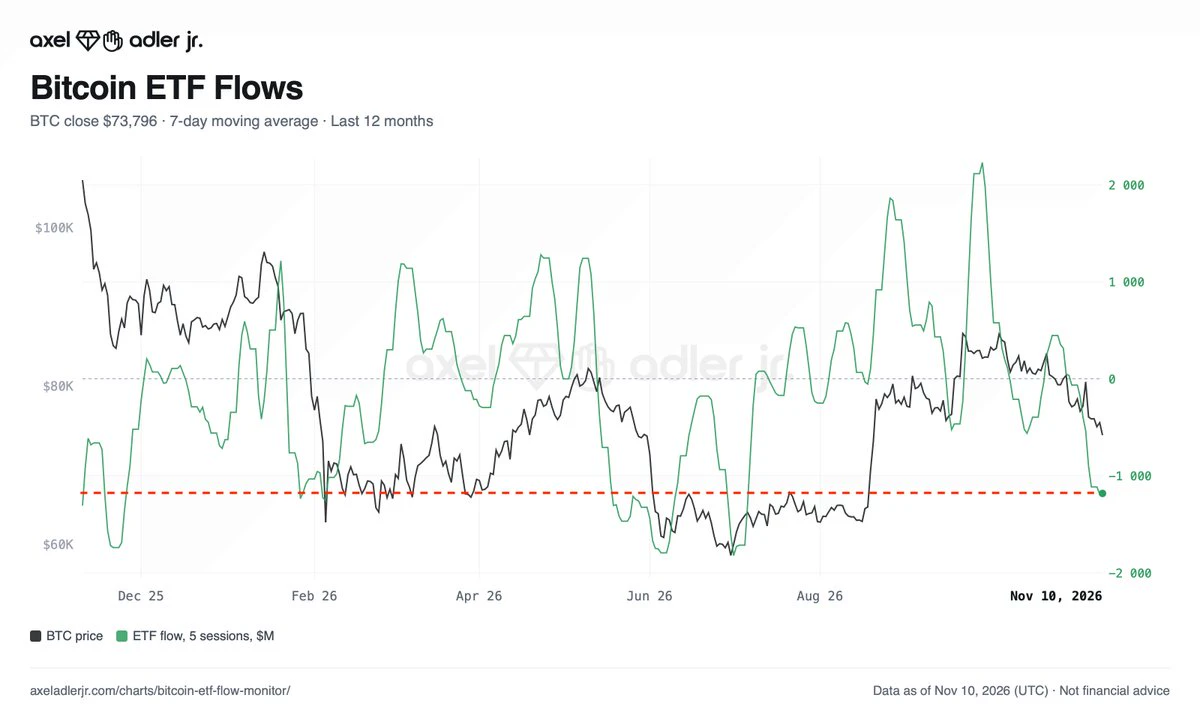
Bitcoin ETF outflows shrank by more than three-quarters in four trading days.
$430 million out on Nov 5.
$412 million on Nov 6.
$201 million on Nov 9.
$95 million on Nov 10.
Still red, guys. but each day shows a less and less selling.
This could be the sellers getting tired, but we won't be able to say the mood has completely shifted until we see more green than red.
Right now... the past few weeks have been more red than green.
post-image
BTC-1.45%
Trenches
mihao
m
bade
b
mihao
4Cxj...pump
Market Cap
$.
Change
.
24h Vol
$.
Holders
.

HOLD
H
bade
b
HOLD
4iJ7...pump
Market Cap
$.
Change
.
24h Vol
$.
Holders
.
X
X
bade
b
X
9VZe...pump
Market Cap
$.
Change
.
24h Vol
$.
Holders
.
PIEVERSE
P
bade
b
PIEVERSE
0x0e...25a9
Market Cap
$.
Change
.
24h Vol
$.
Holders
.
DacityCoin
D
bade
b
DacityCoin
DKYc...pump
Market Cap
$.
Change
.
24h Vol
$.
Holders
.
Why didn’t you leave when you were making money back then?
Who would choose to leave when they feel loved.
post-image
🔹Anthropic Could Go Public as Early as November 20! IPO Valuation Expectations Continue to Cool. Ca
live-cover
LIVE2,117
What Is a Private Key? Why Is It the Core of Your Digital Asset Security?

In the Web3 world, you may often hear the saying: “Not your keys, not your coins.”

But what exactly is a private key? Why is it so important? If you don’t have the private key, does that mean the assets aren’t yours?

To truly understand how digital asset security works, you first need to understand the role private keys play in the blockchain ecosystem.

1. What exactly is a private key?

Simply put, a private key is secret information used to generate a digital signature. In many blockchain systems, wallets use priva
post-image
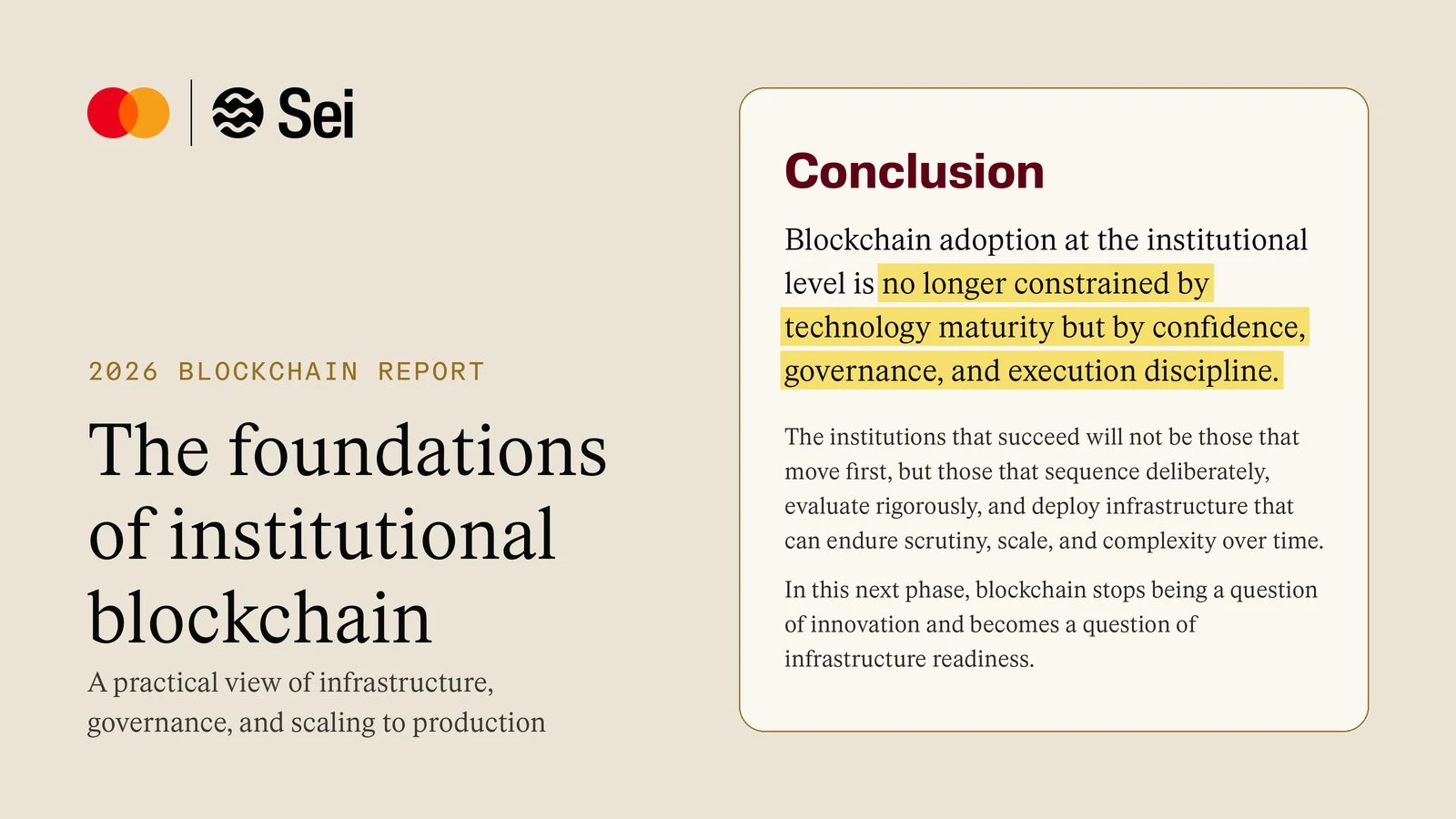
new research from mastercard and sei explores how banks and asset managers can move blockchain adoption from pilot projects to real-world production. the key barriers are now confidence, governance, and execution discipline rather than technology maturity.

\#INSTITUTIONAL #BLOCKCHAIN $GATE
post-image
MA+0.49%
SEI-1.58%
Why Doesn’t a Sudden Surge in Trading Volume Necessarily Mean a Trend Reversal?
In cryptocurrency trading, many people see BTC trading volume suddenly surge and assume a major market move is imminent.
Especially when prices are falling rapidly, a huge volume candle appears, and many people see it as a bottom signal and rush to buy the dip.
But the opposite may happen: prices continue to fall.
Why is that?
First, a surge in volume only indicates increased trading activity; it doesn’t directly show that buying pressure has exceeded selling pressure. Every trade in the market has both a buyer and
post-image
BTC-0.67%
Went long on gold this morning and am still holding—one trade to get rich
post-image
PAXG+0.33%
XAU+0.38%
Why can more detailed trading records make it easier to spot problems in a strategy?

Many traders have a habit of reviewing their trades, but an effective review is not simply a record of how much they made or lost today.

If a trading record only includes the buy price, sell price, and final profit or loss, you may know that you lost money, but it can be difficult to know why.

The value of trading records lies not in preserving the past, but in helping you identify problems that can recur.

I. Why is recording only profit and loss far from enough?

Suppose two trades both lost $100.

For th
post-image
Why Do Altcoins Rise Faster but Fall More Violently?

Many cryptocurrency investors have experienced this:
When a bull market arrives, BTC may rise 10%, while some altcoins can climb 30% or even 50%. Watching other coins surge so quickly, it’s easy to feel that simply buying altcoins can deliver higher returns than Bitcoin.
But when the market reverses, things can be very different.
Why do altcoins often rise faster and fall harder?
First, altcoins typically have less market depth than Bitcoin. When large amounts of capital flow in, limited sell orders can be quickly absorbed, causing prices t
post-image
BTC-0.67%
Why Can Trading Fees Seem Low Yet Accumulate and Affect Returns Over Time?

Many traders focus on price fluctuations, entry timing, and exit targets, but often overlook one detail: trading costs.

A single trading fee may be only a small percentage, but if trading frequency is high and profit margins are limited, these costs can gradually eat into actual returns.

To determine whether a trading strategy is effective, you need to look not only at gross profit but also at net returns after all trading costs.

I. Cryptocurrency Trading Costs Are More Than Just Fees

Trading costs may typically in
post-image
Why do some traders fail to make money even when they read the market correctly?

Have you ever experienced this?

You correctly predicted that Bitcoin would rise, but entered too late and made only a little; you correctly identified a downtrend, but closed your position too early and missed the main move; you even accurately predicted the market’s direction, yet your account still failed to deliver the returns you hoped for.

This highlights an important point:

Reading the market correctly is only part of trading success. Getting the direction right does not guarantee a profitable trade.

I.
post-image
BTC-0.67%
In cryptocurrency trading, many people spend a lot of time studying candlestick charts, indicators, and trading strategies, yet overlook a harder problem: their own emotions.

Why do some traders have decent trading systems but still keep losing money in the end? Often, the problem isn’t the market, but emotions interfering with execution.

First, FOMO (fear of missing out). Seeing BTC suddenly rise, they fear missing an opportunity and chase the price regardless of its level, only to see a pullback right after entering.

Second, greed. They’ve already reached their take-profit target, but bec
post-image
BTC-0.65%
Samsung is reportedly developing a phone with a vertically rolling screen that can transform from 16:9 to 21:9. Ice Universe shared concept images showing its vertically extendable design.

The screen gets longer, but the battery has to get shorter. This isn’t the evolution of foldables—it’s turning a phone into a telescoping pole: stretch it out for a better viewing experience, then retract it and stick it in your pocket, where it digs into your thigh.

$BTC
post-image
BTC-0.67%
🚀 Gate Square Content Mining Upgrade | Post to Earn Up to 60% Commission Rebates, Win Rewards for Quality Content!

🎁 Triple Benefits, Bigger Creator Rewards!
1️⃣ Base Rebates: Up to 30%! The more actively you post, the more engagement you get, and the higher your ranking, the higher your rebate rate!
2️⃣ Newcomer Perk: Newly onboarded and returning creators get double rebates for 30 days, up to 60%!
3️⃣ Upgraded Content Rewards: Keep publishing quality content and driving genuine engagement to earn extra content rewards!

🔥 Drive Trading with Posts, Earn More with Quality Content!
Post Now
post-image
  • 7
  • 1
Outflows from US Bitcoin ETFs continue, totaling $969 million over 5 sessions. What are fund flows and US spot demand showing?
More in Morning Brief #298👇
post-image
BTC-1.45%
  • 1
Why Are Traders More Likely to Underestimate Risk After a Winning Streak?

A winning streak is usually something to celebrate.

But in the trading market, getting several calls right in a row can quietly change the way someone makes decisions.

Some start increasing their position sizes, others loosen their stop-losses, and some think they have figured out how the market works. The risk has not disappeared; recent success has simply made it harder to see.

I. Why Can Profits Change Risk Perception?

1. Mistaking short-term success for long-term skill

Several consecutive profitable trades may
post-image
NEW MARKET UPDATE
live-cover
LIVE1,919
Stablecoins Are Not Cash: 4 Boundaries to Understand Before Use

Stablecoins are often seen as a bridge between traditional finance and the cryptocurrency market.

They can be used for trade settlement, on-chain transfers, DeFi applications, and cross-border value transfers. But many people overlook one issue:

A relatively stable price does not mean an asset is risk-free.

Before using stablecoins, there are four boundaries worth understanding.

1. A peg does not mean you can always redeem at the target price

Stablecoins are usually pegged to an asset, such as the US dollar. But their second
post-image
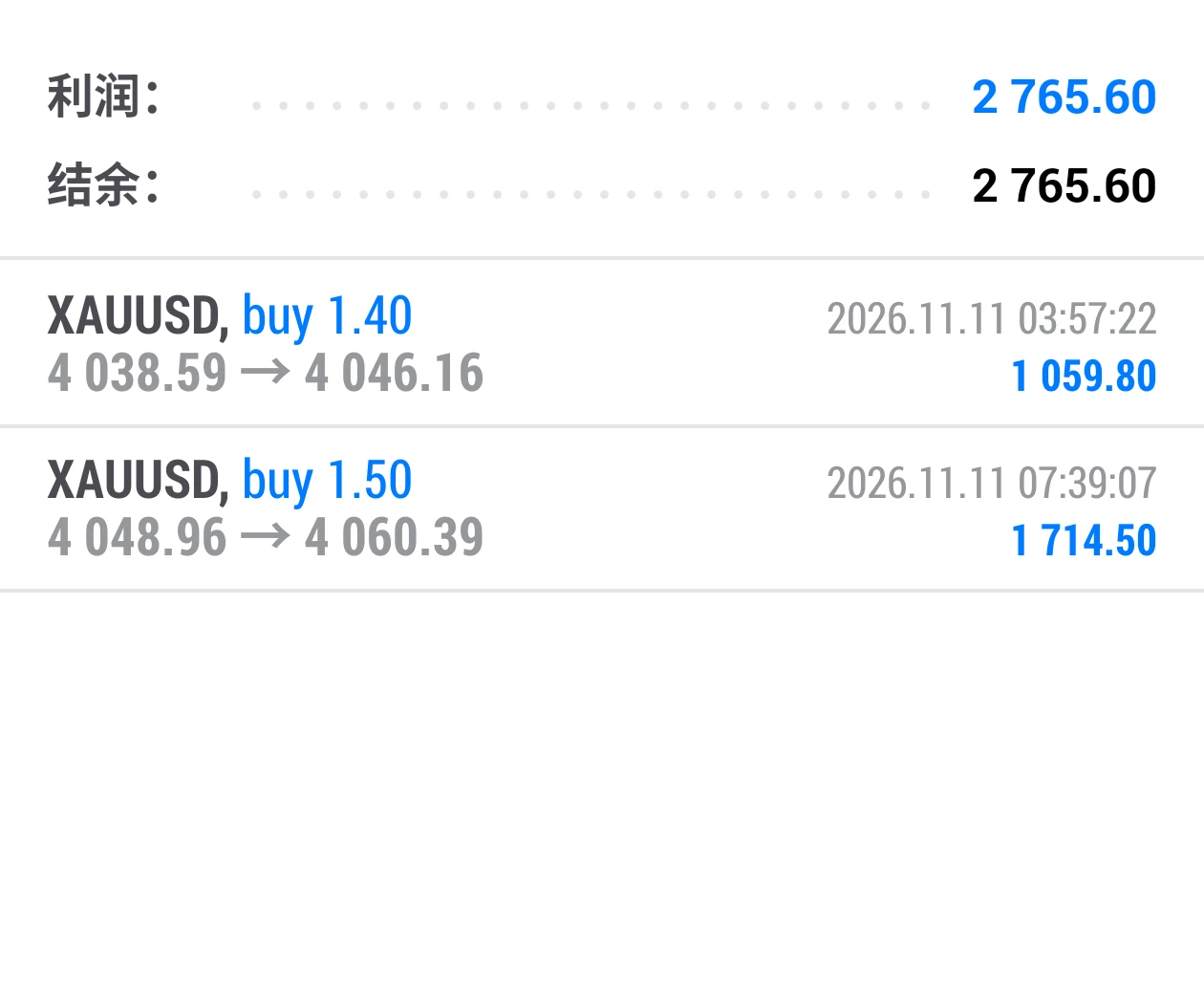
Bulls are strong; follow the trend and go long. Long at 4048, exit at 4060, capturing a $12 move for $1714!
$SOL $XAU #黄金 #美伊谈判出现新进展
post-image
SOL-0.74%
XAU+0.38%
Load More

Join 40 M users in our growing community

⚡️ Join 40 M users in the crypto craze discussion

💬 Engage with your favorite top creators

👍 See what interests you

Trending Topics

GateGlobalComplianceExpansion

14.88k Views336 Discussing

Gate continues to expand its global compliance footprint, now covering 81 regulated jurisdictions across Europe, North America, Asia, and Oceania. From MiCA and U.S. state-level MTLs to Japan’s FSA, Dubai, and Australia-related regulatory approvals, global exchanges are entering a new stage of compliance competition. Do you think regulatory strength will become as important as products and liquidity for exchanges in the future?

USOctoberCPIBeatsExpectations

84.53k Views2.6k Discussing

AnthropicIPOValuationCouldReach1.4T

11.3k Views1.59k Discussing

View More