Square
Following
Hot
News
Notifications
Profile

LingTaiLt

vip
Not talented at market making but love researching slippage and latency. I like to use the simplest methods to test strategies—if I don't make money, I just consider it tuition.
Peak Tier VIP 00.7 Year(s)
86
Following
13
Followers
3
Liked
6,983 — round number or actual support?
User_any
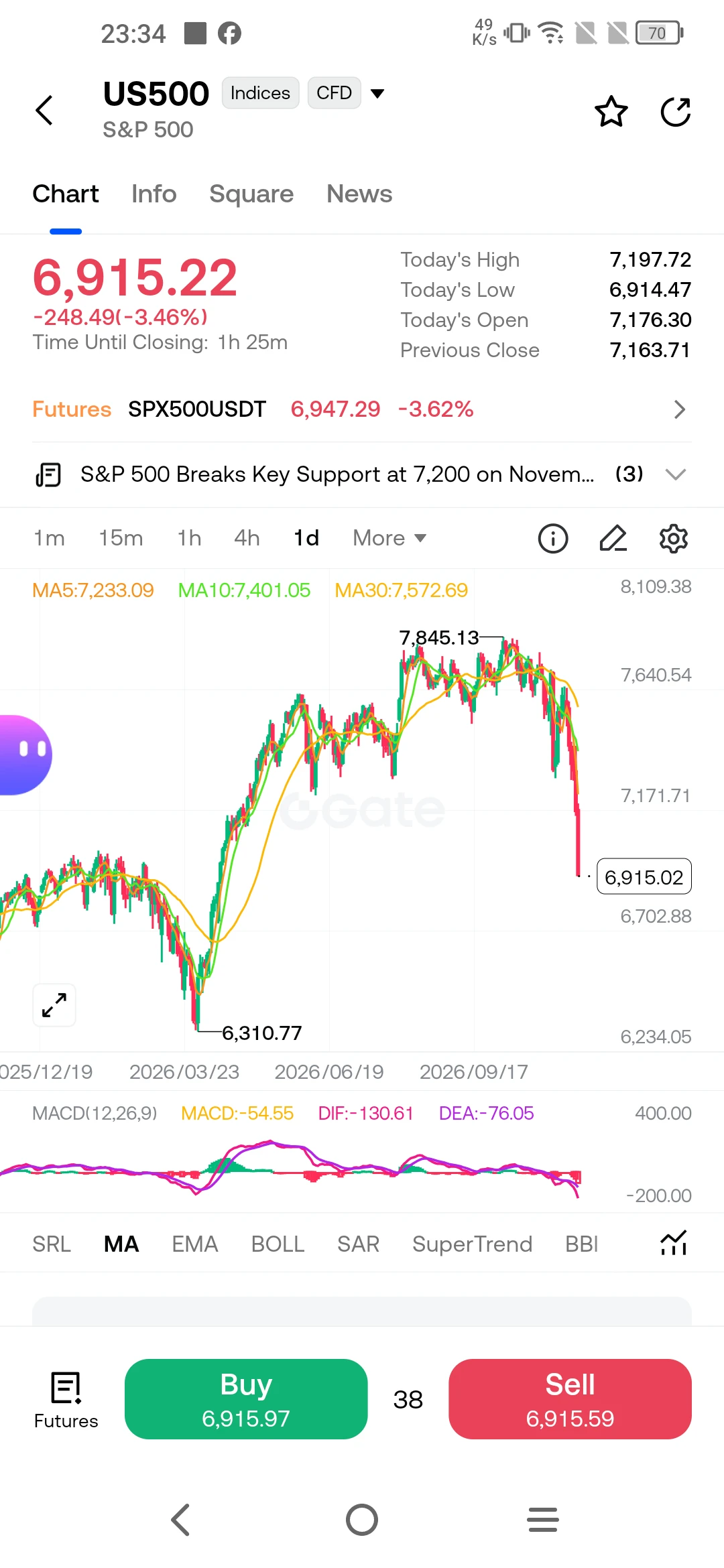
The current landscape clearly illustrates just how fragile global risk appetite has become. As of November 20, 2026, the S&P 500 index has retreated to 6,983.46, falling below the critical 7,000-point threshold. This sharp intraday decline of 2.68% is more than just a price movement; it signals that the market’s months-long, artificial intelligence-driven optimism is giving way to serious questioning.
The primary dynamic behind this decline is the valuation pressure on artificial intelligence-related stocks. The first major shock in this process occurred on November 5, when the S&P 500 dropped 4.36% to 7,353.73, while the Nasdaq lost 5.5% of its value. Since then, the market has been attempting to price in the sustainability of the massive expenditures tech giants are pouring into AI infrastructure—and whether these investments will ever translate into profitability. The steep decline in Nvidia’s share price, coupled with uncertainties regarding leadership within the sector, lies at the heart of this scrutiny.
From a technical perspective, the picture is quite clear. The 7,000-point level—previously highlighted by analysts—represents a decline of approximately 10.8% from the October peak of 7,844, pushing the index into "technical correction" territory. The fact that the index has fallen below its 200-day moving average (roughly the 7,350 level) and failed to hold that level as support underscores the intensity of the current selling pressure. Falling below the 7,000 level signifies the loss of a psychologically significant threshold, which may lead investors to begin discussing the next support zones—for instance, the 6,800 range.
The macroeconomic backdrop is also fueling this decline. US inflation data coming in higher than expected has reinforced the anticipation that the Federal Reserve will keep interest rates "higher for longer." A high-interest-rate environment exerts direct selling pressure on growth stocks, which are valued based on their projected future cash flows. Furthermore, upcoming midterm elections and geopolitical uncertainties are additional factors dampening risk appetite.
On the other hand, some analysts have already begun to view this downturn as an opportunity. Strategists at Bank of America suggest that, provided the US economy avoids a recession, a drop in the S&P 500 below 7,000 points could represent a buying opportunity. At this juncture, however, it is crucial to distinguish whether the decline is "mechanical" or "structural." The market is currently repricing the future of the artificial intelligence narrative; whether it will remain persistently below the 7,000 level will become clearer in the coming days, as corporate earnings are released and the Federal Reserve provides further signals.
For individual investors, the lesson to be drawn from this situation is to avoid acting out of panic and to steer clear of leverage. While a dip below 7,000 creates a risky environment for short-term traders, it may offer long-term, disciplined investors an opportunity to monitor the market for potential entry points. What matters is correctly interpreting the reasons behind the decline and sticking to a plan that aligns with your own risk tolerance.
Do you think this downturn is a sign that the artificial intelligence bubble is beginning to deflate, or is it simply a healthy market correction?
#SP500 #Macro #StockMarket #ArtificialIntelligence #ShareWeekly
Not investment advice.
$US500 ‌
repost-content-media
4994.08, make a note of it
LuzhouSanyren
South Korean stocks broke below 5,000 right at the open.
The KOSPI opened at 5008.09, down 1.81%.
It hit an intraday low of 4994.08, breaching the 5,000-point mark for the first time since November 9.
Samsung fell 2.69% and SK Hynix fell 1.07%, still feeling the chill from overnight losses in US semiconductor stocks.
Nvidia fell 4.1%, Micron fell 7.6%, and AMD fell 5.6%, sending shockwaves straight to Seoul.
Nvidia’s earnings tonight are the real test; they’ll determine whether the 5,000-point mark can hold.
See you live at 21:20.
I just came across an address that sent the exact same amount to the same contract seventeen times over three days, each about 4 minutes and 32 seconds apart. My first thought was that a bot had glitched, but gas prices fluctuated quite a bit, so it wouldn’t be this consistent if it had.

I took a closer look and found that the funds actually passed through three addresses before finally reaching that contract. Basically, it’s splitting one transfer to make it look like a “coincidence,” but the timestamps and gas habits give you away. I’ve manually set up a route like this before to test slipp
Slippage will be pretty rough in the 2020–2035 range
Alronbit
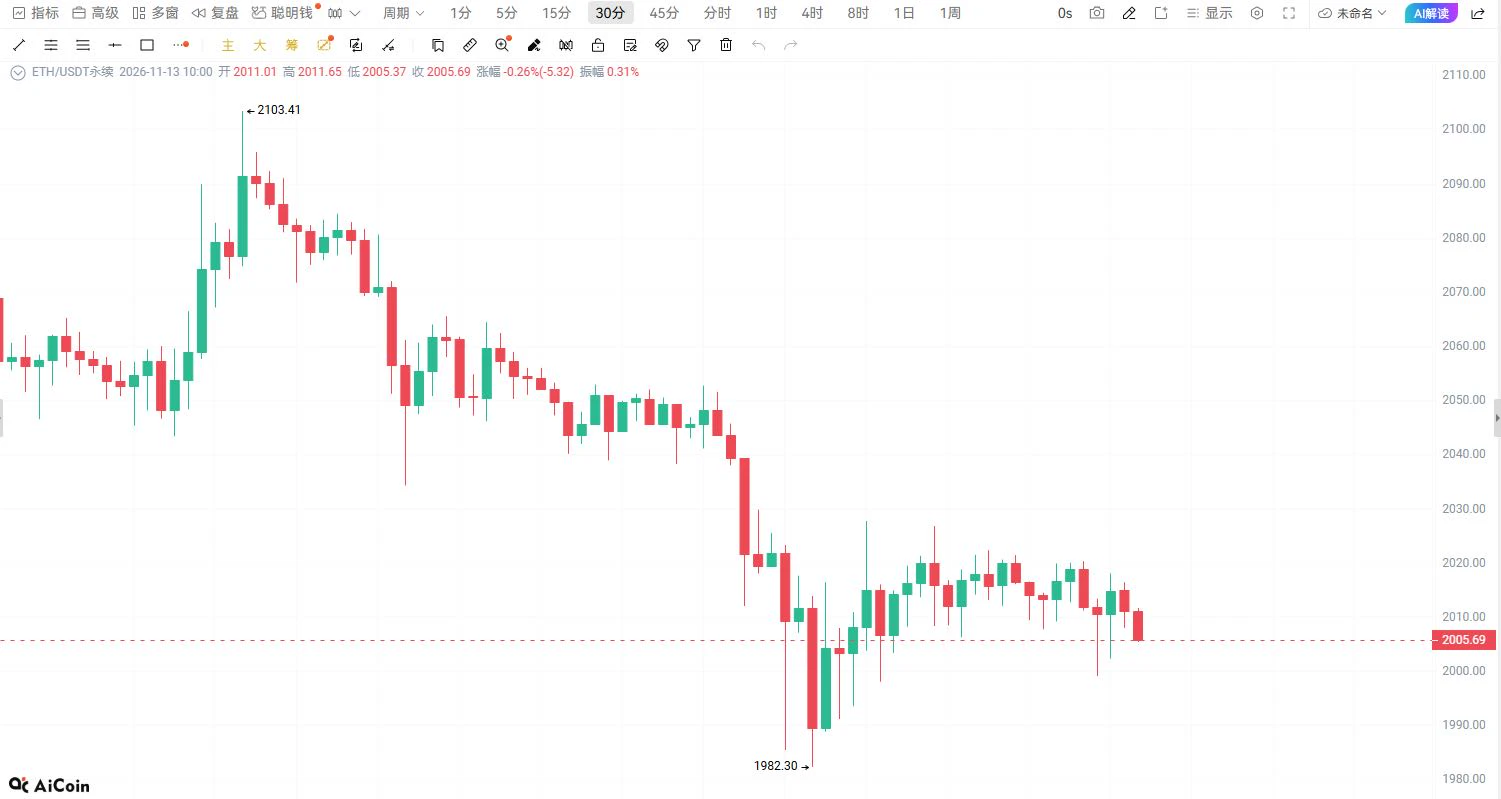
November 13: ETH’s weak downward consolidation remains intact; prioritize shorting rallies.
[Today’s Plan]
Short entry zone: enter on a rebound to 2020—2035
Stop-loss: above 2055
Take-profit: target 1995—1985
[Core Logic]
On the 30-minute timeframe, price pulled back from the 2103.41 high, tested a new interim low of 1982.30, and entered a weak consolidation phase, with the overall descending channel still intact. MACD continues to trade below the zero line, rebound momentum is weak, and bulls lack the strength to reverse the downtrend. The 2020—2035 area above is a dense resistance zone for recent rebounds; price is prone to weaken again after retesting it, making trend-following shorts better suited to current market conditions.#ETH #美国初请失业金人数高于预期
repost-content-media
After grinding points tasks for several hours, I suddenly felt like I was working for the project team...

Airdrops used to be windfalls, but now they’ve turned into KPI assessments. I’ve learned my lesson: I only do interactions that I can complete along the way, such as swaps or staking I was already going to do, and collect the points while I’m at it. I won’t grind just for the sake of grinding. I once went all-in on a project, spent nearly $200 on gas, and ended up with an airdrop worth $30. Purely an expensive lesson.

Now, when I see a new platform, I ask myself first: Will I actually us
AI Agent—every day it’s another project launching a token and shilling it. I’m getting a little numb to it. Anyway, with automated trading, no matter how pretty the narrative is, it ultimately comes down to slippage and security. Don’t just look at the profit screenshots people post.

By the way, I just cut a position I’d been dragging out for nearly half a month. How should I put it? Stop-losses are a lot like breakups—when you keep putting them off, you reassure yourself every day that “if I wait a little longer, I can break even,” but in reality, interest, funding rates, and opportunity cos
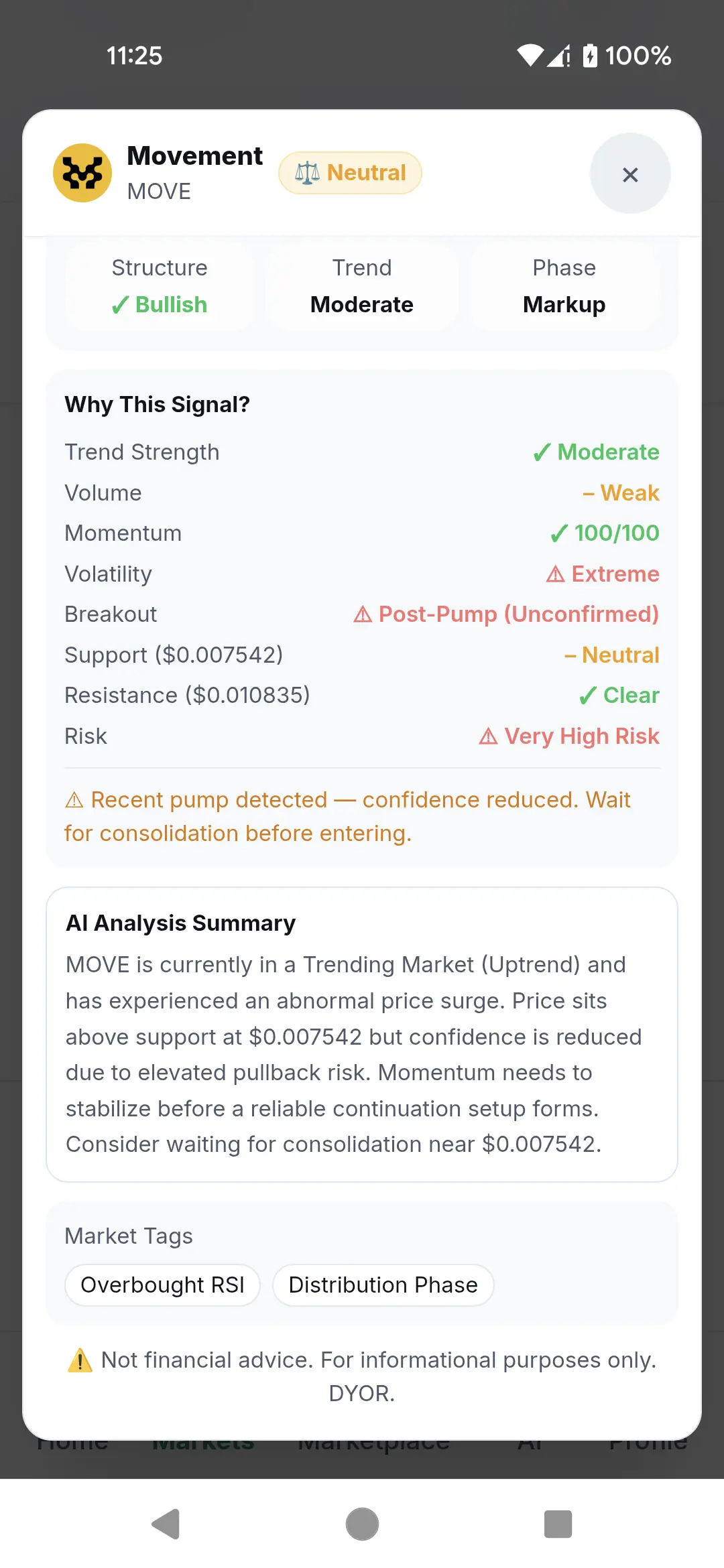
Seeing this Post-Pump warning for MOVE set off alarm bells: momentum is 100/100 but volume is weak, volatility is maxed out, the risk is extremely high, and two key conditions still haven't been met. Charging in at a time like this is basically gambling with your life. If you really want to go long, patiently wait for a pullback to 0.007542 to stabilize, or simply wait for a volume-backed breakout above 0.010835 before chasing, with targets at 0.0108 and 0.0120, and be sure to place the stop-loss below 0.0070; if you want to short, also wait for a volume-backed break below 0.007542, otherwise
CryptoJourney1
$MOVE ‌ — POST-PUMP WARNING! HIGH RISK!
Movement is showing extreme momentum at 100/100 but the breakout is Post-Pump (Unconfirmed). Volume is weak. Volatility is Extreme. Risk is Very High. Setup is NOT ACTIVE — 2 requirements still missing.
Key Levels:
· Support: $0.007542 (Moderate)
· Resistance: $0.010835 (Moderate)
If LONG:
· Wait for consolidation near $0.007542 or a confirmed break above resistance.
· Targets: $0.0108 and $0.0120.
· Stop-loss: below $0.0070.
If SHORT:
· Only if price breaks below $0.007542 with volume.
· Targets: $0.0065 and $0.0060.
· Stop-loss: above $0.0085.
If watching:
· Stay patient. No active setup yet.
Then vs Now: MOVE pumped hard, but confidence is reduced. Pullback risk is high. Protect your capital and wait for confirmation.#GateLaunchesJapaneseStockTrading
repost-content-media
MOVE-1.45%
I spent the whole afternoon reading IBC docs and it got me thinking. Cross-chain messaging actually relies on more things than you might expect: on-chain light clients, relayers, sequencers, and all kinds of credential logic. Many people only see that “the bridge is fast,” without considering what could happen if one of the components in the middle acts maliciously or has a bug. I have the same problem with my own market making—I’m always trying to grab speed, only to have slippage teach me a lesson. I’ve learned better now: being half a beat slower actually lets me see things more clearly. La
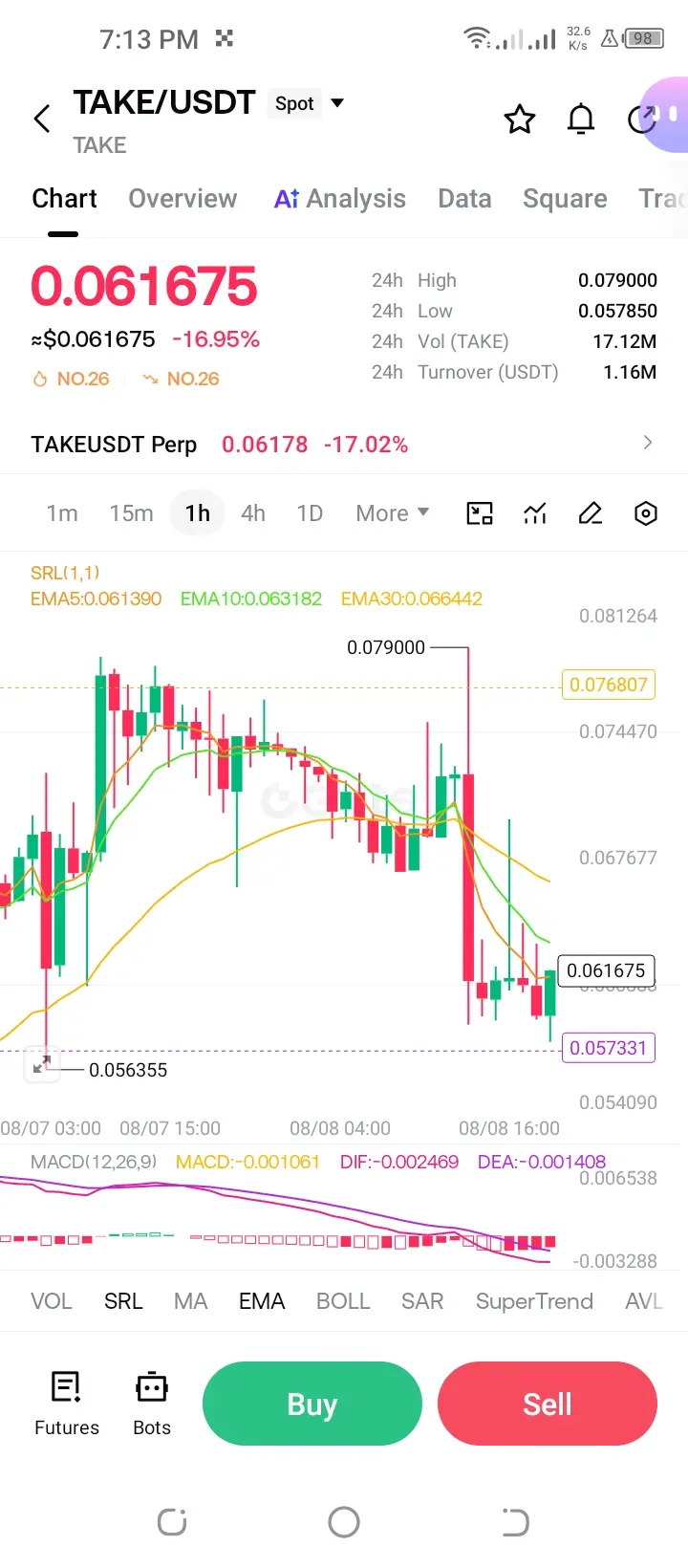
Just a dead-cat bounce; a rebound to around EMA5 is an opportunity to go short. The downside target is 0.05785.
Cryptoluter
$TAKE /USDT Perp – "Dead Cat Bounce – Short"**
**Trading Plan Short $TAKE
Entry: 0.0630 – 0.0640
SL: 0.0660
TP1: 0.0600
TP2: 0.0578
TAKE is down -16.95% at 0.061675. It is trading under all EMAs (EMA30 at 0.06644). MACD is overwhelmingly negative. Previous highs at 0.07900 are gone. Sell into the recovery toward the EMA5 (0.06139). Target the 0.05785 low.
#LYTEETFFirstDayVolume72M
repost-content-media
Hey, back when I first got into DeFi, I really thought market making was pure lay-and-collect—just drop in some U, collect trading fees every day, and everything feels great. So what happened? Slippage and impermanent loss taught me a lesson.

In plain terms, that AMM curve isn’t a free cafeteria. Once you provide liquidity and the price moves, losses can hit harder than just holding one side. I recently tested an old strategy I used to run with the dumbest method—manually calculating slippage. I found that as long as volatility goes beyond 5%, those fees can’t cover the losses at all.

Now I’
Woke up this morning and my eyes feel unbearably sore, and my neck is stiff too. Staring at the screen for too long still doesn’t work. Lately I’ve been following cross-chain bridges and it’s given me some thoughts.

To be honest, cross-chain bridges look convenient, but I always feel uneasy in my gut. The multisig can create a false sense of security, and oracle prices aren’t necessarily reliable either. What if there’s a bit of delay and slippage—then it’s a real stomach-turning experience. My own dumb method is: I’d rather wait a few extra minutes for confirmation than be greedy for that sp
To be honest, lately I’ve been seeing a lot of arguments in the group about privacy coins and mixers, and it’s pretty divisive. One side thinks compliance is the big trend, while the other side believes on-chain privacy is actually a fundamental need. When I was market making myself, the most annoying thing was really slippage and latency. But the more I researched, the more I found that privacy and liquidity sometimes conflict. Think about it: if every trade record is fully transparent, market makers are much easier to target. But if everything is fully hidden, liquidity depth and pricing bec
$BANK The entry at this single point is quite solid, and the stop loss is set clearly too—I followed it.
Tm_Crypto
$BANK Trade Watch 📈
Entry: $0.0415–0.0425
Target: $0.0450 / $0.0470
Stop Loss: Below $0.0390
BANK remains supported by a strong volume backed breakout and capital inflows. However, keep an eye on profit taking and the July 17 token unlock, as both could increase short term volatility. Manage risk and avoid overleveraging.
$BANK ‌#PredictWorldCup🇳🇴vs🏴󠁧󠁢󠁥󠁮󠁧󠁿 #USIranWarCloudsGather #GUSDYieldRisesto3.8%
Zelensky’s move upgrades guerrilla warfare into a technology war—fast reaction plus drones—putting traditional armored forces under tremendous pressure.
Original content no longer visible
The MGBX listing this time is quite interesting, as both traditional tech ETFs and AI chip stocks have been included. The market opens at 6:00 PM on July 8th, so keep an eye on the opening volatility.
Original content no longer visible
After being caught in a liquidation once, you learn your lesson.

The other day I was looking at a lending protocol. The oracle price feed was about twelve seconds late. The on-chain price had already crashed through the liquidation line, but the contract was still calculating health based on the old price. By the time the update came in, the position was long gone, and the liquidator made a killing. In simple terms, your collateral ratio isn't real-time — it's "real-time from a few minutes ago."

Now I see a similar scenario playing out in GameFi. When the token price drops, if the oracle fee
An average of 912 coins per day—this is no longer allocation but accumulation.
Original content no longer visible
Exchange Art's news of shutting down in 2026 is not surprising, but the fact that the escrow contract automatically releases assets is commendable—at least users won't lose everything. The remaining thing is to quickly migrate the artworks to other markets.
Original content no longer visible
Whales are starting to accumulate again, this move looks like institutional positioning.
Original content no longer visible
Load More