Square
Following
Hot
News
Notifications
Profile

ThisIsTranslateContent:

vip
Winning the Global Content Creator of the Year is not the goal; my original intention is to learn and grow together with like-minded friends! I want to share a quote I really like: If things don't go as planned, trust that there is a higher purpose. Unmet expectations don't need to weigh on you; regrets may be paving the way for a better ending.
Peak Tier VIP 88.2 Year(s)Web3 Creator
180
Following
4.4k
Followers
168.1k
Liked
Pin
Voting for the annual gala has begun. Friends passing by, please lend me a hand and cast your valuable vote to help me get ahead with your good luck. Thank you! 🙏🏻 Wishing everyone wealth and good fortune, and success in all you do. 🥰

Join the Gate 2026 Annual Gala of Glory, sign up to claim 100 support points, and vote for your favorite Star of the Year. For every 100 support points contributed, you’ll receive 1 chance to win a surprise prize. https://www.gate.com/zh/competition/Annual-Gala?ref_type=165&ch=Direct&ref=VgUSAFpX
ThisIsTranslateContent:
Take part in Gate's 2026 Annual Honors Gala. Sign up to receive 100 support points and vote for your favorite Star of the Year. For every 100 support points you contribute, you'll receive 1 chance to win exciting prizes. https://www.gate.com/zh/competition/Annual-Gala?ref_type=165&ch=Direct&ref=VgUSAFpX
repost-content-media
  • 52
  • 2
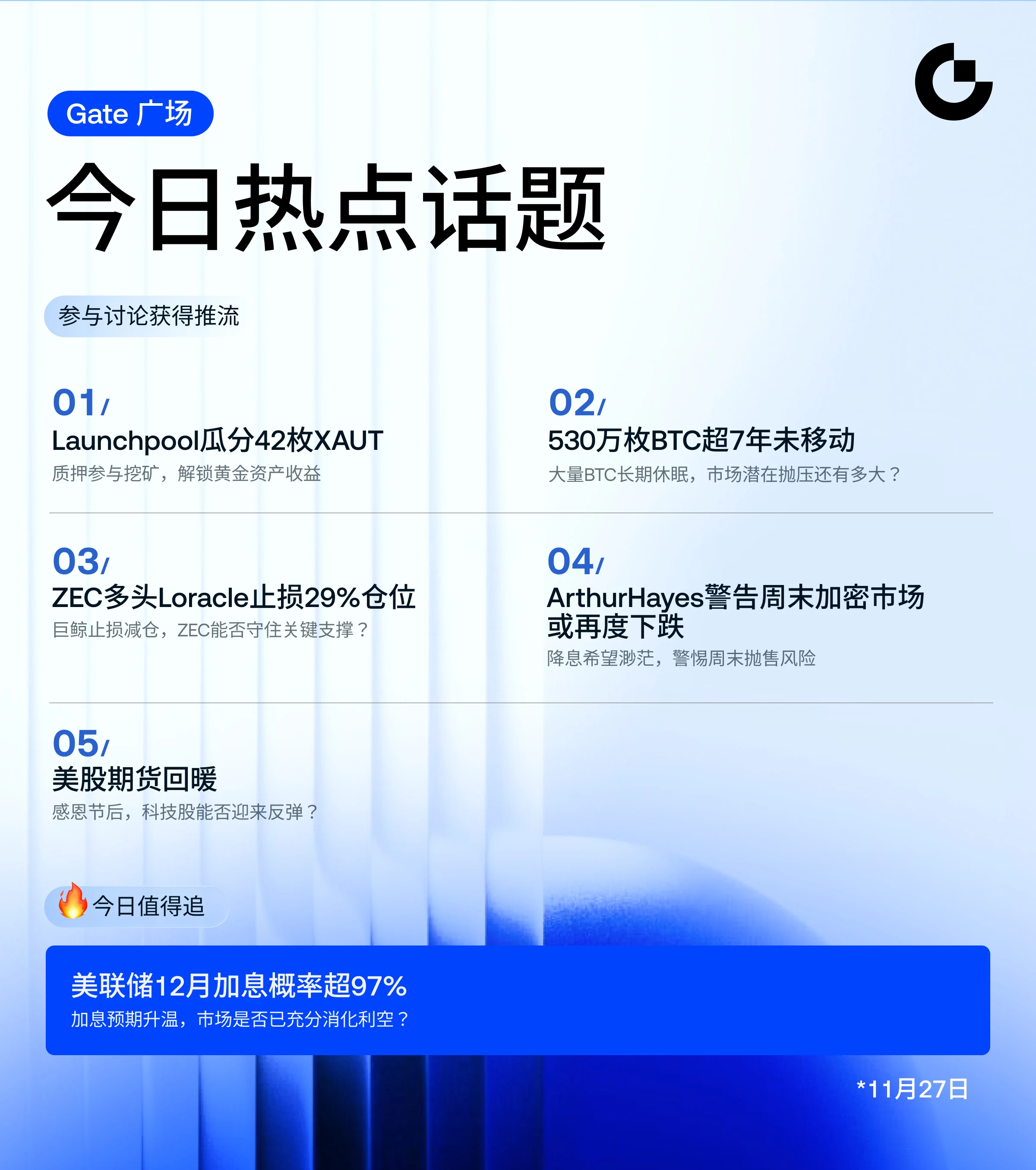
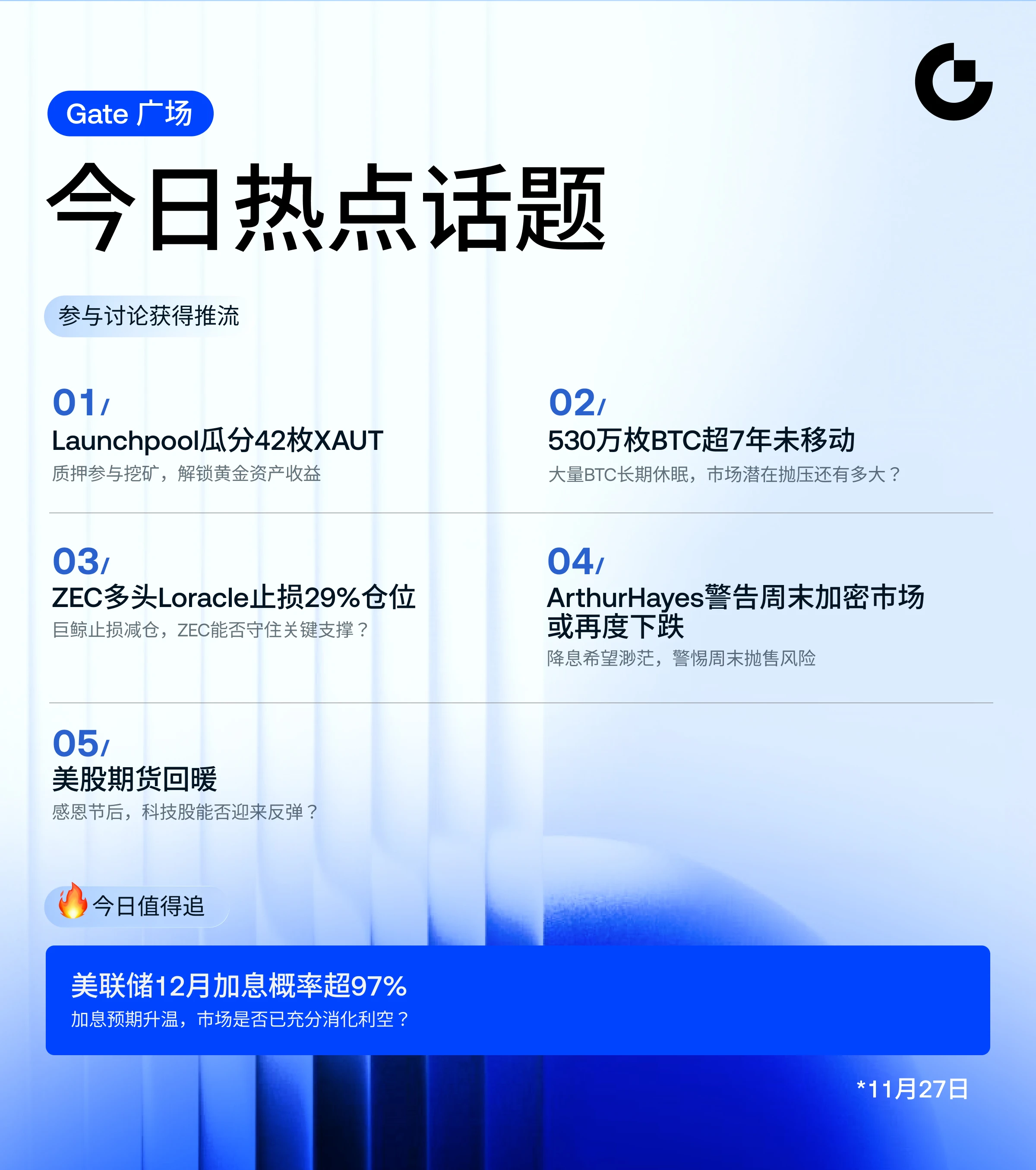
#美联储12月加息概率超97% #每周来晒 A 25-basis-point rate hike in December is now almost a certainty. The market has only priced in the surface-level downside of a “single rate hike,” while the tail risk of subsequent, more aggressive tightening is completely unpriced.

📊 Core background to the rate hike (inflation remains stubbornly high)

1. U.S. core PCE rose to 3.3% year over year in October, its highest level since November 2023 and far above market expectations.

2. U.S. GDP growth in the third quarter was revised up to an annualized 4.3%, showing that the economy’s heat is proving impossible to cont
SPCX+1.15%
NAS100-0.07%
BTC-0.67%
#Gate事件市场 Polymarket Trade Review: Lessons and Reflections on Event Contracts

My Latest Two Event Market Trades
Bayern Munich vs. Cologne: Lost $9.06
Italy vs. France: Lost $2.92

Trade Strategy Review:
Both trades were sports event contracts, a category where outcomes are relatively "predictable," but these seemingly familiar scenarios are precisely the ones that can make you let your guard down. Football matches are highly uncertain—team form, injuries, and tactical adjustments during the game can all overturn expectations. Applying traditional sports analysis to event contract betting can
NVDA-3.99%
  • 1
#美股期货回暖 During Thanksgiving, U.S. stock index futures edged higher and sentiment toward tech stocks partially recovered. After Thanksgiving, a short-term rebound is more likely to come first, but there is no sign yet of a reversal. The latest gains in U.S. stock futures were mainly driven by a rebound in oversold tech stocks. Bitcoin also moved back above $60k, but concerns about interest rate hikes and AI valuations remain.

Why this looks more like a rebound than a reversal
Futures surged: On Friday (November 27), Nasdaq 100 futures rose nearly 3% at one point, while S&P 500 futures gained m
post-image
HYPE+0.33%
#ArthurHayes警告周末加密市场或再度下跌 Arthur Hayes’ warning is conditional: only if the Fed sends no dovish signals before entering its quiet period on Friday could selling become concentrated over the weekend. BTC is now back above $60,000. In the short term, it needs to hold this level first, then the area around $58,500.

What Hayes is concerned about
He treats crypto assets as highly liquid assets. If the Fed does not turn dovish, investors may cut positions before traditional markets open on Monday. Weekend liquidity is thin, so prices can fall sharply. This is a short-term liquidity risk, not a decl
post-image
BTC-0.67%
  • 1
#感恩有你 @毅博说币 Before writing this article, I realized I’ve been following Yibo Talks Crypto for a little over three years. No matter how unpredictable the market has been over those three years, I’ve hardly missed a single one of Mr. Yibo’s livestreams!

Why did I first click into his livestream? Honestly, it was by chance. After watching a few sessions, I felt he explained things clearly. There are too many people in this industry who make things sound mysterious, cramming three technical terms into one sentence so you feel clueless if you don’t understand, an
post-image
  • 6
#美联储12月加息概率超97% #每周来晒 A 25-basis-point rate hike in December is already largely priced in. What the market has yet to digest is the Fed’s guidance on the 2027 rate path and whether it will signal another hike in January.

Why a 25bp hike is already priced in
Rate futures are nearly unanimous: As of November 26, CME FedWatch showed about a 98.1% probability of a 25bp hike, with only about a 1.9% chance of no change.
Treasuries and the dollar have already moved: The 2-year Treasury yield has risen to around 4.69%, the dollar has strengthened, and high-valuation tech stocks and Bitcoin have alrea
BTC-0.67%
  • 22
  • 2
#530万枚BTC超7年未移动 BTC that has not moved for a long time can ease market selling pressure, but that only means there is less potential selling pressure—not that selling pressure is gone. About 5.3 million BTC have not moved in seven years, indicating that these coins are not entering the market for now; if their owners start transferring them to exchanges, they can still create sell-side supply.

Why it can ease pressure
These coins are not being sold for now: Prices are determined by the coins whose owners are willing to trade. Coins that have not changed hands for a long time are not participa
BTC-0.67%
  • 20
  • 2
#ZEC多头Loracle止损29%仓位 Loracle partially cut its losses this time rather than closing the entire position. The signal is short-term bearish, but the bulls have not completely capitulated. For now, ZEC is more likely to continue ranging and probing for a bottom; a rebound would need to reclaim around $800 to have staying power.

What signal did the whale’s position reduction send?
Leveraged longs are actively reducing risk: Loracle used 10x leverage and opened the position at around $726 on November 25. The subsequent price weakness triggered a stop-loss, showing that this long position could no
ZEC+1.16%
  • 20
  • 2
#美联储12月加息概率超97% The 25-basis-point rate hike in December is most likely already fully priced in. But the market is still repricing “how many more hikes will follow and how long rates will stay high,” so it’s too early to say the downside has been fully priced in.

U.S. stocks: The hike itself has limited impact, but pressure remains ahead
Already priced in: A 25-basis-point hike is almost a foregone conclusion, and the widely expected move usually triggers only short-term volatility.
Not yet priced in: The market’s focus has shifted to next year’s rate path. Goldman Sachs expects a hike in Dec
BTC-0.67%
  • 22
  • 4
#Gate广场跟单交流季 Logic is what I value most in trading: first figure out which part of the move this trade is aiming to profit from and why the idea holds. Price and timing are both conditions for validating the logic.
Logic: Set the direction first, then decide whether the opportunity is worth taking. Even if the direction is right, the move may already be over, making the risk-reward unattractive.
Price: Look at where it is trading. For a long position, the odds are favorable only when the price is near effective support and there is room before resistance.
Timing: Wait for a confirmation signal
post-image
  • 19
  • 2
#感恩有你 |To everyone willing to “argue about ideas” with me

I post on Gate Square every day, and what I share has never been about “what to buy or sell.” It’s about how I view the market, how I understand cycles, and how I build my own framework for making judgments. Honestly, sharing opinions can attract criticism, because everyone has their own views.

But what surprised me is that my comment section is almost never quiet—some people carefully share their differing opinions and discuss them with me; some say after reading my thoughts, “You made me rethink my trading approach”; and many others
  • 26
#每周来晒 #SpaceX下调英伟达Blackwell租赁价格
Falling compute prices are not simply a supply glut; AI demand is being reshaped
SpaceX cut the rental price for a small Blackwell GPU cluster from $15–15.5 per hour to $10–12, a maximum drop of about 35%; meanwhile, Anthropic declined to renew a compute cluster with around 50k H200s. The market’s first reaction is easily to interpret this as an oversupply of compute and AI demand peaking. But looking at the two signals separately, the truth lies between “supply expansion” and “a shift in demand structure,” with the latter having a deeper impact on AI sector v
LittleGodOfWealthPlutus
#每周来晒 #SpaceX下调英伟达Blackwell租赁价格
Cheaper compute is not simply a supply glut; AI demand is being reshaped
SpaceX cut rental prices for a small Blackwell GPU cluster from $15–15.5 per hour to $10–12, a maximum reduction of about 35%; meanwhile, Anthropic declined to renew a lease for a compute cluster of around 50k H200s. The market’s first reaction is easily to interpret this as a flood of compute supply and AI demand peaking. But looking at the two signals separately, the truth lies somewhere between “supply expansion” and “a shift in demand structure,” with the latter having a deeper impact on the AI sector’s medium- to long-term valuation.
First, the nature of the price cut: the most obvious change is that the scarcity premium on small clusters has been erased. Previously, with compute capacity in short supply, customers renting in small batches had to pay a premium far above the long-term contract rates offered to major players—a typical feature of the compute-scarcity era. Now, small-order quotes are aligned with the wholesale prices paid by major customers like Google and Anthropic. That does not mean all compute capacity is going unsold. SpaceX mainly offers short-term spot rentals, and it will bring a newer generation of compute online next year, giving it a strong incentive to proactively cut prices to avoid idle capacity depreciating and to make better use of existing resources. The H200s returned by Anthropic are from the previous generation; relisting them at lower prices reflects the natural discount for an older generation, and does not mean there is no demand for high-end new cards.
Next, Anthropic’s decision not to renew its lease is the key signal on the demand side. It does not mean the company has stopped working on AI; rather, the logic behind compute procurement at large-model companies is changing. In the previous market cycle, model companies sought to lock in massive amounts of compute and train aggressively, prioritizing parameter scale. Now, companies are starting to run the numbers, measuring the revenue generated per unit of compute. Model development is shifting toward more efficient inference optimization, MoE architectures, and fine-tuning, rather than blindly piling up vast numbers of cards for continuous pretraining. At the same time, constraints on cash burn have tightened in a high-interest-rate environment. Companies like Anthropic are proactively cutting long-term compute contracts with low utilization and poor returns, concentrating capital on businesses that can generate revenue. This is a shift in demand structure: from “securing cards at any cost” to “allocating cards based on ROI.”
Supply-side pressures are also continuing to build. Leading cloud providers and compute operators are expanding their clusters, deliveries of next-generation GPUs are steadily increasing, and some compute capacity freed up by regulatory adjustments is flowing back into the spot market. The short-term spot compute pool is continually expanding, putting downward pressure on rental prices. But it is important to distinguish between training and inference cards, and between compute capacity booked long-term and short-term spot capacity: their price gaps and market conditions are entirely different. The surplus is concentrated mostly in the spot market and previous-generation compute, while long-term targeted orders for top-tier new cards remain robust.
At the macro and trading level, this development fits the current predicament facing AI tech stocks. The underlying assumption the market previously used to value the compute supply chain was that demand would continue to grow exponentially and compute would always be scarce. Now that pricing logic is being revised: falling compute rents mean lower expected returns on compute capital expenditures, putting the valuation logic for upstream chipmakers and compute service providers back under scrutiny. If more model companies follow suit by optimizing compute use and cutting inefficient contracts, the narrative of rising compute prices will weaken further.
Of course, there is no need to take an extremely bearish view of AI demand. Over the long term, demand for agents, multimodal AI, and enterprise inference is still growing; the demand curve is simply no longer a steep, one-way climb, with slower growth and efficiency taking priority. The dividing line ahead will no longer be “Can you get the cards?” but “Can you use them well and turn compute into revenue?”$NVDA
repost-content-media
  • 22
Nvidia Faces Another Epic ❗️
On November 25 local time, international credit rating agency S&P announced that it had placed U.S. chipmaker Nvidia’s issuer credit rating and senior unsecured debt rating on negative watch. Both ratings are currently AA.
S&P said that if it determines Nvidia’s governance deficiencies persist, it could downgrade the ratings within the next 90 days, from AA to AA-. If subsequent investigations find that the company’s reputation or business prospects have been harmed, the downgrade could be greater.
A week earlier, another major international credit rating agency, M
InternetCelebrityMiMiLao
Nvidia Faces Another Epic ❗️
On November 25 local time, international credit rating agency Standard & Poor’s announced that it had placed the issuer credit rating and senior unsecured debt rating of U.S. chipmaker Nvidia Corporation on negative watch. Both ratings are currently AA.
S&P said that if it determines Nvidia’s governance deficiencies are ongoing, it could downgrade the ratings within the next 90 days, from AA to AA-. If subsequent investigations show that the company’s reputation or business prospects have been harmed, the downgrade could be larger.
A week earlier, another major international credit rating agency, Moody’s, had lowered Nvidia’s rating outlook from “positive” to “stable.”
Before the agencies took action, credit markets had already sounded the alarm through trading. The latest data from ICE Data Services, a subsidiary of Intercontinental Exchange Group whose primary business is data services, showed that on the 25th, Nvidia’s five-year credit default swap (CDS) spread widened by as much as 6 basis points to 147.27 basis points, setting a new intraday record. In the stock market, Nvidia shares fell again on the 25th. The stock had surged more than 30% in a single day during Monday’s epic rebound, adding nearly $1 trillion to its market value. But it has now given back most of those gains.
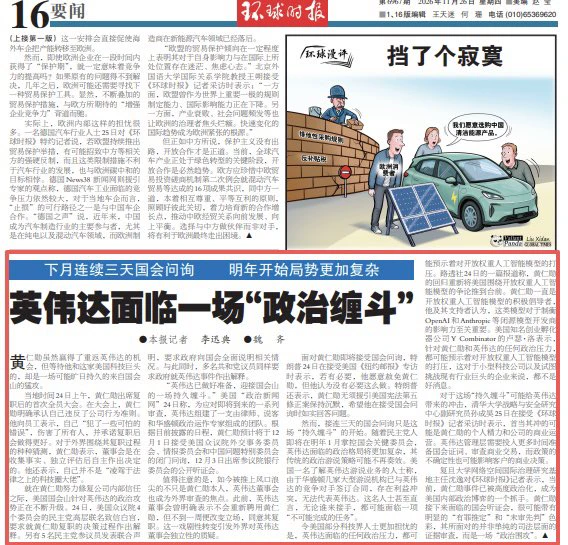
Related report: Nvidia Faces a “Political Battle”
Although Jensen Huang has won the chance to return to Nvidia, what awaits him and the U.S. tech giant is a potentially prolonged assault from Capitol Hill.

On the morning of the 24th local time, Huang attended his first all-hands meeting since returning to his post. At the meeting, Huang explicitly acknowledged that he had violated the company’s code of conduct. He told employees that he had “made some terrible mistakes” that hurt everyone, and promised to do better after returning. Addressing speculation surrounding his return, Huang said the board had made its decision independently after gathering the facts and conducting an independent assessment. He also said he was not a “tech bigwig who is above the law.”

As Huang works to rebuild trust within the company, the political campaign against Nvidia on Capitol Hill is intensifying. On the 24th, senior Democrats from four U.S. House committees sent a joint letter to the White House demanding an explanation of the decision-making process behind Huang’s return. Five Democratic senators also issued a joint statement calling on the government to provide Congress with a full account of the matter. At the same time, several Republican lawmakers have likewise demanded an explanation from the government regarding the Nvidia affair.

“Nvidia is bracing for a protracted battle on Capitol Hill,” U.S. news outlet Politico reported on the 24th. To prepare for a series of upcoming inquiries, Nvidia has assembled a team of lawyers, lobbyists, and Washington political operatives. According to the schedule disclosed so far, Huang is expected to face closed-door questioning on December 1 from the House Foreign Affairs Committee, the House Intelligence Committee, and the Select Committee on China, and to appear at a public hearing of the Senate Banking Committee on December 3.

Notably, Huang is not the only one now in the spotlight; Nvidia’s board has also become a focus of outside scrutiny. Nvidia’s board had previously stated unequivocally that it would not rehire Huang, but less than a week later, it changed course and agreed to his return. This dramatic reversal has prompted questions about the board’s independence.

Ahead of Huang’s upcoming congressional questioning, Trump told the New York Post in an interview on the 24th that he would be willing to pardon Huang if necessary, though he did not think it was necessary. Trump also said Huang did not need to invoke the Fifth Amendment to remain silent, and expressed hope that he would answer questions truthfully when questioned by Congress.

However, three consecutive days of congressional questioning are only the beginning of this “protracted battle.” With Democrats set to take control of key congressional committees next January, the political landscape facing Nvidia will become more complicated, and its traditional lobbying strategies may no longer work. A person familiar with Nvidia’s lobbying operations in the U.S. said that several major Washington lobbying firms have signed contracts with Nvidia’s competitors and have conflicts of interest, making them unable to represent Nvidia. The person even remarked that whoever takes over could face an “impossible task.”

What is even more concerning to some in the U.S. tech industry is that any political pressure on Nvidia could foreshadow a crackdown on open-weight AI models. A Reuters report on the 24th said Huang’s return has once again brought the U.S. debate over open-weight AI models to the forefront. Huang has long been a strong advocate for open-weight AI models. He and his supporters argue that these models are crucial to counterbalancing the influence of closed-model developers such as OpenAI and Anthropic. Luther Lowe of the prominent U.S. startup accelerator Y Combinator said that any political pressure on Huang and Nvidia could foreshadow a crackdown on open-weight AI models, which would be bad news for small tech companies and businesses seeking to challenge established industry giants.

On the potential impact of this “protracted battle” on Nvidia, Sun Chenghao, an associate research fellow at Tsinghua University’s Center for International Security and Strategy, told a Global Times reporter on the 25th that the immediate impact could be on Huang’s personal time and energy and the company’s business operations. Nvidia’s management will need to spend more time preparing congressional testimony and reviewing business deals, while policy uncertainty could also affect customers’ business decisions.

Shen Yi, director of Fudan University’s International Governance of Cyberspace Research Base, told a Global Times reporter that the Huang affair has now been highly politicized and become a tool in domestic political maneuvering in the United States. The congressional hearings Huang faces next are likely to carry a clear tone of “presumption of guilt” and “conviction before trial.” What he faces may not simply be a judicial review of evidence; it may be political!
repost-content-media
NVDA-3.99%
  • 23
Dogecoin (DOGE) is currently generally weak and trading sideways, following broader market fluctuations, with few short-term catalysts for independent upside.

1. Spot Market
Latest price: approximately $0.0565 (about RMB 0.3765).
24H data: 24H high of $0.0576 and low of $0.0544, with a slight overall decline or flat, sideways trading.
2. Market and Fund Flows
Lack of independent catalysts: Dogecoin currently has no notable positive catalysts of its own, and its price action mainly follows broader market trends such as Bitcoin. When broader market sentiment is unstable, it is difficult for DOG
DOGE-0.22%
  • 25
#Gate广场跟单交流季 Copy trading in the crypto market is not “easy money.” The key is to control leverage and principal first, then choose traders to follow, and keep monitoring the market.
First check the leverage and liquidation price: Futures copy trading mirrors positions and leverage. If a trader takes large positions and uses high leverage, a single move in the opposite direction could cause you major losses or even get you liquidated. It is advisable to lower leverage and set an independent stop-loss.
Don’t focus only on total returns: High short-term returns often come from large positions or
post-image
  • 18
  • 2
#感恩有你 @北暖 I spent two or three years hanging out in his livestream, and the first thing I learned was not to rush

Honestly, there are so many people I want to thank, but in the end, it comes down to him—Bei Nuan, a host on Gate Live. I’ve been watching his livestreams for a little over two years, maybe close to three.

It all started by chance. The first time I came across his livestream, there weren’t many viewers, and the setup was simple, without all the loud, over-the-top energy. I remember stopping by on a whim, and then staying for two or three years—l
  • 33
  • 2
#纳指100逼近熊市AI交易遭遇抛售 AI Sell-Off vs. Dot-Com Bubble: Is History Repeating Itself?

History may not repeat itself exactly, but the AI sell-off that has swept through the stock market in recent weeks bears a striking resemblance to the bursting of the dot-com bubble, at least in the force with which it has hit some U.S. tech stocks.
As investors continue to worry about whether there is a bubble in AI, one question worth exploring is: Was there ever a bubble? And has it burst now?
One could look at the large tech giants that survived the dot-com bubble and remain at the center of the action today.
INTC-0.80%
ORCL-5.16%
CSCO+0.15%
QCOM+2.20%
STX-2.15%
  • 28
  • 3
#Launchpool瓜分42枚XAUT I’m a long-term holder—stake the USDT, GT, or XAUT I plan to keep on Gate directly in Launchpool to earn XAUT rewards, rather than temporarily shifting my holdings to chase a higher APY.

Why I choose this:
APY changes with the total amount staked: Launchpool rewards are usually distributed based on each user’s share of the total stake. The more that’s staked overall, the fewer rewards each person receives per hour, so APY declines dynamically.
Frequently switching pools for a higher APY may see returns eaten up by gas fees, spreads, and missed opportunities.
XAUT itself p
XAUUSD+2.87%
  • 30
  • 7
Load More