Square
Following
Hot
News
Profile

ThereAreCatsInTheContract.

vip
Active for: 0.5y
Peak Tier 0
I write small smart contracts, and my greatest achievement is writing fewer bugs. I enjoy reading audit reports and attack post-mortems. I’m as cautious as a cat, but my itchy hands just can’t help messing with things.
62
Following
12
Followers
1
Liked
I keep seeing terms like parallel chains and sharding-based scaling lately. The technology is admittedly pretty cool, but whenever I see descriptions like “shared security” and “stacked yields,” my first reaction isn’t to calculate TPS—it’s to wonder where exactly the money is locked.
I once tried following the documentation for a restaking project. After three hours, I still couldn’t figure out the withdrawal process, so I walked away. I’ve learned my lesson now: before opening a new position, I first note down the fund entry point, the intermediate custody contract, and whether the final exi
I’ve been reading the white papers of several RWA projects lately and noticed something interesting—when talking about liquidity, everyone makes it sound like a checking account, but when you get to the redemption terms, it reads more like a fixed-term insurance policy.
Put simply, the on-chain APY looks great, but the underlying assets are often locked up for six months, with a 3% early redemption penalty or even no redemption at all. This kind of “liquidity illusion” is more insidious than DeFi’s impermanent loss. At least AMM risks are spelled out; RWA terms are buried on page 17 of the app
RWA-0.14%
The courier was at fault, but sand painting took the blame😭
CryptoGlasses
The sand painting can’t be sent because the courier damaged it.😭
If the 96-97 range gets rejected again, the bearish scenario is solid. Put the SL above 98; the risk-reward ratio looks decent.
BlockchainBaller
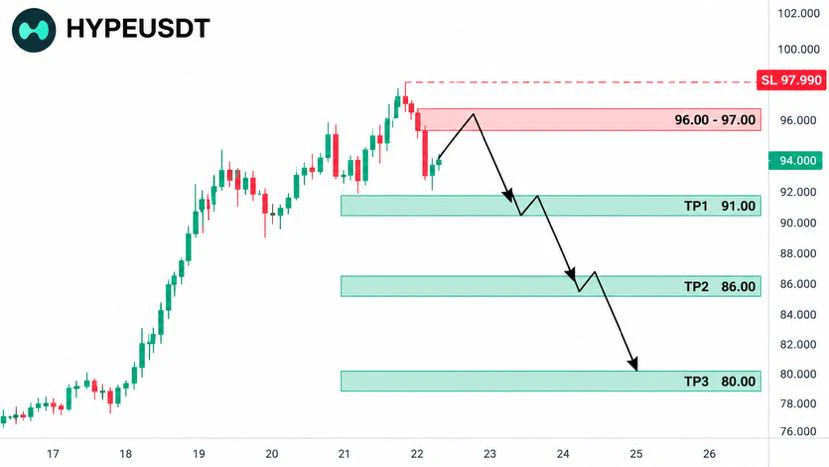
$HYPE is trading near 94.00$ after rejecting from the 97.00$–98.00$ area. Price looks weak after the drop, so this setup favors a short if HYPE gets rejected again from the 96.00$–97.00$ zone.
Entry 96.00$–97.00$
Confirmation Rejection below 97.00$
SL 97.99$
TP1 91.00$
TP2 86.00$
TP3 80.00$
The idea is simple. HYPE moved up strongly, but sellers pushed price down from the top. If price moves back into the entry zone and gets rejected again, it can continue lower toward 91.00$, then 86.00$, and possibly 80.00$.
Invalidation Strong move and hold above 97.99$.
repost-content-media
Entered at 0.2283. The TP1-to-TP4 levels are clearly staggered; move the SL to breakeven and hold to see if it can push to 0.25.
Cryptoguider
💸 LONG — ADA
Entry: 0.2283
💸 Targets: 0.2306 / 0.2348 / 0.2391 / 0.2531
💸 Stop: 0.2166
💸 Move SL to entry after TP1.
$ADA ‌#JapanRealEstatePowerChipStocksRise #USAIConceptStocksRally #GateTopsStockPerpetualCoverage #BOJHikesTo1.25%31YearHigh #ZECKeepsRisingBreaking1500
I can’t choose who gets the C spot for this one, so let’s have an on-chain vote decide.
MeArmy
With so many legendary generals, who deserves to sit in the middle!
repost-content-media
To be honest, I’ve really felt the recent liquidity drought. The market still looks like it can bounce around, but the depth is as thin as paper—one hit and it breaks through. I used to always think about buying the dip; now I’ve learned my lesson: first make sure there’s still some air left in my account, then worry about anything else. After all, once you’re wiped out, it doesn’t matter how low the bottom is.
Lately, everyone everywhere has been talking about staking unlocks and token unlock calendars, as if you can’t survive without one. I looked around, and the anxiety over selling pressur
I just happened to translate an agreement audit report, and saw a validation vulnerability related to oracle price feeding—those “if something goes wrong here” vibes came right back. It reminded me of previous replays of stablecoin depegs: a lot of root causes aren’t actually in the contract itself, but in whether the reserve assets even exist and whether they can be redeemed. You know, on the topic of reserve transparency: on-chain is openly public, but who the auditors are, how they verify it, and whether it’s updated on a regular schedule—those details are so vague that the psychology of a
Wait until you’ve clearly figured it out before you act—this sounds easy, but doing it for real is hard.
Recently I’ve been looking at some address profiling tools. The tags are getting more and more granular: things like “smart money,” “swing-trading dogs,” “interaction hunters.” They sound impressive. But honestly, an address’s behavior across different protocols can be very different. Slapping labels based on just a few transfers is easy to get wrong. I’ve also written my own contracts and often found that the same address might be farming an airdrop today, and tomorrow it could be testing
Just finished a modular blockchain document, and honestly my head feels a bit buzzed. 😅
Danksharding, a separate data availability layer, an execution layer split… each of these concepts is pretty clear when you look at them one by one, but when you think about what they change for end users in combination, what exactly is different? I guess for most people, the end result is “chain abstraction”—you don’t have to worry about which layer your assets are on, or which chain handles settlement; the interaction feels as smooth as using an app. But that’s only true if the infrastructure is mature e
After going through several audit reports related to options, the more I read, the more it feels like “time value” is really predatory—it has the buyer waiting every day for a Gamma breakout, only for most of the time value to be swallowed by theta, bite by bite; meanwhile the seller looks like they’re collecting rent steadily, but just one extreme move over a weekend can turn you from “lying back and cashing in” into “lying down and dead.” After the recent cross-chain bridge hacks and the abnormal oracle price quotes, everyone’s been shouting, “Wait for confirmation,” and I honestly really re
I’m just someone who writes small contracts—just messing around with on-chain data blindly. I really don’t dare to say I’m reading it accurately. Recently I’ve been looking at those address profiling tools, which claim to identify “smart money,” “whale addresses,” and can assign dozens of labels—always pushing you a “high-value address.” I tried a few times: I pulled out a handful of addresses that allegedly received airdrops based on the stats, and found that several of them were automatic aggregation wallets set up by the project team themselves. Their transaction histories were as clean as
Honestly, the group chats and KOL breakdowns are really making people anxious. After one on-chain transfer happens, a few big V’s start praising “smart money moves,” and then a bunch of people follow in and rush. I’m also curious and click to take a look, but then I shut it off—because the lessons from writing contracts have taught me that most so-called “smart money” is just blind guessing. If someone really has a winning edge, who would post on Twitter every day? I’m not sure if I’m just too cautious, but after making too many impulse buys, I slowly learn to look less at the groups and get m
I just looked at another DAO voting proposal. On the surface, it’s community self-governance, but if you dig into the token allocation and voting weights in the proposal, you can see the power structure written out very clearly. Big users already hold more votes, and the proposer also sets up a bunch of incentive thresholds—basically, it’s to get retail users to follow along.
As for that recent public chain upgrade, I heard they’re planning a hard fork, and everyone in the group has been guessing whether ecosystem projects will migrate. I’m pretty curious, but reason tells me not to rush—wait
TOKEN-1.63%
Just saw them chatting in a group about a yield aggregator—its APY is so absurdly high that it’s ridiculous. A bunch of people rushed in to farm. I looked over the contract and it just feels off… I’m not saying I want to be a keyboard warrior, but the nested strategy layer and the permission settings—honestly, after reading it all, I’m a bit scared. A yield aggregator, plain and simple, is handing your money to a contract that “builds bricks” via strategies. In the middle of it, if there’s any contract vulnerability or governance gets compromised, then even a higher APY is just paper wealth.
R
FARM-3.79%
Chip stocks saw a strong broad rally in the early session; the Philadelphia Semiconductor Index jumped by 3 points straight away. AMD and Micron are also surging. It looks like investors have high confidence in a turnaround for the semiconductor cycle.
Original content no longer visible
AMD+0.65%
This CNN report is interesting—Israel chose this time to release the news, the timing is too coincidental.
Original content no longer visible
Drones engage in mutual strikes on military industrial facilities, making this battle increasingly resemble a tech war.
Original content no longer visible
The coffee got cold. Staring at the DAO’s new proposal for half an hour, the more I look, the more it resembles those navigation apps—showing the road ahead is clear, when in reality it’s already jammed like a parking lot.
Back to the main topic. Recently, on-chain label systems have been questioned for being lagging, but I actually think DAO voting is a bigger blind spot. Most people can’t be bothered to unpack the incentive structures buried in proposals; they just follow the “whale signals”. But are those signals real consensus, or carefully designed power anchors? I’ve seen a protocol wher
US stock ETF funds are continuously flowing out, and non-ETF buying power is drying up. This fuel pile is getting a bit high—feels like something’s about to happen.
WuSaidBlockchainW
Wu Says he learned that Jiang Zhuo’er, the founder of the Laibite mining pool, posted a warning that the crypto market may be about to see a major move. He noted that, currently, US stock ETF funds have been continuing to flow out; Coinbase’s discount has fallen to the levels seen before the sharp declines at the end of January and the end of May, reflecting the severe exhaustion of non-ETF buyer liquidity. At the same time, the current market funding rate is positive and positions are at high levels, providing plenty of fuel for a chain of liquidations. These signals suggest the market may be about to experience significant volatility.