XRP falls below $2, down 19% from its peak. Santiment shows "extreme panic," but historical experience indicates that high pessimism often signals a rebound. CryptoQuant found negative funding rates, with both August 2024 and April 2025 negative funding rates preceding significant rebounds. Binance launched the XRP/RLUSD trading pair to enhance liquidity, and technical indicators show bullish divergence signals.
XRP Extreme Panic Sentiment Suggests Reversal Opportunity
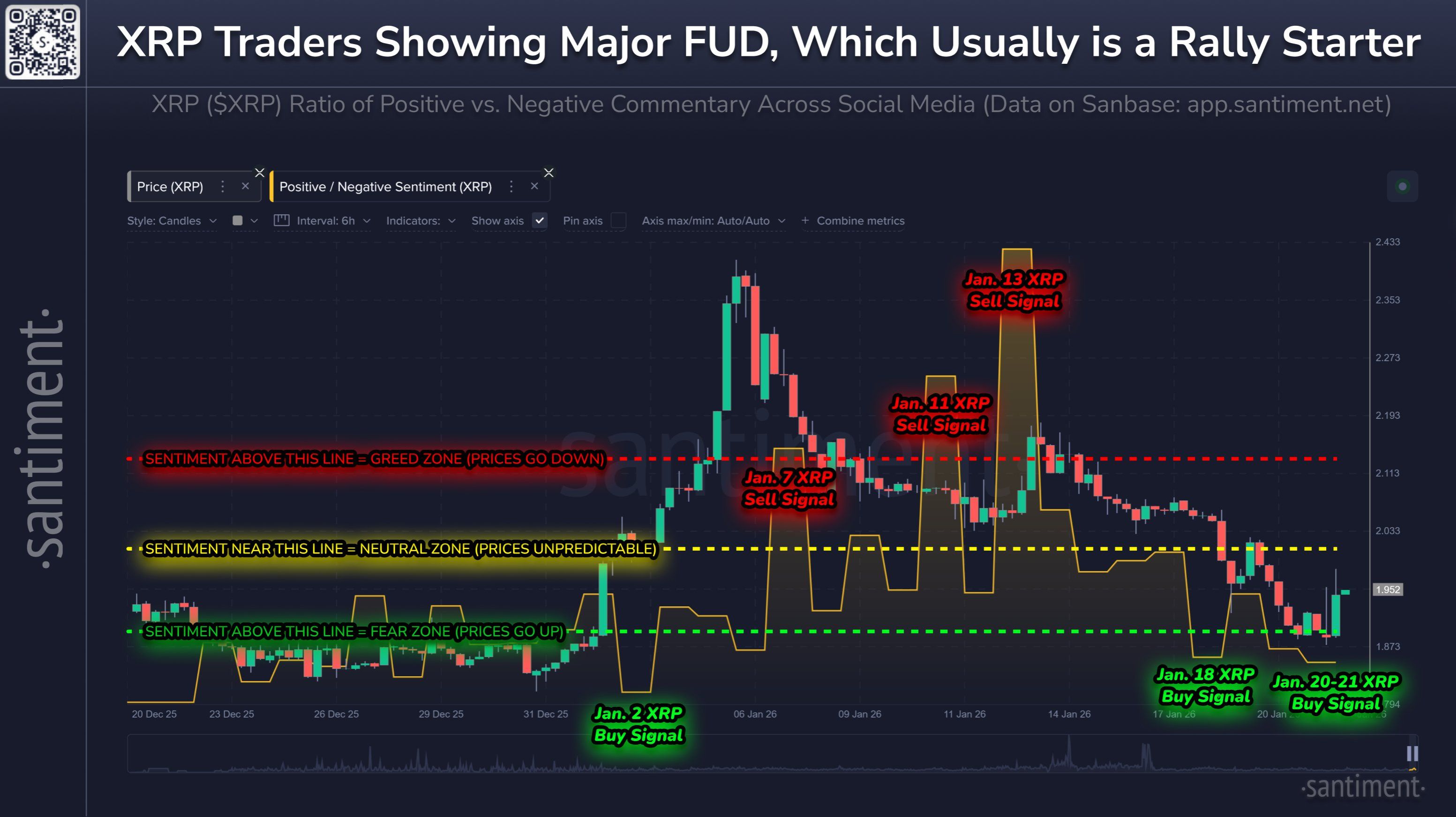
(Source: Santiment)
XRP market sentiment has experienced a sharp reversal. Positive/negative sentiment data from Santiment (a market sentiment analysis platform based on social media discussions) indicates that XRP has entered the "extreme panic" zone. Just a week ago, the same indicator reflected greed in the market. Santiment points out that, based on historical experience, extreme emotions often signal a potential turning point, and market movements tend to go against general expectations.
"From historical experience, such high pessimism often leads to a price rebound. Price trends usually run counter to retail investors' expectations," Santiment reports. This phenomenon is known in behavioral finance as a "contrarian indicator" — when retail investors are extremely pessimistic, it is often a good time for smart money to enter; when retail investors are extremely optimistic, it may signal a market top.
While this observation shows a positive trend, the rapid short-term fluctuations in sentiment highlight the uncertainty and inconsistency of retail traders' confidence. Going from greed to panic in just one week, such intense emotional swings are usually unfavorable for sustained upward trends. However, it is precisely this extremity of emotion that often creates the best contrarian investment opportunities.
Psychologically, during periods of extreme panic, investors tend to make irrational decisions. They may sell at lows out of fear or assume the trend will continue downward after seeing consecutive declines. But markets tend to mean-revert, and extreme emotions cannot be sustained long-term. When panic peaks, selling pressure has been fully released, and any positive news could trigger a strong rebound.
Negative Funding Rates Indicate Excessive Short Accumulation
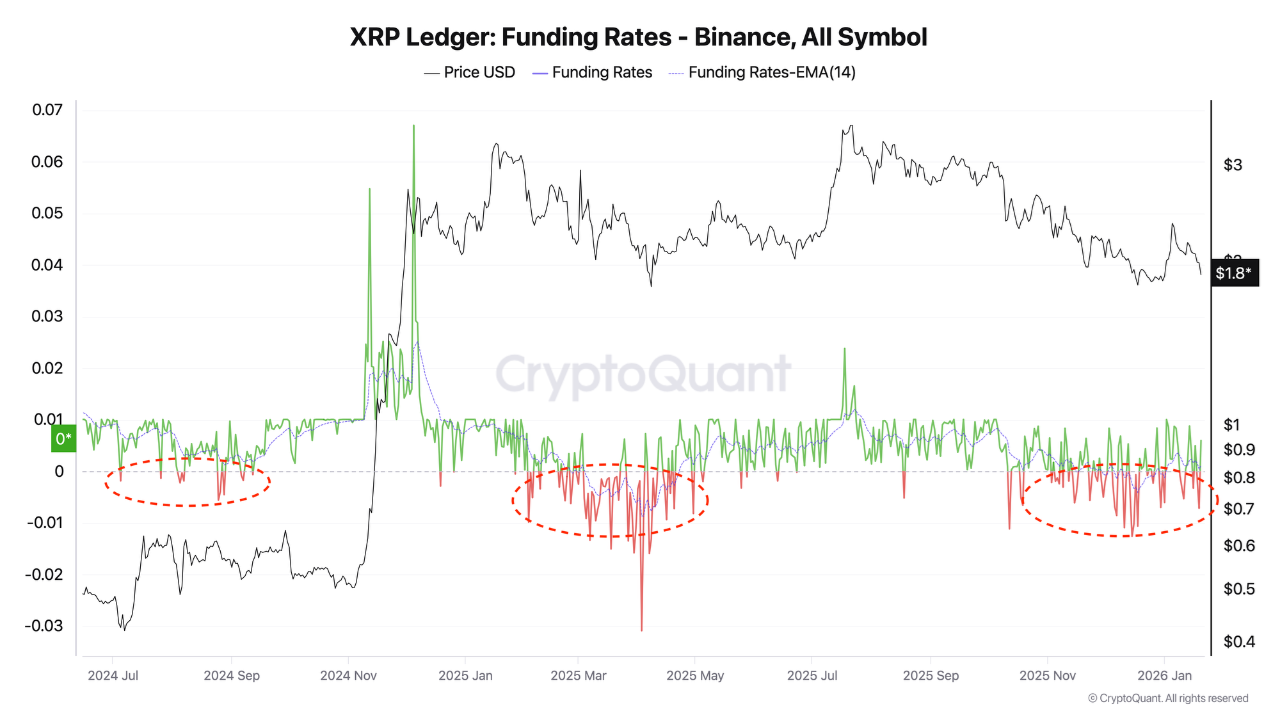
(Source: CryptoQuant)
Market data suggests another potential reversal signal. An analyst at CryptoQuant discovered that the funding rate for perpetual futures contracts is negative, indicating excessive short positions. The funding rate represents periodic payments between longs and shorts in the perpetual futures market; a negative rate means shorts pay longs. Historically, similar situations often precede a rebound in XRP's price.
CryptoQuant's data shows that since 2024, this pattern has occurred twice — in August to September 2024 and April 2025. In both cases, negative funding rates preceded significant price rebounds. CryptoQuant analyst Darkfost explains: "Based on historical experience, markets often reverse after the consensus shifts. Accumulation of short positions can cause short-term selling pressure but also build potential buying pressure. If the price starts rising, these shorts may be forced to cover, pushing the price higher."
This mechanism is known as a "short squeeze." When large short positions are accumulated, an unexpected price increase can cause shorts to incur losses and be forced to buy to cover (stop-loss). This forced buying further drives up the price, triggering a chain reaction. In August 2024 and April 2025, XRP rebounded over 30% and 40% respectively within weeks after negative funding rates appeared.
The current negative funding rate indicates that traders shorting XRP are willing to pay costs to maintain their positions, showing strong confidence in further declines. However, such excessive short sentiment is often a contrarian indicator. When almost everyone in the market is bearish, it suggests the sellers have largely exhausted their positions, leaving only buyers.
From the position structure perspective, negative funding rates combined with extreme panic signals form a double bottom. Both sentiment and capital indicators show the market is overly pessimistic, and any positive catalyst could trigger a rebound.
Binance Launches XRP/RLUSD Trading Pair to Boost Liquidity
Progress in exchange developments also boosts XRP's outlook. On January 21, 2026, Binance announced the launch of a new XRP/RLUSD trading pair. Ripple CEO Brad Garlinghouse expressed optimism, stating that trading RLUSD on Binance will expose the stablecoin to a broader user base. This move will strengthen the XRP Ledger ecosystem and may indirectly support XRP's price.
RLUSD is Ripple's USD-pegged stablecoin competing with USDT and USDC. The introduction of the XRP/RLUSD trading pair is strategic, providing a stablecoin-denominated trading market for XRP. Previously, XRP was mainly traded against USDT; now, with RLUSD options, trading choices are expanded, and the Ripple ecosystem's internal circulation is reinforced.
This listing also opens additional liquidity channels for XRP and RLUSD. In the long term, deeper liquidity in favorable market conditions can improve market depth, reduce volatility, and attract new capital inflows. As one of the largest global cryptocurrency exchanges, Binance's decision to list this new trading pair is a recognition of the asset.
Technical analysis by BeInCrypto further emphasizes the bullish divergence signal that appeared after XRP broke below $2. This enhances the short-term recovery outlook. Bullish divergence occurs when the price makes a new low but technical indicators (like RSI or MACD) do not, indicating weakening downward momentum. Such divergence is often an early sign of trend reversal.
Retail Panic and Professional Bottom-Fishing Moment
In summary, XRP currently shows multiple bottom signals. Extreme panic sentiment, negative funding rates, improved liquidity on the fundamentals, and bullish divergence on the technical side all point to a possible conclusion: XRP is forming a bottom, and a rebound may be imminent.


