Written by: 0xjs@Golden Finance
Recently, Dash has performed remarkably well.
Within 7 days, the price of DASH started from $41 and rose all the way up, even during the significant drop on November 3, it was not affected. On November 4, DASH peaked at nearly $140, reaching more than three times its original price.
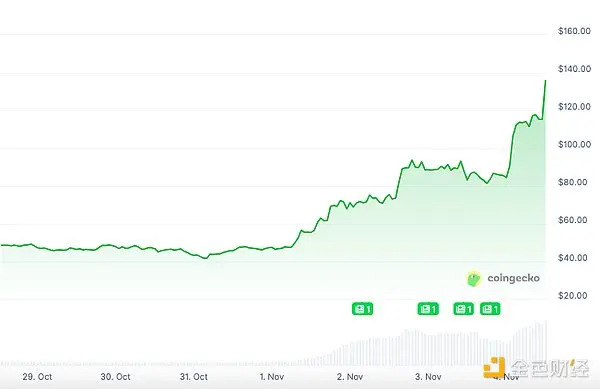
Why has Dash's price performance been so outstanding recently?
Dash officially published an article summarizing the reasons, stating that this did not happen overnight, but is the result of five major achievements over the past few years.
1. DashSpend
First, DashSpend has been released.
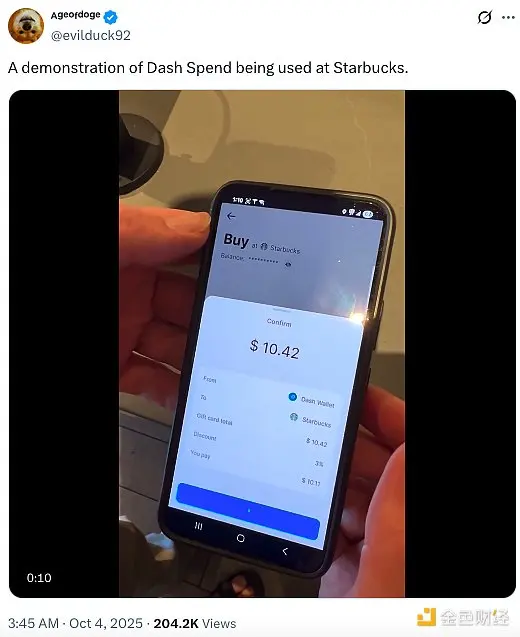
DashSpend demonstration at Starbucks.
This consumer feature, which offers significant discounts, was previously a standalone application called DashDirect, but that application ceased operations years ago. Now, users can spend Dash directly in their wallets at hundreds of thousands of merchants.
2. Billing Payment Issues
Secondly, in-depth research was conducted on the bill payment issue.
Thanks to Spritz Finance, Zypto, and Swapin. It is estimated that 3 billion people worldwide may be able to use Dash to pay at least part of their bills.
"Project Three Billion": Dash is ready to promote globally.
Three billion people.
This is the approximate number of people we can allow to live under a decentralized currency system.
It's not tomorrow, nor ten years from now. It's today.
First, let me briefly introduce the background.
Dash's killer application: cryptocurrency consumption
Dash is one of the oldest cryptocurrencies in history. For a decade, we have been committed to providing a decentralized digital currency that is private, instant, affordable, secure, and easy to use. It operates reliably and stably. During this time, we have continuously refined and improved our technology, preparing ourselves for true mass adoption. Now, that moment is about to arrive.
However, completely changing the global reliance on fiat currencies and the banking system is not an easy task. It requires fundamentally rebuilding the global economic infrastructure, or in the meantime, establishing new connections with the old system. And we have already done that.
If you download the DashPay wallet, you can see for yourself how Dash makes payments for goods and services in the real world easy and convenient, and you can also enjoy significant discounts.
Now that we have achieved this, we finally have the necessary startup funds to tackle the most challenging issue: the bills.
The hardest obstacle to overcome: bills
Over the years, we have seen a wide variety of goods and services used to exchange cryptocurrencies: pizza, alpaca wool socks, VPNs, suspicious items on the dark web, and more. We have also seen prepaid debit cards, digital gift card providers, and others acting as intermediaries to help people use cryptocurrencies as a form of currency.
Unfortunately, one of the most important aspects of living entirely on cryptocurrency—paying bills—is also one of the most complex. This is because bills are usually tied to personal identity and accounts (rather than anonymous goods or services that can be purchased with cash), which means there is a need to interface with traditional financial institutions. These institutions have historically been hostile towards cryptocurrency.
For a long time, many Dash users in various countries have been able to purchase a wide range of goods for small-scale consumption, but they still primarily rely on banks to pay for their largest and most important expenses. This means that for some, Dash is a novelty; for the very few users who can create a personalized local peer-to-peer economy, it is a true digital currency; but for global users, it is far from a mainstream currency.
We are addressing the billing payment issue.
In recent years, this challenge has changed significantly. Thanks to the growing demand for cryptocurrency as a currency and the drive of some innovative companies, many users worldwide can now use cryptocurrency to pay all their bills: utility bills, mortgages, rent, internet fees, phone bills, and so on. These companies allow users to add their current bill payers, pay with cryptocurrency, and then they will pay on their behalf. Moreover, all these premium services accept Dash (.
Among them, the most mature is Swapin, which allows Europeans using euros to seamlessly pay bills with Dash. Bitrefill covers El Salvador. Spritz extends this support to the American public. Zypto enables users from multiple countries and regions, including the United States, Mexico, Costa Rica, Honduras, Guatemala, Egypt, India, Pakistan, the Philippines, and Malaysia, to pay bills with Dash. It is worth noting that in some areas, such as the United States, Dash has established redundancy mechanisms with multiple bill payment service providers, so even if one company fails, users still have backup options.
It is worth noting that all these services are non-custodial, which means that users do not have to bear the risk of fund custody and can pay using wallets they control.
3. Improve Confidential Payment Functionality
Third, we are comprehensively improving the confidentiality payment feature.
This is the original feature launched by Dash in 2014, but we are making significant improvements to make it faster, more efficient, and more stable. We believe that privacy protection will thrive in 2025!
Dash is undergoing a comprehensive improvement and simplification of its privacy features.
In June 2024, Dash DAO voted on a proposal. The governance proposal aims to improve the confidentiality and security of user payments, with the first step being the addition of confidential transaction )CT( support, which will bring a series of different optimizations.
Background
Since its launch in 2014, Dash has been committed to upholding Bitcoin's original promise of permissionless digital cash usage. One of the first improvements was the implementation of the CoinJoin feature at the protocol level. With this feature enabled, the transaction graph (the path between sender and receiver) is effectively broken, allowing users to transact with peace of mind, without worrying that their private financial information will be exposed to the transaction counterpart.
Over the years, Dash's CoinJoin feature has been continuously optimized, and all dedicated wallets support this feature. However, with the advancement of technology and the evolution of user needs, we are making significant upgrades to this feature to make it more efficient, convenient, flexible, and easy to use.
New Chapter: Confidential Transactions
Dash will add support for the following: privacy transactions )CT(, which will be implemented soon after a DAO vote decides to proceed with this upgrade.
In short, CT hides the transaction amount and address balance, so although you can see the source and destination of the transaction, only the sender and receiver know the specific amount of the transaction. If CT is adopted as the default standard by wallets, ordinary users can seamlessly conduct transactions immediately without worrying about their funds or the amount spent on goods/services being exposed, while still maintaining a transparent payment record on the blockchain for accounting purposes.
CT (Confidential Technology) is a well-validated encryption technique that forms the basis for many modern privacy solutions. Notably, it has recently been adopted by major projects in many non-explicit privacy fields, including Solana, PayPal, and Circle. CT is rapidly becoming the standard for confidentiality, with even the most strictly regulated institutions acknowledging it as a fundamental guarantee for ensuring transaction security.
What can CT technology do?
In addition to enhancing the privacy of ordinary users by concealing transaction amounts and balances, CT is also the first step towards many subsequent improvements. Specifically, it can significantly improve Dash's CoinJoin functionality.
By hiding the amounts, the CoinJoin process can be significantly simplified. Currently, funds are split into different denominations, with each denomination being mixed between 4 to 16 times. This makes transactions difficult to trace, but also increases the time and complexity of the process. With CT, the amounts are hidden, meaning you do not need to split the balance into dozens of denominations, nor do you need to undergo multiple mixes. This allows the backend mixing process to take only a few seconds instead of minutes, greatly reducing the likelihood of users noticing it.
Even if not all users mix different amounts of currency, hiding amounts removes an important data point for analysis. In the old system, if a user mixed specific amounts of currency and sent it to others, that amount might appear in future transaction records. If the future recipient does not pay attention to privacy protection, they could associate this transaction with existing records. However, after using transparent addresses, this data point disappears, meaning that even if future recipients are less attentive to privacy protection, the information available for analysis is significantly reduced.
In short, CT provides all Dash users with a robust default standard to help them protect sensitive financial information while unlocking new tools for advanced privacy users.
Looking forward to
Although CT is the first step in making significant improvements to Dash's private payments, we can take other relatively simple additional steps to further enhance its effectiveness.
First of all, we can implement Sietch, which is a technology pioneered by Hush. In short, Sietch sends some zero-value outputs in each transaction, making each payment appear as if it involves multiple parties. This technology was originally designed to address the last vulnerability of zero-knowledge cryptocurrencies like Zcash. While implementing Sietch in a completely transparent blockchain is meaningless (anyone can see which outputs did not actually send any tokens), in Confidential Transactions (CT), outputs containing tokens and outputs without tokens are indistinguishable. It is worth noting that Sietch can be implemented at the wallet level rather than the protocol level, so no changes to Dash's codebase are required.
The default integrated wallet for Sietch and CT can provide Dash users with good instant transaction privacy without the need to implement any interactive features such as CoinJoin. However, when Sietch is used in conjunction with CT and CoinJoin, we can achieve a very powerful privacy solution: transaction amounts will be hidden, transaction graphs will be obfuscated before and after the transaction, and multi-party payments will be indistinguishable from single-party payments. This offers Dash users a range of powerful features, helping them achieve the desired level of payment confidentiality while maintaining the transparency of the blockchain, ensuring that the source and destination addresses of transactions are always traceable.
Another potential improvement is to enhance privacy protection at the network level to prevent malicious nodes from eavesdropping on transactions. One of the improvement measures is... the Hawkweed Protocol, which actually makes it as difficult as possible for these network spies to know which node created a given transaction.
Next Steps
The next priority is to integrate CT support into the Dash protocol. After that, we will add CT support to our own dedicated wallets and services, and further optimize CoinJoin to make it compatible with CT. Finally, we will look for more third-party wallets and services in the broader Dash ecosystem to deploy CT, thereby providing users with the best experience.
The new era has arrived. Dash has always adhered to its original intention to become the most efficient, convenient, and complete private digital cash. Join us in bringing it to the public.
4. DEX Integration
Dash has been added to the Maya Protocol. Maya is a powerful cross-chain AMM DEX that supports decentralized Dash trading globally. It is the first DEX platform to integrate Dash (making it particularly special), but more features are set to launch soon.
5. Dash Evolution, smart contract functionality
Last but not least: Dash Evolution.
Dash has launched a new blockchain called Dash Evolution, which features an advanced indexing database at its core, along with proof functions. This supports our username system, but its capabilities go far beyond that.
Evolution is a platform for executing data contracts. These contracts write data into a decentralized storage that is indexed and queryable. Sidechains, which are run by nodes identical to those on the main chain, handle data transactions, while the network's decentralized API allows anyone to access this data on demand.
It is very suitable for any application that needs to store data in a decentralized manner and can quickly search for and access the required data. For example, accounting software, merchant maps, social media, etc., any application that requires data to be stored in a decentralized, censorship-resistant manner and can easily call the required data anytime and anywhere is applicable.
This is an ambitious project. It is not just about adding a new set of features to Dash, but rather launching a completely new and different blockchain network that will interface with the existing Dash network.
The Dash smart contract feature will be launched in 2026.


