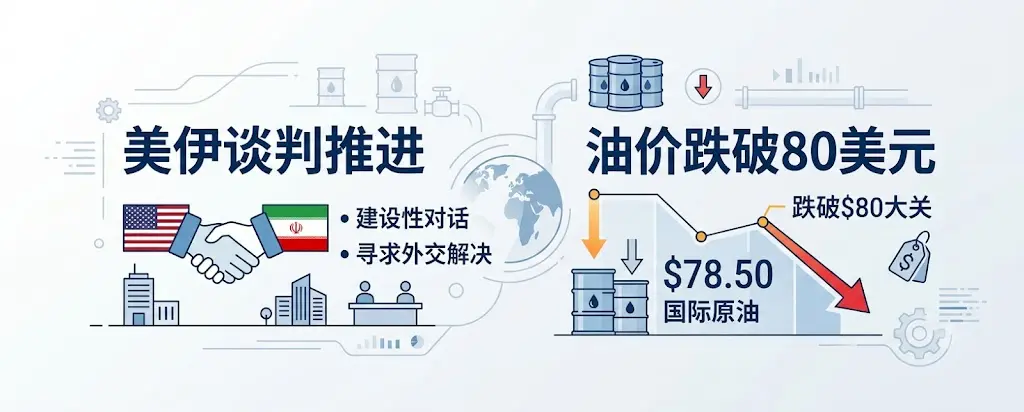
Brent crude fell below $80, but the agreement hasn’t even been signed? The market is pricing in something that “may never happen”
Something bizarre happened last night.
Brent crude plunged 5.26% in a single day, falling below the $80 mark. WTI fell 5.7%, closing at $75.77.
The market voted with real money—believing that the Strait of Hormuz is about to reopen and oil prices are about to collapse.
U.S. Treasury Secretary Bessent said an agreement could be reached “on the 4th or 5th.” U.S. Secretary of State Rubio said “progress has been made in the negotiations, but the agreement has not yet been finalized.” Iran’s Foreign Ministry said—“there have been no talks resumed with the United States.”
One says “it will be signed soon,” while the other says “there have been no talks at all.”
The agreement hasn’t even gotten off the ground, yet oil prices have already fallen 5%.
The market is pricing in something that may never happen.
That’s the most dangerous part of trading on expectation gaps—you’re betting on “the agreement being reached,” but what if it isn’t?
First, let’s see what the agreement actually looks like.
According to Axios and Xinhua, the interim agreement under discussion would roughly work as follows:
A 60-day interim arrangement, which could be extended later
Ships entering the Persian Gulf would use the northern Iranian route, while outbound ships would use the southern Omani route
No transit fees would be charged during the 60-day period
The mines in the central part of the strait would be cleared within 30 days
Iran would monitor departing vessels and retain the right to intervene when necessary
Looks fairly plausible, right?
But Iran also said something else—unless the U.S. lifts the blockade on Iranian ports and resumes honoring the previous 14-point memorandum of understanding, “the Strait of Hormuz will remain closed.”
In other words—the prerequisite for signing the agreement is that the U.S. makes concessions. But has the U.S. made any concessions?
Trump said on the 3rd: “The U.S. will not allow Iran to charge fees to ships passing through the Strait of Hormuz. If anyone is going to collect fees, it will be us.”
One side wants to collect fees, while the other won’t allow it.
Can this agreement be signed?
Let’s work through two scenarios:
Scenario A: The agreement is actually implemented
Oil prices remain under pressure, easing inflationary pressures
Expectations of Fed rate hikes cool
Risk assets benefit—BTC and U.S. stocks continue to rally
Scenario B: The agreement collapses or is delayed (personally, I don’t think the probability is low)
Oil prices rebound violently to above $90
The inflation narrative reignites
Risk assets suffer—BTC takes the hit first
Current prices have already price in “the agreement being reached,” but have not yet price in “the agreement failing.”
The geopolitical risk premium embedded in oil prices is rapidly fading. The market is already trading on the assumption that the strait will reopen.
But what if that doesn’t happen?
The expectation gap is the biggest trading opportunity over the next 72 hours.
On one side is the positive impact of easing inflationary pressures (BTC above 64000, the Nasdaq surging 2%); on the other is the risk that the agreement could collapse.
At this level, both bulls and bears have a valid case, but getting the direction right means enormous profits.
Don’t wait until the agreement is actually signed before chasing the move. And don’t wait until it truly falls apart before cutting your losses.
Expectation-gap trading is about who sees first what others have failed to see.
#Gate上线宇树科技盘前合约 #美股芯片股全线大涨 #GateCard消费返现最高8% $BTC $BZ $CL Disclaimer: The information on this page may come from third-party sources and is for reference only. It does not represent the views or opinions of Gate and does not constitute any financial, investment, or legal advice. Virtual asset trading involves high risk. Please do not rely solely on the information on this page when making decisions. For details, see the
Disclaimer.