CryptoCircleAraki
CryptoCircleAraki
2025-12-09 13:24
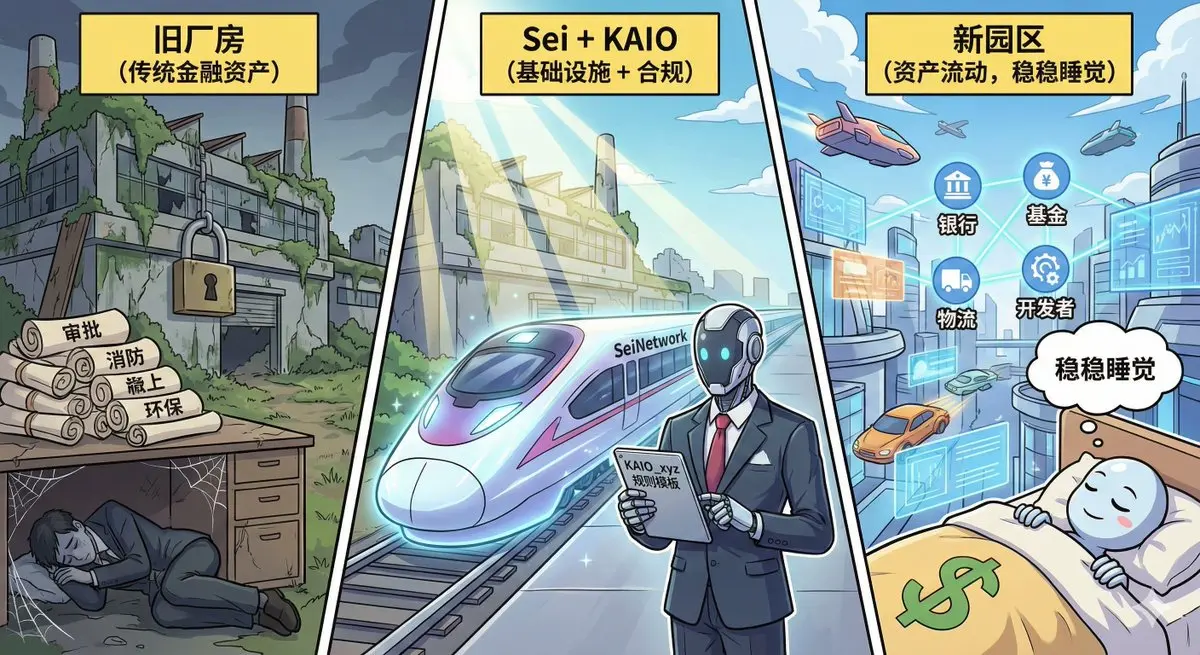
I have a friend who took over an old factory complex that nobody wanted.
The land isn’t bad, and the location is pretty good, but it’s just too much trouble: all sorts of approvals, fire safety, environmental regulations—all stuck at various points. Anyone who looks at it gets a headache, so the whole asset just lies there like that. Technically it’s an “asset,” but in reality, it’s half-dead.

Later, he brought in two teams:
One team was responsible for getting the roads, electricity, and internet all connected, turning the park into infrastructure that’s “ready to run at any time”—this is a lot like @SeiNetwork, in charge of speed and settlement. The other team specialized in studying policies, clearly defining what can and can’t be done, and which industries are allowed in, writing everything into a set of clear rule templates—this is a lot like @KAIO_xyz, in charge of compliance.

As a result, the situation changed:
Banks, funds, logistics companies, and software teams were all willing to come in:
On the banking side, they broke down the original dormant project into small shares, like slicing up the “old asset” into pieces to put on the market, making the money flow;
Funds came in to do industrial operations, with contracts, reports, and procedures all running according to the park’s existing rules, saving a huge chunk of labor costs;
Trade and warehousing companies treated this place as a “cargo + capital transfer station.” Things that used to be locked in their own ledgers could now connect, circulate, and earn service fees within the park’s “public rules”;
Development teams could build systems and tools on top of this, without having to decipher the policies themselves—just plug into the park’s set of “rules APIs.”

That’s when I suddenly realized:
Those loans, bonds, and credit assets in traditional finance are actually just like this old factory complex—not worthless, but no one dares to touch them, and they’re hard to move.
What @SeiNetwork + @KAIO_xyz are doing is basically:
On one side, paving the “on-chain roads” to make things move quickly;
On the other, packaging the “rules” so that institutions dare to use them without stepping on landmines.
Banks, funds, exchanges, developers,
let assets that used to just lie dormant, start moving,
while still being able to sleep soundly themselves.
View Original
post-image
Disclaimer: The information on this page may come from third-party sources and is for reference only. It does not represent the views or opinions of Gate and does not constitute any financial, investment, or legal advice. Virtual asset trading involves high risk. Please do not rely solely on the information on this page when making decisions. For details, see the Disclaimer.
0
Add a comment
Comment
No comments