Oasis Network stands out with its unique two-layer architecture, separating consensus and execution. This allows for:
-
High Scalability: Multiple ParaTimes process transactions independently, preventing bottlenecks. Developers can even build their own specialized ParaTimes for specific needs.
-
Increased Efficiency: Sophisticated discrepancy detection makes Oasis more efficient than sharding, requiring fewer nodes for the same security.
-
Improved Developer Experience: Emerald ParaTime offers 1,000 TPS and 99% lower fees compared to Ethereum, attracting developers with its cost-effectiveness.
-
Strong Privacy: Cipher ParaTime offers privacy-preserving smart contracts, enabling confidential transactions and data storage.
-
Bridging Gaps: Sapphire ParaTime combines EVM compatibility with confidentiality, allowing developers to easily add privacy features to existing Solidity contracts.

Consensus Mechanism
At the heart of the Oasis Network lies its consensus mechanism, which is a critical component ensuring the network's integrity, security, and continuity. The Oasis Network adopts a Proof of Stake (PoS) model, leveraging the Tendermint Byzantine Fault Tolerance (BFT) consensus protocol. This pairing offers a system that is less energy-intensive than Proof of Work (PoW) models and holds up the promise of high throughput and instant finality, meaning transactions are confirmed and irreversible almost immediately after being processed.
The Tendermint BFT mechanism is particularly well-suited for Oasis's requirements due to its leader-based approach. A validator node is selected as the proposer of a block, and other nodes (validators) participate in voting rounds to agree upon the next block to be added to the blockchain. The protocol ensures that as long as more than two-thirds of the validators are honest, the network remains secure and operational even in the presence of malicious actors.
This consensus layer is responsible for block production and also manages validator committees and handles native token operations critical for the network's self-management. The consensus process is insulated from the execution layer to enhance security and system performance.
Network Architecture
Oasis's network architecture is modular, consisting of several layers that compartmentalize different functionalities, which collectively contribute to the network's performance and capabilities:
-
Consensus Layer: The aforementioned layer that manages the blockchain's state, validates transactions, and maintains the continuity and security of the chain.
-
ParaTime Layer: A parallel runtime environment where the actual smart contract execution takes place. ParaTimes are distinct, replicated compute environments that can be developed and operated by anyone. They offer the flexibility to cater to various compute needs, from private, confidential computation to high-performance execution.
-
Key Manager Layer: This layer is responsible for securing sensitive data, particularly within the ParaTimes that utilize Trusted Execution Environments (TEEs) for confidential computations. Key managers handle the cryptographic keys needed to access encrypted data, ensuring that only authorized compute nodes can execute the smart contracts and access the data within ParaTimes.
-
Storage Layer: While not explicitly detailed in the core architecture, the storage component is crucial for maintaining the state of the blockchain and the smart contracts. It ensures data is consistently and securely stored across the network, providing the foundation upon which the Oasis ecosystem operates.
The combination of these architectural elements with the innovative consensus mechanism establishes the Oasis Network as a forward-thinking platform aimed at catering to the next generation of blockchain applications, particularly in the realms of DeFi and private computation.
ParaTime Layer
The ParaTime Layer of the Oasis Network is a distinctive design that caters to smart contract execution while being decoupled from the consensus layer, which provides several technological advantages:
Smart Contract Execution and Decoupling from Consensus
The decoupling of smart contract execution from consensus allows each component to be optimized for its particular role. This separation enhances the network's performance and security. Smart contracts within the Oasis Network are executed within ParaTimes, which are parallel runtimes that function alongside the consensus layer but operate independently of it. This architecture allows the network to manage smart contract execution and consensus separately, increasing efficiency and scalability.
Use of Trusted Execution Environments (TEEs) for Confidentiality
ParaTimes leverage Trusted Execution Environments (TEEs) to ensure confidentiality and integrity of the smart contract execution. TEEs are secure areas of the main processor that protect the code and data loaded inside from disclosure or modification from outside. By executing contracts within a TEE, the Oasis Network can provide a protected environment that keeps the execution confidential, making it highly suitable for privacy-sensitive applications.
Discrepancy Detection and Verifiable Computing Techniques
The Oasis Network employs verifiable computing techniques, notably discrepancy detection, to ensure the integrity of smart contract execution within ParaTimes. This method involves several checks and balances, including:
-
Random Selection of Compute Nodes: A random selection of nodes is made to form a compute committee, and the results of smart contract executions are accepted only if all members of this committee agree, ensuring the integrity of execution.
-
Discrepancy Resolution: In the event of a discrepancy, a separate protocol called “discrepancy resolution” is used. This secondary protocol acts as a "slow-path" mechanism to resolve discrepancies and ensure the correct execution of smart contracts.
These techniques allow the Oasis Network to provide a secure and verifiable execution environment for smart contracts, fostering trust in the system's integrity without compromising on performance.
Privacy Features
The Oasis Network introduces a groundbreaking approach to privacy, distinguishing itself with private transactions and data handling. At its core, the network utilizes secure enclaves and data capsules to protect user information, ensuring data remains confidential throughout its lifecycle on the blockchain.
Secure Enclaves and Data Capsules: Leveraging Trusted Execution Environments (TEEs), Oasis allows for the execution of smart contracts within a protected environment. This "black box" processing ensures that sensitive data remains encrypted both in transit and at rest, accessible only to authorized parties. This setup is critical for maintaining privacy, as the data is never exposed to node operators or developers.
The concept of data capsules in Oasis encapsulates sensitive data, providing a secure container that interfaces with smart contracts within TEEs. By doing this, Oasis ensures that data, even if highly sensitive, can be used in decentralized applications (DApps) without compromising the privacy of the individuals to whom the data belongs.
Smart Contract Capabilities
Oasis Network supports a diverse range of smart contract capabilities, crucial for its versatile ecosystem.
Support for Solidity and WASM: Developers can write smart contracts in familiar languages as Oasis supports both Solidity and WebAssembly (WASM). This support ensures that developers from Ethereum's community and those accustomed to traditional web development can seamlessly transition to building on Oasis.
Confidential Smart Contracts: The ability to execute confidential smart contracts is a hallmark of the Oasis Network. It allows the processing of encrypted data and ensures that the state of these smart contracts remains private. This is a significant leap forward, as it opens up the possibility for contracts to handle personal data, financial records, and other sensitive information without compromising user privacy.
Cipher - A Confidential ParaTime

Cipher ParaTime: Oasis introduces Cipher, a confidential ParaTime designed to support confidential smart contracts. It requires nodes to use TEEs, ensuring that data is encrypted and processed privately. Cipher illustrates the innovative approach of Oasis to combine confidentiality with smart contract execution. By integrating Intel SGX in its reference implementation, Oasis sets the stage for a broad array of secure computing technologies like ZKP and HE to be utilized in the future.
Implications for Blockchain Use Cases: The introduction of Cipher and the confidential computing capabilities of the Oasis Network signal a transformative shift in how blockchain can interact with sensitive data. It paves the way for personal data to be monetized and controlled by users, offering a new paradigm where data becomes an income-generating asset while preserving privacy.
Versatility and Customization: The ParaTime layer’s versatility reflects in its capacity to support various Runtime VMs and smart contract languages, be it for confidential computation or other specialized requirements. The adaptability to run Permissioned or Permissionless ParaTimes allows for a wide range of applications, from enterprise solutions to open community projects, further enhancing the network's utility and appeal.
Supported Projects and DApps
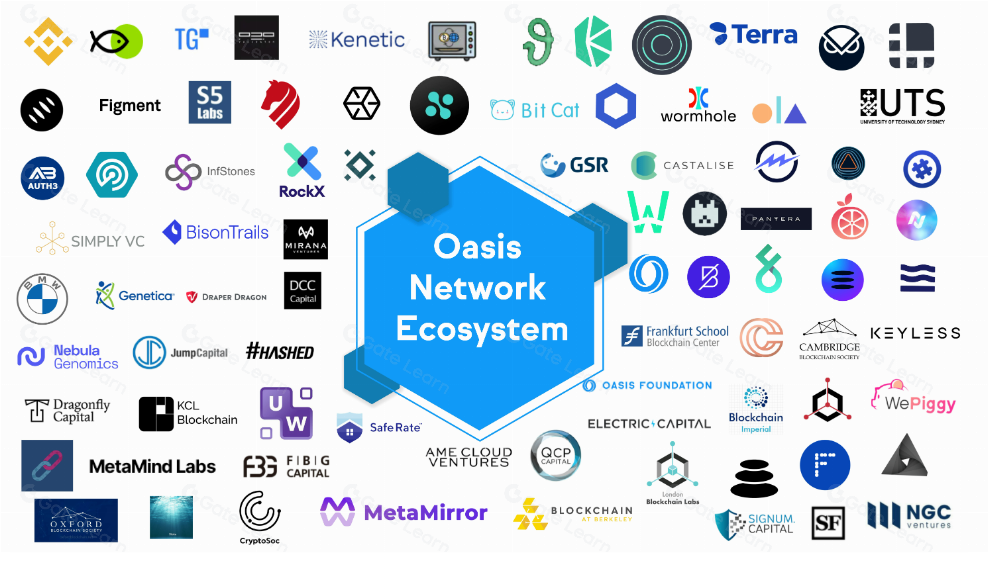
The Oasis Network is home to a burgeoning ecosystem, characterized by a diverse array of projects and decentralized applications (DApps) that span across various facets of blockchain technology and real-world applications. From DeFi and NFTs to data privacy solutions and beyond, the network has attracted an array of developers and entrepreneurs, leveraging its unique features to innovate and expand the boundaries of what's possible with blockchain technology.
This ecosystem is a testament to the network's technical capabilities and a reflection of its community's vibrancy. These projects play a pivotal role in network growth by driving user adoption, contributing to the network's overall value proposition, and enhancing the Oasis Network's utility. With each new project, the network's versatility is showcased, demonstrating its ability to cater to a wide range of needs within the blockchain space.
The Role of Projects in Network Growth and User Adoption
The Oasis Network's expansion and user adoption are significantly bolstered by its partnerships and collaborations. Each project built on the network contributes to this growth by:
-
Addressing Diverse Use Cases: By facilitating a variety of applications, the Oasis Network ensures that it can serve a broad audience, thereby encouraging more widespread use and adoption.
-
Showcasing Innovation: New projects on the network often bring innovative ideas to market, which can attract attention and drive adoption both within and beyond the existing crypto community.
-
Creating Network Effects: As more projects are developed on the Oasis Network, it can lead to a positive feedback loop where the success of one project fuels the growth of others.
##The DeFi Ecosystem
 The emergence of Emerald, the EVM-Compatible ParaTime, has been a significant milestone for the Oasis Network, enabling a slew of DeFi projects to launch and thrive. These projects benefit from the network's high throughput and low fees, which are particularly advantageous for DeFi applications that require fast and cost-effective transactions. The DeFi ecosystem on Oasis includes lending services, DEXs, and other financial instruments, all of which contribute to the robustness and appeal of the network.

Yuzu-Swap
YuzuSwap is a decentralized exchange (DEX) built on the Oasis Emerald paratime, emphasizing a safe, fair, and high-composability ecosystem. It utilizes a non-custodial, peer-to-peer, automated market-maker model to enable token swaps within the Oasis ecosystem. Key features include a fair launch with no pre-mine, a unique trade mining mechanism, a buyback strategy to stabilize its token price, a DAO vault funded by transaction fees, and extensive integration capabilities with other Oasis projects. The platform encourages community involvement through the Yuzu DAO, allowing token holders to vote on various initiatives.
The $200m Ecosystem Fund
The Oasis Foundation, along with industry giants like Binance Labs and Pantera, has established a $200 million Ecosystem Fund. This fund is dedicated to supporting developers and projects that align with the network's vision of a privacy-centric Web 3.0. The fund demonstrates the commitment of Oasis and its partners to fostering a rich environment for innovation and the development of new applications on the network.
Grants & DevAccelerator
Through its Grants program, the Oasis Foundation actively supports talented development teams in creating new applications and integrations. The diversity of projects funded highlights the network's flexibility and its suitability for a wide range of applications, from AI to health management solutions.
Community Efforts
The Oasis Network's success is buoyed by its active and global community. The Oasis Ambassador program exemplifies this community spirit, with volunteers worldwide driving network engagement through various initiatives. Moreover, the Oasis University Program stands out as the most extensive in the Layer-1 blockchain space, with participation from prestigious academic institutions across the globe.
Future Roadmap

- 2024 Vision and Growth Strategy
- Expansion of the Ethereum ecosystem integration, including the addition of support for verifying arbitrary Ethereum state.
- Launching of Ethereum ecosystem tools such as Foundry support, Oasis TypeScript client improvements, and plugins for encrypted transactions.
- Developer Experience Enhancements
- Continued focus on the ease of application development using the Sapphire runtime and Oasis Privacy Layer (OPL).
- The introduction of new example dApps, documentation, and user guides to showcase the unique features of the Oasis Network.
- Updating the Oasis Playground for developers to access the latest tools and resources for application development on Oasis.
- User Experience Improvements
- Development of a more secure and user-friendly Oasis Wallet Browser Extension.
- Introduction of mobile wallet applications for both iOS and Android to improve accessibility and convenience for users.
- A UI/UX overhaul across all wallet platforms to streamline user interactions.
- Security and Resilience
- Investigation into additional TEE (Trusted Execution Environment) technologies to enhance network security.
- Implementing a multi-layered defense approach to increase the resilience of the network against a wide array of threats.
- Performance Upgrades
- Enhancements to runtime and storage performance, focusing on optimizing the Merkle trie storage database and the runtime storage protocol.
- Evaluation of different storage layouts and backends to reduce I/O amplification and improve system efficiency.
- Community and Ecosystem Development
- Strengthening the Oasis ecosystem through increased community engagement and support for new projects.
- Further development of the $200m Ecosystem Fund, encouraging innovation in Web 3, DeFi, Metaverse, DAO, and NFT projects on Oasis.
- Emphasizing the Oasis Ambassador program to fuel global community efforts.
- University Program Expansion

- Continued investment in the Oasis University Program, aiming to foster innovation and development from academic institutions worldwide.
- Anticipated Outcomes
- A summary of the expected advancements and how they will contribute to the overall progress and adoption of the Oasis Network.
- Insight into how these developments align with the long-term goals of creating a robust, secure, and privacy-focused blockchain ecosystem.
This roadmap maintains a forward-looking perspective, building upon the foundations laid in previous years while steering clear of content overlap. It emphasizes on significant advancements, with a keen eye on ensuring these developments are complementary and not redundant to existing capabilities.
Comparison with Other Blockchains
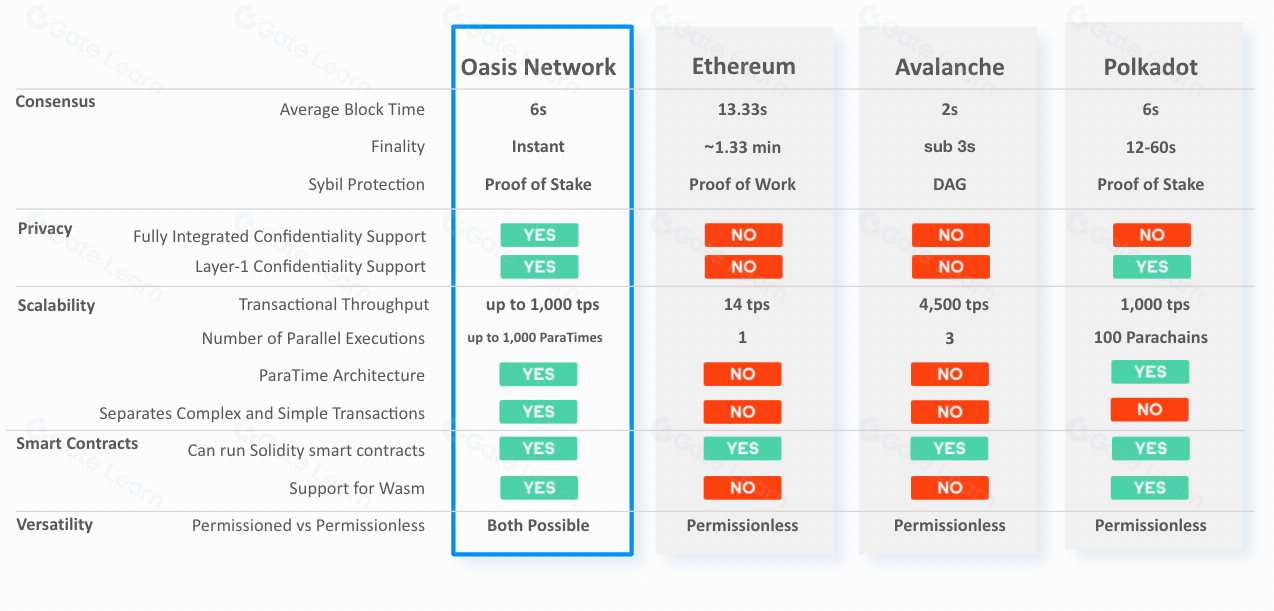
The blockchain landscape is diverse and competitive, with various platforms aiming to offer unique advantages over their rivals. Oasis Network, with its emphasis on privacy and high-throughput computing, has positioned itself as a formidable contender in this space. Here’s how it stands in comparison to giants like Ethereum and Polkadot:
Transaction Speed and Finality
- Oasis Network boasts an impressive transaction speed with the ability to handle up to 1,000 transactions per second (tps), and it promises instant finality. This means that transactions on the Oasis Network are confirmed and irreversible almost immediately after being processed, which is not only efficient but also provides a high degree of certainty to users.
- Ethereum, on the other hand, currently handles around 14 tps with an average block time of 13.33 seconds and a finality time of approximately 1.33 minutes. While Ethereum 2.0 aims to improve these numbers significantly, Oasis currently offers a faster alternative.
- Polkadot has a similar block time to Oasis at 6 seconds and supports 1,000 tps with its multiple parachains. However, its finality can range from 12 to 60 seconds, which is less immediate compared to Oasis's instant finality.
Fees
- Oasis Network's fee structure is highly competitive, claiming to be up to 99% cheaper than Ethereum. This makes it an attractive option for developers and users who are cost-sensitive, especially when it comes to DeFi transactions which can be fee-intensive on networks like Ethereum.
- Ethereum is known for its high transaction fees, especially during network congestion, which can make it prohibitive for smaller transactions or for DApps that require frequent on-chain interactions.
- Polkadot's fee structure varies and can be more economical than Ethereum's, but it still doesn't match the low fee proposition of the Oasis Network.
Privacy
- One of the unique selling points of the Oasis Network is its fully integrated confidentiality support, offering privacy features at the Layer-1 level. This is a significant divergence from Ethereum, which does not natively support confidentiality, often requiring complex layer-2 solutions or other workarounds for privacy.
- Polkadot allows for privacy-focused parachains, but this privacy is not inherent to the Relay Chain itself. This means that while privacy can be achieved on Polkadot, it relies on the specific implementation of individual parachains.
Versatility and Smart Contracts
- Oasis Network’s versatility is evident in its support for both permissioned and permissionless environments, catering to a wide array of use cases from open community projects to enterprise solutions. It can run Solidity smart contracts, making it an easy transition for Ethereum developers, and supports WebAssembly (WASM), broadening its developer appeal.
- Ethereum, being the first mover in the smart contract space, has a vast ecosystem of DApps and supports Solidity smart contracts. However, its lack of native privacy features and current scalability issues are areas where Oasis stands out.
- Polkadot, similar to Oasis, offers versatility with its parachain model, allowing for various runtimes including WASM. It also provides a degree of interoperability that is currently unrivaled.
In conclusion, while Ethereum and Polkadot have their strengths and established ecosystems, the Oasis Network differentiates itself with its focus on privacy and scalability, offering a high-speed, low-cost, and privacy-centric alternative that is well-suited for the next generation of blockchain applications.


