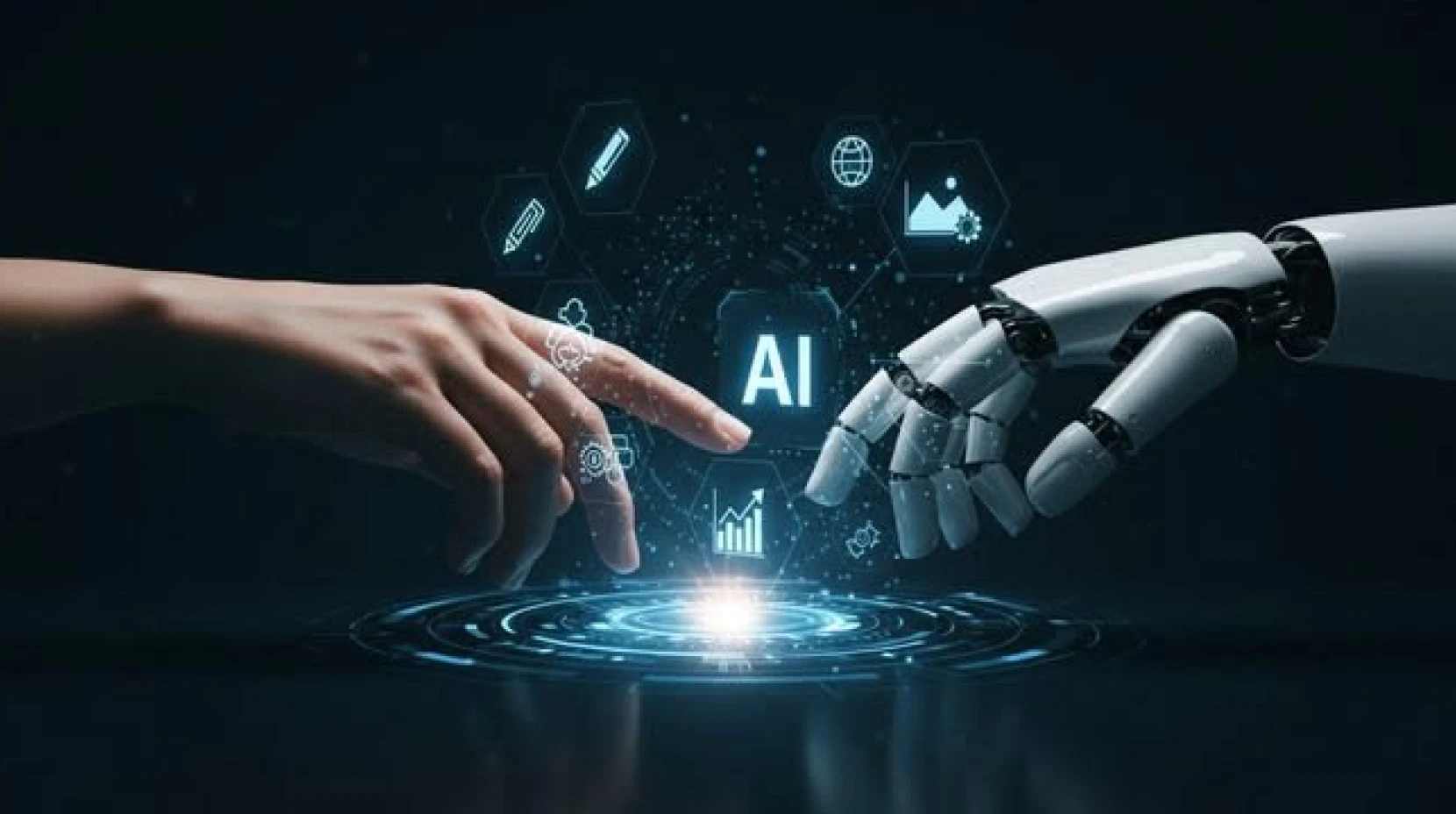
Gate has launched a groundbreaking AI Quantitative Workbench, seamlessly integrating strategy development, historical backtesting, and live trading within a unified platform powered by natural language interaction. Traders simply articulate their trading concepts, and the system automatically generates quantitative strategies, performs backtesting, and enables one-click deployment to real markets. This innovative approach dramatically reduces the technical requirements for programming and data environments in quantitative trading, empowering more traders to rapidly transform market insights into actionable strategies and advancing the widespread adoption of AI and quantitative trading.
2026-11-04 08:11:36
Gate has officially released Gate for AI, seamlessly connecting CEX, DEX, wallets, information services, and on-chain data into a unified interface framework designed for AI Agents, marking a foundational upgrade to exchange infrastructure.
2026-11-04 08:11:36
With the Gate No-Code AI Quantitative Trading Workbench, traders can create, backtest, and deploy quantitative trading strategies effortlessly—no programming experience required. Natural language strategy generation simplifies the trading process, boosts execution efficiency, and enables every trader to fulfill their quantitative trading needs with ease.
2026-11-04 08:11:36
From Spotify’s music distribution to AI programming tools lowering the barriers for developers, technological “equalization” repeatedly raises the baseline but simultaneously lifts the ceiling. Warp founder Naman Bhansali, drawing from his own entrepreneurial experience, points out: AI won’t eliminate disparities; instead, it amplifies the power-law distribution. What’s truly scarce isn’t execution, but rather aesthetics, insight, and the ability to compound value over the long term.
2026-11-04 08:11:36
How does AI power NFTs? The key lies in breaking through the traditional NFT framework that focuses only on ownership verification and scarcity, and instead embedding intelligence directly into the asset structure itself. The original purpose of Non-Fungible Tokens was to solve the problem of digital ownership and uniqueness. Through blockchain technology, artworks, music, and virtual items gained verifiable ownership for the first time. However, this design also defined a structural limitation. Once minted, an NFT's content and functionality are permanently fixed, causing most NFTs to resemble on-chain certificates rather than assets that can be actively used or continuously evolve. As a result, their value depends heavily on narratives and market sentiment.
2026-11-04 08:11:30
A Web3-native AI model aggregation platform integrates multiple AI model capabilities into on-chain architecture and redefines access rights and value distribution through decentralized identity and usage-based payment mechanisms. In the Web2 era, AI services have primarily existed as centralized platforms, where users must register accounts, link payment methods, and obtain model access through subscription plans. While this model accelerated early AI adoption, it has gradually revealed structural limitations, including fragmented models, non-transferable access rights, a severe mismatch between costs and actual usage frequency, and full ownership and control retained by platform providers. These characteristics fundamentally conflict with Web3 principles of sovereignty, composability, and assetization.
2026-11-04 08:11:30

The key difference between AINFT and traditional NFTs lies in their underlying design. AINFT embeds AI capabilities directly into the asset structure, creating intelligent NFTs, while traditional NFTs are static digital assets centered on ownership verification. Traditional NFTs (Non-Fungible Tokens) derive their core value from establishing ownership. Through blockchain technology, they create verifiable and tamper-resistant proof of ownership for digital content, fundamentally addressing the question of who owns an asset. Once minted, the content and functionality of these NFTs are typically fixed, with limited ability to respond to changes in environment, data, or time. As a result, they function more like on-chain digital collectibles. In contrast, AINFT does not represent a surface-level enhancement of the NFT format. By embedding AI capabilities into the NFT structure itself, AINFT transforms NFTs from static ownership markers into intelligent assets capable of understanding, responding, and taking acti
2026-11-04 08:11:30
AINFT is a Web3 platform built within the TRON ecosystem. Its core concept is to natively embed artificial intelligence capabilities into the NFT structure, transforming digital assets from static ownership certificates into intelligent assets that can learn, interact, and continuously evolve. Unlike traditional NFTs, whose content is fixed once minted, AINFT combines AI models with on-chain assets, enabling NFTs to dynamically adapt based on data inputs and user behavior. These NFTs can execute tasks, generate content, and even act on behalf of their holders as digital entities.
2026-11-04 08:11:29
Immutable Contribution Vault (ICV) is an on-chain contribution and revenue sharing mechanism designed for collaborative AI development. Its core idea is that contribution itself is an asset. By writing processes such as model updates, data submissions, feature development, and behavior design directly onto the blockchain, ICV creates immutable contribution records. This transforms development activities that were previously difficult to quantify or track into verifiable and traceable on-chain assets, while providing a transparent and reliable basis for future revenue distribution.
2026-11-04 08:11:13
Virtuals Protocol is a blockchain protocol built specifically for intelligent AI agents. It aims to help AI evolve from a functional tool inside a single platform into a digital entity with autonomous behavior, on-chain identity, and economic value. In its design, each AI agent can be deployed, traded, and co-owned. Through decentralization, it addresses common limitations in traditional AI systems such as concentrated ownership, high deployment costs, and difficulty monetizing outcomes, so that AI can truly become an on-chain asset that participates in market activity.
2026-11-04 08:11:12
IAO (Initial Agent Offering) is a new Web3 asset issuance model designed specifically for AI agents. It represents a shift in asset issuance logic from earlier fundraising focused models such as ICOs and IDOs toward an on-chain economic model centered on digital labor. Under this framework, the AI agent itself becomes the core asset. Its functionality, revenue rights, and governance rights can all be tokenized and discovered by the market, allowing AI to evolve from a simple tool into an on-chain entity capable of economic activity.
2026-11-04 08:11:12
As a new wave of AI hype sweeps across social media and the crypto market, this article draws a parallel with the 2021 NFT craze, pointing out that extreme optimism and panic often represent a premature consumption of an “ending that has not yet arrived.” It deconstructs this emotional cycle by examining the gap between narrative drivers, market behavior, and technological potential.
2026-11-04 08:11:09
The article analyzes the safety debates, interprets the involvement of xAI and Elon Musk as an endorsement of the early singularity phase, and explores the recruitment of cryptography experts to train on-chain trading models. It reveals that the autonomous agent economy is poised to disrupt both human-computer interaction and the landscape of Decentralized Finance (DeFi).
2026-11-04 08:11:05
The article discusses a unified Agent service index, verification of prediction market capabilities, an ERC-8004 reputation system integrated with the x402 payment SDK, achieving a decade of Web2 evolution in just 30 days, addressing data noise and Sybil attacks, and advising developers to seize the crucial 2–3 month product window under legal considerations.
2026-11-04 08:11:04
AI is creating identities, content, and behaviors at extremely low cost, while the current internet lacks native mechanisms to distinguish humans from machines. This article systematically explains why blockchain is becoming the critical infrastructure for the AI era: by raising the cost of impersonation, building decentralized human identity systems, providing portable identity and payment capabilities for AI Agents, and enabling privacy protection through zero-knowledge proofs, blockchain offers the essential foundational constraints for an AI-native internet that can still be trusted.
2026-11-04 08:11:02