As quantum computing technology advances, traditional signature mechanisms based on elliptic curve cryptography face potential long-term security challenges. How to upgrade cryptographic infrastructure without disrupting existing account and transaction systems has gradually become an important area of blockchain security research.
The XRPL community has proposed introducing ML-DSA-44, a post-quantum digital signature algorithm, and is exploring how to enable accounts, transactions, validators, and related network components to support the new signature method. ML-DSA-44 is a post-quantum cryptographic algorithm standardized by the National Institute of Standards and Technology (NIST). It is designed to withstand attacks that future quantum computers with sufficient computational power may be able to carry out.
However, a quantum security upgrade does not mean that XRP is currently facing an actual quantum attack, nor does replacing one signature algorithm resolve every security issue. From public key exposure and transaction verification to wallet compatibility and key migration, XRPL needs to consider how its entire account system can gradually transition to a post-quantum security architecture. This article examines these key issues, analyzing the technical principles of ML-DSA-44, potential risks to XRPL, and challenges that future upgrades may face.
Key Takeaways
-
XRPL's existing signature algorithms face long-term quantum computing risks. secp256k1 and Ed25519 rely on elliptic curve cryptography and could theoretically be attacked by sufficiently powerful fault-tolerant quantum computers.
-
ML-DSA-44 is a standardized post-quantum digital signature algorithm. It is based on lattice-based cryptography, which uses a different mathematical security foundation from traditional elliptic curve signatures.
-
Accounts that have exposed their public keys require particular attention during future migration. The potential target of a quantum attack is deriving the private key from the public key, not directly breaking the XRP assets themselves.
-
Post-quantum signatures increase data overhead. The public keys and signatures used by ML-DSA-44 are significantly larger than those of existing schemes, which may affect transaction size, storage, and network performance.
-
Wallet key migration is an important part of the upgrade. The new signature mechanism must be designed together with account control, key updates, transaction authorization, and wallet compatibility.
-
Testnet support does not mean full mainnet activation. Upgrade status must be determined based on official XRPL amendments, validator support, and mainnet activation.
Why Does XRPL Need to Consider Quantum Computing Security in Advance?
The core issue with quantum computing security is that certain future quantum algorithms may break the mathematical security assumptions underlying existing public-key cryptography.
The secp256k1 and Ed25519 algorithms currently supported by XRPL both belong to the elliptic curve cryptography family. They rely on mathematical problems that are difficult for classical computers to solve efficiently. As a result, even if an attacker obtains an account's public key, the attacker cannot derive the corresponding private key at a practically feasible computational cost.
However, Shor's algorithm shows that a sufficiently capable quantum computer could theoretically solve these mathematical problems efficiently. This means that if devices capable of large-scale fault-tolerant quantum computing become available in the future, traditional elliptic curve signatures may no longer provide their current level of security.
This risk is not limited to XRPL. Bitcoin, Ethereum, and other blockchains that use elliptic curve signatures also need to study long-term cryptographic migration.
However, there is a significant gap between a theoretical risk and real-world attack capabilities. There is currently no public, reliable evidence that quantum computers can break actual blockchain elliptic curve private keys at scale.
XRPL is studying post-quantum signatures in advance mainly because blockchain infrastructure may require a long upgrade cycle.
Unlike ordinary internet services, public blockchains must account for compatibility among large numbers of existing accounts, wallet applications, validators, and transaction applications. Even after a new cryptographic algorithm has been standardized, deploying it to mainnet still requires technical development, security reviews, performance testing, and network governance.
In addition, some accounts may remain inactive for long periods. If users must actively migrate their keys in the future, determining how to handle long-inactive accounts will also become an important issue.
Therefore, the purpose of preparing for post-quantum security is not to predict that a quantum attack is imminent. It is to reserve sufficient time to upgrade the system if new cryptographic risks emerge in the future.
What Is ML-DSA-44, and Why Is It Suitable for Post-Quantum Signatures?
ML-DSA-44 is a digital signature algorithm based on lattice-based cryptography. It is part of the FIPS 204 standard published by NIST in 2024. It originated from the CRYSTALS-Dilithium cryptographic scheme and is primarily used to generate and verify digital signatures.
The basic function of a traditional digital signature is to prove that a transaction was authorized by the holder of the corresponding private key and to ensure that the data covered by the signature has not been modified without authorization.
For example, when a user initiates a transfer through an XRP wallet, the user must sign the transaction data with a private key. XRPL validators then use the corresponding public key to verify the signature and confirm whether the transaction complies with the account's authorization rules.
ML-DSA-44 does not change the basic purpose of digital signatures. Instead, it uses a different mathematical structure to provide signature security.
Its security is primarily based on the computational difficulty of mathematical problems related to lattices. There are currently no known classical or quantum algorithms that can efficiently break ML-DSA-44 with standard security parameters at a practically feasible cost.
However, post-quantum security does not mean absolute security. The algorithm must still be implemented correctly, and related software may be affected by side-channel attacks, random number defects, or other engineering vulnerabilities.
The ML-DSA standard includes different security parameter levels. ML-DSA-44 corresponds to NIST Security Category 2 and is intended to provide a level of post-quantum security consistent with that category. Compared with traditional elliptic curve signatures, the main cost of ML-DSA-44 is its larger key and signature sizes.
| Comparison Dimension |
Existing XRPL Signatures |
ML-DSA-44 |
| Representative Algorithms |
secp256k1, Ed25519 |
ML-DSA-44 |
| Cryptographic Foundation |
Elliptic curve cryptography |
Lattice-based cryptography |
| Quantum Computing Risk |
Theoretically vulnerable to sufficiently powerful attacks using Shor's algorithm |
Designed to address known quantum attack methods |
| Public Key Size |
Typically about 32–33 bytes |
1,312 bytes |
| Signature Size |
Typically about 64–72 bytes |
2,420 bytes |
| Main Advantage |
Compact data and a mature ecosystem |
Post-quantum security design |
| Main Challenge |
Long-term quantum risk |
Data size, performance, and compatibility |
The sizes above reflect important differences between the two types of algorithms. However, the size of an actual on-chain transaction is also affected by the encoding format and other fields. For XRPL, the significance of introducing ML-DSA-44 is to provide a signature option for future account authorization that does not depend on the traditional security assumptions of elliptic curve cryptography. It is not intended to immediately replace all existing wallets.
Why Could Exposing an XRPL Wallet's Public Key Become an Entry Point for Quantum Attacks?
Digital signatures generally involve a public key and a private key. The private key is used to generate transaction signatures, while the public key is used to verify whether the signatures are valid. Under normal circumstances, even if an attacker obtains the public key, the attacker cannot derive the private key within a practically feasible amount of time using a classical computer.
However, this security assumption could be broken if a sufficiently powerful quantum computer becomes available in the future.
On XRPL, an account address is not equivalent to the complete public key. For an account that has not yet publicly disclosed its signing public key, an attacker cannot obtain the corresponding elliptic curve public key from the account address alone.
However, when an account uses a key to sign a transaction, the corresponding public key may be disclosed in the transaction information. On-chain records are preserved long term and can be publicly verified. As a result, an exposed public key could become a target for future quantum attacks.
This does not mean that all XRP accounts that have ever conducted transactions are currently at risk. It means that traditional signature mechanisms carry long-term risks that need to be planned for in advance.
It is particularly important to note that changing an account's signing key is not the same as eliminating the risks associated with the old key. If the old key retains valid transaction authorization, an attacker could still use it to carry out unauthorized operations even after a post-quantum key has been added.
XRPL's existing account system supports Master Key, Regular Key, and multisignature authorization mechanisms. These provide a technical foundation for future key migration, but the upgrade plan must also clearly specify which existing authorizations need to be disabled and how account control will be preserved.
Therefore, the core of a post-quantum security migration is not only generating new ML-DSA-44 keys. It also requires ensuring that outdated signature paths can no longer control the account.
How Can XRPL Upgrade Its Transaction Signature Mechanism Through ML-DSA-44?
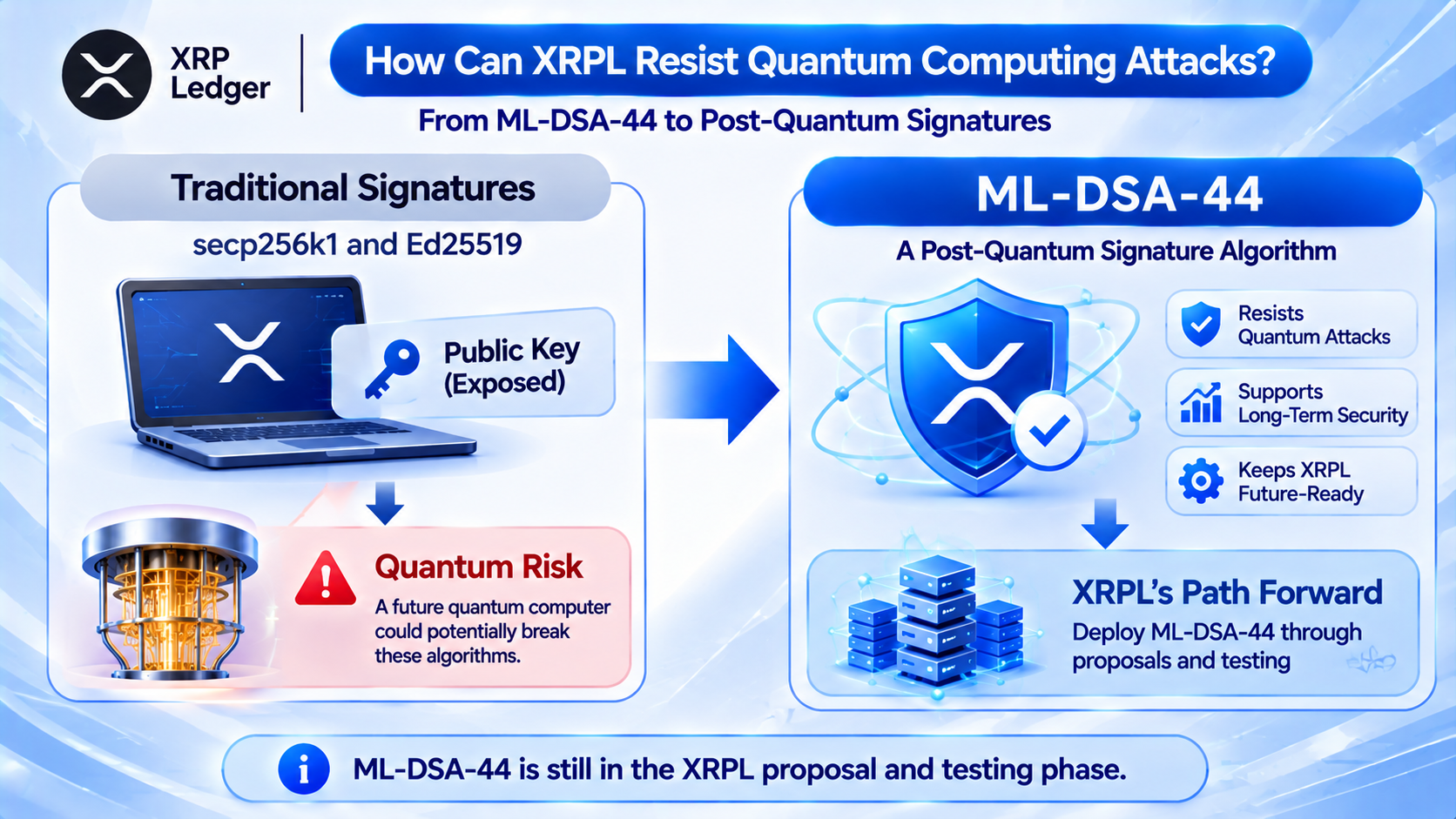
XRPL's post-quantum signature plan is intended to add new key types alongside the existing secp256k1 and Ed25519 types, enabling the network to recognize and verify ML-DSA-44 signatures.
This plan does not redesign XRP transfers. Instead, it upgrades the cryptographic foundation used for transaction authorization and signature verification. For ordinary transactions, the basic process would still include creating a transaction, signing it with a private key, submitting it to the network, and having validators verify the authorization information.
The difference is that accounts using post-quantum keys would generate signatures with ML-DSA-44, and validators would also need to be able to recognize and verify the algorithm.
The XRPL Foundation's 2027 protocol roadmap has listed this direction as a research project covering ordinary accounts, validators, and entities that publish validator lists. The relevant server implementation has been tested on AlphaNet, but issues involving cross-language key derivation consistency, wallet support, and test vectors still need to be resolved.
In terms of implementation scope, the upgrade primarily involves three areas:
-
Account signatures. Wallets must be able to generate and manage ML-DSA-44 keys, and the network must be able to verify the corresponding transaction signatures.
-
Validator signatures. XRPL's consensus process relies on validators signing and verifying relevant messages. If the network needs to substantially reduce its reliance on traditional cryptography in the future, validator identities and consensus messages will also need to be upgraded accordingly.
-
Infrastructure compatibility. Wallet SDKs, hardware wallets, exchange custody systems, and node software must all be able to correctly process the larger public keys and signature data.
Therefore, deploying ML-DSA-44 is not simply a matter of adding an algorithm library. It is a systematic upgrade involving multiple signature scenarios across XRPL.
How Can XRP Holders Migrate to Quantum-Resistant Wallets in the Future?
Wallet key migration is the part of XRPL's post-quantum upgrade that will most directly affect ordinary users.
Under the current technical proposal, existing XRPL accounts may be able to transfer account control gradually to a key system supporting ML-DSA-44 by setting a new signing key, without necessarily creating a new address and transferring all XRP.
This approach uses XRPL's existing account authorization mechanisms. For example, if the relevant functionality is supported, a user could set a new post-quantum Regular Key for an existing account and then disable the Master Key that is no longer considered secure, as required by the protocol. This would preserve the existing account address while reducing the risk that the old signature algorithm could continue to control the account.
However, this process must meet an important prerequisite: the new key must function properly, and the user must be able to securely store and recover the corresponding private key. If the user disables the old key without verifying that the new key works, the account may become unusable. Conversely, if the user only sets a new key without addressing old authorizations that remain valid, the migration may not achieve the expected level of quantum security.
For multisignature accounts, users must also check whether traditional elliptic curve keys remain on the signer list. Upgrading only one signer does not necessarily mean that the entire account has completed its post-quantum migration.
Different types of users will have different migration responsibilities.
| Account Type |
Main Future Migration Tasks |
| Self-Custody Wallet |
Update wallet software, generate new keys, and adjust account authorization |
| Exchange-Custodied Wallet |
Have the exchange upgrade its key management and signing systems |
| Institutional Custody Account |
Coordinate custody systems, hardware devices, and internal authorization procedures |
| Multisignature Account |
Review and migrate the keys of the relevant signers |
It is important to emphasize that ordinary XRP holders do not need to replace their wallets or transfer their assets immediately because of this proposal. The migration process has not yet been officially opened as a general mainnet operation. Specific procedures will depend on future protocol development, audits, and wallet support.
For users, the more important steps at this stage are protecting existing private keys and remaining alert to fake migration websites, seed phrase collection pages, and unverified wallet tools presented as part of a quantum security upgrade.
Why Could Quantum-Resistant Signatures Increase XRPL's Storage and Network Costs?
Although ML-DSA-44 can improve long-term cryptographic security, it also produces much larger signature data. The public keys and signatures used in traditional XRPL transactions are relatively compact, while ML-DSA-44 has a public key length of 1,312 bytes and a signature length of 2,420 bytes.
This means that the network must process more data when verifying and storing the relevant transactions.
The XRPL Foundation's technical research estimates that a payment transaction using a post-quantum signature could require approximately 5,331 bytes after accounting for related storage overhead, compared with a reference value of approximately 1,704 bytes for an ordinary payment transaction. The former is approximately 3.13 times the size of the latter.
This change could affect multiple areas of blockchain operations:
-
Ledger storage. As the number of transactions increases, larger signature data could increase the storage capacity required for validators to preserve transaction history over the long term.
-
Network bandwidth. Validators need to propagate and receive transactions and consensus messages. Larger data sizes could increase network transmission demands.
-
Signature verification performance. Different cryptographic algorithms have different computational costs. Validators need to test the efficiency of ML-DSA-44 signature generation and verification in real-world operating environments.
-
Wallet and custody systems. Hardware wallets, mobile applications, and institutional signing devices must support the new key formats and signature data structures.
It is worth noting that the current proposal does not plan to increase XRPL's base transaction fees solely because ML-DSA-44 is used. However, this does not mean that larger transaction data will not create infrastructure costs, nor does it guarantee that all fee rules will remain unchanged in the future. A post-quantum signature upgrade must therefore balance security, transaction performance, and network resource consumption.
How Far Has XRPL's Post-Quantum Security Upgrade Progressed?
XRPL's quantum security upgrade remains in the gradual research, development, and testing phase. It is not a completed mainnet migration. In April 2026, Ripple proposed a phased post-quantum security roadmap covering emergency risk response, algorithm experimentation, development network testing, and future protocol migration. Its long-term goal is to prepare for broad adoption of a post-quantum signature system around 2028.
The XRPL Foundation protocol roadmap updated in November 2026 further clarified the technical scope, development workload, and subsequent research plans for ML-DSA-44.
XRPL Post-Quantum Security Roadmap
-
2026: Technical research and early testing
-
Research the implementation of ML-DSA-44 in XRPL accounts and validators, and evaluate its feasibility in test environments.
-
First half of 2027: Migration plan research
-
Focus on how existing accounts can migrate, how wallets can adapt, and how different software implementations can maintain consistency.
-
Second half of 2027 through 2028: Development, review, and auditing
-
Based on the research results, advance protocol implementation, code review, security audits, and network performance testing.
-
2028 target: Advance the transition to post-quantum signatures
-
Whether the feature can be activated on mainnet will still depend on technical maturity, amendment approval, and ecosystem compatibility.
The schedule above consists of roadmap targets, not confirmed mainnet activation dates.
XRPL uses an amendment mechanism to coordinate protocol feature upgrades. Changes to transaction validation rules must go through the relevant network governance and validator support processes before they can be activated on mainnet.
Therefore, even if developers have completed a test implementation of ML-DSA-44, this cannot be equated with XRPL mainnet already having comprehensive quantum-resistant protection.
In addition, a post-quantum security migration does not only involve ordinary user wallets. Exchanges, custody institutions, validators, and related infrastructure must also upgrade their software and key management systems in coordination. If some critical participants cannot support the new signature mechanism in time, the upgrade could be delayed. From this perspective, XRPL's post-quantum security plan is more like a long-term protocol engineering project than a simple software update.
Can a Quantum-Resistant Upgrade Eliminate All XRP Security Risks?
ML-DSA-44 can provide a new security foundation against the potential threat that future quantum computing poses to traditional digital signatures, but it cannot eliminate all risks faced by XRP accounts.
-
Post-quantum signatures primarily address the security of digital signature algorithms. If a user's seed phrase or private key is stolen by a phishing website, an attacker could still directly control the relevant account even if it uses ML-DSA-44.
-
Wallet software and hardware devices may still contain vulnerabilities. Key generation, random number processing, signature implementation, and secure storage all require thorough testing.
-
Account permission configuration remains important. If a user has configured a post-quantum signing key but an old Master Key or another insecure authorization path remains valid, the account may continue to face potential risks.
-
Post-quantum cryptography itself also requires ongoing cryptanalysis and engineering review. Standardization means that the algorithm has undergone rigorous evaluation, but it does not mean that new attack methods or implementation flaws can never be discovered in the future.
-
The XRPL ecosystem also includes wallets, exchanges, cross-chain services, and other applications. Even if the underlying ledger completes a signature upgrade, this does not automatically ensure that all third-party systems provide the same level of security.
Therefore, a quantum-resistant upgrade should be understood as a long-term security improvement to cryptographic infrastructure, not an absolute guarantee of XRP asset security.
For ordinary users, protecting seed phrases, verifying transaction authorization, using trusted wallets, and avoiding suspicious links remain the most direct security measures at present.
Conclusion
XRPL is exploring the use of ML-DSA-44, a post-quantum digital signature algorithm, to improve the security of existing accounts and validators in a future quantum computing environment. Unlike traditional elliptic curve signatures such as secp256k1 and Ed25519, ML-DSA-44 is based on lattice-based cryptography and is designed to withstand known quantum attack methods.
The core challenge of this upgrade is not only introducing a new signature algorithm. It also involves determining how to handle account public keys that have already been exposed, how to migrate existing wallet keys, and how to enable validators, custody institutions, and wallet software to support the new cryptographic mechanism together.
Under the current technical direction, XRPL could use its existing account authorization mechanisms to replace signing keys while retaining account addresses. However, completing a quantum security migration would also require disabling traditional signature authorizations that remain valid and confirming that the new keys can be used securely.
In addition, the larger public keys and signatures of ML-DSA-44 could increase network storage, bandwidth, and verification costs. The upgrade must balance security, performance, and ecosystem compatibility.
2028 is an important target year in XRPL's post-quantum security roadmap, but it is not a confirmed mainnet upgrade date. For XRP holders, there is currently no evidence that actual blockchain elliptic curve keys have been broadly broken by quantum computers, and there is no need to transfer assets immediately because of the technical proposal.
Over the long term, XRPL's quantum security research reflects a common challenge facing blockchain infrastructure: preparing for potential changes in computing capabilities while existing cryptography remains effective.
FAQ
What Is XRPL's ML-DSA-44?
ML-DSA-44 is a post-quantum digital signature algorithm based on lattice-based cryptography and included in the NIST FIPS 204 standard. XRPL is studying its use for account transactions, validators, and other signature scenarios.
Can Quantum Computers Break XRP Wallets Now?
There is currently no public, reliable evidence that quantum computers can break actual XRP wallet elliptic curve private keys at scale. The relevant risk primarily concerns high-performance, fault-tolerant quantum computers that may emerge in the future.
Why Could XRP Accounts That Have Exposed Their Public Keys Face Risks?
A sufficiently powerful quantum computer could potentially derive a private key from a traditional elliptic curve public key in the future. Accounts whose public keys have already been exposed therefore need to consider long-term key security.
Will Upgrading to ML-DSA-44 Require a New XRP Address?
Under the current design direction, users may be able to migrate while retaining their existing account addresses by setting a new signing key and disabling the old Master Key. However, the specific process will depend on the protocol and wallet support officially enabled in the future.
Has XRPL Already Enabled ML-DSA-44 on Mainnet?
As of November 12, 2026, the relevant functionality remains in the proposal, development, and testing stages. It should not yet be considered a signature mechanism fully enabled on XRPL mainnet.
Will ML-DSA-44 Increase XRP Transaction Fees?
The current proposal does not plan to increase base transaction fees solely because ML-DSA-44 is adopted. However, larger signature data could increase network storage, bandwidth, and other infrastructure costs.
Will XRPL Complete Its Quantum Security Upgrade in 2028?
2028 is an important target in the relevant roadmap, but the final timeline will depend on technical development, security audits, wallet compatibility, and approval of a mainnet amendment.