Preface
In recent years, the fundamental challenge facing the crypto industry has remained the same: blockchain technology advances far faster than traditional financial regulation can categorize it.
A single Token can act as a payment instrument, investment asset, governance tool, and network credential all at once. Trading platforms may offer spot trading, but also custody, lending, derivatives, and stablecoin services. Some DeFi protocols lack the typical hallmarks of traditional companies, counters, or account managers. When regulators use traditional frameworks for securities, commodities, and financial intermediaries to interpret these innovative businesses, blurred boundaries and uncertainty quickly arise.
As reported by CoinDesk, on September 15, 2026, the U.S. Senate did not advance the Digital Asset Market Clarity Act, or CLARITY Act. A procedural vote ended 49-50, short of the required 60 votes. The bill sought to establish a robust market structure framework for digital assets and to delineate regulatory boundaries between the SEC and CFTC.
If viewed only as a procedural roadblock in Congress, the industry implications would be limited. However, this episode highlights a recurring issue: How should crypto be regulated?
Should regulation be based on asset characteristics, or function?
Should trading platforms be considered securities exchanges, or something entirely new?
For Web3, the critical question is not when any specific bill passes—but whether regulators, financial institutions, and industry insiders can ultimately develop a stable and coherent “boundary language.”
Key Points
- The toughest crypto regulatory issue is shifting from “whether to regulate” to “how to classify and assign responsibility”
- The regulatory boundaries between the SEC and CFTC will directly impact digital asset issuance, trading, and market infrastructure
- Stablecoins, centralized platforms, and DeFi each have unique business models, and therefore require distinct regulatory focus
- More explicit market structure rules could affect company registration, product design, custody solutions, liquidity, and capital entry routes
- A major future evolution for Web3 is the gradual specialization and segmentation of previously mixed business functions
- Regulation doesn’t just restrict activity—it reshapes which business models can secure long-term institutional capital support
- Assessing Web3’s trajectory requires attention to actual regulations, enforcement lines, and market infrastructure—far beyond following a single bill
Why Crypto Regulation Requires “Recategorization”
Early crypto markets were small, and regulators faced basic issues: Is a Token a security? Is a platform offering unregistered services? Did a project raise capital from the public?
As the market’s complexity grew, simple categories could no longer capture real conditions.
A Token may not be a security, but its issuance could involve investment contracts. Stablecoins might serve mostly payment and settlement, not investment. A DeFi protocol, while lacking a company structure, may provide trading, lending, or derivatives services similar to financial intermediaries.
In March 2026, the SEC and CFTC began issuing guidance that defines digital commodities, collectibles, tools, stablecoins, and securities, and discusses the relationships between non-security crypto assets and investment contracts.
This marks a significant shift in regulatory mindset.
Regulators now recognize simply asking “Is this a security?” isn’t enough. They must further ask: Why does the Token exist? Why do users hold it? What are its main risks? Who controls the market? Who safeguards customer assets? Who is responsible for disclosure and integrity?
With such questions, regulation moves from “asset labeling” toward “function and risk.”
Why Market Structure Is More Important Than Single Token Classification
Industry discussions often revolve around a particular Token, but in reality, business behavior is shaped by market structure far more than individual asset labels.
If companies don’t know registration requirements, custody rules, trading conditions for assets, or which services must be separated, it’s nearly impossible to build a long-term business.
A CLARITY Act aim is to create a systematic market structure for digital assets. House committee commentary on H.R. 3633 shows this bill intends to clarify the CFTC’s authority over digital commodities, SEC’s reach over digital asset investment contracts, and to codify customer protection devices.
Such rules reshape business organization.
In the past, trading, custody, brokerage, market making, and asset issuance may have resided within one crypto platform. Going forward, these functions may increasingly split among specialists. Licensing, capital standards, and risk management will differ per function, pushing the industry from “one platform does it all” to a system of specialized collaborating infrastructure providers.
This resembles traditional financial evolution, but in Web3, many functions are likely performed by smart contracts and on-chain protocols, not just regulated financial institutions.
Why SEC and CFTC Boundaries Matter for Web3
Regulatory boundaries matter because different agencies impose unique rules, market structures, and corporate responsibilities.
SEC guidance in March 2026 clarified that both SEC and CFTC will apply securities and commodity laws based on asset and transaction type, with explicit reference to staking, airdrops, and asset wrapping.
This means Web3 firms may face not a monolithic “crypto regulation,” but a set of rules tailored to the actual business function.
For example, businesses centered on commodity trading will see regulatory focus on market integrity, asset protection, and derivatives; meanwhile, asset issuance involving investment contracts will emphasize disclosure and investor protection.
For startups, these distinctions directly impact product design and business positioning.
Projects must decide whether they are a software protocol, asset issuance platform, trading venue, or financial intermediary—not merely for marketing, but for organizational design.
Hence, market structure legislation will deeply influence Web3: it won’t just change the story of any specific Token, but define how companies conduct digital asset business.
Why Stablecoins Are an Independent Issue in Regulation
Stablecoins deserve dedicated analysis because their economic role differs greatly from Bitcoin, Tokenized Securities, or DeFi Tokens.
A stablecoin user typically employs it for payment, settlement, transferring funds among trading counterparts, or as an on-chain unit of account. The core questions are not about future price appreciation, but about issuer reserves, reliability of redemption, asset segregation, and the stability of the settlement network.
Stablecoin regulation has developed its own logic.
This is pivotal for Web3, as stablecoins serve as pricing units in crypto trading, liquidity tools in DeFi, and the foundation for payment and cross-border settlement.
With growth, stablecoins require regulators to consider not only the issuer, but also the potential impact as the tokens enter banking, payment, and capital markets. In recent CLARITY Act negotiations, differences between the banking sector and crypto firms over stablecoin yields and their interaction with bank deposits became apparent. Reuters reported banks’ concerns that stablecoin reward structures could compete with deposits and affect funding and lending.
Thus, stablecoins cannot simply be treated as “another Token.”
They are central to the Web3 financial layer.
DeFi Presents Unique Challenges to Traditional Regulation
Centralized trading platforms have analogs in traditional finance; DeFi is fundamentally more complex.
DeFi protocols execute trading, lending, and liquidity management through smart contracts, with users interacting directly with code—not regulated intermediaries.
The core question becomes:
Who is responsible?
If there’s no traditional intermediary, how do regulators identify the controlling party?
If multiple parties maintain the protocol, who manages risk?
If global developers deploy the system, which jurisdiction applies?
These questions persist regardless of legislative progress on market structure.
In fact, they are central to future regulatory frameworks.
Market structure rules must not only address “companies,” but consider protocols, front ends, developers, governance, node operators, and users—reflecting real functional relationships.
Not all DeFi must be treated identically.
A rational approach is layered regulation based on function and risk: protocols providing trade-matching, lending, stablecoin settlement, or technical tools present distinct risk profiles.
Why Clearer Regulation Alters Capital Entry Points for Web3
Regulation affects capital markets in subtle ways—it’s not simply about “restriction” or “opening up.”
Clear rules enable institutional investors to better assess their risk and help companies plan compliance and operational needs for the future.
In August 2026, SEC Chairman Paul Atkins stated in a speech that the SEC is advancing targeted crypto asset regulations, but that sustainable, stable market rules require ongoing congressional legislation.
This illustrates a key relationship between regulation and market development.
Businesses do not need “no regulation,” but predictable regulation.
Predictability empowers investment in R&D, infrastructure, compliance, product innovation, and partnerships with traditional finance.
For Web3, this means capital deployment patterns are likely to evolve.
Previously, funds tended to flow toward Tokens, exchanges, or early protocols. In the future, as market infrastructure becomes clearer, more capital will support custody, payment, compliance technology, asset issuance, and institutional trading.
What to Watch After Legislative Setbacks
A failed procedural vote for the CLARITY Act does not halt U.S. crypto regulation. On the contrary, the SEC and CFTC continue to develop frameworks through guidance, rulemaking, and enforcement. The House Financial Services Committee has pledged to keep advancing digital asset market structure legislation.
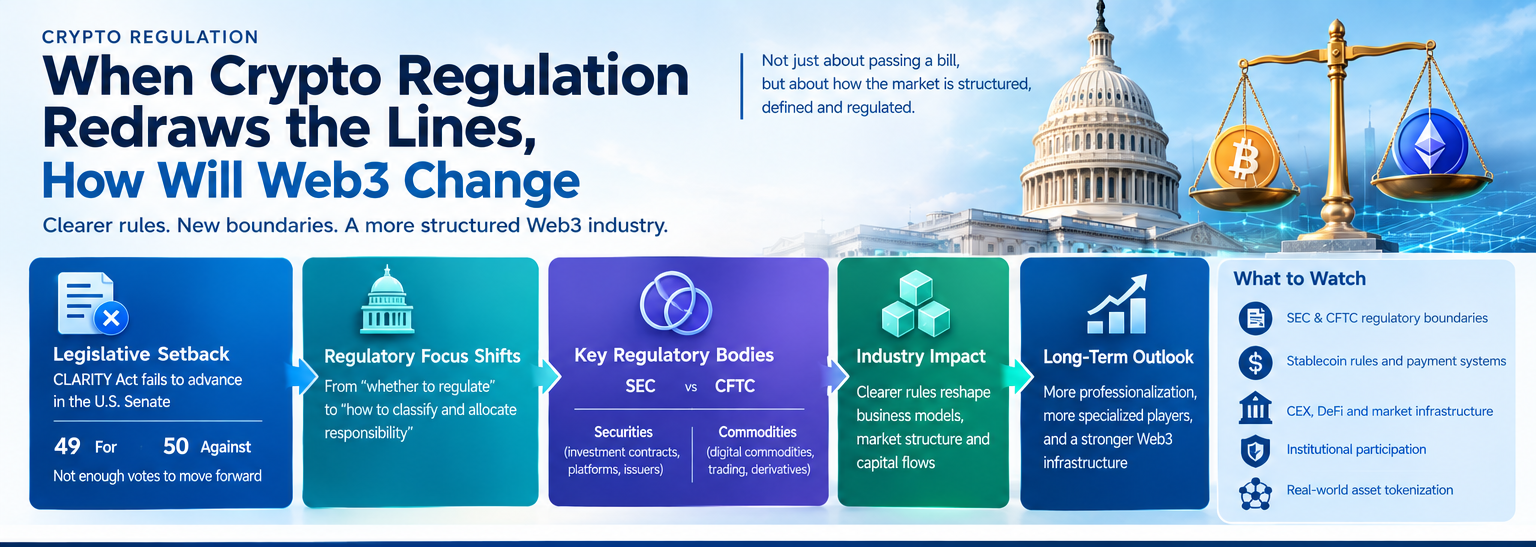
The Web3 industry should focus less on whether any bill is “dead” or “alive,” and more on enduring questions: Will SEC and CFTC boundaries become clearer? How will stablecoin rules be implemented? Are centralized platforms specializing their business lines? How will DeFi fit into risk categorization? Is institutional custody and on-chain settlement infrastructure advancing?
These factors shape industry structure and longevity far more than any single legislative event.
Should regulation shift from a murky “crypto industry” to clear distinctions for stablecoins, trading, custody, issuance, and DeFi, Web3 could experience industry-wide specialization—beyond simple tightening or loosening of oversight.
The Next Web3 Phase May Be “Clear Structure”
The crypto industry’s hallmark in its early days was rapid innovation.
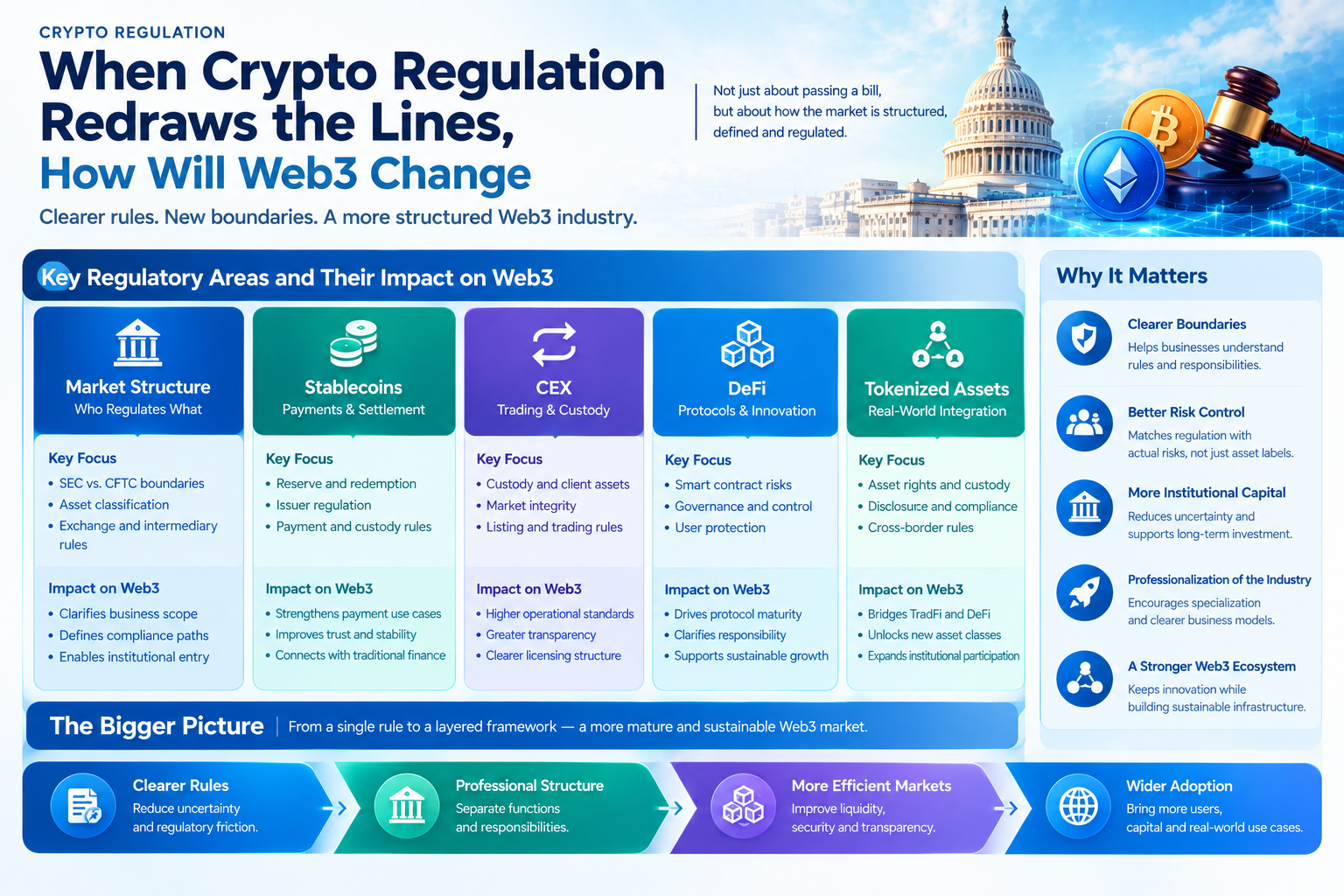
But as market size grows, financial institutions participate, and stablecoins take on larger payment and settlement roles, the industry’s challenges evolve.
The most critical questions are not “can I launch another Token,” but:
What category should this Token belong to?
Who is responsible for issuing it?
Who manages custody?
Who ensures market liquidity?
What is the relationship between protocol and user?
Who bears the risk?
These questions may seem dull compared to “what’s the next hot trend,” yet they are fundamental to whether Web3 becomes durable financial infrastructure.
Viewed through this lens, repeated U.S. market structure legislative cycles are signs of maturing industry. They expose structural gaps between legacy financial rules and blockchain operations—resolving those gaps will require more than just legislation.
The ultimate need is for a market structure where assets, platforms, protocols, users, and regulators understand their respective roles.
This shift will mark crypto’s transition from early experimentation to robust financial infrastructure.
FAQ
What is the primary purpose of the CLARITY Act?
Its main goal is to establish a comprehensive market structure for digital assets, clarify SEC and CFTC regulatory scope for different assets and transactions, and introduce customer protection mechanisms.
Will U.S. crypto regulation stop because a bill fell short?
No. The SEC and CFTC are moving forward with frameworks via guidance, rulemaking, and enforcement. Congressional market structure legislation is a separate, ongoing institutional process.
Why do stablecoins warrant specialized study?
Stablecoins serve as capital, payment, and settlement instruments, and have economic features unlike Tokens focused on investment or governance. For this reason, their reserves, redemption, issuer, and payment functions must be analyzed independently.
Does clearer regulation mean Web3 will suffer?
Not necessarily. New rules may increase compliance costs for some firms, but can lower uncertainty for institutions entering the market. The true long-term impact depends on specific rule design and enforcement.