The development of artificial intelligence technology is propelling the global semiconductor industry into a new growth phase. With the rapid expansion of large language models, generative AI, and cloud computing applications, market demand for high-performance computing and high-speed data processing continues to rise. Against this backdrop, memory chips have become a vital component of AI infrastructure, with High Bandwidth Memory (HBM) emerging as a critical technology in AI servers and GPU systems.
SK hynix is one of the world's largest memory chip manufacturers and a key player in the AI memory space. Leveraging its deep technological expertise in DRAM, NAND Flash, and HBM, SK hynix has established itself as a core supplier for data centers, cloud platforms, and the AI chip ecosystem.
What Is SK hynix?
SK hynix is a South Korean semiconductor company specializing in the design, development, and manufacturing of memory chips. The company traces its roots back to Hyundai Electronics, which was later acquired by SK Group and renamed SK hynix.
The company's core business encompasses DRAM, NAND Flash, enterprise SSDs, and HBM products. As a dominant force in the global memory chip market, SK hynix has consistently ranked among the top DRAM manufacturers, forming the industry's primary competitive landscape alongside Samsung Electronics and Micron Technology.
SK hynix Core Business Overview
| Business Segment |
Key Products |
Typical Applications |
| DRAM |
DDR5, LPDDR, HBM |
AI servers, PCs, smartphones |
| NAND Flash |
Memory Chips |
Mobile phones, SSDs, consumer electronics |
| SSD |
Enterprise SSDs, Consumer SSDs |
Data centers, cloud computing |
| AI Memory |
HBM Series |
GPUs, AI training clusters |
| Automotive Memory |
Automotive-Grade Memory |
Smart vehicles, autonomous driving |
SK hynix Development History
SK hynix has undergone several transformative stages since its founding in 1983, when it first focused on semiconductor production. During the 1990s, Hyundai Electronics expanded its memory chip business and entered international markets.
In 2001, the company was renamed Hynix Semiconductor and evolved into a major global DRAM manufacturer. Following its acquisition by SK Group in 2012, the company was officially renamed SK hynix and significantly increased its R&D investment, building competitive advantages in NAND Flash, enterprise SSDs, and HBM.
With the rise of AI technology, SK hynix has leveraged its leading position in HBM products to secure a more prominent role in the global AI chip supply chain.
What Main Products Does SK hynix Produce?
DRAM is one of SK hynix's core businesses, serving as temporary data storage in servers, personal computers, smartphones, and data center equipment. As demand for cloud computing and AI training grows, the importance of high-performance DRAM products continues to increase.
NAND Flash is a non-volatile memory that retains data without power, widely used in smartphones, SSDs, mobile storage devices, and consumer electronics. SSDs represent a key application of NAND Flash, spanning both consumer and enterprise markets.
HBM is one of the most talked-about memory technologies in the AI industry today. Through 3D stacking and advanced packaging, HBM delivers higher data transfer speeds and energy efficiency. As AI hashrate demands surge, HBM has become one of SK hynix's most strategically valuable product lines.
Differences Between DRAM, NAND, and HBM
| Product Type |
Data Retention Without Power |
Key Features |
Applications |
| DRAM |
No |
High speed, large capacity |
PCs, servers, mobile phones |
| NAND Flash |
Yes |
Long-term data storage |
SSDs, mobile phone storage |
| HBM |
No |
Ultra-high bandwidth, low power |
AI chips, high-performance computing |
Why Is HBM Technology So Important?
HBM (High Bandwidth Memory) is an advanced memory technology designed for high-performance computing. Compared to traditional DRAM, HBM offers higher bandwidth, lower power consumption, and a more compact packaging, making it essential for AI chips and high-performance GPUs.
During AI model training, massive amounts of data must be rapidly transferred between GPUs and memory. If the memory system cannot provide sufficient bandwidth, computing performance becomes bottlenecked. HBM significantly increases data throughput through multi-layer chip stacking and silicon interposer technology, meeting the high-speed memory demands of AI chips.
As large model scales continue to expand, AI hashrate competition now extends beyond pure GPU performance to encompass the entire memory system. HBM has thus become a critical component of AI infrastructure.
SK hynix's Role in the AI Value Chain
The AI value chain typically includes chip design, semiconductor manufacturing, memory systems, server assembly, cloud platforms, and end-user applications. SK hynix primarily serves as a memory solutions provider, with its HBM products widely adopted in AI accelerators and high-performance GPU platforms.
During AI model training, GPUs handle complex computations while HBM manages high-speed data transfer. Together, they form the backbone of AI hashrate systems, making memory performance a key determinant of training efficiency.
SK hynix's Position in the AI Value Chain
| AI Value Chain Segment |
Representative Companies |
SK hynix Role |
| AI Chip Design |
NVIDIA, AMD |
HBM supplier |
| Chip Manufacturing |
TSMC |
Memory supporting partner |
| Server Manufacturing |
Supermicro, Dell |
Memory solution provider |
| Cloud Platforms |
AWS, Google Cloud |
Data center memory support |
| AI Application Layer |
ChatGPT, Copilot, etc. |
Computing infrastructure support |
How Does SK hynix Differ From Samsung Electronics and Micron Technology?
The global memory chip market is dominated by three companies: Samsung Electronics, SK hynix, and Micron Technology. While all three focus on memory, their business structures and market positions differ significantly.
Samsung Electronics operates across consumer electronics, smartphones, foundry, and memory chips, making it a diversified semiconductor conglomerate. SK hynix is more concentrated on the memory industry, dedicating resources to DRAM, NAND, and HBM. Micron Technology is the largest U.S.-based memory chip company, with its market focus primarily in North America and enterprise segments.
| Comparison Dimension |
SK hynix |
Samsung Electronics |
Micron Technology |
| Headquarters |
South Korea |
South Korea |
United States |
| Core Business |
Memory chips |
Semiconductors + Consumer electronics |
Memory chips |
| HBM Position |
Industry leader |
Rapid expansion |
Catching up |
| Product Diversification |
Medium |
High |
Medium |
| AI Value Chain Role |
Core memory supplier |
Comprehensive AI hardware supplier |
Core memory supplier |
Which Industries Rely on SK hynix's Chip Products?
SK hynix products serve multiple key industries. Data centers depend on DRAM and SSDs for high-speed computing and storage, while cloud platforms require large server fleets to support online services and AI workloads.
Smartphone manufacturers use NAND Flash and mobile DRAM to boost device performance, and the automotive industry needs high-reliability memory for autonomous driving and smart cockpit systems. Additionally, industrial automation, edge computing, and IoT devices all demand high-performance memory solutions.
In the AI era, the combination of high-performance GPUs and HBM is driving the growth of generative AI, large model training, and inference systems, further elevating the strategic importance of memory chips in digital infrastructure.
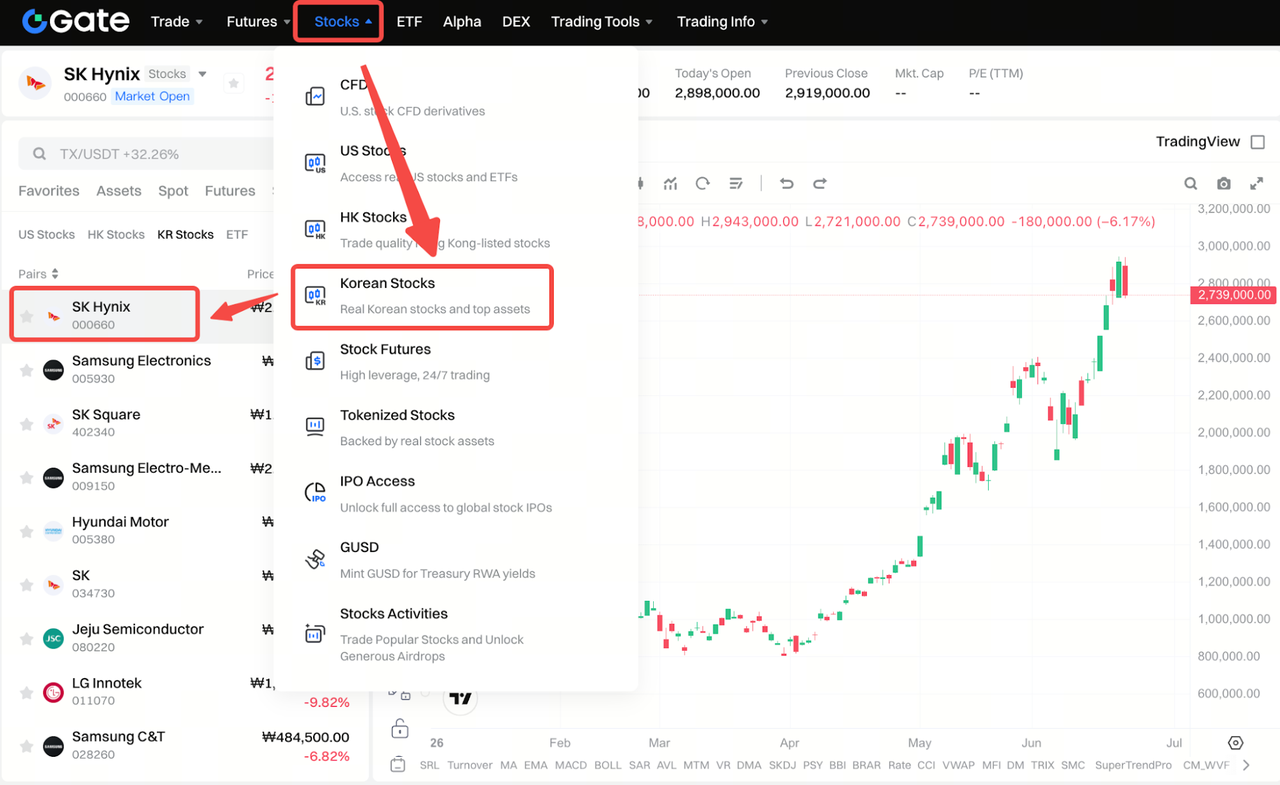
How to Buy SK hynix With USDT?
Traditionally, investing in South Korean stocks requires a securities account, currency exchange through banks, and cross-border trading channels, making the process relatively complex.
SK hynix, listed on the Korea Exchange (KRX) under ticker 000660, is closely tied to AI servers, HBM memory, and the global semiconductor supply chain. Platforms like Gate Stocks are now exploring on-chain securities and tokenized stock models, enabling users to use stablecoins such as USDT to access popular assets in global capital markets.
Key Factors Affecting SK hynix's Business Development
The memory chip industry is highly cyclical, with market supply-demand dynamics directly influencing demand for DRAM and NAND products. Compared to logic chips, the memory market is more sensitive to inventory cycles and fluctuations in end-user demand.
The scale of AI industry investment is a key factor driving HBM market growth. As AI server deployments increase, demand for high-performance memory will continue to rise. Meanwhile, advanced process technology, packaging techniques, and product yields directly impact a company's competitiveness.
Furthermore, the global semiconductor supply chain, international trade environment, data center capital expenditure, and the development pace of next-generation AI chips will all significantly influence SK hynix's future business performance.
SK hynix is a key player in South Korea’s AI semiconductor industry, but it is only one part of the broader market. For a wider view of leading opportunities across AI, semiconductors, finance, and automotive sectors, see Top 10 Korean Stocks to Watch in 2026: Which Has the Most Growth Potential—AI, Semiconductors, or Financials?
Summary
SK hynix is a world-leading memory chip manufacturer and a key player in AI memory infrastructure. The company's business spans DRAM, NAND Flash, SSDs, and HBM, and it has built a strong competitive advantage in the high-bandwidth memory market.
With the growth of AI, large model training, and cloud computing demand, HBM has become a critical component of the AI hashrate system. Leveraging its long-standing expertise in advanced memory technology and packaging, SK hynix has emerged as an indispensable core enterprise in the global AI value chain. Understanding SK hynix's development history, product portfolio, and industry positioning provides a more comprehensive view of the semiconductor industry's evolution in the AI era.
FAQs
What does SK hynix do?
SK hynix is a South Korean semiconductor company that manufactures memory chips including DRAM, NAND Flash, SSDs, and HBM. These products are widely used in data centers, smartphones, personal computers, automotive electronics, and AI servers.
What is HBM?
HBM (High Bandwidth Memory) is a high-bandwidth memory technology that enhances data transfer speeds through 3D stacking and advanced packaging. HBM is primarily used in AI chips, high-performance computing platforms, and data center systems, making it a vital component of modern AI computing infrastructure.
Why is SK hynix gaining attention in the AI era?
AI model training requires high-speed memory systems, and HBM is a key technology to meet this demand. SK hynix has invested heavily in HBM R&D, positioning itself as a crucial supplier in the AI chip ecosystem and data center infrastructure.
What is the relationship between SK hynix and Samsung Electronics?
Both SK hynix and Samsung Electronics are major South Korean semiconductor companies, but they belong to different corporate groups. Samsung Electronics has a broader business scope, while SK hynix is more focused on the memory chip sector. Together, they are leading forces in the global memory industry.
Is SK hynix considered an AI concept stock?
SK hynix is fundamentally a memory chip manufacturer. However, since its HBM products are widely used in AI GPUs and server systems, it is frequently discussed in the context of the AI value chain.
In which industries are SK hynix's products mainly used?
SK hynix's products are used across data centers, cloud computing, artificial intelligence, high-performance computing, smartphones, consumer electronics, automotive electronics, and enterprise storage. Among these, AI servers and data centers have become the fastest-growing application segments in recent years.