Preface
High-quality private assets in traditional capital markets typically undergo lengthy financing, valuation, and IPO preparation processes. Ordinary users often have an opportunity to participate only after the formal public market has been established. As asset tokenization has developed, the market has begun exploring how to reorganize part of the economic value associated with the pre-IPO stage through on-chain structures. PancakeSwap’s Pre-Access emerged in this context. Its inaugural project, pPOLY, was issued by Paimon Finance and uses a tokenized SPV structure to provide indirect exposure to Polymarket-related assets.
The key to understanding these products is not memorizing a Token, but understanding the structure behind it: the nature of the underlying asset, the identity of the issuer, how the SPV holds the relevant rights, what the Token represents, and how users participate through the subscription mechanism. Gate’s Pre-IPOs and IPO Access cover different stages before and during a company’s formal IPO. Viewing these products along the same capital markets timeline makes it easier to see how RWA is expanding from putting assets on-chain to putting the entire asset lifecycle on-chain.
Key Takeaways
-
pPOLY is PancakeSwap’s inaugural Pre-Access project, issued by Paimon Finance
-
pPOLY uses a tokenized SPV structure to provide indirect exposure to Polymarket-related assets
-
Pre-Access centers on time-limited subscriptions rather than continuous public trading
-
SPVs, Tokens, and underlying assets are distinct layers and should not be treated as equivalent rights
-
Gate Pre-IPOs and IPO Access correspond to pre-IPO market participation and formal IPO subscription, respectively
-
When evaluating a Pre-Access product, focus on the underlying asset, issuer, rights structure, subscription rules, and exit mechanism
-
pPOLY is best understood within the broader, long-term development of pre-IPO asset tokenization and RWA
Why Pre-Access Deserves Attention
At its core, Pre-Access gives users indirect, tokenized exposure to certain pre-IPO assets before they enter a traditional public market.
PancakeSwap officially defines Pre-Access as a time-limited subscription event. PancakeSwap hosts the event, while a third-party provider arranges the underlying tokenized exposure. Participants review the project information and risk disclosures, submit a subscription during the designated period, and then receive the corresponding Token or a refund based on the final outcome.
This marks an important shift. Traditional RWA initiatives have focused primarily on bringing existing real-world assets—such as stocks, bonds, and funds—onto the blockchain. Pre-Access extends that focus to the period before a public market is established.
This does not mean users directly own shares in a private company, nor does it mean they are “buying IPO shares early.” Instead, users obtain economic exposure related to private-market assets through an intermediary structure.
The core of Pre-Access, therefore, is not “buying stocks early,” but gaining early exposure to tokenized economic rights associated with pre-IPO assets.
What Is pPOLY?
pPOLY is PancakeSwap’s inaugural Pre-Access project, issued by Paimon Finance under the product name Paimon Polymarket SPV Token. According to public information, the product uses an SPV structure to provide indirect, tokenized exposure to Polymarket-related assets.
The most important concept here is SPV.
An SPV, or Special Purpose Vehicle, is generally established to hold or manage a specific asset. It can isolate an asset or economic right from other business activities and, depending on its design, allocate the relevant rights to participants.
In the pPOLY structure, users receive an on-chain Token, but the Token itself does not represent direct equity in the underlying private company. Public information describes pPOLY as indirect exposure to Polymarket-related assets—not as an official Polymarket Token.
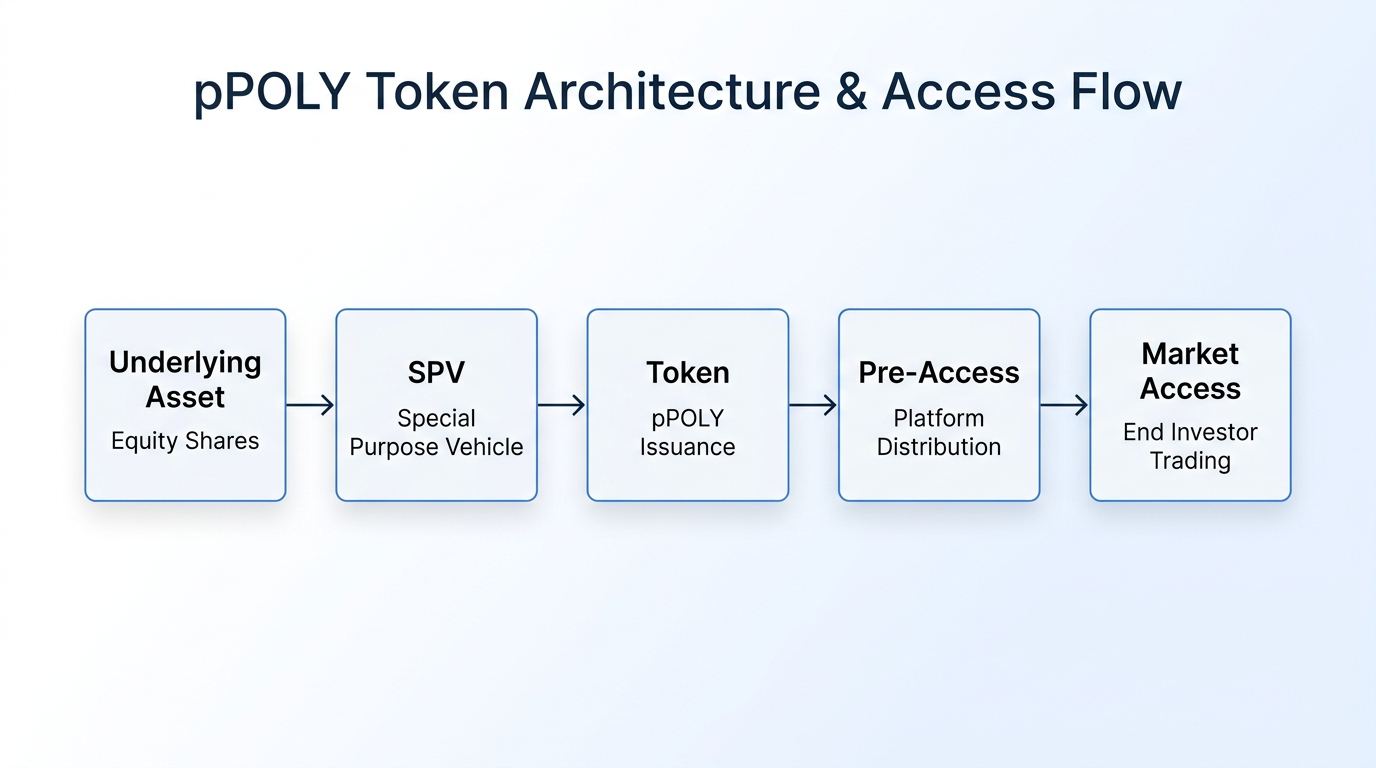
pPOLY can therefore be understood through the following structure:
Underlying asset → SPV → Token → Economic rights obtained by users.
These four layers should not be conflated.
This distinction is essential when evaluating RWA products. A product may be called a “Token,” while the underlying interest could represent stock, fund units, debt, SPV rights, or another form of economic benefit. Determining what users actually own requires a review of the issuance structure and product terms.
How the pPOLY Tokenization Path Works
From a structural perspective, pPOLY represents a process for converting private-market rights into an on-chain Token.
First, the underlying asset and its associated economic rights are identified. In this case, the exposure relates to private-market assets connected with Polymarket—not shares that are already freely traded on public securities markets.
Second, an SPV is established. The SPV holds the relevant assets or economic rights and creates a clear structural relationship between the underlying assets and users.
Third, the rights are Tokenized. A type of interest that originally existed within a traditional financial structure is mapped into a digital certificate that can be recorded and managed on-chain.
Fourth, the subscription is completed through Pre-Access. PancakeSwap structures the process as a time-limited event. Users submit subscriptions during the event window, then proceed to the claim or refund process according to the applicable rules after the event ends.
Tokenization, therefore, is not simply a matter of “turning a stock into a coin.”
The central question is whether the legal structure, underlying asset, Token rights, and user exit mechanism are clearly aligned.
That is more important to understand than the price when evaluating pPOLY.
Why Pre-Access Is More Like a Subscription Than Ordinary Trading
Ordinary crypto asset trading is based on a continuous market. Users can buy or sell at any time, while ongoing quotations facilitate price discovery.
Pre-Access works differently.
PancakeSwap explicitly defines it as a time-bound subscription event with a fixed start and end time. Users review the project materials, accept the relevant terms and risk disclosures, submit a subscription, and then receive the Token or a refund according to the rules after the event concludes.
This structure is well suited to pre-IPO assets.
Unlike publicly traded stocks, private-market assets do not naturally have continuous, sufficiently deep public markets. The first challenge is therefore how to enable user participation—not how to support trading at any time.
When participating in Pre-Access, users should therefore evaluate different variables from those relevant to ordinary Token trading. In addition to price, they should consider the subscription size, event period, allocation method, Token claim date, and future redemption or exit mechanism.
Users are not simply buying a “Marktpreis”; they are participating in a financial product governed by a defined set of rules.
Why pPOLY Cannot Simply Be Understood as “Polymarket Equity”
The name pPOLY may suggest a direct connection, but that assumption requires further analysis.
Public information describes pPOLY as an SPV Token issued by Paimon Finance that represents tokenized, indirect exposure to Polymarket-related assets. It is not an official Polymarket Token and should not be interpreted as direct ownership of Polymarket shares. (Odaily)
The distinction arises from the SPV structure.
When the underlying asset belongs to the private market, the relationship between users and the underlying company can be reorganized through an SPV. The rights users hold after receiving the Token depend on the SPV’s legal structure, issuance terms, and relevant agreements—not on the project name.
The same principle applies to future RWA products.
A Token name may refer to a company’s stock, a fund, an SPV, or a debt product. Without researching the issuer and product structure, determining an asset’s nature solely from its name can lead to confusion.
When researching pPOLY, users should therefore distinguish carefully between “related assets” and “direct equity.”
Where Do Pre-Access, Gate Pre-IPOs, and IPO Access Fit?
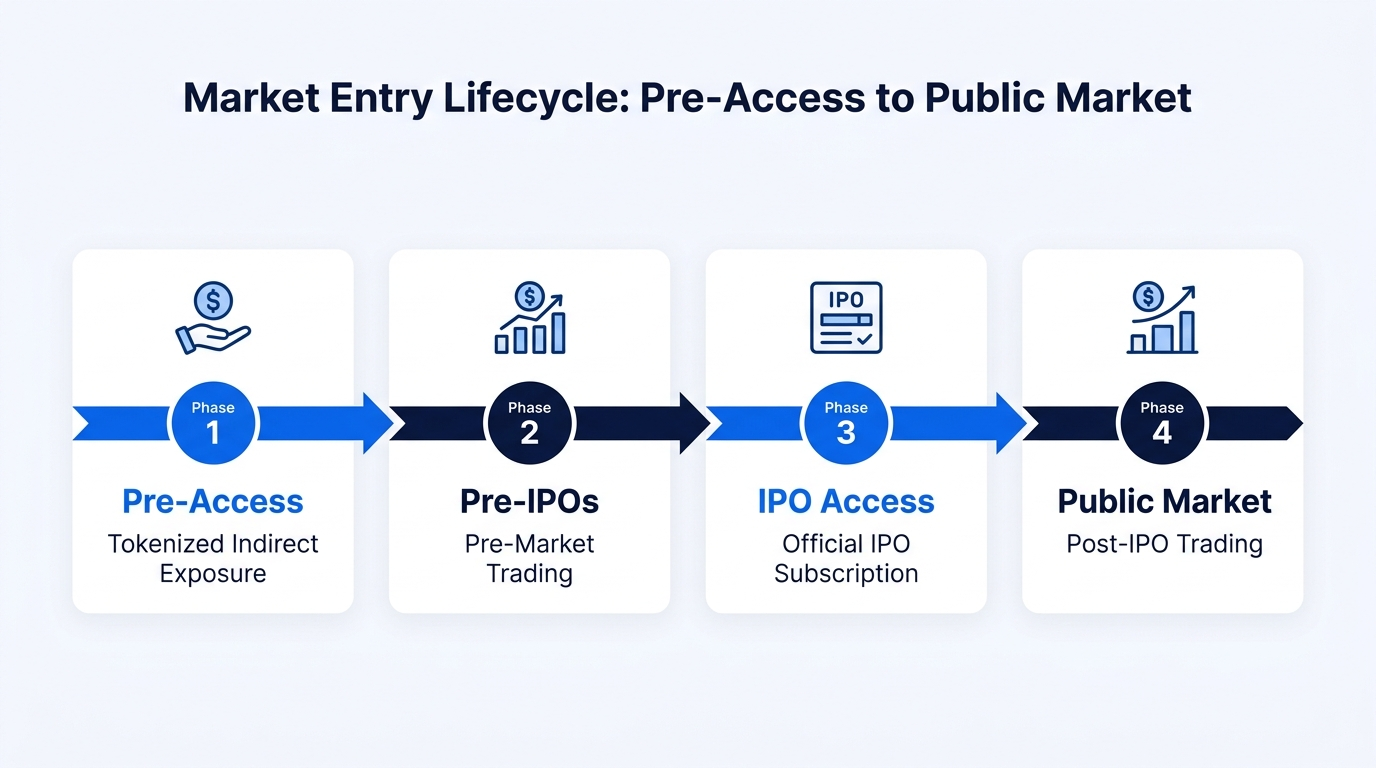
Pre-Access, Gate Pre-IPOs, and IPO Access all relate to participation in assets before a company becomes publicly traded, but they correspond to different stages and product structures.
Pre-Access focuses on indirect tokenized exposure before an IPO plus a time-limited subscription. pPOLY falls into this category. Its purpose is to give users access to certain economic rights before a public market is established through structures such as SPVs.
Gate Pre-IPOs corresponds to market participation before a company’s formal IPO. Gate’s current PreIPO platform includes both primary subscription opportunities and a PreIPO trading market. Users can review market information for specific projects and participate in the relevant pre-IPO asset market.
Gate IPO Access is closer to the formal IPO issuance stage. Users can submit indications of interest before a company officially goes public and receive the corresponding spot shares based on the final allocation.
The three models can be summarized as follows:
Pre-Access: Indirect tokenized exposure before an IPO
Pre-IPOs: The asset market before a formal IPO
IPO Access: Subscription and allocation during the formal IPO stage
These models are complementary rather than interchangeable. Each represents a different way to participate at a distinct stage of the capital markets.
Why Gate Can Serve as an Entry Point for Observing Pre-IPO Assets
For users, understanding these products ultimately requires access to practical market information and participation channels.
Gate’s Pre-IPOs and IPO Access cover pre-IPO market participation and formal IPO subscription, respectively. Pre-IPOs emphasize market information and trading mechanisms for pre-IPO assets, while IPO Access connects indications of interest, allocation, and post-listing stock trading.
Together with the Pre-Access model represented by pPOLY, they provide a valuable point of comparison: even when products operate before an IPO, they may use entirely different legal structures, subscription methods, and liquidity arrangements.
When researching pre-IPO assets, users can first use an entry point such as Gate to understand the relevant market stage, price information, and participation method. They can then examine the specific project’s underlying assets and rights structure.
The connection between Gate and these RWA products is therefore not that pPOLY is a Gate product. Rather, Gate Pre-IPOs and IPO Access provide practical examples for understanding the lifecycle of pre-IPO assets from another perspective.
How to Research a Pre-Access Project
A clear framework can be used to evaluate products such as pPOLY.
First, review the issuer. Identify who issues the Token, who is responsible for the underlying assets, and who provides the relevant services. pPOLY was issued by Paimon Finance.
Second, review the underlying asset. The asset or economic-rights exposure provided by the project determines the nature of the product—not the Token name.
Third, review the SPV structure. Determine what the SPV holds, what rights Token holders receive, and how those rights connect to the underlying assets.
Fourth, review the subscription mechanism. This includes the subscription price, fundraising size, event period, allocation rules, claim date, and treatment of funds that are not allocated. PancakeSwap has stated that the participation rules for each Pre-Access project must be reviewed separately.
Fifth, review the exit mechanism. Tokenization does not automatically create a deep secondary market. The future redemption, transfer, or other treatment of the Token and underlying asset is therefore a critical part of the product structure.
Finally, review the disclosures. Distinguish carefully among information provided by the project team, information provided by third-party platforms, and market participants’ speculation.
This framework applies to pPOLY and can also be used to evaluate future Pre-Access and RWA products.
SPVs did not originate with blockchain. Traditional finance has long used them for purposes such as asset isolation and the holding of assets for specific purposes.
In the RWA context, an SPV provides an important intermediary layer between real-world assets and on-chain Tokens.
The real-world asset retains its original legal and operational structure. The SPV holds the corresponding economic rights, while the Token provides an on-chain digital representation of those rights.
This makes it possible for more traditional assets to enter blockchain systems.
However, the intermediary layer also increases the amount of analysis required from users. A tokenized product may involve underlying asset risk, issuer risk, SPV risk, custody risk, and Token liquidity risk simultaneously.
Asset Tokenization therefore changes the way assets are accessed, recorded, and settled. It does not automatically eliminate the risks inherent in traditional financial products.
One of pPOLY’s key contributions is that it makes this structure easy to see.
The Next Stage of RWA Through the Lens of pPOLY
RWA discussions have traditionally focused on “how to bring real-world assets on-chain.”
Existing assets such as stocks, bonds, gold, and funds can enter blockchain systems through Tokenization.
Pre-Access advances the question further: If an asset has not yet entered the public market, can part of its economic rights be brought on-chain through an appropriate legal and technical structure?
pPOLY provides an example. Rather than simply turning a publicly traded stock into a Token, it uses an SPV to create indirect tokenized exposure to relevant pre-IPO assets.
RWA may therefore eventually cover a more complete asset lifecycle:
Private market → Pre-IPO → IPO → Post-listing secondary market.
Each stage may use different Token, subscription, trading, and settlement structures.
Gate’s Pre-IPOs and IPO Access provide product examples from different stages before and during an IPO. They allow users to observe from another perspective how the asset lifecycle is being digitized.
How to Develop a Complete Understanding of pPOLY
pPOLY can be understood through four layers.
The first is the underlying asset: the relevant private-market economic exposure provided by the product.
The second is the SPV, which holds and organizes the relevant assets or rights.
The third is the Token, which represents those rights on-chain.
The fourth is Pre-Access, which connects the product to on-chain participants through a time-limited subscription.
Beyond these layers are the trading and capital markets entry points. Gate Pre-IPOs and IPO Access correspond to the pre-IPO market and formal IPO subscription, respectively. Together, they allow users to observe how a company’s assets move from the private market toward the public market.
Taken together, these layers show that pPOLY is more than a new Token. It is a case study in how pre-IPO assets can enter the digital financial system through SPVs, Tokenization, and on-chain subscription mechanisms.
Conclusion
The launch of PancakeSwap’s inaugural Pre-Access project, pPOLY, shows how RWA is moving toward earlier stages of the asset lifecycle.
Rather than simply putting publicly traded stocks on-chain, it uses Paimon Finance’s SPV structure to provide users with indirect tokenized exposure to Polymarket-related assets. It then connects on-chain participants through Pre-Access’s time-limited subscription mechanism.
The key to understanding these products is not remembering a project name, but understanding the relationship among the underlying asset, SPV, Token, and user rights.
Gate Pre-IPOs and IPO Access provide additional perspectives through the pre-IPO market and formal IPO stages.
As RWA continues to develop, the key question may extend beyond “which assets have already been put on-chain?” It may also concern whether an asset’s entire lifecycle—from the private market to the public market—can support a clearer digital participation pathway.
FAQ
What is pPOLY?
pPOLY is PancakeSwap’s inaugural Pre-Access project. It was issued by Paimon Finance and uses a tokenized SPV structure to provide users with indirect exposure to Polymarket-related assets.
What is Pre-Access?
Pre-Access is a time-limited subscription mechanism launched by PancakeSwap. PancakeSwap hosts the event, while third-party providers arrange the underlying tokenized exposure. Users participate according to the subscription rules of the specific project and receive the Token or a refund based on the outcome after the event ends. (PancakeSwap)
Is pPOLY an official Polymarket Token?
No. Public information defines pPOLY as an SPV Token issued by Paimon Finance that provides indirect exposure to Polymarket-related assets. It should not be understood as an official Polymarket Token or direct equity.
What is the difference between Gate Pre-IPOs and IPO Access?
Gate Pre-IPOs primarily correspond to the market stage before a company’s formal IPO. IPO Access is closer to the formal IPO issuance stage, allowing users to submit indications of interest and receive the corresponding share allocation based on the final allocation results.
Why does Pre-Access use an SPV?
An SPV serves as an intermediary structure between real-world assets and on-chain Tokens. It allows specific assets or economic rights to be managed under an independent legal and operational framework before being mapped on-chain through Tokens.
What should users focus on most when researching pPOLY?
Users should focus on the underlying asset, issuer, SPV structure, Token rights, subscription rules, claim method, and exit mechanism. For pre-IPO tokenized products, this information provides a more complete understanding of the product than simply reviewing the Token price.