What Is Orochi?

(Source: OrochiNetwork)
Orochi Network is a decentralized infrastructure built around Verifiable Data, leveraging advanced cryptographic technologies such as Zero-Knowledge Proofs (ZKP), Fully Homomorphic Encryption (FHE), and Trusted Execution Environments (TEE). This combination achieves the right balance between data verifiability and confidentiality.
Core Principles
Orochi aims to create a data processing layer that is verifiable, composable, and privacy-preserving. Orochi realizes this vision through two main technologies:
- Verifiable Data Pipeline
- ZK-Data-Rollups
Traditional Oracle systems typically rely on trust in data sources or institutions for processing. Orochi’s Verifiable Data Pipeline uses proof composition to cryptographically validate data at every stage—from sampling and transformation to querying.
Compression, Verification, and Privacy—Unified
ZK-Data-Rollups represent Orochi’s evolution of ZK-Rollup technology, extending its use beyond Layer 2 scaling into data validation and compression. By utilizing zero-knowledge proofs, Orochi condenses complex data computations into concise cryptographic proofs. This enables verification without revealing content. The key benefits are:
- Efficient verification: Data accuracy is confirmed by checking compact proofs;
- Privacy preservation: Data remains completely hidden from outside observers;
- Low-cost validation: Verification logic mirrors on-chain transactions, drastically reducing computation expenses.
This approach positions Orochi as the ZK Rollup for the Web3 data layer, delivering enhanced scalability while maintaining robust security.
zkMemory: ZK Virtual Machine Engine for Developers
Orochi introduces zkMemory, a modular engine designed for building custom Zero-Knowledge Virtual Machines (zkVM).
What Is zkMemory?
zkMemory provides infrastructure for Memory Consistency Proofs, enabling developers to quickly build zkVMs with verification capabilities—without designing intricate mechanisms from scratch. This breakthrough supports applications in privacy-preserving computation, on-chain verification, and smart contract security analysis.
Key Benefits of zkMemory
- Convenience: Automates zkVM memory verification and generation, reducing development time significantly;
- Flexibility: Supports custom VM architectures, memory size, computational instructions, and validation logic;
- Seamless integration: Modular design enables direct incorporation into existing blockchain systems;
- Fully open source: Fosters collaborative innovation within the zk developer community.
With zkMemory, Orochi is lowering the barrier to zkVM development, enabling more projects to combine verifiability and privacy without compromising efficiency.
Orochi Ecosystem Vision
Orochi’s vision is to make data itself the source of trust (“Data-as-Trust”). In this ecosystem, developers leverage Orochi for data validation and privacy; institutions build transparent business processes and data contracts; everyday users can verify their actions without exposing personal information. Orochi is designed to support cross-chain applications, AI data markets, DeFi protocols, and enterprise privacy solutions.
Tokenomics
$ON serves as the core economic engine of the Orochi Network, powering incentives, verification, and governance. It connects developers, validators, storage nodes, and users in a circular economy, with a total supply of 1,000,000,000 tokens.
Primary Use Cases
1. Validator Incentives
- Validators must stake $ON to join PoS consensus, safeguarding network integrity and security.
- Stable, successful operators earn $ON rewards, maintaining an autonomous security network.
2. Distributed Storage Rental
- Users pay $ON for decentralized data storage services.
- Node providers are compensated for maintaining data reliability and availability.
3. ZK Sequencer Rewards
- ZK Sequencers—responsible for generating and verifying zero-knowledge proofs—earn $ON for ensuring privacy and efficiency.
4. Transaction and Network Fees
- All network operations, validation requests, and data interactions require $ON, maintaining protocol sustainability.
Token Allocation
Orochi distributes tokens according to three guiding principles: long-term growth, community engagement, and technological innovation, balancing network security, stability, and ecosystem development.
- 30% of tokens are allocated to network validators and ZK Sequencers, ensuring smooth consensus operations and strengthening security and privacy.
- 21.55% is allocated to the ecosystem reserve fund, supporting developer grants, research initiatives, hackathons, and partnerships—enabling more innovative projects to build on Orochi’s technology.
- 15% goes to the foundation for long-term governance and operations, including liquidity support, technical audits, and security checks.
- 11.65% is allocated to marketing and liquidity, funding community events, education, promotions, and ecosystem incentives to drive user and project growth.
- 10% is allocated to the core team and contributors, rewarding ongoing efforts in product development and network maintenance.
- 8% is allocated to strategic investors, whose early support and funding have been vital for Orochi’s infrastructure and market expansion.
- 3.8% will be airdropped to early users, validators, and community members in recognition of their contributions to ecosystem growth.
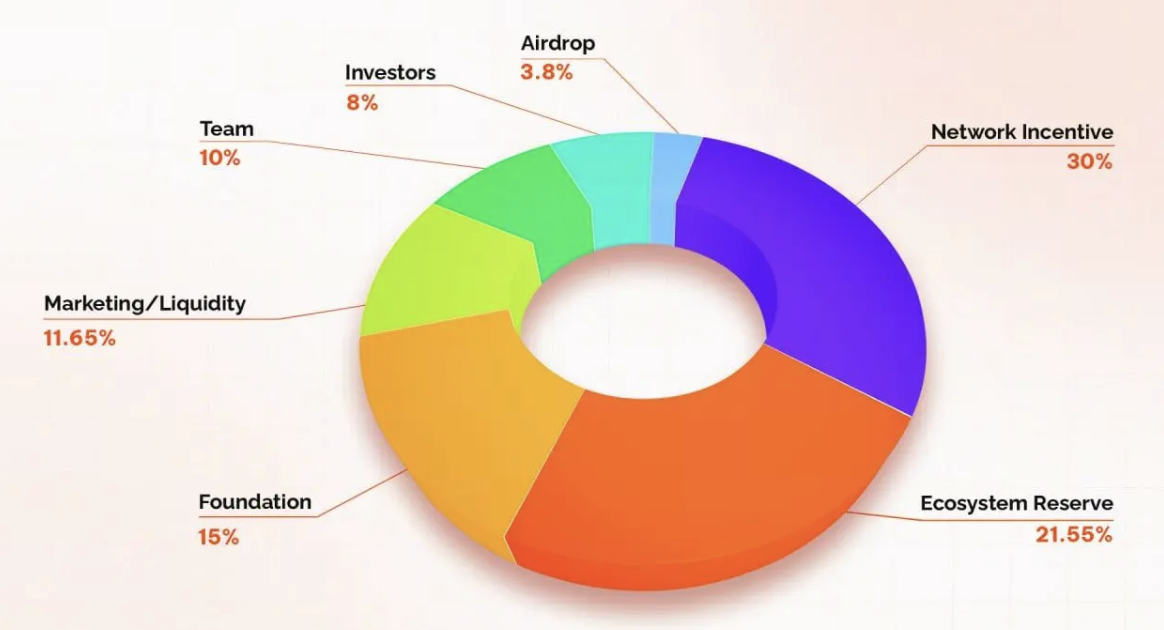
(Source: orochi.network/blog)
This allocation structure balances technological, community, and market needs, ensuring the $ON ecosystem maintains a healthy economic cycle and sustained growth over the long term.
To explore more Web3 content, register at: https://www.gate.com/
Conclusion
In a world overwhelmed by information, where AI and blockchain data converge, trust is founded on verifiability—not authority. $ON is building a future where every data point is cryptographically secured, every verification is traceable, and every user helps establish data authenticity. Orochi Network is restoring trust to data itself.







