Grok AI agent trading's capability compresses the traditional "watch the market, plan, then place an order by hand" routine into a single natural-language instruction. For beginners who find trading terminals intimidating, Grok AI agent trading lowers the barrier to entry; yet handing account control to an AI also means its permissions and risks must be re-understood. As of September 2026, Coinbase for Agents already lets major AI assistants such as Grok, ChatGPT, and Claude connect (Source: Coinbase developer documentation). Interest in AI-assisted trading has been building for more than a year, and these official connectors are a good example of how the results are finally reaching everyday users.
The sections below break down how Grok AI agent trading works across six layers: the connection mechanism, the order flow, permission boundaries, the industry landscape, the risks, and the alternative paths on Gate.
Key Takeaways
- Grok AI agent trading lets Grok, once authorized by the user, connect to an exchange account to check balances, analyze holdings, and place orders in natural language.
- The connection relies on a remote MCP protocol and OAuth authorization, and funds stay inside the exchange account because the agent cannot withdraw to external addresses.
- Orders follow a "preview, confirm, execute" flow, and Grok is positioned as "no autopilot," so a real fill requires user confirmation first.
- The main risks are AI misreading instructions, access security, and passive decision-making, which can be managed with limits, confirmations, and revocable access.
What Is Grok AI Agent Trading?
Grok AI agent trading is a way of trading in which an AI assistant performs account actions on the user's behalf. Instead of logging into an exchange manually, the user gives Grok a natural-language instruction such as "check my holdings" or "buy $200 of ETH," and Grok calls the exchange's interface to read data or place the order.
At its core, the exchange's trading and account interfaces are wrapped into tools an AI can call. Grok acts as an "agent" sitting between the user and the exchange: on one side it understands user intent, and on the other it translates that intent into standardized API calls. The most prominent deployment today is Coinbase for Agents adding Grok to its official allowlist, which lets Grok connect to a Coinbase Advanced Trade account.
Unlike earlier third-party "read-only" bridges, the official connector upgrades Grok from "can only view data" to "can place trades." That upgrade shifts the user's entry point for interacting with an exchange, moving it from the exchange app to the AI chat window.
How Does Grok Connect to a Trading Account via MCP?
Grok connects to a trading account through two protocol layers: a remote MCP (Model Context Protocol) endpoint and OAuth authorization. MCP is an open protocol that lets an AI assistant call external tools, with its specification described in the Model Context Protocol documentation; the exchange exposes capabilities such as "check balances, preview orders, place orders, and cancel orders" as MCP tools, and OAuth issues Grok a scoped access credential after the user grants authorization.
Connecting is simple for the user: add the exchange connector in Grok's connector management screen, complete the OAuth redirect, and the account is linked, with no terminal commands or developer setup required. During authorization, the user can designate a separate "agent portfolio," confining the AI's operations to a dedicated slice of funds rather than the entire account.
This isolated-portfolio design is the key to permission reduction. It lets a user expose only a small amount of funds to the AI agent while keeping the rest of the assets segregated, limiting the blast radius of mistakes or overreach at the source.
How Do You Place an Order with Grok in Natural Language?
Placing an order with Grok follows four steps: instruction, preview, confirmation, and execution. Take a spot buy as an example:
- Give the instruction: the user types a natural-language request in the chat, such as "buy $200 of ETH at market."
- Preview the order: Grok calls the preview tool and returns the estimated fill amount, price, and fee for the user to review.
- User confirms: only after the user replies "confirm" or gives an execution instruction does Grok submit the real order.
- Execution and report: once the exchange fills the order, Grok returns the status, size, and fees in the chat.
Beyond placing orders, Grok can check balances, analyze portfolio composition, cancel open orders, and convert between USD and USDC with no fee. Throughout the process, funds keep moving inside the exchange account, and the user never has to leave the chat window.
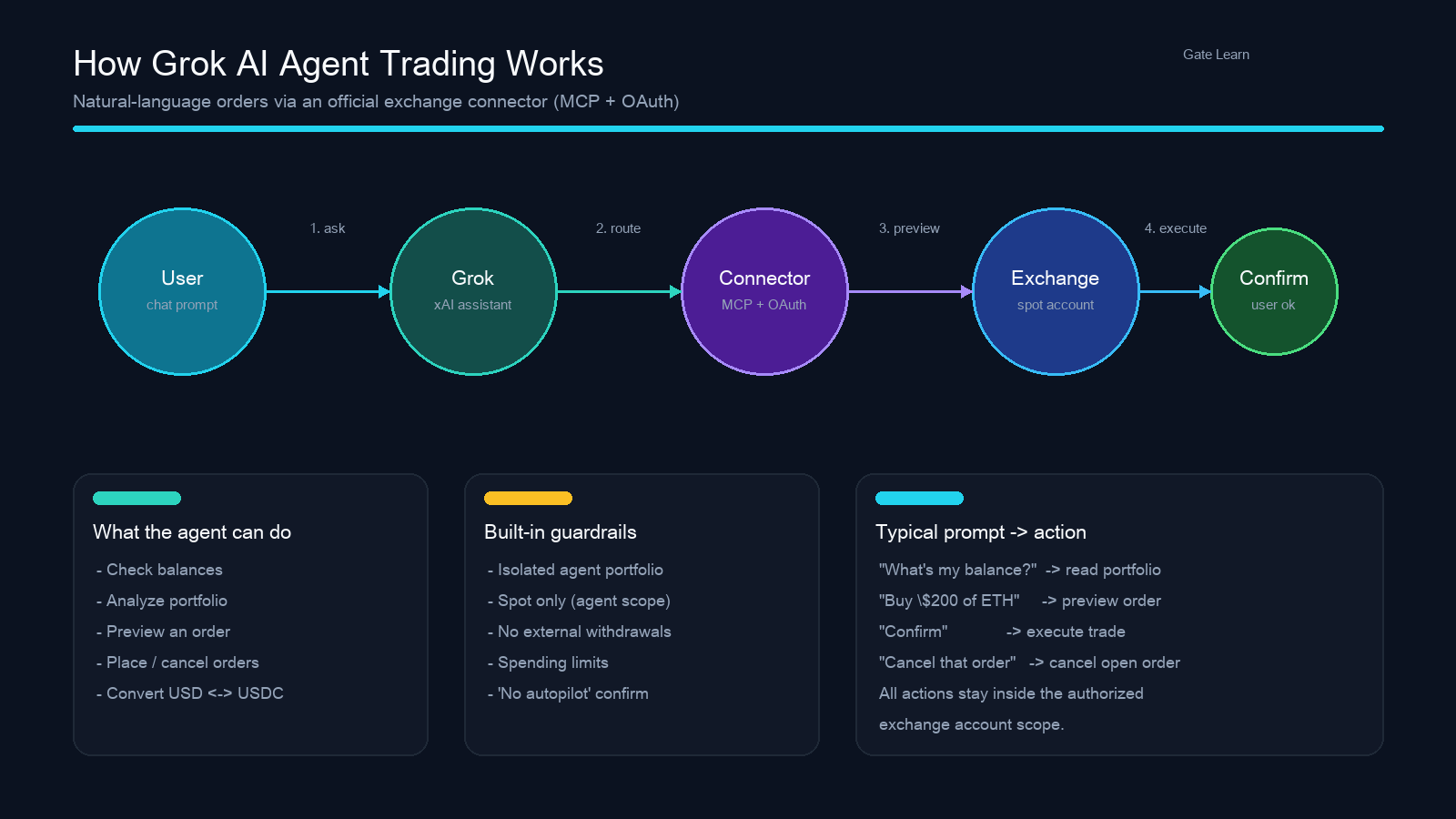
Figure 1. The Grok AI agent trading flow: the user issues an instruction in chat, Grok routes it through the official connector (MCP + OAuth) to the exchange account, and the order is executed after preview and user confirmation; the diagram also lists agent capabilities, built-in guardrails, and example prompts.
What Permissions and Limits Does Grok Agent Trading Have?
Grok agent trading is deliberately narrow in scope, with four core boundaries. First, the isolated agent portfolio is usually limited to spot trading, while derivatives such as futures generally stay in the default portfolio. Second, the agent cannot withdraw crypto to external addresses; funds can only move between portfolios inside the account. Third, the user can set spending limits for the agent, and instructions beyond that limit will not be executed. Fourth, most actions require explicit user confirmation, a setup Grok itself describes as "no autopilot."
Together these limits answer two common worries: "Will Grok trade without my confirmation?" and "Can Grok move my crypto out?" Under the official connector design, both are blocked by mechanism—confirmation is required before a fill, and the withdrawal channel is off by default. That said, exact behavior can vary with Grok's reasoning mode or platform policy, so users should rely on the official documentation before authorizing.
| Dimension |
Agent can |
Agent cannot |
| Read funds |
Check balances, positions, and open orders |
— |
| Execute trades |
Preview, place, and cancel spot orders |
Futures and derivatives in the agent portfolio |
| Move funds |
Move between in-account portfolios, USD<->USDC |
Withdraw to external addresses |
| Spending control |
Operate within user-set limits |
Trades that exceed preset limits |
| Autonomy |
Execute after user confirmation |
Fill an order without confirmation |
The table above summarizes the permission boundaries under the official connector: it can read, place, and cancel orders, but it cannot withdraw, exceed limits, or bypass confirmation. These boundaries frame the AI agent as a "scoped execution assistant" rather than a full custodian of funds.
Which Players Are in the AI Agent Trading Space?
Grok connecting to an exchange is not an isolated event but part of a broader trend in which exchanges open their interfaces to AI. Coinbase launched Coinbase for Agents in June 2026, initially supporting ChatGPT and Claude, and later added Grok and Perplexity to the allowlist; its interface and permission design are documented in the Coinbase for Agents developer docs. In August 2026, xAI also integrated MoonPay's PayBox payment infrastructure, which requires the user's passkey confirmation before funds move, with capabilities described in the xAI documentation.
Traditional brokers and other exchanges are following suit. Robinhood introduced MCP-based Agentic Trading in May 2026 and expanded it to crypto over the summer, and platforms such as Kraken have spent years making their APIs friendlier to trading bots and automation tools. Whether it is a crypto exchange or a broker, the industry is shaping the "AI agent" into a new trading entry point; Coinbase for Agents is simply one of the earlier deployments, not the space itself.
For readers, understanding this trend matters more than memorizing a single product: when multiple platforms are opening interfaces to AI, both the choice and the risk awareness should rest with the user.
What Are the Benefits and Risks of Using Grok Agent Trading?
The benefits of Grok AI agent trading center on convenience and a low barrier to entry. Natural-language ordering removes the need to learn a trading terminal; the isolated agent portfolio and spending limits provide a controlled space to experiment; and conversational queries make portfolio analysis more intuitive.
The risks are equally clear and fall into three categories. The first is AI misreading: the model may misinterpret an instruction, reading "sell" as "buy," which is why the preview and confirmation steps cannot be skipped. The second is access security: if an access credential leaks or is misused, the agent could execute unintended actions within its limit, so limits should be set and access should be revocable at any time. The third is passive decision-making: relying on AI to place orders over the long term can hand active judgment to the model, amplifying losses during volatility and thinning liquidity. Making a habit of reviewing each preview is a good first defense, because even a small misread can compound once real funds are reached.
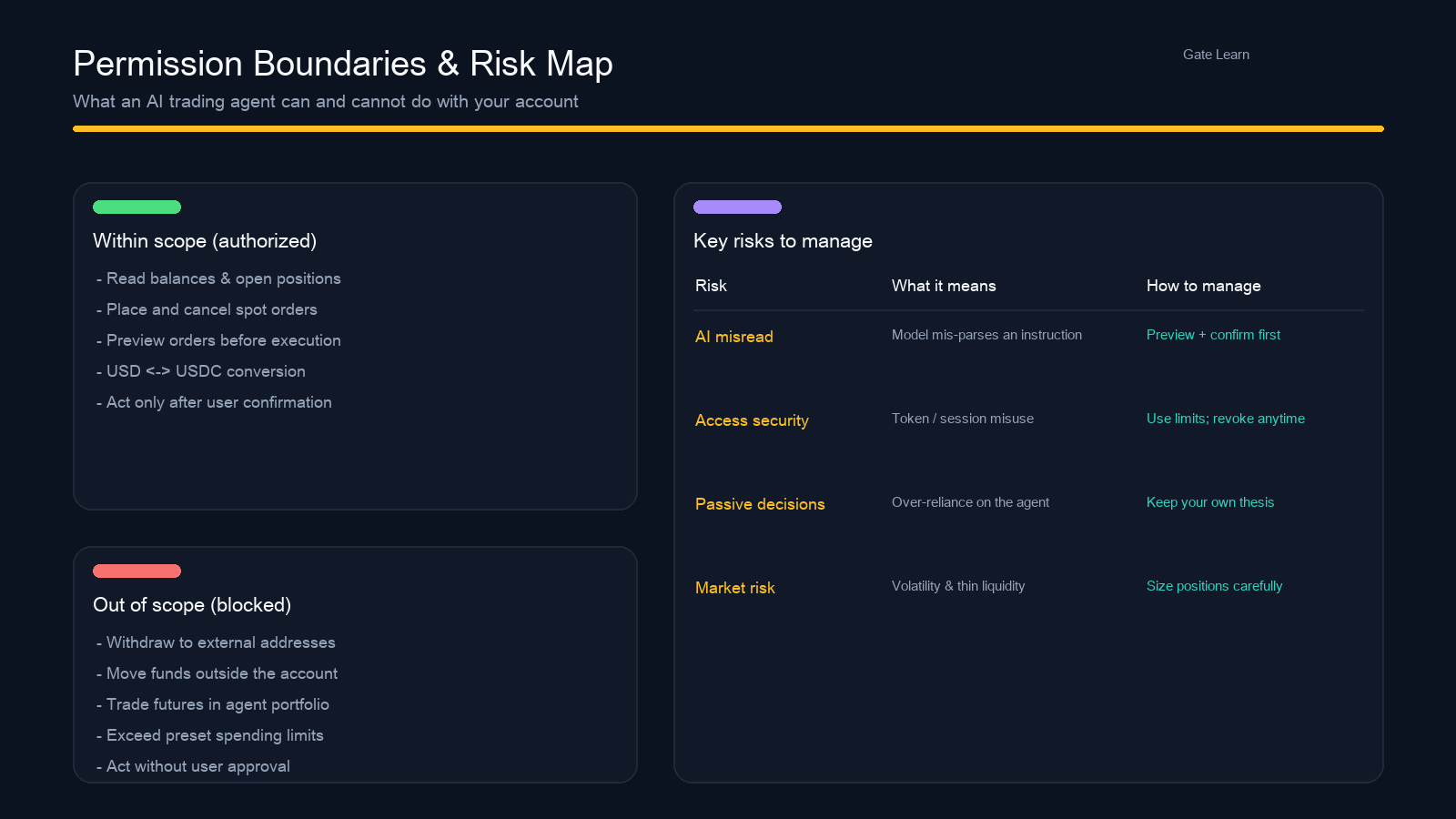
Figure 2. The permission boundaries and risk map of Grok AI agent trading: the left side separates "in-scope authorized" actions from "blocked by mechanism" ones, while the right side maps AI misreading, access security, passive decisions, and market risk against their mitigations.
The principle for managing these risks is straightforward: treat AI as an execution tool rather than a decision-maker, and keep the final call on every step in your own hands through previews, limits, and confirmations.
What AI and Smart Trading Paths Does Gate Offer?
For users who prefer not to hand an exchange account to a third-party AI, Gate offers a good alternative: use smart trading tools inside the platform without opening the account interface to an outside agent. Gate's quantitative and grid strategies let users preset a price range and parameters, and the system then buys low and sells high automatically within the Gate account, with transparent logic that can be paused at any time. Getting started is simple: a trader opens the strategy page, picks a pair, sets the range, and one click is enough to launch it.
Compared with a natural-language agent, these trading bots run on rules the user sets explicitly rather than on a model's interpretation of instructions, so their behavior is more predictable. Users who want deterministic execution can configure grid or quantitative strategies directly in a Gate spot account; readers who want to understand where price gaps come from can also look at what is arbitrage trading to see automated trading through the lens of price differences across markets. The results of a rule-based bot are usually easier to backtest than the output of a chat-driven agent, which is one thing worth keeping in mind when making a choice.
It is worth stressing that neither a third-party AI agent nor an in-platform strategy guarantees profit. Both are only execution tools, and the final directional judgment and risk control still rest with the user.
How Do You Start AI Agent Trading Safely?
Using AI agent trading safely follows a path from shallow to deep. The first step is read-only actions: have the AI check balances and holdings first, confirm the data matches the exchange app, and only then consider enabling order placement. The second step is a small test: put a small amount of funds into the isolated agent portfolio and run through the full "preview, confirm, execute" cycle to verify the instruction is understood correctly.
The third step is to set guardrails: configure a spending limit for the agent and confirm the withdrawal channel is off. The fourth step is regular review: periodically check the authorized connectors and access credentials, and revoke them promptly when they are no longer needed. Making "read first, test small, set limits, review often" a habit keeps the risks of AI agent trading within a tolerable range while enjoying its convenience. Traders who started with a small test in the past year often report good results, because the early stats on fills and fees tell them far more than a marketing page ever could.
Summary
Grok AI agent trading brings exchange account operations into the AI chat window: users can query, analyze, and, after confirming, place orders in natural language. Its safety foundation rests on remote MCP and OAuth authorization, an isolated agent portfolio, spending limits, and a "no autopilot" confirmation mechanism. Coinbase for Agents is an early deployment of this trend, while Gate's in-platform quantitative and grid tools offer an alternative for users who do not want to open their account interface.
Whichever path you choose, the principle is the same: AI is an execution assistant, not a decision-maker. Understanding permission boundaries, using confirmations and limits well, and keeping access revocable at any time is the sound way to use Grok AI agent trading.
FAQ
Can Grok place trades on an exchange?
Yes. After Grok connects to an exchange account through an official connector such as Coinbase for Agents, it can check balances, analyze holdings, and preview, place, or cancel spot orders within the user's authorized scope. A real fill usually requires explicit user confirmation first, a setup Grok positions as "no autopilot."
Is Grok agent trading safe?
Grok agent trading has multiple built-in guardrails: an isolated agent portfolio limits the funds in scope, withdrawals to external addresses are blocked, spending limits can be set, and confirmation is required before a fill. Risks such as AI misreading instructions and credential leaks remain, so safety largely depends on whether the user makes good use of previews and limits and reviews authorization regularly.
Will Grok trade automatically without confirmation?
Under the official connector design, no. Grok places real orders only after user confirmation, the "no autopilot" setup. Exact behavior can vary with Grok's reasoning mode or platform policy, so users should check the official documentation before authorizing and further constrain the agent with limits.
Can Grok withdraw my crypto?
No. The official connector disables the withdrawal channel by default, so Grok can only move funds between portfolios inside the exchange account and cannot withdraw to an external address. This limit mechanically prevents an AI agent from moving funds out of the user's account.
What AI or smart trading tools does Gate offer?
Gate provides smart tools inside the platform, such as quantitative and grid strategies. Users can preset a range and parameters in a Gate spot account and let the system execute automatically, without opening the account interface to a third-party AI. The strategy rules are set explicitly by the user, are transparent, and can be paused at any time.