Gate Stock Copy Trading is a Gate product that lets users one-click follow lead traders and replicate real stock and ETF positions in real time across U.S., Hong Kong, and South Korean markets, covering more than 12,500 stocks and ETF instruments, with fractional-share copying from 0.01 shares, proportional position sizing, and High-Water Mark (HWM) profit sharing.

Gate launched Stock Copy Trading on July 24, 2026, describing it as the first crypto platform to support stock copy trading. The feature builds on Gate's earlier real stock trading access via compliant brokerage firms with U.S. broker-dealer licenses. Copiers browse lead-trader profiles on the platform, allocate an amount and optional stop-loss on the copy trading account, then mirror portfolio structure rather than placing each stock order manually.
Key takeaways
- Gate Stock Copy Trading mirrors real U.S., Hong Kong, and South Korean stocks plus ETFs through one-click lead-trader following on the Gate platform.
- Proportional copying sizes positions from the ratio of available assets and supports fractional shares from 0.01 shares so smaller accounts can still follow portfolio weights.
- High-Water Mark (HWM) profit sharing applies only when a copier’s cumulative net PnL exceeds the prior high-water mark—aligning traders’ fee eligibility with peak performance.
- App support requires Gate App V8.29.0 or later; Web Stock Copy Trading was announced as coming soon at launch.
What is Gate Stock Copy Trading, and how does it differ from futures copy trading?
Gate Stock Copy Trading applies copy trading to real equity and ETF instruments. A copier selects a lead trader, commits capital and risk controls on the account, and the platform replicates that trader's stock portfolio structure as positions update. Underlying exposure is stock and ETF inventory through Gate's stock-trading stack rather than solely crypto perpetual or futures contracts.
Copy trading means the platform automatically mirrors selected traders so investors can follow strategies instead of placing every order manually. Futures and related copy products on Gate typically center on derivatives such as crypto futures (Gate copy trading). Stock copy trading instead targets listed equities and ETFs in U.S., Hong Kong, and South Korean markets. Following lead-trader activity is described as available around the clock on the following layer, though underlying exchanges still have their own trading calendars for instrument execution.
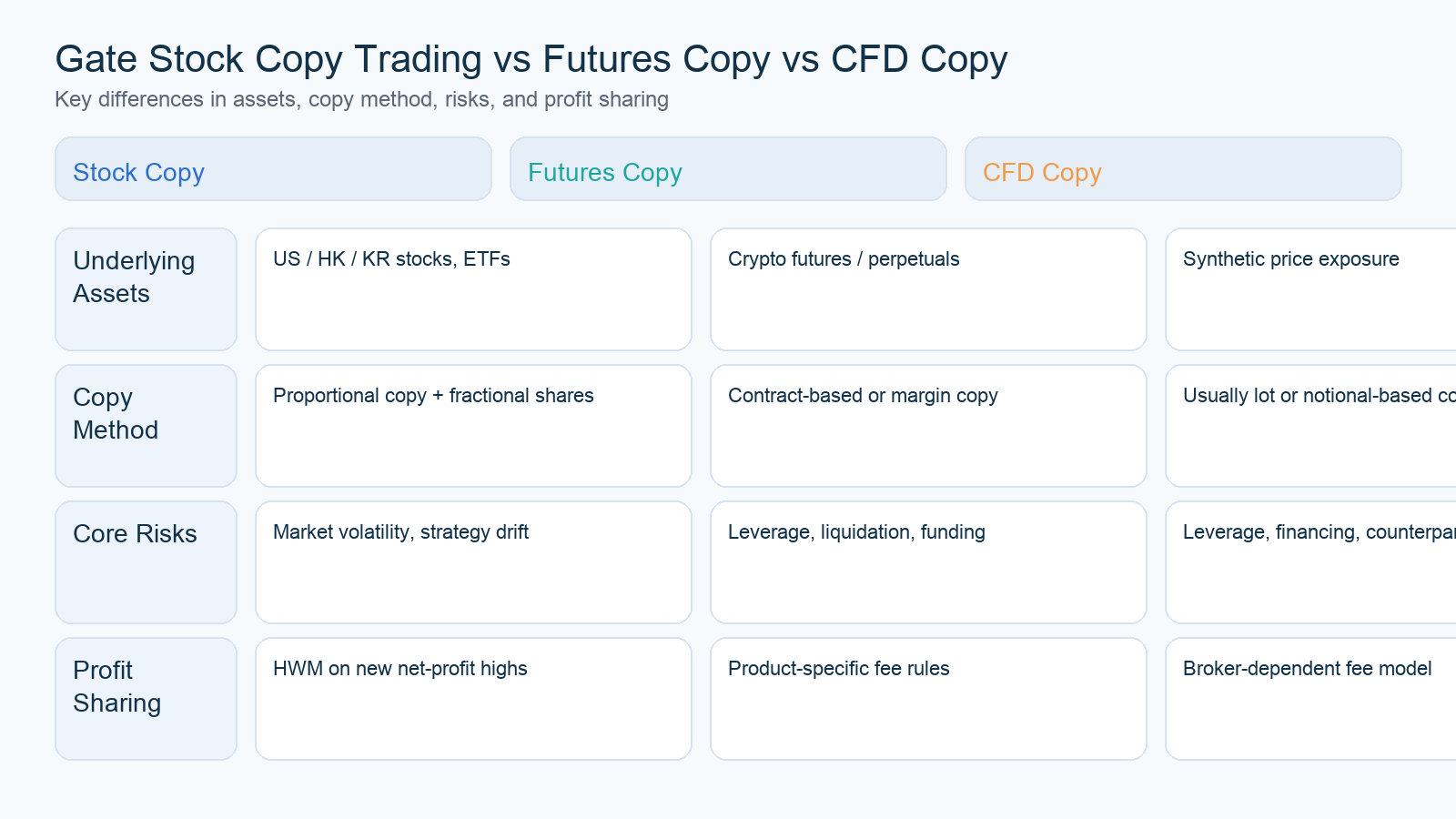
This chart compares Gate Stock Copy Trading with futures and CFD-style copy products across underlying assets, sizing, and core risk sources.
| Dimension |
Gate Stock Copy Trading |
Futures / CFD-style copy trading |
| Underlying |
Real stocks and ETFs (US, HK, KR) |
Primarily derivatives (e.g. crypto futures) |
| Instrument count (at launch) |
12,500+ stocks and ETFs |
Product-dependent on futures markets |
| Sizing model |
Proportional; fractional from 0.01 shares |
Often fixed-amount or contract-based rules |
| Profit sharing |
High-Water Mark (HWM) on copier net PnL |
Rules vary by futures copy product |
| Entry path (at launch) |
App Copy Trading → Stocks (V8.29.0+) |
Separate copy-trading entry points |
Which markets and instruments does Gate Stock Copy Trading cover?
At launch, Gate Stock Copy Trading covered U.S., Hong Kong, and South Korean stocks together with a full range of ETFs, more than 12,500 stock and ETF instruments on the platform. A lead trader's book may mix U.S. large-caps, Hong Kong listings, South Korean equities, and ETF investments. Copiers follow that multi-market structure in one Gate Stock Copy Trading flow rather than opening separate regional brokerage accounts. Instrument availability can expand over time; the July 2026 announcement fixed these three equity regions plus ETFs as the baseline market coverage for stock trading strategies on the platform.
How do proportional copy and fractional shares work (from 0.01 shares)?
Proportional copying calculates positions in real time from the ratio of available assets between the copier and the lead trader. The design goal is 1:1 proportional replication of the lead trader’s stock portfolio structure, unlike fixed-amount copy that may apply the same notional per name regardless of portfolio weights—so beginners with smaller account balances can still follow traders’ strategies with sized exposure.
Fractional-share copy trading starts from 0.01 shares. When a copier's capital is smaller than the lead's account, holdings can scale down while still reflecting relative weights. As the lead trader opens, closes, or rebalances investments, proportional logic recalculates the copier's side against the current asset ratio on the platform. Mechanism edge cases are covered in HWM and proportional copy.
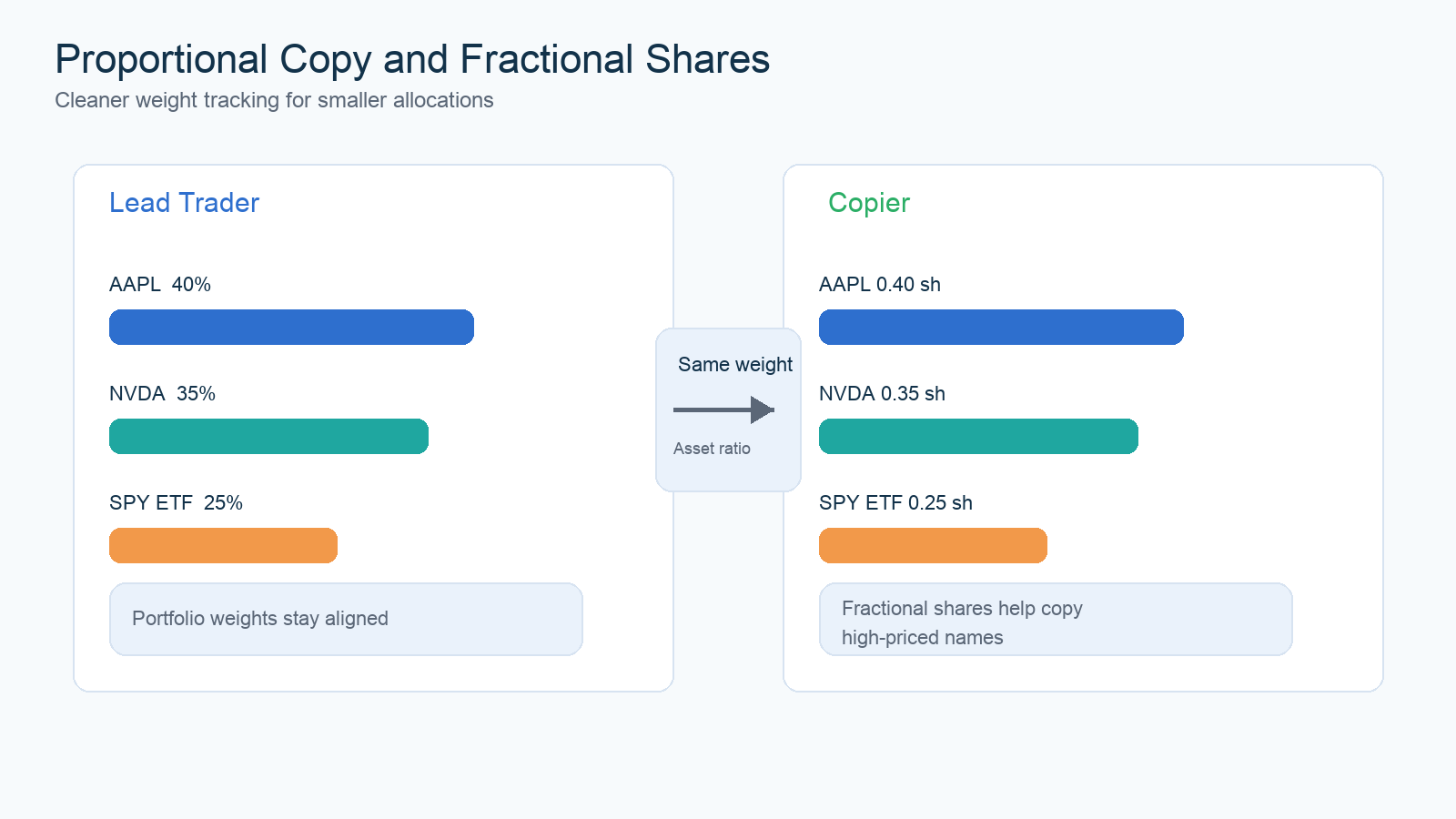
This diagram shows how proportional copy and 0.01-share fractional support help smaller accounts stay closer to the lead trader's target weights.
How does High-Water Mark (HWM) profit sharing protect copiers?
High-Water Mark (HWM) is the profit-sharing rule Gate announced for Stock Copy Trading. New profit sharing is charged only when the copier’s cumulative net PnL exceeds the previous high-water mark. During loss periods, no profit sharing applies. Lead traders must fully recover prior losses before they become eligible for profit sharing again on that copier relationship—so fee timing tracks peak account performance rather than every bounce.
HWM ties fees to new peak cumulative performance rather than every interim rebound. Gains that only refill a drawdown do not trigger a new share until cumulative net PnL sets a fresh high. HWM does not remove market risk or lead-trader skill risk for investors; it only governs when performance fees can be taken from the copy trading account. That distinction matters for beginners who may confuse fee protection with guaranteed trading outcomes.
How do you start stock copy trading on Gate?
At launch, Stock Copy Trading was available on the Gate App at version V8.29.0 or later, with Web Stock Copy Trading announced as coming soon. High-level steps for beginners and experienced investors: update the app and log in to the account; open Copy Trading → Stocks on the platform; browse lead traders by returns, drawdown, and copier count; tap Copy to follow; set amount and stop-loss risk controls; agree to the agreements; manage under My Copies. Users who want to become lead traders can use Join Now on the Stock Copy Trading homepage to offer strategies other investors can follow. Screen-level detail belongs in the how-to cluster; official help is at Gate Stock Copy help. Customisable risk management settings such as stop-loss sit on the copy relationship, not on every individual stock ticket.
How should you evaluate stock lead traders (returns, drawdown, copiers)?
Lead-trader cards on the platform surface returns, drawdown, and copier count as primary filters when investors evaluate lead traders. Returns summarize historical performance over the displayed window and do not guarantee future results. Drawdown shows peak-to-trough decline under the strategy and frames trading risk experience. Copier count reflects how many accounts currently follow that lead; popularity alone is not a quality certificate for copy trading strategies.
A balanced screen pairs return level with drawdown depth, then checks whether the lead’s US/HK/KR and ETF mix matches the market exposure the copier wants. Because proportional copy mirrors portfolio structure, concentration in volatile names transmits to copiers at scale. Investors should also ask how copy trading differs from manual trading: the platform follows traders automatically, so account risk settings and lead selection replace ticket-by-ticket decisions.
What are the advantages and risks of Gate Stock Copy Trading?
Advantages include one-click multi-market stock and ETF access on a single platform, fractional proportional mirroring from 0.01 shares for smaller accounts, consolidated following of traders' strategies without manually cloning every order, HWM-aligned profit sharing tied to peak performance, and App entry with transparent lead metrics that beginners can screen. Prior real-stock trading via licensed brokerage partners underpins the real-stock positioning of the copy trading layer.
Risks remain material for investors: equity and ETF market prices can move sharply; lead-trader strategies can underperform; proportional sizing scales losses with allocated account capital; stop-loss and available-asset ratios can create fill or sizing differences versus the lead; regional listing rules and liquidity differ across U.S., Hong Kong, and South Korean names. HWM limits fee timing; it does not cap losses. Copy trading is not risk-free, and past performance of traders is not a guarantee.
Summary
Gate Stock Copy Trading, launched July 24, 2026, lets users one-click follow lead traders across U.S., Hong Kong, and South Korean stocks and ETFs, more than 12,500 instruments, using proportional copying, fractional shares from 0.01, and High-Water Mark profit sharing on the Gate platform. Starting requires Gate App V8.29.0+, Copy Trading → Stocks, lead selection, and amount or stop-loss risk settings on the account. Advantages center on multi-market mirroring and fee-rule design; risks center on market moves, lead selection, strategy performance, and execution scaling versus the lead.
FAQ
What is Gate Stock Copy Trading?
Gate Stock Copy Trading is a Gate platform feature that lets users one-click follow lead traders and replicate real stock and ETF positions in real time across U.S., Hong Kong, and South Korean markets, covering more than 12,500 stocks and ETF instruments at launch.
How is Gate Stock Copy Trading different from futures copy trading?
Stock copy trading mirrors real equities and ETFs with proportional fractional sizing and HWM profit sharing, while Gate's futures-oriented copy trading focuses on derivatives such as crypto futures through separate entry points.
What is the minimum for fractional stock copy trading?
Fractional-share copy trading starts from 0.01 shares, with positions calculated proportionally from the ratio of available assets so smaller accounts and beginners can still follow the lead trader’s portfolio structure and strategies.
How does High-Water Mark (HWM) profit sharing work?
New profit sharing applies only when a copier’s cumulative net PnL exceeds the previous high-water mark; no profit sharing occurs during loss periods, and lead traders must fully recover prior losses before becoming eligible again—so fees track peak account performance, not every rebound.
How do you start Gate Stock Copy Trading?
Update the Gate App to V8.29.0 or later, open Copy Trading → Stocks on the platform, browse lead traders, tap Copy to follow, set amount and stop-loss risk controls on the account, agree to the agreements, then manage under My Copies; Web Stock Copy Trading was announced as coming soon at launch.
What are the main risks of stock copy trading on Gate?
Risks include equity and ETF market losses, lead-trader strategy underperformance, sizing and execution differences under proportional copy, and cross-market liquidity effects; HWM governs fees only and does not prevent drawdowns—investors should treat past performance as experience data, not a guarantee.