DAPPOS is best understood as an attempt to turn Web3 tooling into a more conversational operating layer. Instead of asking users to assemble wallets, scripts, agents, and execution paths across several separate products, DAPPOS presents the idea that a chat-driven interface can coordinate intent, tooling, and delivery in one workflow.
DAPPOS matters because many Web3 users still face a gap between what they want to do and the operational knowledge needed to do it. A product such as xBubble aims to lower that barrier by treating prompts as an input layer for tasks and applications, but the usefulness of that model still depends on product reliability, scope, and the quality of execution.
Key takeaways
- DAPPOS is positioned as a Web3 AI operating system rather than as a single-purpose chatbot or exchange product.
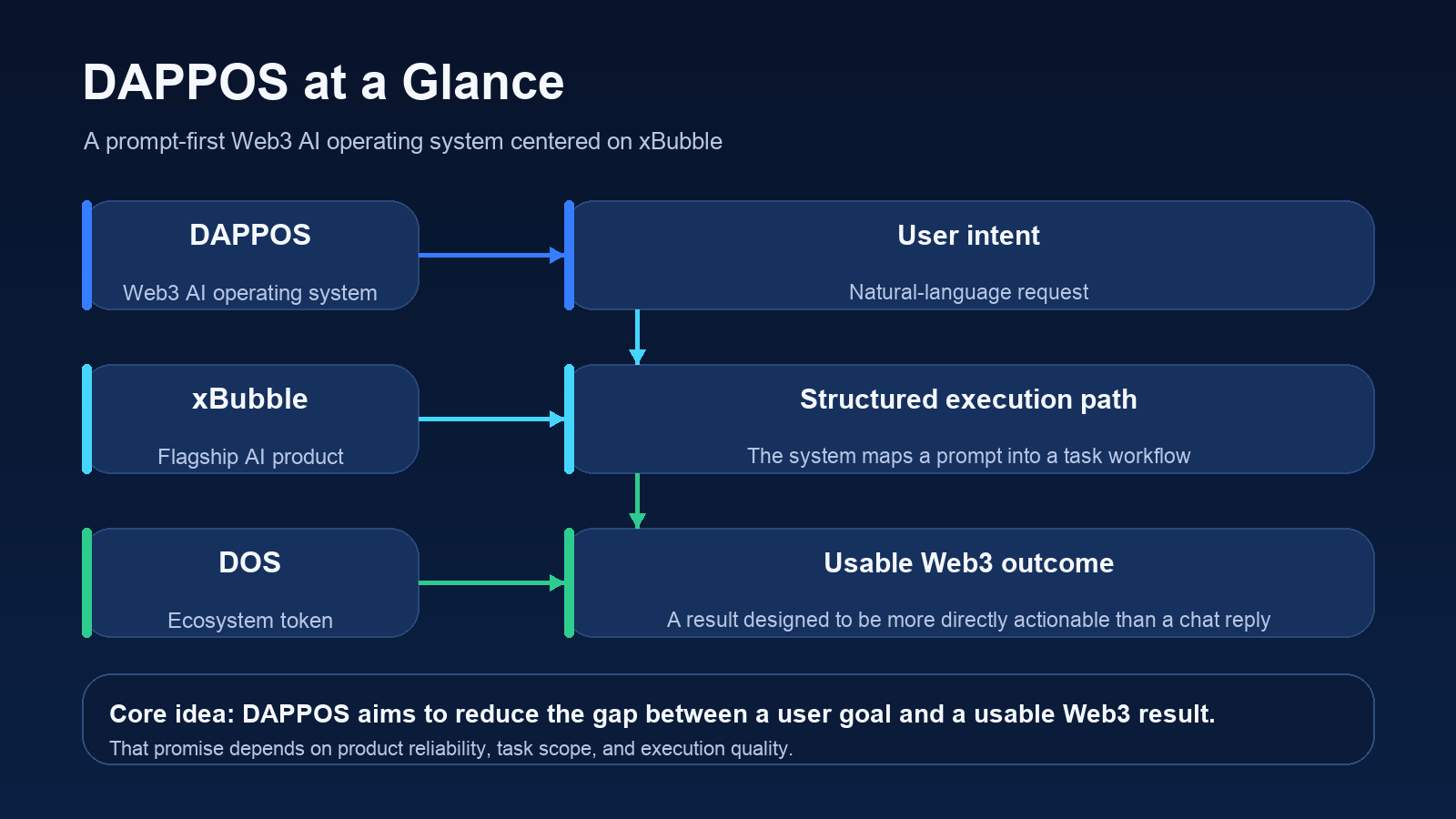
- xBubble is the core product in the DAPPOS ecosystem and is designed to turn simple prompts into usable Web3 outcomes.
- DOS is the token associated with the DAPPOS project, but the project's product positioning is driven mainly by its AI operating-system concept.
- DAPPOS combines product narrative, funding support, and traction disclosures, but users still need to distinguish between platform convenience and actual execution quality.
What is DAPPOS?
DAPPOS is a Web3 AI operating system built around the idea that users should be able to express intent in plain language and receive usable Web3 results without navigating a fragmented tool stack. The project frames AI not as a general chat layer alone, but as a practical interface for initiating and coordinating on-chain or Web3-related tasks.
DAPPOS is therefore not best described as a wallet, a traditional exchange, or a single-feature automation script. DAPPOS is better described as an orchestration layer that aims to connect prompts, logic, task execution, and deployable outcomes inside one product environment.
What is xBubble, and how does it fit into DAPPOS?
xBubble is the flagship AI product inside the DAPPOS ecosystem. xBubble appears to function as the main user-facing interface through which people describe what they want to build, automate, or execute in a Web3 context.
That makes xBubble central to understanding DAPPOS. Readers who want a product-level view can compare this section with a dedicated explanation of what xBubble is and how it works, because the broader DAPPOS thesis depends heavily on whether xBubble can reliably turn short prompts into structured and usable results.
How does DAPPOS turn prompts into Web3 outcomes?
DAPPOS is positioned around a prompt-to-result workflow. A user provides a request in natural language, the system interprets that request, maps it to an operational path, and then returns an output that is meant to be directly usable in a Web3 setting.
The exact technical path may vary by task type, but the conceptual model remains consistent: intention is expressed through chat, transformed into machine-usable logic, and delivered as a workflow, application output, or execution-ready result. This model matters because it shifts user attention away from manual setup and toward describing goals.
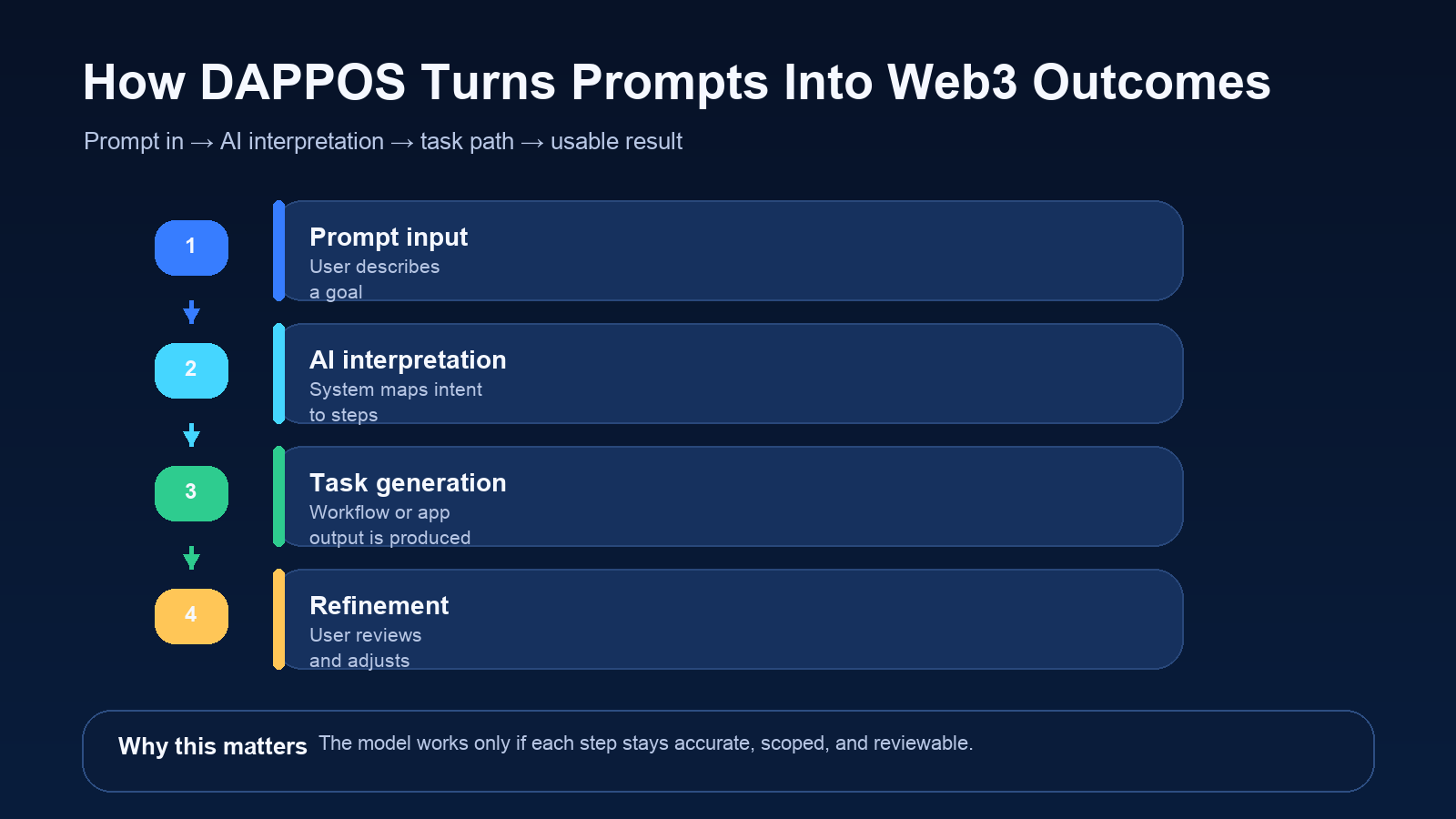
| Workflow stage |
What happens |
Why it matters |
| Prompt input |
The user describes a desired task or application outcome |
Lowers the barrier to expressing intent |
| AI interpretation |
The system maps the request into a structured execution path |
Connects plain language to operational logic |
| Task or app generation |
The platform produces a usable result, workflow, or deployable output |
Makes the prompt actionable rather than merely conversational |
| Delivery and refinement |
The user reviews the output and may adjust the request |
Supports iterative improvement of the result |
What is DOS used for?
DOS is the token linked to the DAPPOS ecosystem. A neutral explanation should focus on utility within the project context rather than on speculation, because token value and token function are not the same question.
Readers generally want to know whether DOS relates to access, incentives, payments, governance, or broader ecosystem coordination. The answer should therefore explain the token's role as clearly as the available official information allows, while avoiding assumptions that go beyond disclosed utility.
What do DAPPOS's funding and traction disclosures suggest?
DAPPOS has disclosed total funding of 20.3 million dollars, with backers that include Polychain, YZI Labs, OKX Ventures, and Sequoia China. That information matters because capital support can signal external confidence in a project's product direction, team, and market opportunity.
DAPPOS has also disclosed that, as of July 2026, xBubble had more than 10,275 paying OPC customers and more than 6.8 million dollars in cumulative revenue. These numbers do not prove long-term success, but they do provide a more concrete operating signal than projects that rely only on narrative without traction disclosures.
Those traction disclosures also help explain why DAPPOS is discussed as more than a token listing story. A product with paying customers, revenue, and repeat usage suggests that the ecosystem is trying to build a service layer around AI-assisted Web3 execution rather than relying only on speculative attention. For readers evaluating DAPPOS as an educational topic, that distinction helps separate product adoption signals from simple market visibility.
Funding and traction do not guarantee that every workflow inside DAPPOS will be equally mature. They do, however, provide a clearer context for understanding why the project emphasizes an operating-system narrative, why xBubble is treated as the flagship interface, and why the DOS token is usually discussed in relation to ecosystem access, participation, and coordination instead of as an isolated market symbol.
What are the main opportunities and limitations of DAPPOS?
DAPPOS may appeal to users who want Web3 workflows to feel more like asking for outcomes than assembling infrastructure. That positioning can be powerful if the system consistently produces useful results for users who would otherwise face a steep setup burden.
At the same time, a conversational interface does not remove the usual constraints of Web3 execution. Product claims still need to be evaluated against reliability, accuracy, scope boundaries, dependency on external systems, and the difference between a polished demo path and repeatable real-world utility.
Another limitation is that AI-oriented Web3 products often depend on layers that users do not immediately see, including data connections, wallets, routing logic, and execution services. If one part of that stack is incomplete or only partially automated, the overall experience can still feel less seamless than the product narrative suggests. That is why DAPPOS should be assessed as both an interface concept and an execution framework, not just as a branding exercise around Web3 AI.
DAPPOS differs from traditional Web3 tool platforms mainly in its interface logic. Traditional platforms often ask users to learn menus, scripts, dashboards, and manual configuration paths, while DAPPOS emphasizes a prompt-first operating model.
That difference is important enough to justify a separate comparison article on how DAPPOS differs from traditional Web3 tool platforms, because interface style, user burden, and output format are often the clearest ways to understand what DAPPOS is trying to change.
Summary
DAPPOS is a Web3 AI operating system built around the idea that chat-based intent can be transformed into usable Web3 applications, workflows, or task outcomes. The best way to evaluate DAPPOS is to look at its core product xBubble, the stated role of DOS, and the extent to which the project's funding and traction disclosures support its claim that AI can serve as a practical operating layer for Web3.
FAQ
What is DAPPOS?
DAPPOS is a Web3 AI operating system that aims to let users create and deploy Web3-related outputs through chat-based prompts. DAPPOS is designed to reduce the need for users to assemble multiple separate tools before getting a usable result.
What is DOS in DAPPOS?
DOS is the token associated with the DAPPOS ecosystem. DOS should be explained through its disclosed project utility and ecosystem role rather than through price speculation or trading narratives.
What is xBubble in the DAPPOS ecosystem?
xBubble is the flagship AI product within DAPPOS. xBubble is presented as the main interface that turns simple prompts into usable Web3-oriented outputs or workflows.
DAPPOS is better described as a Web3 platform with a chat-driven AI interface than as a generic chatbot. The key idea is not conversation alone, but the conversion of user intent into practical outcomes.
What should users check before evaluating DAPPOS?
Users should check DAPPOS's official product documentation, token utility disclosures, current feature scope, and operational limitations before evaluating the platform. Users should also distinguish between product narrative, actual execution quality, and the repeatability of results.