As generative AI, large language models, and cloud computing infrastructure continue to develop, market attention on AI computing power is gradually expanding from GPUs, HBM, and advanced packaging to data center construction. Even if a company has already purchased high-performance chips, the equipment still cannot be deployed as planned without sufficient power capacity, cooling systems, and network infrastructure. As a result, data centers are no longer simply buildings that house servers. They are critical infrastructure in the AI computing power industry chain.
On October 28, 2026, Equinix announced its third-quarter results, reporting quarterly revenue of $2.571 billion, up 11% year over year, while also raising its full-year guidance. The company also disclosed progress in AI inference services, liquid-cooling facilities, and the delivery of additional capacity.
Against this backdrop, data center REITs offer another perspective for observing AI infrastructure investment. Investors can look beyond chip manufacturers and also study the real estate operators that provide the space, power, and connectivity required to operate computing infrastructure.
What Are Data Center REITs? How Do They Differ from Traditional Real Estate Investments?
REITs stands for Real Estate Investment Trusts. Their core mechanism is to own or finance real estate assets and share the related income and asset operating returns with investors. The asset structures, tax treatment, and distribution requirements for REITs vary across jurisdictions.
In the United States, REITs that meet certain conditions can generally receive applicable tax treatment. One important requirement is that they distribute at least 90% of their taxable income to shareholders each year. However, taxable income is not the same as accounting net income or operating cash flow. This structure often gives REITs a strong income-distribution feature, but it does not mean that dividend amounts are fixed or that investors' principal is protected.
Data center REITs belong to the specialized real estate sector. Their assets include not only land and buildings, but also power distribution systems, backup power supplies, cooling equipment, network connections, and other infrastructure. Customers lease these facilities to deploy servers, storage equipment, and network systems. According to Nareit's industry overview, data center REITs primarily own and manage specialized facilities designed to house critical IT infrastructure, serving large technology companies, telecommunications companies, and other institutional customers.
Compared with traditional real estate, the value of data centers depends more heavily on technical facilities and operating capabilities. Conventional office buildings are generally valued based on location, building conditions, and leasing demand, while data centers also require consideration of power access, network latency, cooling efficiency, power reliability, and equipment deployment density.
Therefore, although data center REITs belong to the real estate investment sector, their operating performance is also affected by technology industry capital expenditures, energy infrastructure, and enterprise IT demand.
Why Does AI Computing Demand Drive Data Center Real Estate Investment?
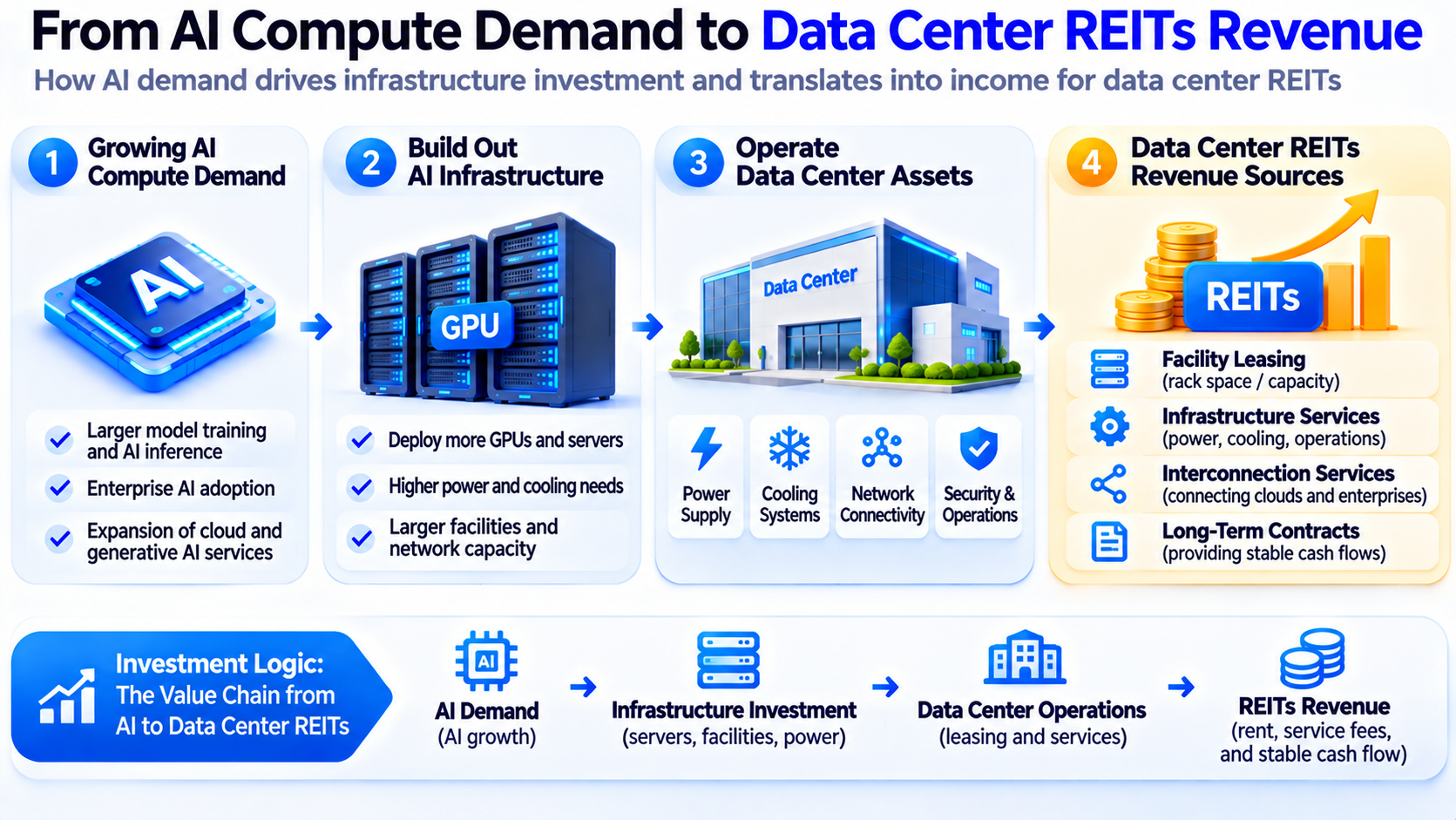
Growing demand for AI computing power generally means that companies need to deploy more GPUs, servers, storage equipment, and high-speed network infrastructure. However, this hardware cannot operate independently. It requires data center infrastructure to provide power, cooling, physical security, and network connectivity.
-
AI training and inference place greater demands on power capacity. Large-scale GPU clusters typically need to be deployed together. During operation, servers not only consume significant amounts of electricity but also generate substantial heat. As a result, data center operators need to build higher-capacity power distribution systems and maintain the operating environment through air cooling, liquid cooling, or hybrid cooling solutions.
-
AI infrastructure construction is subject to significant time constraints. Server procurement and chip deliveries can proceed according to production schedules, but land approvals, grid connections, transformer availability, and data center construction may require more time. For companies seeking to deploy computing capacity quickly, data centers that already have power access, network connectivity, and available facility capacity may be more attractive.
-
AI inference demand may change how data centers are deployed. Large-model training typically emphasizes the centralized coordination of large-scale computing resources, while some inference applications also need to consider network distance from end users, enterprise data, and cloud services. As a result, data centers in different regions may serve different functions.
However, growing AI computing demand does not necessarily translate directly into revenue growth for all data center REITs. Large technology companies may build their own data centers or lease facilities from specialized operators. The extent to which each company benefits depends on its business structure, deliverable capacity, and customer base.
How Do Data Center REITs Primarily Generate Revenue?
Data center REIT revenue models generally include facility leasing, supporting infrastructure services, and network interconnection services. The business mix varies among operators.
Space and capacity leasing. Operators lease cabinets, data center rooms, or large-scale data center capacity to customers, who deploy servers and related equipment in these facilities. Some lease agreements are priced based on floor space, power capacity, or agreed infrastructure usage conditions. Large cloud service providers may use long-term leases or customized data center partnership models.
Colocation and infrastructure services. In addition to physical space, customers may require stable power supplies, backup power, cooling systems, physical security, and facility operations and maintenance support. These services can increase the operating value of a data center, but they also require operators to bear ongoing maintenance and equipment replacement costs.
Network interconnection services. Some data center operators connect cloud service providers, network operators, and enterprise customers, providing infrastructure for data exchange between different systems. Interconnection services may generate a revenue stream separate from facility leasing and increase the complexity of customer migration.
Equinix, for example, operates across categories including Colocation, Interconnection, and Managed Infrastructure. In its third-quarter 2026 disclosure, the company reported that interconnection revenue grew 10% year over year, highlighting the importance of network connectivity services to its business model. Therefore, data center REITs should not simply be viewed as landlords collecting rent. Some companies combine real estate operations, infrastructure management, and network services, resulting in a more complex revenue structure than traditional property leasing.
How Do Equinix and Digital Realty Differ?
Equinix is known for its global data center colocation and interconnection ecosystem, serving enterprises, cloud platforms, and network operators. Its business involves not only cabinets and facility capacity but also network connections and interconnection services among different customers.
Digital Realty also provides global data center infrastructure. Its business covers large-scale data center leasing, colocation, and interconnection services, while PlatformDIGITAL supports enterprise and cloud computing needs.
Both companies are data center REITs, but their business focuses and customer structures are not identical. Equinix is particularly recognized for its interconnection ecosystem and retail colocation business, while Digital Realty has a significant presence in large-scale data center capacity and wholesale leasing, while also providing colocation and interconnection services.
| Comparison Dimension |
Equinix (EQIX) |
Digital Realty (DLR) |
| Primary Businesses |
Colocation, interconnection, digital infrastructure |
Data center leasing, colocation, interconnection |
| Typical Customers |
Enterprises, cloud platforms, network operators |
Cloud platforms, large enterprises, IT service providers |
| Operating Characteristics |
Emphasis on interconnection ecosystems and multi-customer connectivity |
Coverage of large-scale capacity leasing and diversified colocation needs |
| AI-Related Opportunities |
Inference connectivity, enterprise AI deployment, high-density colocation |
Large-scale computing facilities, cloud and AI capacity demand |
| Key Risks |
Expansion costs, competition, financing, and technology upgrades |
Development cycles, customer concentration, financing, and power constraints |
It is important to note that the two companies do not have completely different business models. Their customer types and service offerings overlap, and their specific revenue structures may change as new projects are developed, acquisitions are completed, and customer needs evolve.
For investors, comparing the two companies requires more than looking at the number of data centers. Investors should also analyze actual leased capacity, customer contracts, revenue quality, capital expenditures, and cash flow performance.
How Can FFO and AFFO Be Used to Evaluate Data Center REIT Profitability?
Traditional stock analysis typically focuses on revenue, net income, and earnings per share (EPS). However, evaluating REIT operating performance also requires consideration of FFO (Funds From Operations) and AFFO (Adjusted Funds From Operations).
FFO typically starts with accounting net income and adjusts for real estate-related depreciation and amortization, as well as certain gains and losses from real estate sales as defined by Nareit. Because real estate depreciation can have a significant impact on accounting profit, FFO can help investors assess REIT operating performance from another perspective.
AFFO generally makes further adjustments to FFO for certain noncash items, recurring capital expenditures, and other factors. It more closely reflects the adjusted operating funds available for distribution and reinvestment. However, AFFO does not have a completely standardized calculation method, and the methodologies used by different companies may vary. Therefore, AFFO should not be treated as equivalent to free cash flow.
Equinix, for example, disclosed AFFO of approximately $1.156 billion for the third quarter of 2026, up 20% year over year. AFFO per share was $11.64, up 18% year over year. The company also reported quarterly revenue of approximately $2.571 billion.
For data center REITs, investors also need to examine the composition of capital expenditures. Building new data centers, expanding power capacity, and installing cooling equipment may require substantial funding. However, expansion capital expenditures have different economic implications from spending required to maintain existing facilities. Therefore, FFO and AFFO help investors understand operating performance but cannot replace a comprehensive analysis of debt, capital expenditures, and cash flow.
Why Is Power Capacity Becoming an Important Competitive Factor for Data Center REITs?
The value of data center real estate depends not only on land and buildings but also on whether the facility can obtain sufficient, stable, and reasonably priced power. For customers deploying high-density GPU clusters, power capacity directly affects the number of servers that can be deployed, operating efficiency, and project delivery timelines.
For example, two data centers may have similar floor areas. However, if one already has substantial available power capacity and fully developed cooling facilities while the other is still waiting for a grid connection, their commercial values may differ significantly.
Insufficient power supply can also affect data center construction schedules. Even if an operator has completed land acquisition and building construction, the facility may be unable to deliver the capacity required by customers as planned if transformers, transmission facilities, or grid connections are not yet ready.
In its data center industry analysis, Nareit noted that AI clusters' demand for centralized power supply makes power access a major constraint on data center development while also encouraging operators to consider liquid cooling and higher-density infrastructure designs.
This means that competition among data center REITs is expanding beyond the location and building conditions traditionally associated with real estate to include energy infrastructure, project development capabilities, and operating efficiency.
However, power capacity cannot simply be equated with revenue. Projects that have secured power commitments may still be affected by construction delays, changes in customer demand, and rising capital costs. Investors need to distinguish among planned capacity, contracted capacity, delivered capacity, and operating capacity that is already generating revenue.
How Do Data Center REITs Differ from AI Chip Stocks Such as NVIDIA?
Data center REITs and AI chip companies may both benefit from AI infrastructure investment, but they occupy different parts of the industry chain and have significantly different business models, revenue sources, and risk structures.
AI chip companies such as NVIDIA primarily generate revenue by selling GPUs, networking equipment, and related products. Their operating performance is closely tied to product competitiveness, customer procurement, technological iteration, and the supply chain. Data center REITs primarily generate revenue by providing facility capacity, colocation, and interconnection services, with greater emphasis on lease contracts, asset utilization, and long-term operating capabilities.
| Comparison Dimension |
AI Chip Companies |
Data Center REITs |
| Core Assets |
Chip technology, products, and software ecosystems |
Data center facilities and related infrastructure |
| Primary Revenue |
Sales of chips, equipment, and related products |
Leasing, colocation, and interconnection services |
| Main Drivers |
AI hardware procurement and product competitiveness |
Data center capacity and infrastructure demand |
| Key Costs |
Research and development, manufacturing, and supply chain |
Land, construction, power, operations and maintenance, and financing |
| Common Metrics |
Revenue, gross margin, EPS |
FFO, AFFO, occupancy, rent, and capital expenditures |
| Key Risks |
Technological iteration, competition, and order volatility |
Interest rates, construction cycles, customer risks, and power constraints |
From an investment perspective, AI chip companies are more directly affected by hardware procurement cycles, while some data center REIT revenue comes from long-term contracts and may follow a different revenue recognition timeline.
However, long-term leases do not eliminate cyclical risks. If AI companies reduce capital expenditures, delay data center deployments, or find that existing facilities cannot meet the power and cooling requirements of next-generation hardware, the related REITs may also be affected.
Therefore, data center REITs can be viewed as an indirect way to participate in AI infrastructure investment, but they are not simple substitutes for chip stocks such as NVIDIA.
What Risks Should Investors Consider When Investing in Data Center REITs?
Interest rate and financing cost risk. Data centers are capital-intensive assets, and developing new projects generally requires significant upfront investment. REITs may raise funds through debt, equity financing, or joint ventures. Changes in interest rates can therefore affect financing costs and may also change how the market values future cash flows.
Power supply and construction risk. Data center development requires coordination among landowners, utilities, equipment suppliers, and customer deployment schedules. Even when market demand is strong, projects may fail to generate revenue as planned because of insufficient power supply, delayed equipment deliveries, or construction cost overruns.
Customer concentration risk. Large cloud computing and technology companies may lease substantial amounts of data center capacity. If a project relies heavily on a small number of customers, its operating performance may be affected by changes in customer capital expenditures, contract renewals, or credit conditions.
Technology upgrade risk. As GPU power density increases, older data centers may require upgrades to their power distribution and cooling systems. Whether the investment in these upgrades can be recovered through higher rents or additional demand must be assessed on a project-by-project basis.
Valuation risk. Even if a company's AFFO continues to grow, a decline in valuation multiples may still cause its stock price to fall if the share price already reflects high expectations for future growth.
For investors, the following metrics may warrant particular attention:
-
AFFO per share growth rate: Determine whether operating growth is translating into earnings at the per-share level.
-
P/AFFO: Assess the stock's valuation relative to AFFO per share, taking growth rates, asset quality, and capital costs into account.
-
Occupancy and pre-leasing: Evaluate customer demand for existing facilities and development projects.
-
Capital expenditures and debt levels: Assess the funding requirements and financing pressure associated with expansion.
-
Available power and project delivery progress: Determine whether planned data center capacity can actually be brought into operation.
These metrics should be used together. Relying on any single metric may overlook important operating risks associated with data center REITs.
How Will the Development of AI Computing Power Change the Long-Term Investment Case for Data Center REITs?
Demand for AI computing power is gradually driving data centers from traditional server colocation facilities toward high-density computing infrastructure. This shift may increase the commercial value of data centers with sufficient power, advanced cooling capabilities, and strong network connectivity.
On the demand side, cloud computing, large-model training, and AI inference may jointly drive demand for data center capacity. As AI inference becomes more integrated into enterprise applications, some customers may place greater emphasis on network connectivity, service availability, and regional deployment capabilities rather than centralized computing scale alone.
On the supply side, power access, land availability, and project construction timelines may limit the speed at which new capacity can be delivered. For operators with mature facilities and established customer bases, these constraints may create certain competitive advantages, but they may also raise expansion costs.
From a capital markets perspective, the investment case for data center REITs may increasingly combine real estate, energy infrastructure, and technology industry demand. Investors need to assess not only whether the AI industry will continue to expand but also whether operators can convert that demand into lease contracts that generate reasonable investment returns.
Therefore, long-term investment value depends not simply on growth in the number of AI servers. It depends on whether data center operators can establish a sustainable profit model that balances capital costs, infrastructure investment, and customer demand.
How Can You Trade Equinix (EQIX) U.S. Stocks on Gate?
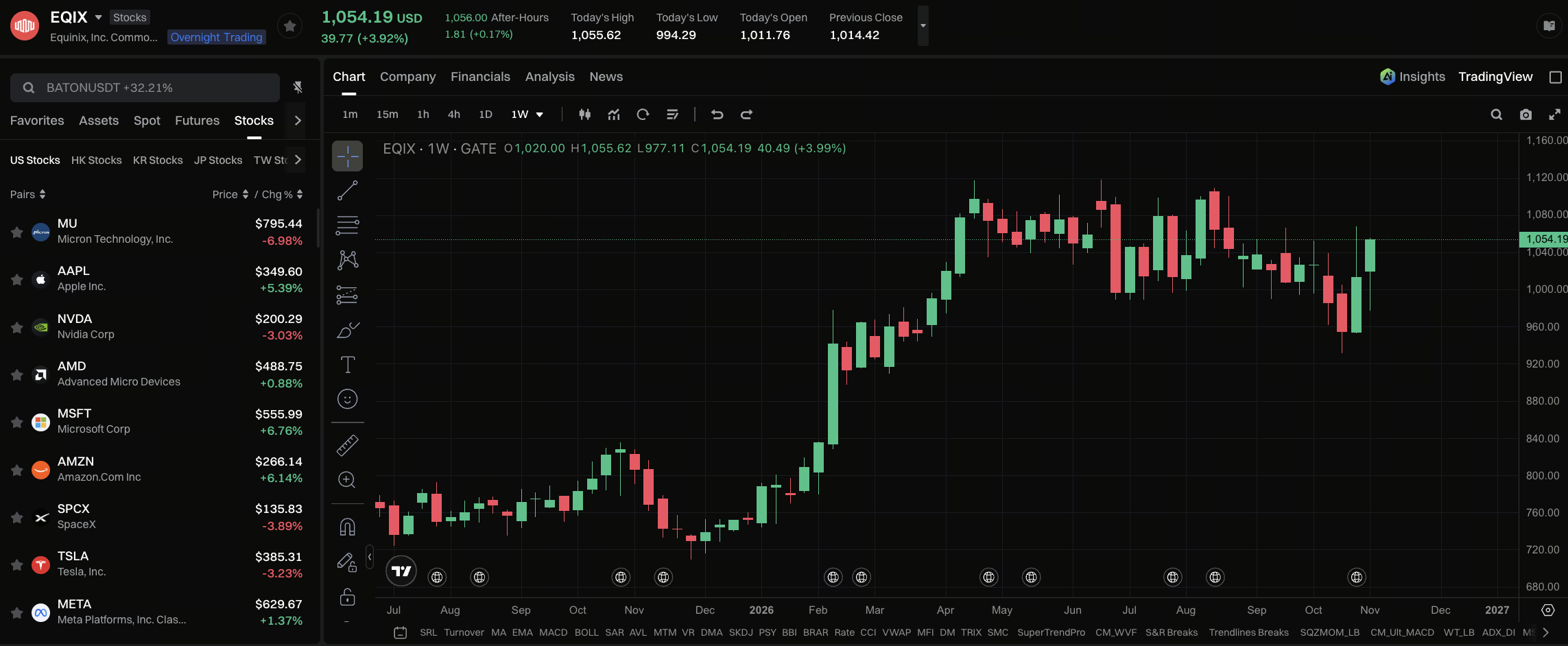
Equinix (NASDAQ: EQIX) is a representative data center REIT in the United States. Its stock price is affected by data center leasing demand, AI infrastructure investment, enterprise capital expenditures, and the interest rate environment. For users interested in AI computing infrastructure investment opportunities, in addition to analyzing Equinix's operating performance, they can use the U.S. stock trading services provided by Gate to review EQIX market data and related trading opportunities.
Gate has launched U.S. stock trading services that allow users to participate in eligible U.S.-listed stocks using USDT, subject to the platform's trading conditions. The services also provide functions such as market data viewing, order management, and position inquiries. Users can enter the Gate stock trading page and search for the stock symbol EQIX to view Equinix's price trends, trading information, and available trading methods. After confirming account eligibility, trading fees, and order rules, users can select the appropriate action based on their own needs. Whether a stock and specific product functions are supported is subject to the actual page display.
Please note that the U.S. stock spot, tokenized stock, and other stock-related trading products provided by Gate may differ in terms of asset characteristics, trading hours, settlement methods, and investor rights. Users should first confirm the type of product they are selecting and assess investment risks in light of Equinix's AFFO, occupancy, capital expenditures, and debt levels. Growing AI computing demand does not mean that EQIX's stock price will necessarily rise. Investors should continue to consider valuation changes, interest rate fluctuations, and data center construction cycles.
Conclusion
Data center REITs are an important asset class connecting real estate investment with digital infrastructure demand. By owning and operating data center facilities, these companies provide the physical space, power, cooling, and network connectivity required for cloud computing, internet services, and AI computing deployments, generating revenue through leasing and related services.
As AI infrastructure continues to develop, the investment value of data centers is no longer determined solely by floor area. Power capacity, cooling efficiency, network interconnection, and project delivery capabilities are becoming increasingly important factors. Companies such as Equinix and Digital Realty offer investors different perspectives for observing this industry chain.
However, data center REITs remain a form of real estate investment with capital-intensive characteristics. Growing AI demand does not mean that stock prices will necessarily rise. Investors need to analyze FFO, AFFO, capital expenditures, debt costs, and valuation levels rather than assessing investment value based solely on the AI theme.
FAQ
What Are Data Center REITs?
Data center REITs are Real Estate Investment Trusts that primarily invest in and operate data center real estate and related infrastructure. They generate revenue by providing enterprises with facility capacity, colocation, interconnection, and other services.
Are Data Center REITs Technology Stocks or Real Estate Stocks?
In the U.S. market, companies such as Equinix and Digital Realty are generally classified in the real estate sector. However, their businesses are closely connected to cloud computing, AI, and digital infrastructure, so they are also affected by changes in technology industry demand.
Does Growing AI Computing Demand Necessarily Benefit Data Center REITs?
Not necessarily. AI demand may increase demand for data center leasing, but the ultimate benefits also depend on power supply, construction costs, customer contracts, financing conditions, and market valuations.
What Is the Difference Between Equinix and Digital Realty?
Both companies operate data center infrastructure. Equinix places greater emphasis on colocation and its interconnection ecosystem, while Digital Realty has a significant presence in large-scale data center leasing and diversified colocation services. However, their businesses overlap.
Why Should Investors Consider AFFO When Analyzing REITs?
AFFO makes further adjustments to certain items based on FFO, helping investors understand a REIT's adjusted operating performance. However, the AFFO calculation methodology may differ among companies.
Which Is Less Risky: Data Center REITs or AI Chip Stocks?
There is no simple answer. AI chip stocks are more directly affected by technological competition and hardware procurement cycles, while data center REITs are affected by interest rates, financing costs, construction cycles, and customer demand. Their sources of risk are different.