In the past, AI infrastructure investment focused primarily on GPU performance, computing power demand, and capital expenditures. However, as large data centers continue to expand, grid capacity, cooling systems, construction permits, and community acceptance are gradually becoming important factors affecting project deployment. Even if a company has already purchased a large number of GPUs, this does not mean the equipment can be put into operation immediately. For companies across the AI industry value chain, such as NVIDIA, CoreWeave, and IREN, data center construction constraints may affect the pace of computing power deployment, capital utilization efficiency, and future revenue expectations.
This article examines the practical challenges facing AI computing power expansion, starting with the U.S. policy of suspending certain data center construction projects, and analyzes the potential impact of these changes on technology stock investments.
Key Takeaways
-
A Data Center Moratorium typically refers to a local government or regulatory authority limiting the approval of new projects for a certain period to assess their impact on energy, water resources, and land use. It does not mean that all data centers will stop operating.
-
In 2026, several regions in the United States implemented construction or permitting moratoriums of varying scopes. However, the policy duration, applicable projects, and exemption conditions differ.
-
Electricity supply is becoming a major constraint on AI data center expansion. The timing of GPU procurement, data center construction, and grid connections may not be aligned.
-
Data center construction restrictions may increase project delivery costs and timeline uncertainty for AI cloud computing companies. They may also increase the value of existing power resources and operational computing capacity.
-
The impact on AI infrastructure stocks needs to be assessed based on each company's actual project footprint, capital expenditures, customer contracts, and cash flow. Policy restrictions should not be equated directly with declining AI demand.
I. Why Has the United States Begun Suspending Certain Data Center Projects?
A Data Center Moratorium refers to a government or local regulatory authority temporarily suspending the acceptance, review, or approval of certain types of data center construction projects for a specified period. These policies are typically used to assess the impact of large facilities on electricity supply, water resources, the environment, and land-use planning, while allowing time to develop new construction standards.
As generative AI, large language models, and cloud computing services have developed rapidly, data centers have gradually evolved from traditional information storage facilities into critical infrastructure supporting high-density computing workloads. Large AI data centers typically need to deploy substantial numbers of GPU servers, along with power supply, cooling, networking, and backup power systems. This means data center construction is no longer simply a matter of real estate development or server procurement. It is a comprehensive project involving local energy and public infrastructure.
Some regions have become concerned that concentrated construction of large data centers could cause electricity demand to grow faster than the grid's expansion capacity, while also increasing water consumption and infrastructure costs. If the costs of new transmission lines, substations, and other facilities are passed on to ordinary residents and other businesses, data center investment could also trigger public interest disputes.
Accordingly, the primary purpose of a construction moratorium is generally not to reject AI technology or the cloud computing industry, but to clarify rules governing resource use, cost sharing, and environmental protection before projects expand further. For data centers that are already operational, these measures typically do not directly require them to stop providing services. However, new construction, expansions, and projects with incomplete permitting may be affected.
II. Which U.S. Regions Have Implemented Data Center Construction Restrictions in 2026?
In 2026, data center regulation in the United States showed a trend of expanding from local land-use planning to state-level infrastructure policy. The measures adopted by different regions vary. Some suspended construction permits, some restricted projects above a certain size, and others primarily adjusted tax incentives or grid connection requirements.
New York State is a representative state-level example. On July 14, 2026, New York State announced a moratorium of up to one year on environmental permits for certain new hyperscale data centers. While a unified environmental impact assessment framework is being developed, relevant departments will not issue certain discretionary permits for projects that have not completed the application process. The policy focuses on electricity demand, water resources, air quality, and related infrastructure costs, rather than imposing a permanent ban on all data centers across the state.
Oklahoma City approved temporary suspension measures on April 21, restricting applications related to new data center construction or expansion, rezoning approvals, and permit issuance. The measures are scheduled to remain in effect through December 31, 2026, or end earlier if new land-use regulations are approved. Exceptions have been established for two projects that had already entered the approval process.
Raleigh, North Carolina, approved a six-month development approval moratorium on October 6. The primary purpose is to study the impact of large data centers on nearby properties, public resources, and city infrastructure, while improving subsequent regulatory rules. The city plans to advance revisions to the relevant planning ordinances during the moratorium.
| Region |
Policy Timing |
Main Measure |
Policy Nature |
| New York State |
July 2026 |
Suspend environmental permits for certain new hyperscale data centers |
Up to one year |
| Oklahoma City |
April 2026 |
Suspend related new applications, rezoning, and permitting processes |
Temporary measure with exemptions |
| Raleigh |
October 2026 |
Suspend data center development approvals |
Six months |
These cases show that data center regulation in the United States is becoming highly localized. Companies cannot assess project feasibility solely by determining whether a state supports the AI industry. They must also analyze the land-use planning, power connection, and environmental permitting conditions in the specific city where a project is located.
It is important to distinguish between construction moratoriums, permanent bans, grid connection delays, and adjustments to tax incentives. These policy tools may all increase project costs, but their direct effects on companies are not the same.
III. Why Is Electricity Supply a Core Bottleneck for AI Computing Power Expansion?
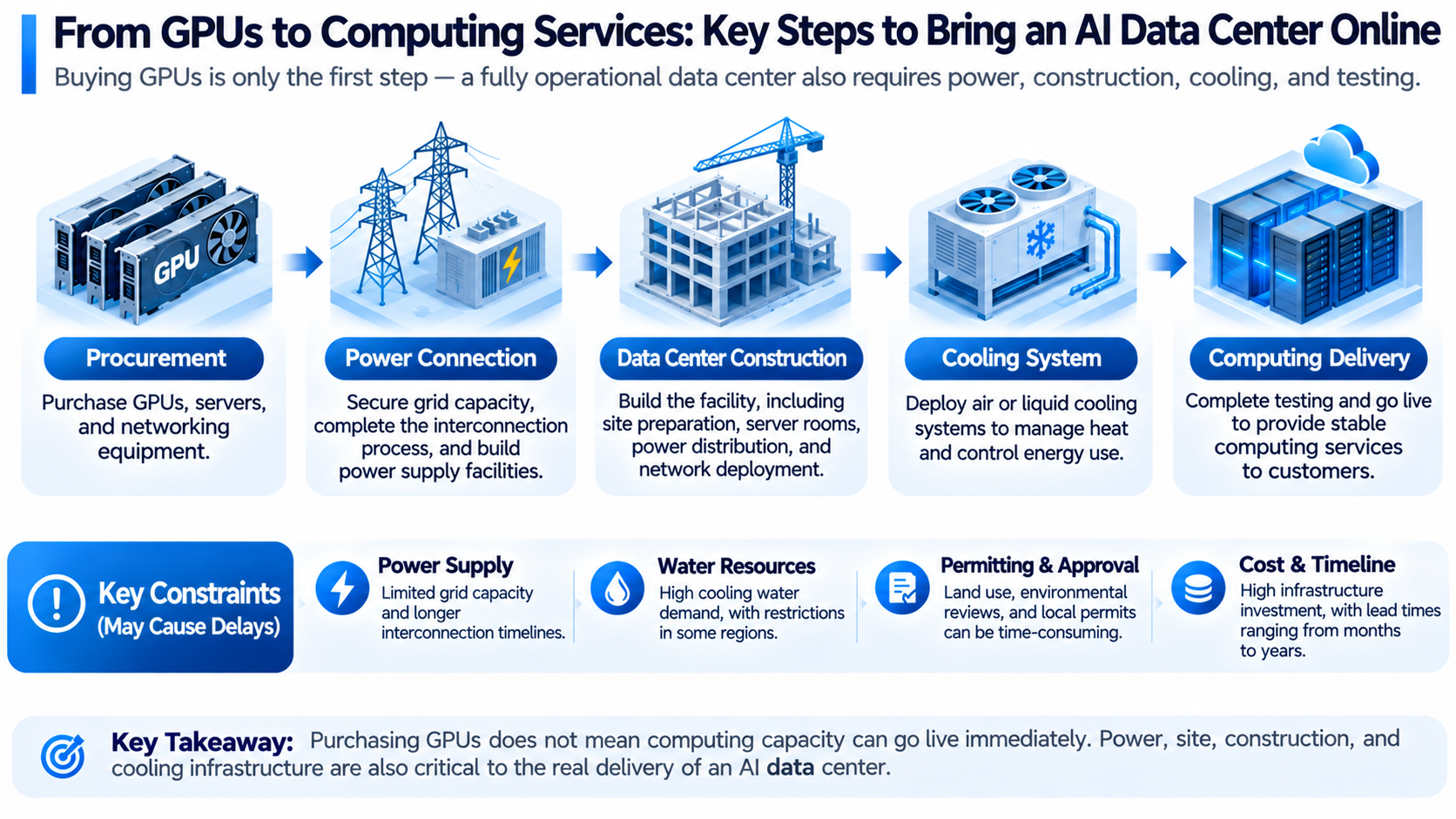
One of the key differences between AI data centers and traditional data centers is the continuously increasing power density of computing equipment and overall electricity demand. As high-performance GPU clusters grow, data centers need not only more servers but also grid connections, transformers, distribution systems, and backup power capable of providing a stable and continuous electricity supply.
A large data center typically goes through multiple stages from planning to actual operation, including land development, facility construction, equipment procurement, grid connection, and system testing. The construction timeline for power infrastructure may not align with GPU procurement or the growth of customer orders.
For example, an AI cloud computing company may have already signed long-term customer contracts and planned to deploy a new GPU cluster. However, if the region where the project is located lacks sufficient grid capacity, the company may still need to wait for a substation expansion, transmission line construction, or other connection work to be completed. During this period, some capital has already been invested, but the corresponding computing capacity has not yet been converted into deliverable services.
For utilities and local governments, another issue is how to share the costs of additional infrastructure. Large data centers may require dedicated power facilities, but these investments often have long economic lives. If a data center operator later scales back the project, the related infrastructure may be underutilized.
As a result, regulators are paying closer attention to whether data centers bear an appropriate share of grid construction costs and whether their electricity demand will affect power prices for local residents and other businesses.
From an industry perspective, power constraints may change the competitive dynamics of AI infrastructure. In the past, companies primarily competed based on their ability to procure GPUs and raise financing. In the future, companies with stable electricity supplies, completed permits, and mature operational facilities may also gain more important competitive advantages.
IV. Why Do Water Resources and Cooling Systems Also Affect Data Center Approvals?
In addition to electricity, cooling systems are critical infrastructure for large AI data centers. GPU servers generate substantial heat when operating under heavy loads and require air cooling, liquid cooling, or other thermal management solutions to maintain normal operation.
Different cooling technologies have significantly different resource requirements. Some evaporative cooling systems consume substantial amounts of water, while certain closed-loop liquid cooling solutions can reduce direct on-site water consumption. However, they still require comprehensive consideration of equipment power consumption, heat dissipation efficiency, and system construction costs.
In regions facing water shortages, data center projects may compete with residential use, agriculture, and other industrial activities for water resources. Local governments therefore need to assess a project's long-term water consumption, water sources, and the availability of resources under extreme weather conditions.
The choice of cooling technology can also affect a data center's energy efficiency. For example, a solution that uses less water may not necessarily reduce total energy consumption. More efficient liquid cooling systems may also require additional facility upgrades and upfront capital investment.
As a result, the actual construction cost of a data center depends not only on the prices of servers and GPUs but also on the local climate, water supply conditions, electricity prices, and cooling technology.
For AI infrastructure companies, balancing energy efficiency, cooling capacity, and resource use may help improve the likelihood of project approval and lower long-term operating costs.
V. How Will a Data Center Construction Moratorium Affect the Revenue and Costs of AI Computing Power Companies?
For AI cloud computing companies, the most direct potential impact of a data center construction moratorium is a change in the timing of new computing power deployment and customer delivery. Companies typically need to invest in data center facilities, servers, and GPUs in advance while signing computing service contracts with customers for specified terms. If a data center cannot become operational as originally planned, the time gap between capital expenditures and revenue generation may widen.
This impact can be understood in three areas.
-
Construction costs. If a project requires new permits, cooling system adjustments, or greater contributions to grid upgrades, its initial investment may increase.
-
Delivery timelines. If power connections or construction approvals are delayed, a company may need to adjust its equipment installation and customer service plans.
-
Financing pressure. Some AI infrastructure companies rely on debt financing or other external capital to support expansion. If a project becomes operational later than expected, the matching between interest expenses and cash flow may be affected.
However, data center construction restrictions do not necessarily lead to lower company revenue. For companies that are already operational and have stable power supplies and long-term customer contracts, restrictions on new competing projects may instead make existing computing resources more scarce. If market demand remains strong, operational data centers may achieve higher capacity utilization and stronger pricing conditions.
Accordingly, the impact of a construction moratorium on the AI computing power industry may vary. Projects still in the development stage or dependent on new power connections face greater uncertainty, while operators with completed infrastructure may have a relative advantage.
This difference also means investors cannot determine a company's future revenue growth simply by looking at how many GPUs it plans to purchase or how many megawatts of data center capacity it has announced. Actual available power, project construction progress, and customer delivery capabilities are equally important.
VI. How Will CoreWeave, IREN, and NVIDIA Be Affected Differently?
Although CoreWeave, IREN, and NVIDIA are all connected to AI computing power infrastructure, the three companies occupy different positions in the industry value chain and therefore face different data center construction risks.
CoreWeave (CRWV) primarily provides cloud computing infrastructure for AI workloads. Its business growth is closely tied to GPU cluster deployment, data center capacity, and customer demand for computing power. For CoreWeave, data center construction restrictions may affect the launch timeline for new facilities and increase uncertainty around power connections and project delivery. If the company has already arranged financing and equipment procurement for the relevant projects, construction delays could also affect capital utilization efficiency.
IREN (IREN) is expanding from Bitcoin mining into AI cloud computing infrastructure. Both Bitcoin mining and AI data centers require large-scale power supplies, but they differ significantly in equipment configuration, networking requirements, cooling systems, and customer service models. IREN's existing power resources and data center development experience may provide a foundation for expanding its AI business. However, existing mining capacity does not mean it can be directly converted into computing capacity for AI customers. The company still needs to invest in infrastructure that meets the requirements of GPU computing.
NVIDIA (NVDA) operates upstream in the industry value chain and primarily provides GPUs, networking equipment, and related computing platforms to cloud computing companies and other customers. Compared with operators that directly build data centers, NVIDIA may not bear responsibility for land-use approvals or grid connections for specific projects. However, changes in customer construction plans could affect the pace of product procurement. If some data center projects are delayed, the delivery schedules for related GPU orders may be adjusted. At the same time, upgrades to existing data centers and computing investments in other regions could create new demand.
| Company |
Industry Position |
Key Metrics to Monitor |
| CoreWeave (CRWV) |
AI cloud computing service provider |
GPU deployment scale, customer contracts, capital expenditures, financing costs |
| IREN (IREN) |
Data center and AI cloud infrastructure operator |
Available power, project construction progress, AI cloud revenue, cash flow |
| NVIDIA (NVDA) |
GPU and computing platform supplier |
Data center revenue, customer capital expenditures, product delivery demand |
At present, these impacts primarily represent operating risk considerations. They do not mean that the companies listed above have already experienced project delays or revenue losses of the same magnitude as a result of specific construction moratoriums.
From an investment perspective, a company's position in the industry value chain determines how risks are transmitted. Data center operators are more directly affected by land, power, and permitting constraints, while upstream chip suppliers are more affected by customer capital expenditures and equipment procurement cycles.
VII. Will Data Center Construction Restrictions Make AI Computing Power More Scarce?
Data center construction restrictions may change the supply and demand dynamics of AI computing power. However, the specific outcome depends on the scope and duration of the restrictions and on whether companies can increase computing capacity through other means.
If demand for AI model training, inference, and enterprise applications continues to grow while the pace of new data center construction slows, deliverable computing resources may become more constrained in the short term. In this situation, companies with existing power supplies, mature facilities, and available GPU clusters may gain certain advantages.
However, computing power supply does not depend entirely on new data center construction. Companies can also increase computing capacity by upgrading existing servers, improving GPU utilization, optimizing model inference efficiency, and shifting some workloads to other regions.
In addition, computing power prices are affected by GPU product upgrades, market competition, and changes in customer demand. Even if some regions restrict data center construction, it cannot be directly inferred that global GPU rental prices will necessarily rise.
Another development worth watching is data center site selection. In the past, large cloud computing facilities often prioritized network connectivity, proximity to customers, and operating costs. As electricity becomes a more important constraint, some companies may place greater emphasis on regions with sufficient power, scalable land, and clearer approval processes.
This could encourage AI data centers to move toward new sources of energy supply. It could also increase the commercial value of existing industrial facilities, power infrastructure, and sites suitable for conversion.
However, relocating data centers is not cost-free. New sites must still meet requirements related to network latency, equipment transportation, operations and maintenance, and customer service. Therefore, construction restrictions are more likely to change the regional distribution and investment pace of AI infrastructure than to simply bring the industry's expansion to an end.
VIII. How Should Investors Assess the Risks of Data Center Construction Restrictions?
For investors focused on AI infrastructure stocks, data center construction moratoriums offer an opportunity to reassess the quality of company growth. A company's announced computing power plans, data center capacity, and long-term contract value can gradually translate into actual revenue and cash flow only after the relevant infrastructure becomes operational as planned.
Investors need to distinguish between planned capacity and operational capacity. For example, when a company announces plans to develop hundreds of megawatts of data center capacity, this does not mean that the capacity has already been built, connected to the power grid, or is ready for immediate GPU deployment. Investors should assess whether the project has obtained key permits, whether the power connection has been secured, and when the project is expected to begin generating revenue.
Investors also need to analyze the relationship between capital expenditures and cash flow. AI infrastructure is a capital-intensive industry, and companies may need to pay substantial equipment and construction costs before revenue is generated. If a project is delayed, depreciation, interest, and other costs may emerge before revenue growth.
The specific terms of customer contracts also require attention. Long-term contracts can improve the predictability of future revenue, but contract value does not equal realized revenue. Whether customers have minimum purchase commitments, whether delivery timelines are clearly defined, and whether delays involve additional costs may all affect actual operating performance.
Investors should also distinguish between short-term market sentiment and long-term industry demand. A data center construction moratorium may cause investors to worry that AI infrastructure expansion will slow. However, if demand for AI applications continues to grow, the industry may still find new growth opportunities by improving the utilization of existing facilities, adjusting construction locations, and improving energy efficiency.
For different companies, regulatory restrictions may increase costs and alter the competitive landscape. Rather than simply determining whether a policy is favorable or unfavorable, it is more important to analyze whether a company can continue delivering economically viable computing services under limited power, capital, and construction resources.
Conclusion
The suspension of certain data center construction projects in multiple parts of the United States in 2026 reflects the fact that AI infrastructure expansion is gradually moving beyond pure investment in computing equipment. Its development is increasingly being determined jointly by electricity, land, water resources, and regulatory conditions.
As large GPU clusters continue to be deployed, data center projects require not only sufficient capital and customer demand but also stable power supplies, appropriate cooling systems, complete construction permits, and support from local communities. Delays at any stage may affect the timing of computing power deployment and capital utilization efficiency.
The impact of data center construction restrictions differs for AI industry companies such as CoreWeave, IREN, and NVIDIA. Companies that directly operate data centers may face more apparent construction and delivery risks, while upstream chip suppliers are primarily affected indirectly by changes in customer investment cycles. At the same time, companies with existing power resources and operational computing capacity may gain a relative advantage when new supply is constrained.
Over the long term, competition in the AI computing power industry will depend not only on which companies have more GPUs but also on which companies can secure electricity at a reasonable cost, complete infrastructure construction, and convert computing capacity into recurring operating revenue.
FAQ
What Does Data Center Moratorium Mean?
Data Center Moratorium refers to a suspension of data center construction measures, typically implemented by governments or local regulatory authorities. These measures suspend construction permits, planning approvals, or application processing for certain data center projects for a specified period to assess their impact on energy, water resources, and land use.
Has the United States Completely Banned the Construction of AI Data Centers?
No. Some states and local governments in the United States have implemented restrictions of varying scopes, but there is no uniform construction ban covering all AI data centers nationwide. The specific measures depend on the region, project size, and permitting status.
Why Do AI Data Centers Require So Much Electricity?
AI model training and inference require large amounts of high-performance computing equipment to operate continuously. They also require supporting facilities such as cooling systems, networking, and backup power. As a result, large GPU clusters can create substantial ongoing electricity demand.
Will a Data Center Construction Moratorium Affect NVIDIA Stock?
It could have an indirect impact. If customers' data center construction projects are delayed, GPU procurement and delivery plans may change. However, NVIDIA serves customers across multiple regions and industries, so a single local policy will not necessarily determine its overall performance.
Can IREN's Existing Bitcoin Mining Facilities Be Directly Converted Into AI Data Centers?
Not necessarily. Bitcoin mining facilities and AI data centers both require power infrastructure, but AI computing typically has different requirements for servers, networking, cooling, and operational reliability. Whether existing facilities can be converted depends on their specific technical conditions and the cost of upgrades.
Will Data Center Construction Restrictions Cause AI Computing Power Prices to Rise?
This is possible but not inevitable. If new computing power supply slows while demand continues to grow, some computing resources may become more constrained. However, computing power prices are also affected by GPU technology upgrades, improved utilization, market competition, and new supply from other regions.