Unlike the previous approach, under which the government primarily held cryptocurrency through judicial forfeiture, asset custody, and disposal procedures, this policy is the first to explicitly propose at the federal level incorporating a portion of BTC into a long-term reserve system.
On March 6, 2025, Trump signed Executive Order 14233, formally establishing two management frameworks: the Strategic Bitcoin Reserve and the U.S. Digital Asset Stockpile. The order requires BTC included in the Strategic Bitcoin Reserve to be retained, while allowing the Treasury Department and Department of Commerce to explore acquisition strategies that do not impose additional costs on taxpayers. However, establishing the policy framework does not mean that the U.S. government has received full authorization to use public funds to purchase Bitcoin directly.
Entering 2026, the actual operation of the U.S. Strategic Bitcoin Reserve still faces questions involving legal authority, departmental responsibilities, and funding sources. Market attention has also shifted from whether the United States is willing to hold BTC to whether the government can actually execute additional purchases. This article analyzes how the U.S. Strategic Bitcoin Reserve operates, what budget-neutral acquisition means, and what issues must still be resolved before the policy can move from an executive order to actual market purchases.
Key Takeaways
-
The United States has established a Strategic Bitcoin Reserve policy, but this does not mean large-scale market purchases have begun. Establishing the reserve, consolidating government assets, and making new purchases are separate stages.
-
The initial reserve mainly consists of BTC that the government has legally forfeited and ultimately acquired ownership of. Transferring these assets to the reserve does not necessarily create new market demand.
-
Budget neutrality is an important condition for new purchases. The executive order requires related strategies not to impose additional incremental costs on U.S. taxpayers.
-
Executive orders and congressional legislation are different. A large-scale purchase program may require clearer fiscal authorization, legal authority, and implementation rules.
-
BTC and other digital assets have different policy statuses. The Strategic Bitcoin Reserve emphasizes long-term holding, while the Digital Asset Stockpile follows a different management approach.
-
The reserve's impact on the price of BTC depends on actual implementation. Reducing potential government selling pressure and actively adding spot buying demand are two different market mechanisms.
What Is the U.S. Strategic Bitcoin Reserve? Why Does the Government Want to Hold BTC Long Term?
The U.S. Strategic Bitcoin Reserve is a policy framework for centrally managing eligible BTC held by the federal government and retaining it as a long-term reserve asset.
Before this, the U.S. government already held substantial digital assets through criminal investigations, civil asset forfeiture, and law enforcement procedures. These assets may have been connected to illicit transactions, financial crimes, or other judicial cases. Their eventual disposition is generally subject to asset forfeiture laws, judicial procedures, and government management regulations.
The change introduced by the Strategic Bitcoin Reserve is that the government no longer treats eligible BTC solely as forfeited assets awaiting disposition. Instead, it expressly assigns them a long-term reserve function.
The executive order issued in March 2025 stated that Bitcoin's capped supply and scarcity characteristics warranted research into its value as a strategic reserve asset for the United States. Under the order, the Treasury Department is responsible for establishing the relevant management framework and incorporating eligible government-held BTC into the Strategic Bitcoin Reserve. BTC already included in the reserve generally may not be sold and must be used for government purposes in accordance with applicable laws.
However, long-term reserve status does not mean that the government may hold or transfer all forfeited assets without restriction. Some assets may be subject to victim compensation, judicial restitution, law enforcement funds, or other legal obligations. Therefore, all BTC controlled by the government cannot be treated as assets that may be freely incorporated into the reserve.
This means that the U.S. Strategic Bitcoin Reserve is first a government asset management policy and only secondarily involves potential future purchases.
Why Doesn't Establishing the Strategic Reserve Mean the United States Has Started Buying BTC?
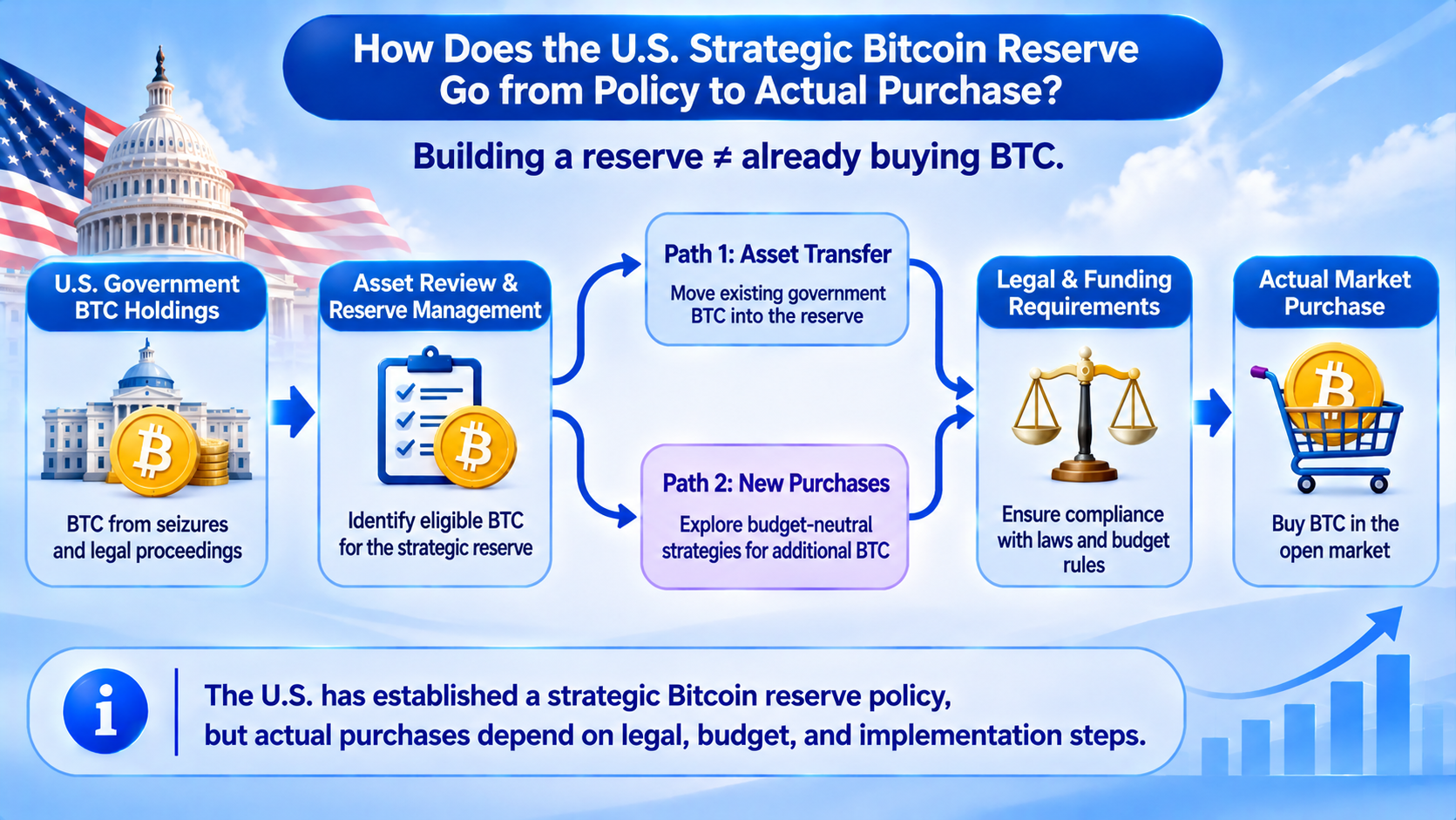
Understanding the U.S. Bitcoin reserve policy requires distinguishing three stages: establishing the policy framework, consolidating existing assets, and executing new purchases.
The first stage is to establish the policy direction through an executive order. The executive order signed in March 2025 completed this stage by setting the policy objectives and basic management requirements for the Strategic Bitcoin Reserve.
The second stage is to inventory and consolidate the government's existing BTC. Federal agencies must confirm the amount held, asset ownership, custody accounts, and relevant legal restrictions, and determine which assets can be transferred to the Strategic Bitcoin Reserve.
Only the third stage involves new purchases. The government must clarify the funding source, purchasing authority, executing entity, and related accounting and legal arrangements before it can convert the policy intent into actual purchases.
These three stages have significantly different market impacts. If the government merely transfers BTC it already holds from existing accounts into the Strategic Bitcoin Reserve, this generally does not directly create new spot demand. The ownership of the relevant assets has not materially changed; only the management purpose and holding arrangements have changed.
If the government decides to stop selling some BTC that might otherwise have been disposed of, this could reduce potential future supply, but it still does not constitute new market buying.
Only when the government actually uses funds to purchase BTC in the market does it directly create new demand.
As of July 2026, discussions remain ongoing regarding the departmental responsibilities and legal authority under the management structure of the U.S. Strategic Bitcoin Reserve. The roles of the Treasury Department and Department of Commerce in the relevant arrangements have also drawn attention. This indicates that specific operational and legal issues still need to be resolved after the policy was established. Therefore, the market cannot infer solely from the U.S. announcement that it has established a reserve that the government has begun making sustained BTC purchases.
What Is Budget-Neutral Acquisition? Why Has It Become a Key Condition for Increasing BTC Holdings?
Budget-neutral acquisition is an important concept in the U.S. Strategic Bitcoin Reserve policy.
Executive Order 14233 requires the Treasury Department and Department of Commerce to develop strategies for increasing the government's BTC holdings, but expressly states that these strategies must comply with the principle of budget neutrality and may not impose additional incremental costs on U.S. taxpayers. Simply put, the government cannot rely solely on this executive order to authorize a new taxpayer-funded expenditure for purchasing Bitcoin.
Budget neutrality does not mean that purchasing BTC has no cost at all. It means that the relevant proposal must satisfy policy restrictions concerning its budget impact. For example, the government may explore obtaining BTC by adjusting existing asset allocations, using specific lawful revenue sources, or adopting other approaches that comply with budget rules. These are only possible policy design directions and do not mean that such methods have been approved or implemented.
Opportunity costs are also involved. Suppose the government sells an existing asset to obtain funds and then uses those funds to purchase BTC. Even if this does not increase nominal government spending, it means the government has given up potential returns or other uses associated with the original asset.
Different assets and funding sources may be subject to separate legal restrictions. The fact that an asset belongs to the government does not mean that an executive agency may independently sell it and use the proceeds to purchase Bitcoin. Therefore, budget-neutral acquisition must simultaneously satisfy requirements including lawful funding sources, compliant fiscal treatment, and clearly defined implementation authority. This is why the principle of budget neutrality leaves room for future increases in BTC holdings but cannot be understood as granting the government unlimited purchasing authority.
Why Can't an Executive Order Directly Resolve the Legal Issues Involved in Purchasing Bitcoin?
A U.S. presidential executive order can direct federal executive agencies to act within their existing legal authority, but it cannot automatically replace Congress's responsibilities regarding appropriations and legislation.
Executive Order 14233 expressly requires the relevant measures to comply with existing laws and remain subject to available appropriations. Therefore, even if the executive branch wants to expand the Bitcoin reserve, it must confirm whether the relevant agencies have statutory authority to purchase, custody, and hold digital assets over the long term.
-
Funding sources. If the government wants to use public funds to purchase BTC, it must determine whether existing laws permit the relevant expenditure and whether Congress must provide additional authorization.
-
Asset management responsibilities. The Treasury Department, Department of Commerce, and other federal agencies have different functions. The responsible entities for custody, auditing, financial reporting, and risk management related to the Strategic Reserve must be clearly defined.
In addition, Bitcoin is highly volatile. The government's long-term holding of BTC also involves asset valuation, financial reporting, risk disclosure, and management responsibilities. Proposals to institutionalize a Strategic Bitcoin Reserve have already emerged in the U.S. Congress. For example, the BITCOIN Act proposes expanding the government's BTC holdings through a long-term purchase program. However, the introduction of a bill, committee consideration, and its eventual enactment into law are separate procedures.
Therefore, an executive order can establish a policy direction, but it may not be sufficient to support a large-scale, long-term, and binding government purchase program.
Where Does the U.S. Government's Existing BTC Come From? Why Can't It All Be Treated as Part of the Strategic Reserve?
The BTC held by the U.S. government primarily comes from criminal and civil asset forfeiture, law enforcement actions, and related legal procedures. In cases involving digital assets, law enforcement agencies may first seize the cryptocurrency and then determine ownership through judicial proceedings. However, seizure, forfeiture, and the government's final acquisition of ownership are not the same legal stage.
For example, although a batch of BTC may already be under government control, it cannot simply be treated as a strategic reserve asset that the government may hold over the long term if the relevant case is still pending or the assets must be returned to their lawful owner. Executive Order 14233 also distinguishes between government-held BTC that qualifies for the reserve and assets that remain subject to other legal requirements.
This means that the U.S. government's BTC balance tracked by external blockchain data platforms does not necessarily equal the actual size of the Strategic Bitcoin Reserve. Blockchain analysis can identify some wallet addresses associated with the government, but uncertainties remain regarding address ownership, custody structures, the legal status of assets, and the interpretation of on-chain transfers. As of 2026, public market tracking data provides different estimates of the amount of BTC held by the U.S. government, but these figures cannot be directly treated as Strategic Reserve balances audited by the Treasury Department.
Accordingly, when evaluating the size of the U.S. Strategic Reserve, it is necessary to distinguish between government-controlled assets, assets ultimately forfeited to the government, BTC eligible for inclusion in the reserve, and assets that have actually been transferred into the reserve.
What Is the Difference Between the Strategic Bitcoin Reserve and the U.S. Digital Asset Stockpile?
The U.S. government established two different digital asset management frameworks in the same executive order. The Strategic Bitcoin Reserve specifically covers BTC, while the U.S. Digital Asset Stockpile manages eligible government-held digital assets other than BTC.
The most important difference lies in their asset management objectives and rules for obtaining additional assets.
| Comparison Category |
Strategic Bitcoin Reserve |
Digital Asset Stockpile |
| Asset scope |
BTC |
Digital assets other than BTC |
| Primary source |
Eligible government-forfeited assets |
Eligible government-forfeited assets |
| Policy objective |
Long-term strategic holding |
Centralized and orderly management |
| Additional acquisitions |
Budget-neutral acquisitions may be explored |
Active purchases are generally prohibited unless further authorization is provided |
| Asset sales |
BTC included in the reserve generally may not be sold |
A disposal strategy may be established in accordance with the law |
In March 2025, Trump publicly mentioned assets including XRP, SOL, ADA, BTC, and ETH, prompting discussion about the composition of a U.S. cryptocurrency reserve. However, the formal executive order did not require the government to actively purchase these tokens, nor did it grant all digital assets the same long-term reserve status as BTC.
For non-BTC assets such as ETH, XRP, SOL, and ADA, the relevant arrangements primarily fall within the management scope of the Digital Asset Stockpile. Their actual inclusion still depends on whether the government lawfully holds the corresponding assets. Therefore, the establishment of a Strategic Bitcoin Reserve should not be interpreted as meaning that the government will simultaneously purchase all of the cryptocurrencies previously mentioned.
If the United States Actually Purchases BTC in the Future, How Could It Affect the Market?
New BTC purchases by the U.S. government could affect Bitcoin's price through spot demand, market expectations, and the long-term supply structure. The actual effect would depend on the purchase size and execution method.
-
Direct purchase demand. If the government uses lawful funds to purchase BTC in the market, it will increase spot demand during the relevant period. When the purchase volume is large and market liquidity is limited, it could push prices higher. However, if the government purchases in stages, uses over-the-counter transactions, or adopts another execution method, the short-term market impact may differ from that of concentrated purchases in the open market.
-
Reduced potential selling pressure. The Strategic Reserve policy requires eligible BTC to be retained over the long term, which could reduce the likelihood that some government-held assets will be sold in the future. However, reducing potential supply and making new purchases are different economic mechanisms. The former affects expectations regarding future selling, while the latter directly increases purchase demand.
-
Changes in policy expectations. If the United States formally adopts a long-term accumulation plan, it could affect policy discussions among other governments, institutional investors, and asset managers. However, this demonstration effect is uncertain, and it cannot be assumed that other countries will adopt the same strategy.
-
Advance market pricing. Bitcoin's price is influenced not only by actual capital flows but also by investors' expectations regarding future policy. If the market has already priced in expectations of government accumulation, the eventual implementation of a purchase program may not necessarily trigger a sustained increase.
Conversely, if policy progress falls short of expectations, the market may reassess previous optimistic pricing.
Therefore, assessing the impact of the Strategic Reserve on the price of BTC requires distinguishing four stages: policy announcement, legal authorization, funding allocation, and actual purchases.
What Signals Should Investors Watch to Determine Whether the United States Has Actually Started Increasing Its BTC Holdings?
For investors following the U.S. Strategic Bitcoin Reserve, the most important consideration is not simply whether political figures express support again, but whether the relevant policy shows verifiable implementation progress.
-
Congressional legislation. Bills involving long-term purchase targets, funding sources, and government asset management authority may provide a clearer legal basis for subsequent implementation if formally enacted.
-
Specific arrangements by the Treasury Department and Department of Commerce. These include budget-neutral strategies, funding sources, custody mechanisms, and the division of relevant responsibilities.
-
Actual purchase information released by the government. Formal purchase announcements, verifiable transaction records, or audit reports would provide a stronger basis for determining whether the government has created new BTC demand.
-
The distinction between government wallet transfers and purchases. Large BTC transfers from government addresses may involve custody adjustments, judicial disposition, or internal asset transfers. They do not necessarily indicate buying or selling.
-
Market liquidity and institutional capital flows. Even if the government launches a purchase program, its market impact will still depend on the purchase volume, execution timeline, and trading activities of other market participants during the same period.
Ordinary investors should also avoid treating a long-term policy objective as a short-term trading signal.
The U.S. Strategic Bitcoin Reserve has a lengthy policy implementation cycle and may be affected by legal review, fiscal conditions, and changes in the political environment. Even if the policy direction remains unchanged, the timing and scale of actual purchases may be adjusted.
Therefore, a more appropriate analytical approach is to continuously monitor verifiable policy and funding developments rather than infer solely from market rumors that the government has begun purchasing BTC.
Conclusion
The U.S. Strategic Bitcoin Reserve established its policy framework through the executive order issued in March 2025. However, establishing the reserve does not mean that the U.S. government has begun making large-scale BTC purchases. The policy initially targets Bitcoin that the government has legally forfeited and ultimately acquired ownership of, requiring eligible assets to be managed as a long-term reserve. For new purchases, the executive order imposes a budget-neutrality condition, requiring related strategies not to impose additional incremental costs on taxpayers.
This leaves the U.S. government's accumulation of BTC facing multiple issues involving funding sources, executive authority, departmental responsibilities, and congressional legislation. Even if the government holds a substantial amount of Bitcoin, it must distinguish between assets already under its control, assets eligible for inclusion in the reserve, and new assets actually purchased in the market.
For the crypto market, the Strategic Reserve may reduce some potential selling pressure from government-held BTC, but only actual new purchases will directly create market demand. Policy expectations can affect market sentiment, but they cannot replace real capital flows.
Therefore, determining whether the U.S. Strategic Bitcoin Reserve can become a long-term source of demand for BTC depends not on whether the government expresses support, but on whether the relevant legal, funding, and implementation mechanisms are ultimately put into effect.
FAQ
Has the United States officially established a Strategic Bitcoin Reserve?
On March 6, 2025, the United States established the Strategic Bitcoin Reserve policy through Executive Order 14233, but the specific management and accumulation mechanisms still require further implementation.
Why Can't the United States Directly Use Public Funds to Purchase BTC?
Government spending and asset management must comply with existing laws and fiscal authorization. The executive order requires new purchase strategies to remain budget-neutral and cannot be treated as unlimited purchasing authority.
What Is Budget-Neutral Acquisition?
Budget-neutral acquisition means that a new BTC acquisition program may not impose additional incremental costs on U.S. taxpayers. The specific funding source and implementation method must still comply with relevant legal requirements.
Does All BTC Held by the U.S. Government Belong to the Strategic Reserve?
Not necessarily. Digital assets controlled by the government may be subject to judicial proceedings, victim compensation, and other legal restrictions. All government holdings cannot be directly treated as the balance of the Strategic Reserve.
Does the U.S. Strategic Reserve Include XRP, ETH, and SOL?
The formal policy designates BTC separately as the asset of the Strategic Bitcoin Reserve. Other eligible government-held digital assets are managed through the Digital Asset Stockpile. The executive order does not require the government to actively purchase XRP, ETH, or SOL.
Will the United States Purchase 1 Million BTC in the Future?
Some legislative proposals have included long-term purchase targets, but a proposal is not the same as an effective purchase program. Actual purchases still depend on legal authorization, funding arrangements, and policy implementation.
Would a U.S. BTC Purchase Program Push Bitcoin Higher?
It could increase market demand, but the price impact would depend on the actual purchase volume, execution method, market liquidity, and investor expectations. It cannot be guaranteed that BTC will rise.