On November 16, 2026, the U.S. Department of Commerce announced further restrictions on exports of advanced AI chips and overseas access to computing capacity, which officially took effect on November 19. The new rules add licensing requirements for certain advanced computing chips and related servers shipped to Malaysia, Singapore, Thailand, Indonesia, and Brazil. They also introduce new restrictions on overseas data centers providing large-scale computing capacity to companies in China and other restricted regions. Following the policy announcement, shares of Southeast Asian data centers and related technology companies came under significant pressure as the market began reassessing the growth prospects of local AI infrastructure investment.
The policy changes affect not only chip suppliers such as NVIDIA and AMD, but may also be transmitted through equipment procurement, customer demand, financing costs, and project delivery schedules to cloud computing providers, server manufacturers, power equipment suppliers, and data center operators. However, the impact will vary by company. This article analyzes which parts of the value chain face direct risks, which areas of demand may remain resilient, and how investors should assess order fulfillment and long-term cash flow for related companies, based on export control mechanisms, Southeast Asian data center business models, and industry structure.
Key Takeaways
-
The latest U.S. export controls cover not only the cross-border transportation of advanced AI chips but also the provision of large-scale computing services by certain overseas data centers to companies in restricted regions.
-
Malaysia, Singapore, Thailand, and Indonesia are affected by new licensing requirements. This does not mean that all chip purchases or data center construction projects are prohibited.
-
Advanced computing chip suppliers such as NVIDIA and AMD face risks related to order approvals and changes in customer composition. The actual impact will depend on product specifications, customer identities, and licensing outcomes.
-
Regional cloud service providers that rely on renting GPU computing capacity to customers in restricted regions may face more direct operating pressure than large cloud computing companies with diversified customer bases.
-
Data center construction, power equipment, cooling systems, and network infrastructure continue to have long-term demand. However, project delays may change the timing of revenue recognition and order fulfillment for related companies.
-
Investors need to distinguish between planned data center investment, actual capital expenditures, equipment delivery, rack utilization, and operating cash flow. Construction scale should not be treated as equivalent to profitability.
Why Is the U.S. Further Restricting Advanced AI Chip Supplies to Southeast Asia?
U.S. restrictions on advanced AI chips initially focused primarily on high-performance computing chips, semiconductor manufacturing equipment, and related technologies. The objective was to limit the flow of certain controlled technologies to restricted end users. As the AI industry has developed, companies have increasingly obtained computing capacity not only by purchasing GPUs directly but also by renting computing resources through overseas cloud service providers. This has created new challenges for regulations centered on the physical movement of chips.
For example, even if a company cannot directly import a specific model of advanced GPU, it may still remotely use related computing resources through a data center located in another country. In this situation, the chips themselves have not been transported across a border into a restricted region, but their computing capacity may still be provided to external customers through cloud services. For regulators, simply tracking the final transportation destination of hardware is no longer sufficient to cover all pathways for technology access.
The new rules introduced in November 2026 further bring certain overseas data center services under regulatory oversight. They also add licensing requirements for the export, reexport, and in-country transfer of advanced computing chips to Malaysia, Singapore, Thailand, Indonesia, and Brazil. The rules also cover equipment such as servers that contain controlled chips.
It is important to note that the new rules do not target all semiconductor products in Southeast Asia, nor do they impose a blanket ban on local data centers using U.S. chips. Certain U.S.-headquartered companies and eligible affiliated entities may qualify for specific license exceptions, although they must still meet requirements such as reporting obligations. Other companies may need to apply for licenses based on the specific transaction.
The key policy change is therefore the increased compliance requirements applicable to high-end AI computing capacity, from equipment procurement through end use. For data center operators, access to GPUs will no longer depend solely on purchasing funds and supply capacity. It will also depend on customer composition, end use, and regulatory approval.
Why Have Malaysia and Singapore Become Key Areas of Policy Impact?
The expansion of data centers in Southeast Asia is closely linked to regional economic conditions. Singapore has long had relatively mature financial, communications, and cloud computing infrastructure. However, comparatively high land, power supply, and construction costs have encouraged some data center investment to expand into surrounding areas.
Malaysia’s Johor state has gradually developed into an important data center cluster due to its proximity to Singapore, relatively abundant land resources, and growing infrastructure investment. Local projects serve not only domestic digital economy demand but also cross-border cloud computing, enterprise IT, and AI computing markets.
After the November 2026 export control announcement, shares of some Southeast Asian data center and chip supply chain companies fell significantly, with Malaysian listed companies experiencing particularly substantial declines. This reflected market concerns that some projects could face delays in chip procurement, changes in customer demand, or adjustments to construction schedules.
However, a decline in share prices cannot be directly equated with the cancellation of actual corporate orders. Data center projects typically include different stages, such as land development, construction, power connection, electromechanical equipment procurement, and server deployment. Even if the procurement of high-end GPUs is affected, completed civil engineering work or facilities serving ordinary enterprise cloud computing needs may not stop operating at the same time.
Singapore and Malaysia also have different industry positions. Singapore has advantages in regional headquarters, financial technology, international network connectivity, and enterprise services, while certain areas of Malaysia are more focused on hosting large-scale infrastructure construction. Export restrictions may change the expected investment returns of different projects, but a company’s risk level cannot be determined solely by its country of location.
How Will NVIDIA and AMD’s AI Chip Businesses Be Affected?
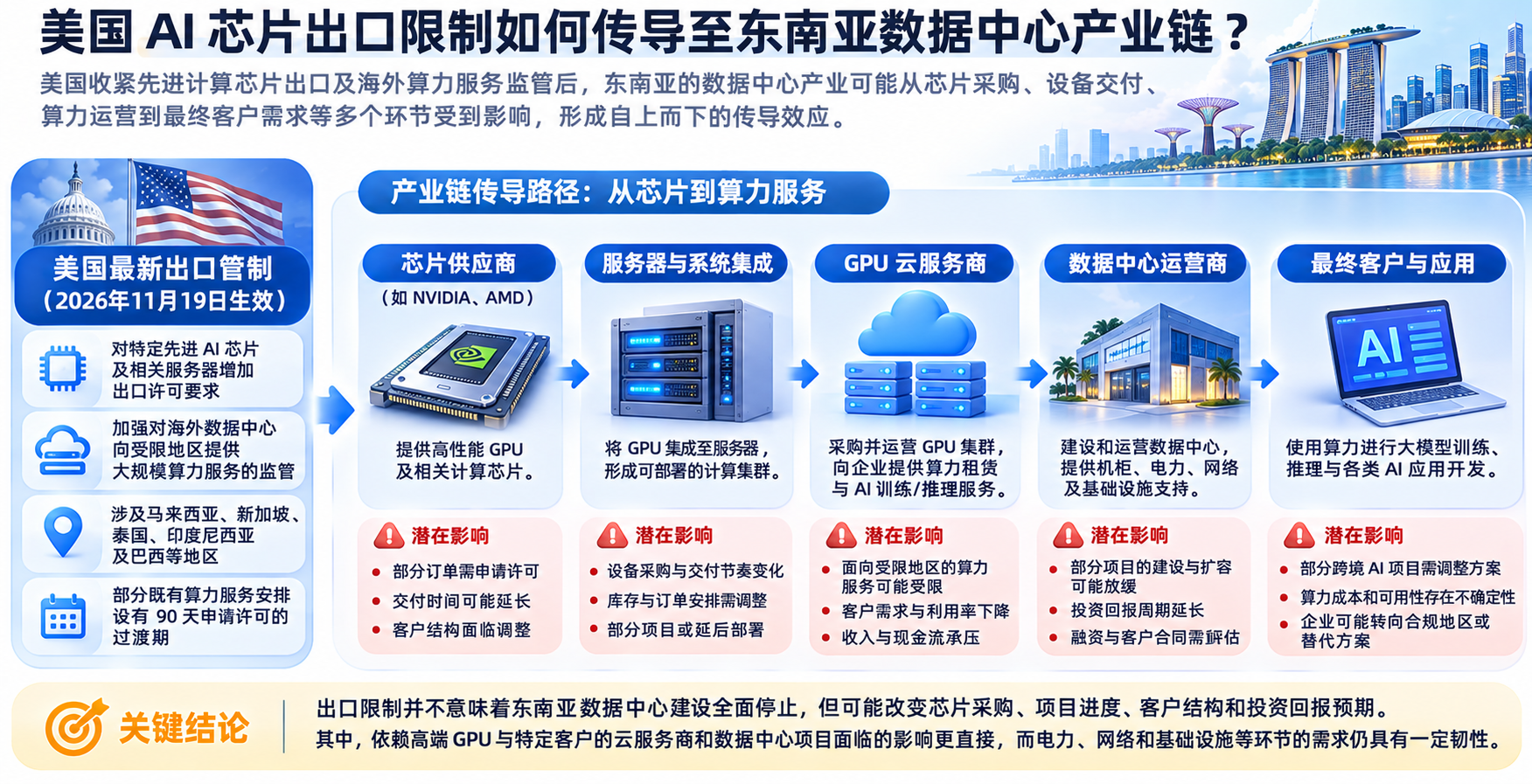
NVIDIA and AMD are important participants in the global advanced AI computing chip market. Data center operators typically use GPUs, servers, and network equipment to build training and inference clusters, and these types of hardware may be subject to the U.S. Export Administration Regulations.
-
Procurement processes for certain Southeast Asian customers may be affected. For transactions requiring a license, chip suppliers and system integrators must confirm the end customer, equipment use, and relevant transaction conditions. The timing and outcome of license approvals are uncertain, which may delay equipment deliveries that were originally scheduled.
-
Chip suppliers may need to reassess their customer mix. If certain regional cloud service providers primarily offer large-scale AI training capacity to customers in restricted regions, their incremental purchases may face greater scrutiny. By contrast, projects serving compliant enterprise customers, with clear end uses and eligibility for license exceptions, may follow different approval pathways.
-
Southeast Asia represents only part of global AI chip demand. AI infrastructure investment in the United States, Europe, the Middle East, and other regions may continue to generate equipment demand. Therefore, Southeast Asian export restrictions should not be interpreted directly as meaning that NVIDIA or AMD’s global revenue will decline year over year.
For investors, it is more important to monitor the data center revenue of both companies, regional order trends, customer concentration, and management disclosures regarding the impact of export controls. If demand from restricted regions is redirected to other compliant markets, the impact on global revenue may be relatively limited. If some computing investments are canceled or postponed for an extended period, however, the order timing of relevant suppliers may be affected.
Why May Southeast Asian GPU Cloud Providers Face More Direct Operating Pressure?
Compared with companies that simply sell chips, GPU cloud providers depend more heavily on computing resource utilization. Their primary operating model is to purchase high-performance servers, build or lease data centers, and rent GPU computing capacity to customers based on time, resource scale, or contract term.
This model generally requires substantial upfront capital investment. Companies may obtain GPU clusters through debt financing, equity financing, or long-term equipment leases, and gradually recover their investment through customer contracts. If certain customers cannot continue using the relevant computing resources because of export controls, operators may face lower revenue and the risk of idle equipment.
Customer concentration deserves particular attention. If most of a regional cloud provider’s revenue comes from a small number of large AI model developers, changes to a single customer contract could significantly affect overall cash flow. The new rules impose requirements on services that provide large-scale computing capacity to companies in restricted regions. As a result, some operators may need to review their existing contracts and prospective customers.
In addition, GPU cloud profitability depends not only on whether equipment has been deployed but also on actual utilization, rental prices, depreciation expenses, and financing costs. When market supply increases while some customer demand is restricted, operators may need to lower prices to attract new customers, which could compress profit margins.
This means that the risks facing regional GPU cloud providers arise not only from whether they can continue purchasing chips but also from whether their existing GPUs can maintain sufficiently high utilization. For highly leveraged businesses, lower utilization may further amplify debt repayment and refinancing pressure.
Will Data Center Construction, Power Equipment, and Cooling Supply Chains Be Affected at the Same Time?
The data center supply chain includes more than GPUs. Large AI data centers require construction, substations, power distribution systems, uninterruptible power supplies, cooling equipment, network communications, security systems, and other infrastructure. Even if chip procurement is restricted, these areas may continue to experience demand to varying degrees.
The impact on construction and engineering companies will depend on the project’s construction stage. Projects that have entered the construction phase and have clear funding arrangements may continue completing some basic engineering work. Projects that remain in the planning or financing stage are more likely to reassess their investment scale because of changes in customer demand.
Demand for power equipment suppliers has a degree of independence. Transformers, switchgear, power distribution systems, and backup power supplies are used not only in AI data centers but also in industry, grid upgrades, and other infrastructure projects. Therefore, a slowdown in regional AI investment may affect some orders, but it cannot be directly interpreted as a decline in global demand for power equipment.
Liquid cooling and thermal management systems are generally closely tied to the deployment of high-density GPU servers. If some advanced GPU clusters are delayed, the delivery schedules for related cooling systems may also be affected. However, traditional data centers and other high-power computing facilities will continue to require thermal management.
From a listed-company research perspective, Eaton (ETN), Vertiv (VRT), and GE Vernova (GEV) can serve as representative companies for observing the data center power and cooling supply chain. However, these companies have different global business structures, so changes in the Southeast Asian market should not be equated directly with changes in their overall profitability.
To assess the actual impact, investors should examine regional revenue exposure, order backlogs, project delays, and customer capital expenditures rather than relying solely on the overall investment scale of the data center industry.
How Will Export Restrictions Change Data Center Project Financing and Cash Flow?
Data centers are typically capital-intensive businesses. From land acquisition and power connection to facility construction and server procurement, projects often require long construction periods and substantial upfront investment. Therefore, any change affecting equipment delivery or customer contracts may alter project cash flow forecasts.
Suppose a data center operator plans to invest significant funds to build a GPU cluster and arranges financing based on customer rental contracts for the next three years. If the relevant chip procurement requires an additional license, the project may be unable to deploy equipment according to its original schedule, delaying the start of revenue recognition.
At the same time, the company may still need to bear land leases, construction costs, loan interest, and other fixed expenses. If the delay is prolonged, the project’s return on capital may decline, while financing institutions may require a higher risk premium or stricter lending conditions.
For data center operators that have signed long-term lease agreements, investors also need to determine whether the contracts include minimum purchase commitments, equipment delivery conditions, termination clauses, and provisions addressing regulatory changes. A large nominal contract value does not mean that all revenue can be realized as scheduled.
Investors should distinguish among four indicators in particular: announced investment scale, actual capital expenditures, contracted revenue, and operating cash flow. Announced investment represents a plan by a company or project. Capital expenditures reflect actual funds invested. Contract revenue is subject to the fulfillment of performance conditions. Operating cash flow reflects the recovery of funds through business operations.
Accordingly, the most important impact of chip export restrictions on the data center industry may not be the amount by which orders decline in a given quarter, but whether the entire timeline from construction to cash flow generation becomes longer.
Which Companies May Benefit From a Reconfiguration of the Supply Chain?
Export restrictions generally change how resources are allocated across the supply chain, but they do not affect all participants to the same degree. Companies with compliance capabilities, diversified customer bases, and mature infrastructure may gain relative competitive advantages during the industry adjustment.
-
Large cloud service providers with clear customer identities, robust compliance systems, and global operating capabilities may find it easier to adapt to new licensing and reporting requirements. Certain U.S.-headquartered companies that meet specific exception criteria may also have different compliance pathways for relevant transactions. This does not mean that all of their businesses will be unaffected by regulation.
-
Data center operators capable of serving multiple types of computing demand may have greater operating flexibility than companies that depend heavily on a single AI training customer. Ordinary enterprise cloud services, data storage, network connectivity, and certain inference workloads may continue to generate demand, although whether a specific business is subject to controls still depends on the equipment and customer conditions.
-
Power equipment and infrastructure suppliers may benefit from demand outside regional data center construction. Global grid upgrades, industrial electrification, and data center expansion in other regions may support orders for related companies. Actual profitability, however, will still depend on capacity, pricing, and project execution.
-
Export restrictions may encourage some markets to research alternative computing solutions, including different GPU architectures, computing efficiency optimization, and domestic technology supply chains. However, alternative technologies differ in performance, software ecosystems, production capacity, and cost. It should not be assumed that demand for restricted U.S. chips can be immediately replaced by other products.
Accordingly, companies considered potential beneficiaries of the supply chain adjustment must be supported by verifiable customer demand, orders, and profitability. Policy changes alone cannot establish that a company will necessarily generate more revenue.
How Should Investors Determine Which Stocks Are Truly Affected?
When researching the Southeast Asian data center supply chain, investors need to identify where each company sits in the overall value chain. Chip suppliers are primarily affected by equipment sales and export licenses. Cloud service providers focus more on customer contracts and GPU utilization. Data center operators depend on rack leasing and project delivery, while power equipment companies are affected by infrastructure orders and delivery schedules.
| Supply Chain Segment |
Representative Companies or Types |
Key Metrics to Monitor |
Potential Impact |
| AI chips |
NVIDIA, AMD |
Data center revenue, regional orders, licensing status |
Delayed delivery of certain equipment or changes in customer mix |
| GPU cloud services |
Regional neocloud operators |
GPU utilization, rental prices, customer concentration |
Revenue and cash flow may come under pressure |
| Data center operations |
Regional IDC and colocation service providers |
Pre-leasing rate, delivery schedule, customer contracts |
Project delays and adjustments to new demand |
| Power equipment |
Eaton, GE Vernova |
Order backlog, regional revenue, delivery capacity |
Changes in the timing of certain projects |
| Cooling systems |
Vertiv and others |
High-density rack demand, liquid cooling orders |
Related to the pace of GPU deployment |
| Networking and servers |
Server manufacturers and network equipment suppliers |
System orders, equipment delivery, customer mix |
Changes in procurement cycles and configuration requirements |
Investors should examine whether a company’s revenue is highly concentrated among restricted customers. Even if two companies are both involved in Southeast Asian data center construction, projects serving the digitalization needs of local enterprises may face very different regulatory risks from projects that primarily rent advanced AI computing capacity to companies in restricted regions.
Investors should also assess whether the policy impact has already been reflected in valuations. A sharp decline in share prices following the policy announcement may reflect a repricing of future growth expectations, but share price volatility alone does not prove that company fundamentals have changed by the same magnitude.
For semiconductor stocks such as NVIDIA and AMD, as well as infrastructure-related stocks such as ETN, VRT, and GEV, research should focus on financial disclosures, order fulfillment, customer demand, and changes in profit margins rather than simply using policy news to predict short-term price movements.
Will Southeast Asia’s Data Center Expansion Lose Its Long-Term Growth Drivers?
Long-term demand for data centers in Southeast Asia comes from multiple sources, including enterprise digitalization, cloud migration, internet services, financial technology, data storage, and AI applications. Restrictions on advanced GPU exports primarily affect certain high-performance computing equipment and related end uses. They do not mean that all of these sources of demand will disappear.
However, the policy may change the growth structure of local AI data centers. In the past, some projects attracted investment through relatively low construction costs and cross-border computing demand. New regulatory requirements may make customer compliance, equipment origin, and service recipients important factors in project location decisions.
Going forward, some operators may place greater emphasis on local and regional enterprise customers and reduce their reliance on a single source of cross-border AI training demand. Large international cloud service providers may also reassess data center investment plans in different regions and seek a new balance among power availability, regulation, customer demand, and operating costs.
From an industry development perspective, this may shift Southeast Asia’s data center market away from simply pursuing construction scale toward greater emphasis on customer quality, compliance capabilities, and project returns. For projects with genuine demand and stable cash flow, the long-term investment rationale may not fundamentally change. For projects that depend heavily on specific chips and a single customer, growth expectations may need to be reassessed.
Therefore, export restrictions alone cannot determine the long-term outlook for Southeast Asia’s data center industry. The key questions are whether the region can continue obtaining compliant equipment, stable power, reliable customers, and reasonable financing, and whether these conditions can support sustainable cash flow.
How Can You Follow the AI Data Center Supply Chain Through Stock Trading on Gate?
The expansion of Southeast Asian data centers and changes in U.S. chip export policies provide investors with a new perspective for analyzing global AI infrastructure stocks. NVIDIA (NVDA) and AMD (AMD) operate in the advanced computing chip segment, while Vertiv (VRT), Eaton (ETN), and GE Vernova (GEV) are involved in data center cooling, power management, and energy infrastructure, respectively. These companies have different business positions within the supply chain and may be affected differently by export restrictions, project delays, and capital expenditure adjustments.
Gate’s stock trading service supports participation in U.S. stocks and ETFs using USDT. Investors can search for relevant ticker symbols in Gate’s TradFi stock section to view market data, price changes, and trading information. They can also analyze the potential impact of policy changes on company operations by reviewing quarterly financial reports, order backlogs, regional revenue, and cash flow performance. For example, when researching NVIDIA and AMD, investors can focus on data center business growth and the impact of export licenses on order delivery. When researching Vertiv and Eaton, they should monitor power equipment and cooling system orders as well as data center construction schedules.
Note that Gate stock spot trading, stock perpetual contracts, and contracts for difference are different products with different asset ownership models, trading rules, and risk structures. Investors should confirm tradable assets, fees, trading hours, and access requirements in their region on the relevant product page. For leveraged stock derivatives, investors should also pay close attention to funding fees, margin requirements, and liquidation risks. Changes in U.S. chip export policies may cause short-term share price volatility, but the long-term investment value of a company should still be based on actual orders, profitability, and cash flow performance.
Conclusion
In November 2026, the United States further tightened regulation of advanced AI chip exports and overseas computing services, creating new operating uncertainty for Southeast Asia’s data center industry. Certain projects in Malaysia, Singapore, Thailand, and Indonesia may be affected by license approvals, adjustments to customer demand, and equipment delivery delays. Related pressure may also gradually spread through the chip, server, cloud services, and infrastructure construction supply chains.
The impact varies significantly across the different parts of the supply chain. Chip suppliers such as NVIDIA and AMD need to monitor regional orders and customer mix. GPU cloud providers need to assess utilization and cash flow more closely. Power equipment, cooling system, and data center construction companies should focus on project delivery schedules and actual order fulfillment.
Over the long term, Southeast Asia still has growth drivers including digital economy expansion, regional cloud service demand, and infrastructure investment. However, the competitive standards for AI data centers may be changing. The value of future projects will depend not only on how many racks can be built or how many GPUs can be purchased, but also on whether the projects can meet regulatory requirements, secure stable customers, and convert capital investment into sustainable operating cash flow.
FAQ
Does the U.S. Completely Ban Exports of NVIDIA and AMD Chips to Southeast Asia?
No. The new rules add licensing requirements for advanced computing chips and related equipment that meet certain technical conditions and establish specific exceptions. Actual applicability depends on equipment specifications, destination, end user, and end use.
Why Have Malaysian Data Centers Received Significant Attention?
Malaysia has attracted substantial data center investment in recent years, with Johor state receiving particular attention. Some projects involve advanced AI computing equipment and cross-border cloud services. As a result, the new rules may affect their equipment procurement, customer arrangements, and investment expectations.
Will Chip Export Restrictions Affect Data Centers That Have Already Been Built?
They may affect certain existing businesses, particularly services that provide large-scale computing capacity above regulatory thresholds to companies in specific restricted regions. Existing arrangements may need to apply for licenses during the prescribed transition period. However, it should not be assumed that all completed data centers must cease operations.
Will NVIDIA and AMD’s Global Revenue Decline as a Result?
This conclusion cannot be drawn directly. These companies sell products in multiple markets worldwide. The actual impact will depend on the size of restricted orders, licensing outcomes, and changes in demand in other regions.
Will Data Center Power Equipment Companies Also Be Affected?
They may be affected by delays to certain projects. However, power equipment is also used in other data centers, industrial projects, and grid construction. The impact must therefore be assessed based on the specific company’s regional revenue and order structure.
How Can Investors Determine Whether Southeast Asian Data Center Stocks Deserve Attention?
Investors can focus on customer concentration, contract terms, equipment delivery, rack utilization, capital expenditures, financing costs, and free cash flow. They should also monitor companies’ latest disclosures regarding the impact of export controls.