For a long time, the stock market has primarily relied on spot trading and traditional derivatives as investment tools. Investors can buy stocks directly and share in the gains or losses resulting from price changes. They can also use options, futures, and other instruments to manage risk or express a view on future price movements. These instruments differ in their trading structures, holding periods, margin requirements, and rights and obligations, together forming the stock market's risk management framework.
As the cryptocurrency market has developed, perpetual futures have gradually become a representative form of derivative. Unlike traditional futures, which have fixed expiration dates, perpetual futures generally have no preset settlement date. Instead, mechanisms such as funding rates are used to keep the contract price as close as possible to the reference asset's price. This structure was initially used mainly in digital asset trading and has since begun to be explored for traditional financial assets such as stocks.
Single-Stock Perpetual Futures are the result of extending this mechanism to individual stocks. Their core purpose is not to give traders stock ownership, but to provide a derivative instrument for gaining exposure to the price movements of a single stock. Understanding this distinction is the starting point for analyzing their trading value, applicable scenarios, and risk boundaries.
What Are Single-Stock Perpetual Futures?
Single-Stock Perpetual Futures are perpetual derivative contracts that use the price of a specific publicly listed company's stock as the reference underlying asset. Traders can establish long or short positions based on their view of the underlying stock's price and participate in trading through a margin system. These contracts generally have no fixed expiration date, so positions do not need to expire or be rolled over on a predetermined date as traditional futures positions do.
For example, a perpetual contract that uses the stock of a large technology company as its reference underlying asset may trade around the stock's reference price. Traders who are bullish on the stock can establish long positions, while those who are bearish can establish short positions. Position P&L depends primarily on changes in the contract price between opening and closing, as well as costs arising from funding rates, trading fees, and other contract rules.
It is important to note that Single-Stock Perpetual Futures do not automatically give traders shareholder status. Holding a contract generally does not mean holding the corresponding company's stock. Therefore, it should not be treated as direct ownership of voting rights, dividend entitlements, or other shareholder rights. If the contract involves dividends, stock splits, mergers, or other corporate actions, the applicable adjustments to the reference price or contract value are subject to the product rules published by the trading venue.
In economic substance, Single-Stock Perpetual Futures are closer to a stock price exposure instrument. They convert changes in a stock's price into P&L on a derivative position, allowing traders to express directional views without directly purchasing the underlying stock. However, this convenience also means that traders must understand the contract's own pricing, margin, and liquidation mechanisms.
How Do Single-Stock Perpetual Futures Work?
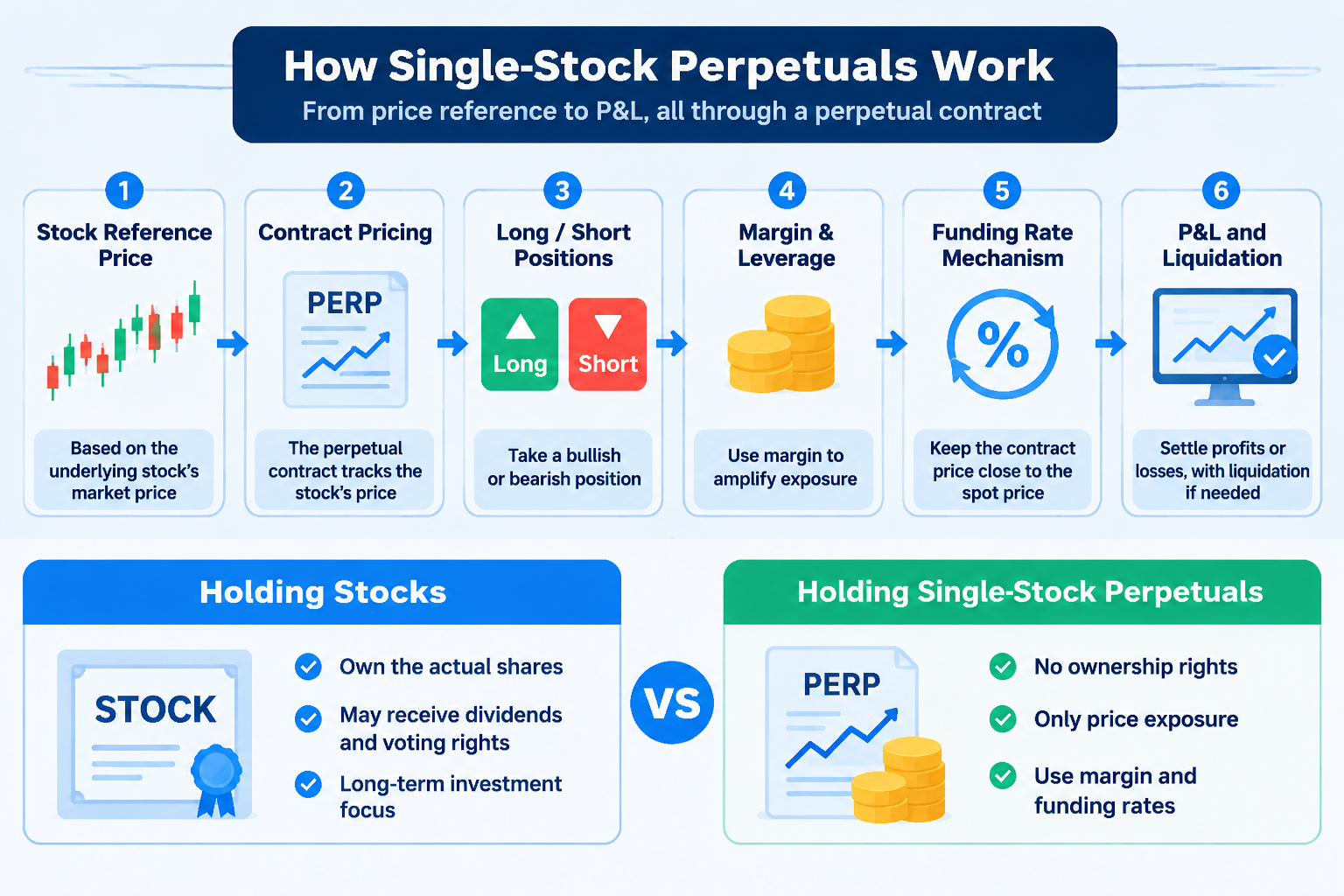
Trading Single-Stock Perpetual Futures generally revolves around the reference price, contract price, margin, funding rate, and liquidation mechanism. The reference price is used to reflect the market value of the underlying stock, while the contract price is formed through buying and selling activity on the trading venue. The two may diverge due to differences in liquidity, trading hours, market sentiment, or price sources. Therefore, the contract price will not necessarily match the stock's spot price exactly at every moment.
To reduce the risk of a perpetual contract price deviating from its reference price over an extended period, trading venues typically use a funding rate mechanism. Funding rates are calculated based on the relationship between the contract price and the reference price, as well as the platform's rules. Periodic funding payments may be exchanged between long and short positions. The party responsible for payment, the amount, and the settlement frequency depend on the rules of the relevant contract. It should not be assumed that the long side always pays the funding rate or that the rate always remains at a fixed level.
The margin system determines the size of the notional position that traders can establish with a given amount of their own capital. Leverage can improve capital efficiency, but it also magnifies the impact of price movements on account equity. When losses cause the margin level to fall below the maintenance requirement, the trading venue may initiate an auto-deleveraging or liquidation process. Even a relatively limited change in the underlying stock's price may cause a highly leveraged position to reach its liquidation threshold quickly.
In addition, Single-Stock Perpetual Futures require clear rules regarding the source of the reference price, the handling of abnormal prices, trading suspensions, corporate action adjustments, and risk management during extreme market conditions. The stock market has special circumstances such as pre-market and after-hours trading, trading halts, earnings releases, and corporate actions. These factors may affect the continuity of the reference price. If the contract's trading hours do not fully match those of the stock's spot market, price discovery and risk control become more complex.
How Do Single-Stock Perpetual Futures Differ From Traditional Stock Trading?
Traditional stock trading centers on buying and selling stocks themselves. After purchasing a stock, investors generally hold the corresponding securities rights and may be entitled to dividends, voting rights, and other rights based on their holdings. Investor P&L is primarily determined by the purchase price, sale price, related fees, and corporate actions. Without margin financing or other derivatives, investors generally will not face automatic margin liquidation due to short-term price fluctuations.
Single-Stock Perpetual Futures are different. Traders hold derivative contracts rather than the underlying stocks. Their P&L depends on changes in the contract price, position size, funding rates, and trading fees. Because these contracts generally support margin trading, traders can establish larger notional exposure with less initial capital, but they must also bear greater liquidation risk.
The two approaches also differ in terms of trading direction. In traditional spot trading, short selling generally requires borrowing shares or using another specific mechanism. With perpetual futures, traders can express a bearish view by establishing a short contract position. However, short selling does not mean that risk is limited. If the price continues to rise, a short position may incur ongoing losses and, particularly when leverage is high, may trigger liquidation.
Therefore, the choice between stock spot trading and Single-Stock Perpetual Futures should not be based solely on trading convenience or the availability of higher leverage. Traders should first determine whether they need shareholder rights, long-term asset allocation, or short-term price exposure and hedging. The two serve different trading purposes and have different risk structures.
How Do Single-Stock Perpetual Futures Differ From Traditional Single-Stock Futures?
Traditional single-stock futures generally have clearly defined expiration months or settlement arrangements. Their prices are affected by factors such as the remaining term, financing costs, and expected dividends. As the expiration date approaches, the contract may require physical delivery, cash settlement, or a rollover. Investors holding traditional futures need to consider the operational arrangements and term structure associated with expiration.
Perpetual futures do not have a conventional fixed expiration date, allowing traders to continue holding positions as long as they meet the margin requirements. To compensate for the absence of expiration-based settlement, perpetual contracts generally use mechanisms such as funding rates to maintain a connection between the contract price and the reference price. Therefore, perpetual contracts reduce the need for periodic rollovers, but this does not mean that holding a position is cost-free.
Traditional futures pricing generally relies more heavily on term structure and cost-of-carry models, while perpetual futures require continuous monitoring of funding rates, contract premiums or discounts, market depth, and liquidation rules. Both are derivatives. The absence of an expiration date does not mean that perpetual futures are simpler or more suitable for investors in every scenario.
For single-stock underlyings, the perpetual structure also faces additional challenges. Stocks can differ significantly in liquidity, trading hours, volatility, and corporate actions, so the same set of parameters cannot simply be applied to every stock. Trading venues need to design reference prices, risk limits, and abnormal-market handling rules for each underlying.
What Are Some Potential Uses of Single-Stock Perpetual Futures?
One potential use is to establish directional price exposure. Based on their views of a company's operations, industry trends, or market valuation, traders can establish long or short positions without directly buying or selling the stock. For those seeking to trade short-term strategies around a particular stock, this structure provides another way to express a market view.
Another potential use is portfolio risk management. Suppose an investor holds a stock and is concerned about a short-term decline. Subject to the contract rules, the degree of underlying-asset matching, and trading costs, the investor could consider using a related short derivative position to reduce part of the price exposure. However, differences in basis, funding rates, and trading hours may exist between derivatives and spot trading. As a result, the hedge may not match the exposure completely.
Single-Stock Perpetual Futures may also support more flexible long and short strategies, such as adjusting risk exposure around earnings releases, industry events, or market volatility. However, these strategies require a high level of attention to price information, liquidity, and risk control. If the reference price changes during abnormal trading hours or the spot market is suspended, derivative positions may face additional uncertainty.
It is important to emphasize that an instrument's ability to support a strategy does not mean that the strategy is suitable for every investor. The suitability of Single-Stock Perpetual Futures depends on the trader's understanding of derivatives, risk tolerance, capital arrangements, and the specific rules of the trading venue.
Key Risks of Single-Stock Perpetual Futures
The first risk is leverage and liquidation risk. Margin trading can increase notional exposure, but it also magnifies changes in account equity. When an underlying stock experiences a gap, an unexpected earnings result, or breaking news, the contract price may change rapidly, and traders may not be able to close their positions at the expected price. Highly leveraged positions are particularly likely to reach the maintenance margin requirement within a short period.
The second risk is funding rate and holding cost risk. Perpetual contracts have no fixed expiration date, but this does not mean that positions can continue indefinitely at no cost. If the funding rate remains unfavorable, the cumulative cost of holding a position over the long term may materially affect the strategy's results. Traders need to treat funding rates as part of the holding cost rather than focus only on the underlying stock's price movements.
The third risk is reference price and liquidity risk. Single-Stock Perpetual Futures rely on a reference price mechanism, while the stock market's trading hours, trading halts, and corporate actions may affect price continuity. If the contract market lacks sufficient liquidity, bid-ask spreads may widen or large orders may move the price, causing actual execution results to differ significantly from expectations.
The fourth risk is corporate action and special event risk. Stock splits, mergers, cash dividends, special dividends, delistings, and trading halts may affect the reference price and settlement method of a derivative contract. Traders must understand how the trading venue handles these situations and should not assume that the contract will automatically and without loss track every change in the stock market.
The final risk is regulatory and trading venue risk. Single-Stock Perpetual Futures involve the intersection of stock and derivatives regulation. Whether the product can be offered, which customers can access it, and which registration requirements the trading venue must meet depend on the relevant jurisdiction and product structure. Regulatory authorization or product classification does not mean that every platform can offer these contracts without conditions.
Gate Stock Contracts and TradFi: Different Ways to Trade Traditional Asset Price Exposure
Single-Stock Perpetual Futures incorporate individual stock price exposure into a derivative structure with no fixed expiration date. Gate Stock Contracts provide a specific market example: users can participate in price movements related to stock underlyings through margin and long or short positions without directly buying or holding the corresponding stocks. At the same time, Gate TradFi also covers trading services for traditional financial assets beyond stocks, reflecting how digital asset trading platforms are providing users with more ways to access traditional asset price exposure. However, stock contracts are a specific type of derivative trading, while TradFi refers to a broader category of trading services for traditional financial assets. The two should not be conflated.
When evaluating these products, the first step is to distinguish the trading object from the nature of the associated rights. Directly holding stocks is different from trading stock contracts: the former involves stock assets and their corresponding rights, while the latter primarily centers on changes in the underlying price and calculates P&L through margin, leverage, funding rates, and liquidation mechanisms. Different products under Gate TradFi may also use different trading structures. Therefore, users should not infer from the name TradFi or stock trading alone whether a specific product is a perpetual contract, nor should they treat a derivative position as actual stock ownership. Users should refer to the underlying asset, trading method, settlement rules, available jurisdictions, and risk disclosures stated on the relevant product page.
Over the long term, the trading services represented by Gate Stock Contracts and TradFi provide a specific perspective on how traditional asset price exposure can enter digital asset platforms through different financial instruments. However, greater variety in trading access does not mean that the underlying risks are the same. Investors must still determine whether they hold an asset or a contract based on the product structure and understand the potential effects of leverage, fees, liquidity, and liquidation mechanisms.
FAQ
Do Single-Stock Perpetual Futures Mean That I Own the Corresponding Company's Stock?
No. Single-Stock Perpetual Futures generally provide derivative exposure based on a stock's price rather than ownership of the stock itself. Merely holding a contract generally does not automatically grant traders shareholder voting rights or dividend entitlements. Specific arrangements are subject to the contract terms.
Why Don't Single-Stock Perpetual Futures Have an Expiration Date?
Perpetual contracts use mechanisms such as funding rates to try to keep the contract price around the reference price, so they do not need a fixed expiration date for regular rollovers or settlement. However, the absence of an expiration date does not mean that there are no holding costs or that a position can be held indefinitely without margin requirements.
Can I Short Single-Stock Perpetual Futures?
For contracts that support two-way trading, traders can generally establish long or short positions. However, short positions also face the risks of adverse price movements, funding rates, insufficient margin, and forced liquidation.
Are Single-Stock Perpetual Futures the Same as Stock CFDs?
Both may provide price exposure without direct ownership of the stock, but their legal nature, trading venues, pricing methods, fee structures, settlement rules, and regulatory arrangements may differ. They should not be treated as exactly the same product solely because they support leverage or have no expiration date.
Are Single-Stock Perpetual Futures Suitable for Ordinary Stock Investors?
This depends on the investor's objectives and risk tolerance. If the primary goal is to hold stocks over the long term and obtain shareholder rights, spot stocks and derivatives serve different functions. Anyone considering perpetual futures for short-term trading or hedging needs to fully understand funding rates, leverage, liquidation, and the contract rules.