Definition materials answer what PayFi is. Comparison pages answer which layer of the payment stack it occupies relative to DeFi and bank rails. Payment-financing yield explains where fees come from; this page stays on structure so readers can map products without collapsing every narrative into a single APR.
Key Takeaways
-
Traditional payments are strong on fiat finality and compliance networks, and weak on cross-border lag plus prefunded working capital.
-
DeFi is strong on permissionless composability and transparent on-chain rules; its core scenes are often trading, lending, and yield strategies—not payment-institution treasury ops.
-
PayFi narratives place payment settlement and financing for payment prefunding on the same stablecoin rail, emphasizing the time value of money.
-
Risks are not interchangeable: bank counterparties, smart contracts, credit, and compliance appear with different weights across the three models.
What Problem Does Each Settlement Logic Solve?
Traditional payments (TradFi payments) move fiat through banks, clearing houses, card networks, and payment service providers, with traditional payment systems relying on multiple intermediaries. Strengths include fiat finality and mature merchant or consumer rails. Costs include long cross-border paths, layered intermediary fees, and balances parked in nostro or prefunded accounts so payouts can still clear on time.
DeFi, short for decentralized finance, moves on-chain assets across trading, lending, and strategy protocols. In DeFi, rules live in smart contracts and settlement is bounded by block finality. Strengths include composability and global verifiability. Most product design still targets traders and liquidity providers, not licensed payment institutions’ prefunding and merchant acquiring workflows, including strategies such as yield farming.
PayFi, short for payment finance, in public materials combines payments and financing on stablecoin rails: faster value transfer plus short-duration financing that can replace idle prefunding and improve cash flow—the capital-efficiency problem described in the CoinMarketCap Academy PayFi glossary. The point is not inventing another DEX; it is connecting payment-institution liquidity needs to programmable settlement while keeping stablecoins as the unit of settlement for global payments and cross border payments.
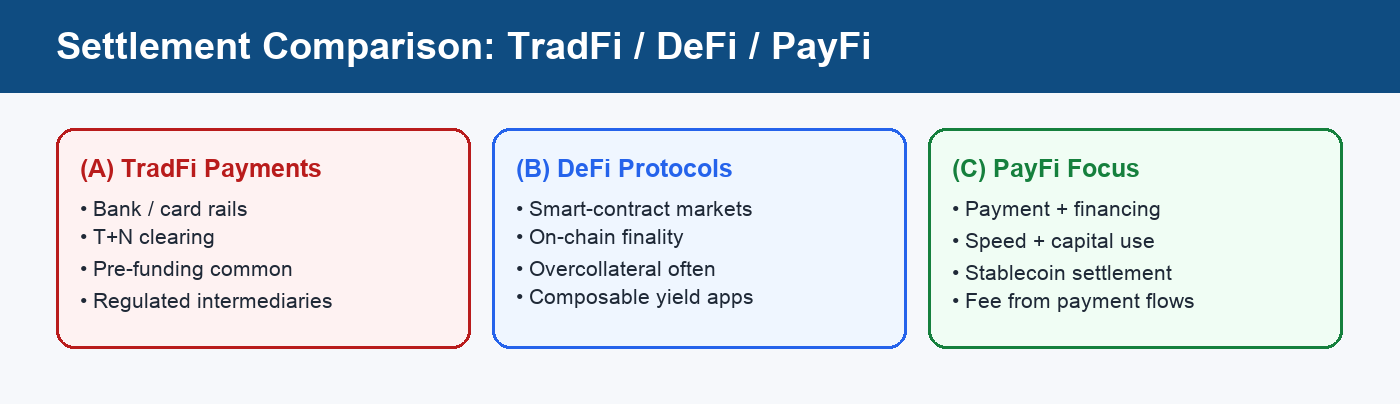
Figure 1. Schematic contrast of settlement goals and capital usage across traditional payments, DeFi, and PayFi.
How Do Settlement Speed, Prefunding, and Capital Lock Compare in Traditional Finance?
| Dimension |
Traditional payment settlement |
DeFi protocols |
PayFi-oriented design |
| Primary finality |
Bank/clearing-system book finality |
On-chain transaction finality |
On-chain stablecoin transfer plus payment-side delivery |
| Typical lag |
Cross-border often T+N; local RTP varies by market |
Seconds to minutes (network-dependent) |
Aims for near instant settlement or instant settlement in some flows, with shorter prefunding locks |
| Capital lock |
Prefunding, margins, nostro balances common |
Collateral, LP positions, borrow positions |
On-demand short-duration financing instead of long prefunding |
| Fee logic |
Remittance/FX/intermediary fees |
Trading fees, interest, emission incentives |
Payment-financing fees plus rail fees |
“PayFi-oriented” describes a design goal. Not every product labeled PayFi has bank-grade finality or uniform compliance, and outcomes still depend across PayFi systems on stablecoin mint and redeem paths, partner institution licensing, and local rules for that money path.
When DeFi users say settlement “already feels fast,” they usually mean wallet-to-protocol confirmation. Payment institutions feel pain in fiat on/off ramps, multi-currency prefunding, and idle balances at correspondent banks, where legacy cross-border rails also add high transaction fees and extra transaction costs. CoinGecko Learn on PayFi likewise pairs real-time settlement with financing and RWA layers—showing that “fast on-chain transfer” alone does not define PayFi.
A concrete example helps separate the clocks. In traditional systems, those settlement delays can disrupt business operations, which is part of why PayFi-style design emphasizes low cost settlement around the handoff. A DEX swap may finalize in one block, yet the merchant still cannot treat that confirmation as fiat payroll funding until an off-ramp, banking cut-off, and compliance checks complete. PayFi designs try to shrink the financing gap around that handoff, not to pretend the banking cut-off disappeared.
How Do Credit Sources, Access, and Composability Differ with Smart Contracts?
Traditional payment credit and access are institutional: accounts, KYC/AML, credit lines, clearing membership, and relationships with financial institutions decide who can use which rail. Dominant risks include bank or payment-service-provider counterparty failure, counterparty risk, operational outages, and compliance actions. Transparency for end users is usually limited to statements and dispute channels rather than a public ledger of every intermediate hop.
Decentralized finance defaults closer to overcollateralization and algorithmic liquidation: access is low-friction and rules are transparent, but credit creation is constrained by collateral ratios. Permissionlessness also expands phishing, contract, and governance attack surfaces. Liquidity is often priced continuously, which is useful for traders and less aligned with invoice-cycle financing, even if it helps form open financial markets.
PayFi often sits between the two: the on-chain leg can be composable because digital-asset flows and financial instruments can plug into lending markets, yield receipts, and stablecoin rails, and these structures can also support trade-finance use cases, while the off-chain leg still depends on licensed payment institutions, trade counterparties, and compliance modules. Public cases such as Huma Finance emphasize liquidity infrastructure for payment financing—showing that “who can borrow, for how long, under which compliance rules” differs from a generic DeFi money market.
| Dimension |
Traditional payments |
DeFi |
PayFi (typical discussion) |
| Who can participate |
Strong KYC / institutional access |
Wallet access (subject to front ends and sanctions lists) |
Liquidity side may be open; financing side often includes permissioned components |
| Credit basis |
Bank credit and clearing arrangements |
Overcollateralization and liquidation parameters |
Payment flows, future receivables, receivable/short-loan underwriting plus on-chain execution |
| Composability |
Low (siloed systems) |
High (contract-to-contract calls) |
Medium–high (stablecoins/receipts can enter DeFi under compliance constraints) |
| Transparency |
Opaque to end users |
On-chain state is inspectable |
On-chain flows inspectable; off-chain credit details may not be fully public |
Where Do Information Flow and Funds Flow Split in Cross-Border Payments?
Payment practitioners often separate information flow (who owes whom, for which invoice) from funds flow (which account actually moves balances). Traditional stacks keep those layers in different legacy systems across broader payment systems—ERP, messaging networks, and bank rails—creating reconciliation work. Some PayFi infrastructure narratives explicitly aim to keep a shared ledger view of funds movement while compliance and commercial data remain controlled.
That split matters for comparison readers. DeFi swaps usually merge information and funds into one atomic transaction. Traditional payments keep them apart for decades of banking practice, with PayFi effectively connecting traditional finance information layers to on-chain funds movement. PayFi experiments sit in the middle: on-chain settlement can make the funds leg more transparent, while underwriting and KYC data stay off-chain. Misreading a transparent wallet transfer as full commercial finality is a common category error.
How Do Risks Migrate Instead of Disappear?
Moving from TradFi to on-chain payment financing does not automatically remove risk; it rewrites the risk list:
-
Traditional payments: intermediary failure, freezes, corridor outages, FX and correspondent deductions, plus fraud risks from opaque, multi-step processing.
-
DeFi: smart contracts, smart contract vulnerabilities, oracles, collateral volatility, market volatility, unsustainable incentives.
-
PayFi: adds short-duration credit, partner-institution interruptions, stablecoin depeg or freeze risk, and leverage from re-hypothecating yield receipts.
Faster settlement and higher capital efficiency are design goals, and more transparent on-chain rails are often framed as helping with reducing fraud risks. Whether they scale under controlled risk depends on underwriting, disclosure, regulatory paths, and regulatory uncertainty. Fee mechanics sit in payment-financing yield; category vocabulary starts from what PayFi is.
A practical reading habit is to ask which clock failed when something goes wrong: the blockchain confirmation clock, the banking cut-off clock, or the credit repayment clock. Those three clocks explain many “it settled on-chain but funds were still stuck” stories without blaming a single label.
When Is Each Model the Better Mental Model?
Use a TradFi payments mental model when the binding constraint is fiat finality, card network rules, or licensed acquiring inside the traditional financial system. Use a DeFi mental model when the binding constraint is collateral ratios, liquidation parameters, or composable strategy risk. Use a PayFi mental model when the binding constraint is short-dated payment prefunding, stablecoin settlement corridors, and fee income tied to payment occupancy rather than to speculative leverage, with returns linked to real-world economic activity.
These mental models can overlap in one product UI, even when different business models sit behind similar-looking interfaces. A wallet may show a DeFi-looking APR while the borrower set is a payment institution under a compliance wrapper. The comparison tables above exist to force that distinction before readers treat every on-chain dollar yield as the same asset class.
Summary
Traditional payments deliver fiat finality and merchant networks but raise time costs through cross-border lag, prefunding, and other routine financial transactions. Decentralized finance delivers programmable settlement and composable markets, yet its core scenes are not payment-institution treasury ops. PayFi tries to use stablecoin rails for both settlement speed, cost efficiency, and prefunding finance. The comparison’s value is locating the problem—clearing lag, collateralized lending, or payment-financing fees—so one APR or one banking mental model is not applied to every product.
FAQ
Is PayFi just paying with crypto?
Not exactly. Paying with stablecoins or crypto for everyday transfers is closer to Web3 or stablecoin payments. PayFi also emphasizes financing for payment prefunding and settlement gaps, with related fees folded into on-chain liquidity return narratives.
How does PayFi differ from DeFi lending?
DeFi lending is usually a general overcollateralized money market for crypto assets, with capital often sourced from liquidity pools. PayFi financing is closer to short-duration liquidity needs of payment institutions, often tied to compliance modules, payment volume, and receivable-style underwriting against future payment obligations, with different tenors and controls.
Why do traditional payments need heavy prefunding?
Institutions often keep balances ready in wallets and related bank accounts so they can pay out before clearing finishes. Prefunding raises certainty and locks capital—an idle-cost problem PayFi-style on-demand financing tries to reduce, especially when clearing still depends on cutoffs and banking hours.
Does faster settlement mean lower risk?
Not necessarily. Faster on-chain confirmation can cut some settlement-lag risk, and sometimes transaction fees, while introducing smart-contract, stablecoin, and credit risk. Risks migrate and recombine; they do not automatically fall, especially when some off-chain exposure to payment processors remains.
What background helps before reading this comparison?
Start from what PayFi is for vocabulary, then payment-financing yield for fee sources. This page places TradFi, DeFi, and PayFi on one structural map. Background on tokenized real-world assets is especially relevant where PayFi financing links to receivables or invoice-style claims.