Readers who already know what PayFi is often ask a sharper question: which business layer produces the yield shown to liquidity providers, how that differs from emission-heavy DeFi APRs, and when the cash-flow story breaks. Existing Gate Learn explainers already cover definitions, Solana stack narratives, and project intros. The remaining gap is how payment-financing fees become distributable yield without treating a campaign APR as proof of durability.
Key Takeaways
-
In PayFi discussions, real yield emphasizes fees from payment or financing activity rather than governance-token inflation as the primary driver.
-
A common structure is: stablecoin liquidity → short-duration financing for payment institutions inside compliant modules → borrowers pay fees → fees flow back to the liquidity side.
-
Some protocols represent positions with composable yield-bearing receipts or strategy tokens, which can move across lending and swap markets, but a receipt is not a risk-free claim.
-
Evaluation should weigh payment volume, tenor, credit history, compliance boundaries, plus smart-contract and counterparty risk.
What Does Real Yield Mean in a PayFi Context?
In crypto, “real yield” is often used to separate two return sources: emissions-driven incentives versus observable business fees such as trading fees, interest, or financing charges. PayFi narratives map the second category onto payments. Capital covers short-duration liquidity gaps in cross-border settlement, trade finance, or prefunding. Borrowers pay for faster access to usable funds, and those fees become the return for liquidity providers.
The CoinMarketCap Academy definition of PayFi presents PayFi—short for payment finance or payment financing—as a term popularized in 2024 by Lily Liu and commonly framed as a bridge between DeFi, traditional finance, and real-world assets. It stresses that PayFi aims to accelerate global payments with stablecoins and blockchains while improving capital efficiency, with stablecoins supporting 24/7 movement outside traditional banking hours. Traditional payment systems move enormous notional value yet still rely on outdated processes, multiple intermediaries, and idle balances sitting in prefunded accounts, which contributes to settlement delays and higher costs. That framing centers on the time value of money (TVM): capital locked in slow settlement or prefunding cannot be reused elsewhere at the same moment, whereas PayFi targets real time settlement and programmable settlement through smart contracts.
Narrative “real yield” can still be mixed with points, multipliers, or campaign boosts. A useful test is whether fees continue to accrue when payment or financing activity continues—not whether a campaign APR looks high in isolation. If emissions stop and the displayed rate collapses, the product was closer to incentive farming than to payment-financing cash flow.
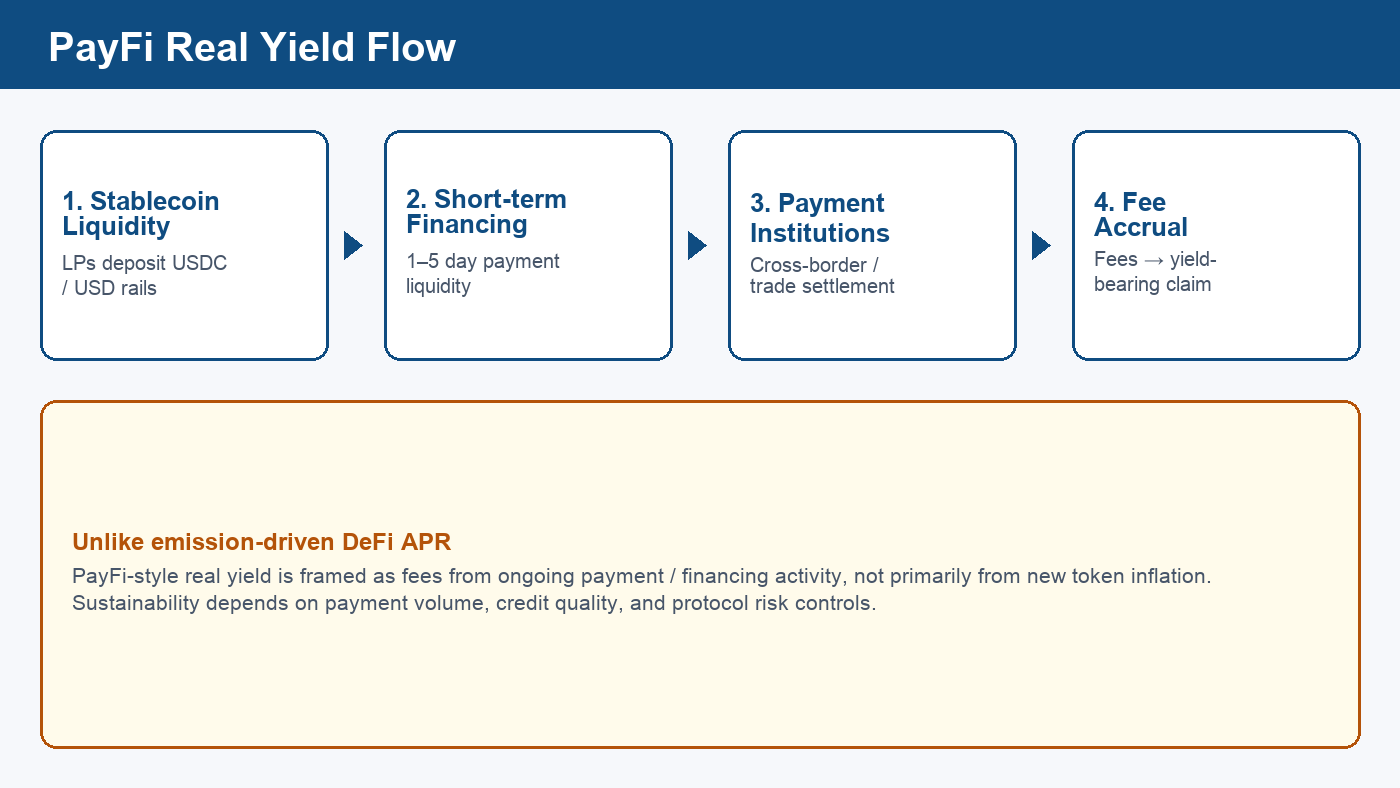
Figure 1. Simplified PayFi-style real yield path: stablecoin liquidity, short-duration payment financing, institutional drawdowns, and fee accrual.
How Does Payment Financing Generate Fees?
Payment financing is not about trading a speculative crypto asset. It targets liquidity gaps inside payment rails for payment companies and payment processors. Cross-border payments are a common example: an institution may need local currency ready across specific payment corridors before settlement completes, instead of leaving capital idle in prefunded accounts. Legacy practice often parks working capital in nostro or prefunded accounts. Multi-day settlement (T+N) raises the cost of that locked capital because the same dollars cannot simultaneously fund other inventory, hedges, or client payouts. PayFi designs often aim to cut intermediary layers and settlement friction relative to multi-hop correspondent rails, though realized fee levels vary by corridor, currency pair, and compliance overhead.
PayFi-oriented designs use on-chain stablecoin liquidity for shorter tenors—often discussed in day-scale windows—letting payment institutions draw funds when needed, repay after settlement, and pay a fee for the occupancy period. Because these rails enable programmable payments, they can also support real-time payouts for freelancers and gig workers or payroll advances for employees who need earlier access to funds. The economic story is payment for speed and availability of funds, not payment for a leveraged trading view. Recurring payment flows can roll fee income with real economic activity, and a future payment or card receivable can even support credit lines tied to settlement timing. That is the same TVM lens highlighted in CoinGecko Learn’s PayFi explainer.
| Stage |
Role |
Link to yield |
| Stablecoin liquidity supply |
Provides usable on-chain dollar-like balances |
Suppliers take occupancy and protocol risk for a share of fees |
| Short-duration financing |
Covers prefunding and settlement-window gaps |
Borrowers pay financing fees |
| Payment execution and settlement |
Completes cross-border or merchant delivery |
cross border payment financing links executed flow to financing demand and the fee pool |
| Risk and compliance modules |
Eligibility, limits, disclosures |
Affects default rates and whether fees are durable |
If any stage breaks—volume collapse, credit events, compliance interruptions—the fee pool weakens. PayFi yield analysis therefore sits closer to short-duration credit plus payment infrastructure than to a pure DEX fee share. A side-by-side payment settlement comparison across TradFi, DeFi, and PayFi helps locate where lag and prefunding sit.
How Do Liquidity Providers Participate, and What Do Yield Receipts Do?
Liquidity providers typically deposit stablecoins into payment-financing pools or strategy modules in exchange for a claim on fee flows. Some networks tokenize that claim as a transferable, re-hypothecable yield-bearing receipt so the position can be used in DEX or lending markets. The receipt is an accounting and composability tool: it makes the claim portable, but it does not by itself improve the credit quality of underlying borrowers.
Huma Finance is a frequently cited public example. Materials position it as a PayFi network for global payment financing using blockchain and stablecoins. Institutional updates also describe growth in payment-financing scale and expansion of yield-bearing positions into lending venues (see Huma on institutions and PayFi). Treat this as a mechanism example only. Payment-flow-backed fees can behave differently from emission-driven crypto yields across market cycles, but they are still not guaranteed. Rates, lockups, point multipliers, and composability change by product version. Historical APR figures are not promised returns.
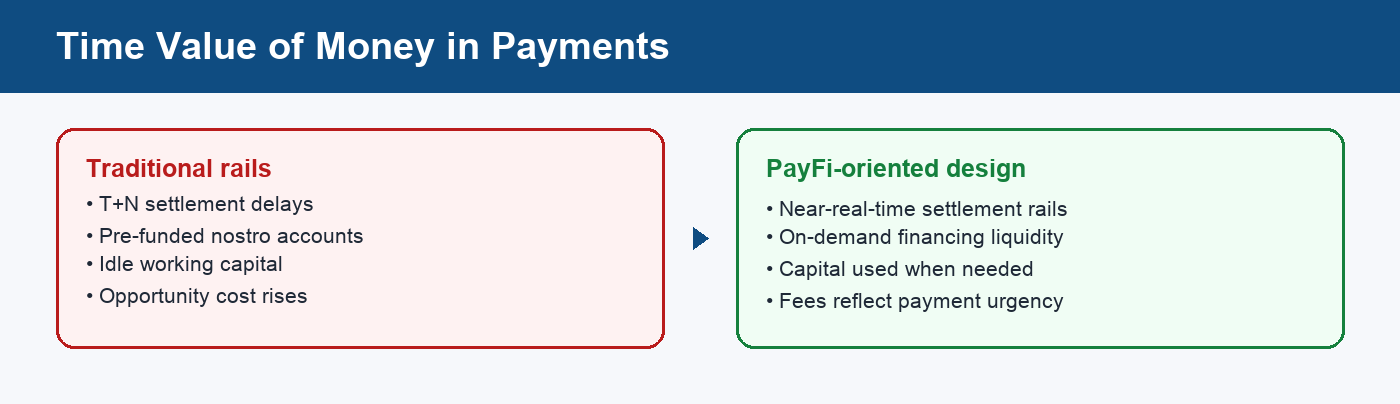
Figure 2. Schematic contrast between idle prefunding and on-demand payment financing under a TVM lens.
Reusing yield receipts as collateral or in looping strategies adds liquidation, oracle, and leverage risk, including when receipts are reused in on-chain lending venues or liquidity pools. Composability moves risk across venues; it does not erase credit, stablecoin, or smart-contract exposure. Evaluating a loop-style strategy means separating fee APY from payment financing from boosted APY that depends on borrowed funds remaining solvent.
How Does PayFi Yield Differ From Common Stablecoin Earn Products?
Ordinary stablecoin yield strategies may source return from lending markets, basis trades, treasury-backed products, or mixed incentive programs, while PayFi payment financing is narrower than many other financial products because borrower demand is supposed to come from payment institutions that need short-dated liquidity to settle or prefund real-world payment flows.
Real yield is also sometimes discussed in purchasing-power terms after inflation, but in PayFi it usually means fee-based returns rather than token emissions.
That difference matters for stress scenarios. A general DeFi money market can cool when crypto leverage demand falls. A PayFi fee pool can cool when cross-border corridors slow, partner licenses change, or underwriting tightens—even if crypto trading volumes stay high. Conversely, busy payment months can support financing demand without a parallel rise in speculative leverage. The correlation structure is different, so risk dashboards that only watch token prices miss key PayFi variables.
Stablecoins remain the shared settlement unit across these designs. Understanding issuer, redeemability, and chain deployment risk for stablecoins is therefore a prerequisite before comparing any PayFi APR table.
What Preconditions Does This Yield Depend On?
Fee income tied to payment flows typically needs several preconditions at once:
-
Ongoing payment or financing demand. If cross-border, merchant, or trade settlement activity shrinks, the fee pool shrinks with it.
-
Usable stablecoin settlement rails. When liquidity is dollar-stablecoin based, issuer policy, banking access, and chain congestion all affect turnover for lower-friction global payments across the broader PayFi ecosystem.
-
Effective credit controls. Short-duration financing is still credit. A zero-default sample from one period does not prove permanence.
-
Durable compliance access. Many payment-financing use cases require licensed entities and KYC/AML constraints, and PayFi infrastructure must navigate rules that are complex, vary by jurisdiction, and create regulatory uncertainty. If compliance modules stall, “real payment” volume can stop even while the smart contracts remain online.
-
Quality of RWA or receivable linkage. When financing maps to invoice-like real-world assets, including cases such as supply-chain financing, legal title, collection rights, and off-chain enforcement still matter.
When these preconditions hold, PayFi designs can reduce dependence on locked prefunding balances and put idle payment capital to shorter-cycle use.
A checklist across these points is more informative than comparing headline APRs alone. Documentation that only markets APY without describing borrower classes, tenor, and default handling is incomplete for PayFi evaluation.
What Risks Matter When Evaluating PayFi Yield?
| Risk type |
Possible manifestation |
What to inspect |
| Credit / default |
Borrowers miss repayment windows |
Default disclosures, concentration, reserves or insurance |
| Liquidity and tenor mismatch |
Simultaneous exits or failed rollovers |
Lockups, redemption queues, financing tenor mix |
| Compliance and licensing |
Partner payment institutions drop out as requirements shift |
Whether borrowers are permissioned; regulatory compliance varies by jurisdiction and can interrupt operations for financial institutions |
| Smart contract and operations |
Bugs, oracles, key or ops failures; smart contract risk includes exploits or bugs that can lead to permanent loss of funds |
Audits, controls, incident history |
| Stablecoin and custody |
Depeg from fiat currencies, freezes, custodian failure |
Which stablecoins and custody setups are used |
| Incentive distortion |
Campaign multipliers hide thin fee income |
Fee share vs token/points incentives |
Reducing fraud exposure is often part of the design pitch, but moving payment flows on-chain does not eliminate fraud, operational, or credit risk.
PayFi is not automatically safer than DeFi. Binding yield to payment activity also imports counterparty and compliance variables familiar from traditional payments and credit, alongside consumer-protection questions and market volatility when positions are layered with leverage or secondary-market exposure. Structural differences in lag, prefunding, and credit show up most clearly in a payment settlement comparison across TradFi, DeFi, and PayFi.
How Should Readers Read PayFi Yield Claims Without Treating Them as Advice?
Educational reading can separate three layers that marketing often blurs:
-
Mechanism layer: Who pays fees, for what occupancy window, how fees reach LPs, and whether smart contracts automate payment processes and fee distribution in the way the mechanism claims.
-
Measurement layer: Whether published rates are trailing fee income, projected ranges, or incentive-boosted displays.
-
Risk layer: Which losses can hit principal even if the mechanism description is accurate.
Keeping those layers distinct reduces the chance of treating PayFi as a guaranteed cash product. It also keeps the article complementary to definition pieces: what PayFi is introduces the category, while this page focuses on where yield claims come from and how they fail.
Summary
PayFi yield discussions pull returns away from token-emission curves and toward whether payments and short-duration financing keep producing fees. Stablecoin liquidity, financing tenor, institutional demand, and compliance modules jointly size the fee pool. Yield receipts improve composability while adding market risk. Treat PayFi as a mechanism framework—often discussed as part of a broader PayFi ecosystem, not as a single ticker or a single APR label—so it complements existing definition and project articles instead of duplicating them.
FAQ
How does PayFi real yield differ from DeFi farming rewards?
PayFi-style real yield usually emphasizes fees from payment financing and related capital occupancy, while many DeFi farming APRs lean on governance-token emissions and may be more exposed to market volatility. Both can mix in campaigns, so the useful test is whether fee income continues with payment activity—not campaign APR alone, because payment-flow-backed yield is sometimes presented as more resilient during downturns, though it still carries credit and protocol risk.
Why do cross-border payments appear so often in PayFi yield explainers?
Cross-border rails often combine multi-day settlement with prefunding locks, raising the time cost of capital. If short-duration on-chain stablecoin financing covers the funding gap, borrowers pay for speed and availability, and those fees may be shared with liquidity providers. Industry explainers also track rising stablecoin settlement activity on card-network and institutional rails, but figures should be checked against the latest primary disclosures rather than treated as a fixed constant.
Does a yield receipt or strategy token guarantee principal safety?
No. A receipt typically represents a claim on a pool or strategy cash flow and still carries credit, contract, stablecoin, and market-liquidity risk. Re-hypothecating the receipt can add liquidation and leverage risk.
What should be checked first when evaluating PayFi protocol yield?
Prioritize whether fees come from verifiable payment or financing activity, payment volume, payment corridors, credit track record, redemption and tenor rules, plus compliance and stablecoin dependencies. Nominal APR and point multipliers are secondary signals, not proof of durability.
Is PayFi yield always higher than ordinary stablecoin earn products?
Not necessarily. Financing fees can exceed some lower-risk stablecoin strategies, but they also embed more credit, compliance, and protocol complexity. Relative yield is a function of supply, demand, borrower mix, credit lines, and risk pricing—and whether the strategy is backed by actual payment finance demand rather than incentives alone, not a fixed advantage.