In 2026, global demand for AI computing capacity continued to drive expansion among related companies. Through large customer contracts, data center construction, and GPU deployment, CoreWeave, IREN, and Nebius gradually became important subjects of research in the AI infrastructure investment sector. The latest financial reports released in November showed that some companies had achieved significant revenue growth. At the same time, however, debt, capital expenditures, and financing needs were also expanding rapidly. The market has begun to focus more closely on one question: Can these companies convert long-term computing capacity orders into sustainable cash flow sufficient to cover their financing costs?
The investment thesis for Neocloud is therefore changing. In the early stages, the market focused primarily on GPU quantity, data center capacity, and customer contract size. As companies enter the large-scale delivery stage, financing costs, equipment depreciation, return on capital, and free cash flow are becoming increasingly important. Understanding the business models and financing structures of CoreWeave, IREN, and Nebius can help investors further assess how growing demand for AI computing capacity affects corporate profitability and why growing orders do not necessarily mean that shareholder returns will improve at the same pace.
Key Takeaways
-
Neocloud companies generate revenue by providing GPU computing capacity, data center capacity, and related software services to AI developers and large technology companies.
-
CoreWeave, IREN, and Nebius have all benefited from demand for AI computing capacity, but they differ in infrastructure development, financing methods, and business development stages.
-
CoreWeave reported approximately $3.661 billion in revenue in Q3 2026, while net interest expense was approximately $846 million during the same period, highlighting the coexistence of high growth and high financing costs.
-
Nebius reported year-over-year revenue growth of 571% in Q3 2026, but continued capital expenditures and cash flow requirements remain important metrics to monitor.
-
Backlog, contract value, and annualized revenue projections do not equal realized revenue or free cash flow. Investors need to pay attention to delivery conditions and the time required to recover invested capital.
-
The long-term value of Neocloud companies depends on whether computing capacity utilization, financing costs, equipment depreciation, and customer demand can produce sustainable economic returns.
What Is Neocloud, and Why Is AI Computing Demand Driving Its Growth?
Neocloud generally refers to specialized cloud service providers whose core business is GPU-accelerated computing. These companies deploy high-performance computing equipment from providers such as NVIDIA to build computing clusters suitable for large language model training, inference, and other AI workloads. They then provide these resources to customers through long-term contracts, dedicated clusters, on-demand usage, and other arrangements. Revenue may come not only from GPU capacity rentals, but also from value-added services such as storage, network connectivity, cluster management, and AI development platforms.
The rise of Neocloud is related to the rapid growth in demand for AI infrastructure. Training large models requires large numbers of GPUs to operate collaboratively, while model inference requires computing resources to process user requests continuously. As AI applications move from model development to commercial deployment, demand for computing capacity is expanding from concentrated training to long-term inference, model optimization, and automated task execution. For companies seeking rapid access to high-performance GPUs, specialized AI cloud providers offer an alternative to traditional general-purpose cloud platforms.
However, Neocloud is not a lightweight internet business model. Companies must purchase expensive GPUs in advance, build or lease data centers, secure power capacity, and configure high-speed networks, cooling systems, and operations teams. Even when customers have signed long-term contracts, the relevant infrastructure generally must be funded before revenue is fully realized. Therefore, the core operating question for Neocloud is not only whether a company can secure orders, but also whether it can build computing facilities at a reasonable financing cost and generate sufficient revenue over the economic life of its equipment.
This gives Neocloud characteristics of both the technology services industry and the capital-intensive infrastructure industry. Its growth potential comes from expanding AI demand, while its profitability is constrained by equipment procurement costs, funding costs, and resource utilization.
How Do the Business Models of CoreWeave, IREN, and Nebius Differ?
CoreWeave, IREN, and Nebius are all expanding their businesses around growing demand for AI computing capacity, but their resource bases and development paths are not identical. CoreWeave places greater emphasis on a dedicated AI cloud computing platform. It uses large customer contracts to support GPU cluster construction and provides software services for training, inference, and AI development workflows. IREN has an energy and data center infrastructure background. Its early business was closely associated with Bitcoin mining, and in recent years it has gradually expanded into GPU cloud computing and AI infrastructure. Nebius focuses on building a complete AI cloud platform, integrating GPU computing, software tools, and developer services while exploring the use of infrastructure partners to expand computing capacity.
CoreWeave's operating model is strongly contract-driven. Long-term computing capacity requirements from large customers can improve the visibility of future revenue and support the company's access to debt financing. However, this model also requires substantial investment before contracts are delivered. If data center construction is delayed or financing costs increase, profitability and cash flow may be affected. By comparison, one of IREN's important resources is its existing and planned power and data center capacity. For AI infrastructure, access to stable power, land, and grid connection conditions is itself an important prerequisite for building high-density GPU clusters. However, transitioning from energy infrastructure to high-performance AI cloud services also requires continued investment in computing equipment and software capabilities.
Nebius places greater emphasis on the completeness of its AI cloud platform. In addition to building its own computing facilities, the company launched an infrastructure partnership model in 2026 that allows partners to provide funding and data center resources, while Nebius provides the technical architecture, software platform, and customer channels. This approach could reduce the reliance of some new capacity on the company's own capital, but its actual effectiveness will still depend on the scale of the partnership projects, contract arrangements, and revenue-sharing mechanisms.
| Comparison Category |
CoreWeave (CRWV) |
IREN (IREN) |
Nebius (NBIS) |
| Core Positioning |
Specialized AI cloud computing platform |
Energy infrastructure and AI cloud computing |
Full-stack AI cloud platform |
| Main Resource Advantages |
Large customer contracts and GPU clusters |
Power resources, land, and data centers |
Cloud software platform and infrastructure integration |
| Expansion Method |
Investment driven by large computing capacity contracts |
Data center and GPU capacity expansion |
Self-built infrastructure and partner model |
| Main Financing Challenges |
High debt and interest expense |
Continued capital investment required for computing capacity expansion |
Rapid growth alongside large-scale construction spending |
| Key Metrics to Monitor |
Contract delivery, interest expense, and cash flow |
GPU deployment, power utilization, and financing needs |
Revenue growth, capital expenditures, and cash flow |
All three companies need to invest substantial capital in advance. They differ in how they obtain computing resources, acquire customers, and allocate the funding burden for infrastructure construction. Therefore, when comparing Neocloud companies, investors should not assess the relative strength of their business models solely by GPU quantity or revenue growth. Their financing structures and actual operating stages must also be considered.
Why Does CoreWeave's Financial Report Highlight the Importance of Financing Costs?
CoreWeave's Q3 2026 financial report showed revenue of approximately $3.661 billion, up from approximately $1.365 billion in the same period of 2025. This demonstrates the contribution of demand for AI computing capacity to business growth. Adjusted EBITDA was approximately $2.256 billion during the same period, with an adjusted EBITDA margin of approximately 62%, indicating a high level of operating profitability under the relevant adjusted methodology.
From a net income perspective, however, CoreWeave continues to face significant financing cost pressure. In Q3 2026, net interest expense was approximately $846 million, up from approximately $310 million in the same period of the prior year, while net loss was approximately $709 million. At the same time, operating income for the quarter was approximately $207 million. This means that even if the computing capacity services business has generated operating income, high financing expenses may still leave the company with a net loss.
CoreWeave's financing structure is closely related to its capital-intensive business. Building large GPU clusters requires the company to purchase substantial amounts of equipment within a short period and make corresponding investments in data centers, power, and network infrastructure. The company can use customer contracts, equipment assets, and future cash flow arrangements to obtain financing and accelerate infrastructure construction. Borrowing, however, also creates interest expense, debt service obligations, and refinancing risk.
In Q3 2026, CoreWeave disclosed a revenue backlog of approximately $132.5 billion. It also raised its full-year revenue guidance to $13 billion–$13.3 billion and expected full-year capital expenditures of $37 billion–$39 billion. These figures indicate a high level of future revenue visibility, but they also show that the company's expansion requires continued investment of substantial capital.
For investors, the most important takeaway from CoreWeave's financial report is that growth in adjusted EBITDA does not mean the company has already generated sufficient free cash flow. Interest expense, capital expenditures, and equipment replacement needs may continue to affect ultimate shareholder returns. Operating profit must therefore be considered together with the financing burden.
How Is IREN Using Power and Data Center Resources to Enter the AI Computing Market?
IREN's business development path differs from CoreWeave's in certain respects. The company initially focused on building data centers and power infrastructure for Bitcoin mining, then gradually redirected some of its resources and new investments toward AI cloud computing. For power-intensive GPU clusters, data center location, energy supply, grid connection conditions, and cooling capacity are important factors affecting construction speed. IREN's existing infrastructure footprint therefore provides a foundation for entering the AI computing market.
In 2026, IREN continued to expand its AI cloud computing business and used large customer contracts to drive GPU deployment. In August, the company announced that it had completed the Horizon 1 delivery for Microsoft while advancing the construction of additional data centers and GPU capacity. On November 5, the company reported results for the first quarter of fiscal 2027 ended September 30, 2026, allowing the market to further assess the progress of its AI business transition.
IREN's investment thesis can be understood at three levels: power resources, computing equipment, and customer contracts. Power and data center resources determine how many computing devices a company can deploy. GPU procurement and software platforms determine whether these resources can be converted into saleable AI computing capacity. Customer contracts determine whether the additional capacity can generate recurring revenue. If a company can obtain power at a relatively reasonable cost and maintain high GPU utilization, it may improve the economic return per unit of computing capacity.
However, an advantage in energy infrastructure does not mean that AI cloud computing can expand at low cost. GPU procurement still requires substantial funding, and high-performance computing clusters also involve high-speed networks, liquid cooling, system maintenance, and software platform development. Even if a data center has sufficient power capacity, that does not mean all of the capacity can immediately be converted into deliverable GPU services.
Therefore, when analyzing IREN, investors should distinguish between existing power capacity, data centers under construction, GPUs already deployed, and computing resources that have begun generating revenue. They should also monitor the additional financing, potential equity dilution, and future capital expenditures required to achieve the company's expansion targets.
Why Can Nebius Grow Rapidly While Still Requiring Significant Financing?
Nebius' Q3 2026 financial report showed revenue of approximately $981 million, up 571% from approximately $146 million in the same period of the prior year. Adjusted EBITDA was approximately $466 million, while net loss from continuing operations was approximately $37.5 million. The rapid improvement in revenue and adjusted operating metrics indicates that its AI cloud services business is expanding, but revenue growth alone cannot establish that the company has entered a stable cash recovery phase.
Nebius' expansion requires substantial investments in computing equipment and data centers. In Q3 2026, the company's cash spending on the purchase of property, plant and equipment and intangible assets was approximately $7.3 billion, while net cash flow from operating activities from continuing operations was negative by approximately $273 million. These figures belong to different cash flow categories and should not be interpreted as meaning that all capital expenditures were current-period losses. They do, however, indicate that the company is in a stage of expansion requiring significant funding.
To support its construction plans, Nebius announced in October 2026 that it had obtained a $3.5 billion senior secured financing facility from Citi. This facility may improve the company's funding flexibility during infrastructure construction, but additional financing also requires consideration of interest costs, security conditions, and future debt service arrangements. The financing amount itself does not mean that the full amount has been drawn. The actual debt burden should be determined based on drawn amounts and liabilities disclosed in the financial reports.
Nebius has also sought to improve expansion efficiency through its infrastructure partnership model. Under the plan announced in July 2026, partners may be responsible for financing, owning the hardware, and operating data centers, while Nebius provides system architecture, a software platform, supply chain capabilities, and customer channels. This model could reduce the amount of the company's own capital required for some additional capacity, allowing it to expand service coverage without relying entirely on self-built data centers.
However, whether the partnership model can improve overall return on capital will still depend on profit sharing, operating responsibilities, and customer demand. For Nebius, the company will need to demonstrate not only that revenue can continue growing, but also that the pace of growth can gradually exceed the pace at which capital investment and financing costs are expanding.
Why Does Neocloud Backlog Not Equal Realized Revenue?
Neocloud companies often disclose large customer contracts, revenue backlog, or annualized revenue projections. These metrics help investors assess future business demand, but they cannot be directly equated with current-period revenue, profit, or cash flow. Particularly in the AI infrastructure industry, customer contracts often represent computing services over several future years. Companies must first complete data center construction, GPU deployment, and system delivery before revenue can be recognized progressively according to the terms of the contracts.
CoreWeave provides an example. The company's disclosed revenue backlog of approximately $132.5 billion represents future revenue opportunities under signed contracts. These amounts must be realized progressively after conditions such as service delivery and capacity availability are met. A larger contract value generally indicates a degree of future revenue visibility, but it may also require the company to bear higher construction expenditures in advance. If projects are delayed, customer demand changes, or equipment delivery problems arise, the pace of revenue realization may be affected.
Backlog must also be analyzed alongside customer concentration. If most of a company's future revenue depends on a small number of large technology companies, those customers may have strong payment capacity, but changes in their capital expenditures, contract renegotiations, or service requirements may still have a significant impact on the Neocloud company. Long-term contracts can reduce some demand uncertainty, but they cannot completely eliminate construction, financing, and operating risks.
Therefore, investors should separately assess backlog, deployed computing capacity, recognized revenue, and cash collection. Only when a company can consistently convert contracts into delivered services and generate stable cash flow after operating costs and financing expenses are deducted can order growth gradually translate into clearer economic value.
How Do Financing Costs Affect Neocloud Profitability?
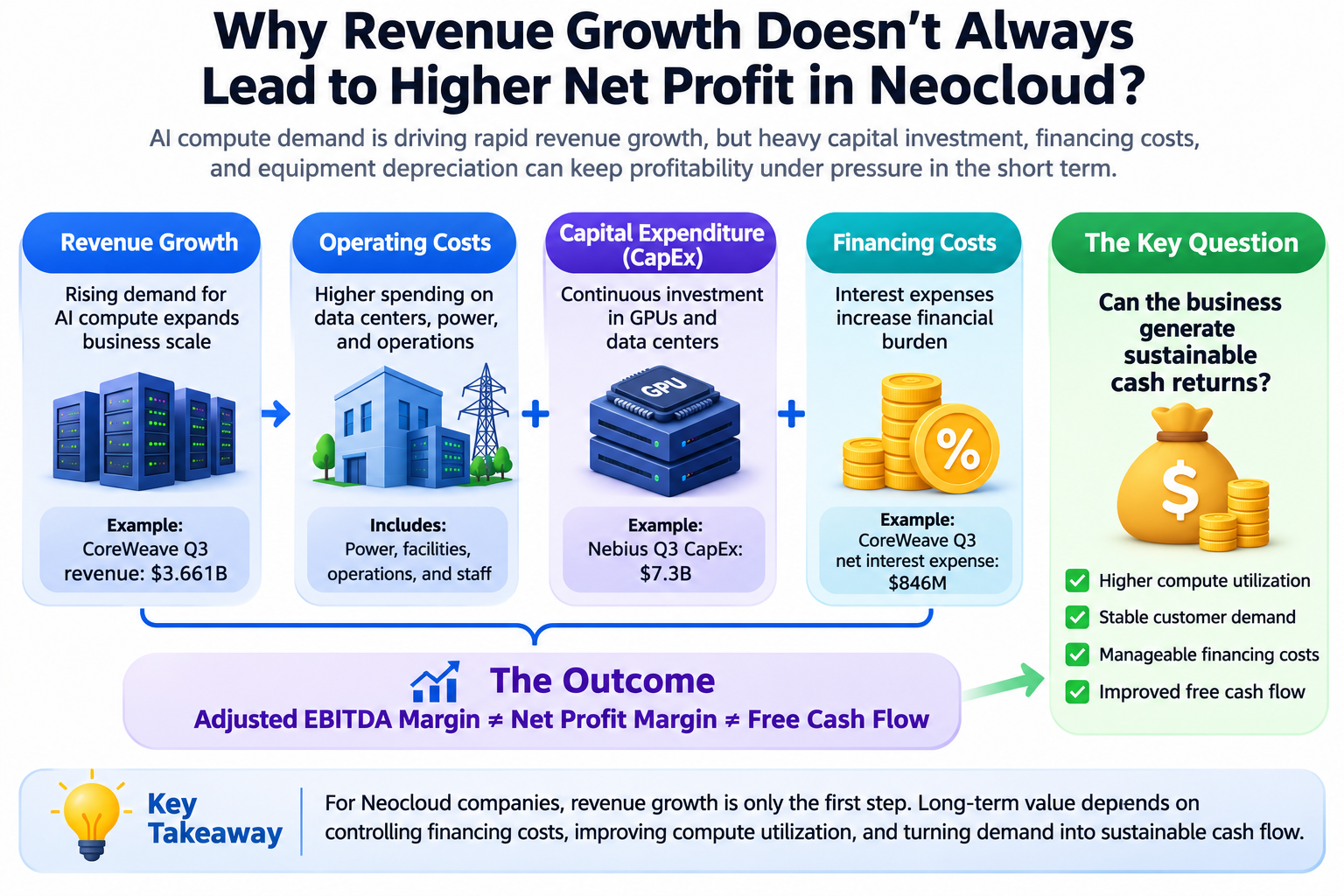
Financing costs are an important variable in understanding the Neocloud business model. Because GPU and data center construction require substantial upfront investment, companies generally obtain funding through debt financing, convertible bonds, equity financing, customer prepayments, project financing, or other methods. Different financing methods can alleviate certain short-term funding pressures, but they also create different types of costs, including interest expense, equity dilution, security restrictions, and future debt service obligations.
The primary effect of debt financing is to increase fixed financial costs. Even when demand for computing capacity declines or project delivery is delayed, a company must still pay interest and repay principal according to the agreed terms. When financing costs are high, new computing capacity projects must generate sufficient operating cash flow to cover debt costs and produce an investment return. Convertible bonds may reduce initial cash interest pressure under certain conditions, but they may cause equity dilution in the future or create maturity repayment requirements if they are not converted.
Customer prepayments are another important source of financing. Large technology companies may pay part of a contract in advance to secure future computing capacity, allowing Neocloud companies to use customer funds to support construction. This arrangement can ease short-term financing needs, but a prepayment does not equal profit already earned. The company must still fulfill its service delivery obligations in the future.
Assume that a Neocloud company invests $1 billion to build a GPU cluster, with $700 million coming from debt financing at an average annual financing cost of 8%. The debt portion alone could generate approximately $56 million in annual interest expense. Even if the GPU cluster generates substantial operating revenue, the company must still pay for power, operations and maintenance, networking, equipment depreciation, and other operating expenses before generating profit available to shareholders.
Therefore, the key question for Neocloud is not whether a larger financing amount is better, but whether new capital can generate a long-term return above its cost. The higher the financing cost, the greater the demands generally placed on computing capacity utilization, customer performance, and equipment service life.
Why Do GPU Depreciation and Equipment Replacement Affect Long-Term Valuation?
In addition to financing costs, GPU depreciation is an important factor affecting the long-term profitability of Neocloud companies. AI computing equipment is generally depreciated over time after being placed into service. Meanwhile, chipmakers such as NVIDIA continue to release new generations of products, which may change the computing efficiency, energy consumption, and market rental prices of different GPUs. Therefore, even if an existing GPU cluster can continue operating, its commercial value may not remain unchanged over the long term.
The economic value of a GPU depends on how much customers are willing to pay for computing resources and how much cash flow the equipment can generate over its useful life. If a new-generation GPU offers higher performance per unit of power consumption, older equipment may face pressure from falling rental prices or lower utilization. Companies need to use software optimization, customer contracts, and different types of computing workloads to extend the economic life of existing equipment as much as possible.
Depreciation expenses must also be distinguished from actual cash spending. When purchasing GPUs, a company typically pays funds in advance or assumes financing obligations, while depreciation is recognized gradually as an expense in subsequent accounting periods. As a result, adjusted EBITDA may show a high profit margin, but this metric generally excludes depreciation and certain financing costs and cannot independently reflect all the funding required for equipment replacement.
For Neocloud companies, long-term valuation must consider GPU purchase prices, actual service life, average rental revenue, maintenance costs, and replacement cycles. If a company must continue purchasing new equipment to remain competitive, it may need to invest capital continuously even if revenue continues to grow, placing long-term pressure on free cash flow.
Therefore, investors should not look only at adjusted EBITDA or revenue growth. They should also consider depreciation policies, capital expenditures, and equipment replacement needs when assessing whether a company is truly generating sustainable returns on capital.
How Can Financial Reports Be Used to Assess the True Profitability of Neocloud Companies?
Neocloud companies can be analyzed through four levels: revenue realization, operating profitability, financing burden, and free cash flow. Revenue realization primarily involves assessing whether customer contracts are consistently converted into actual revenue and whether newly added GPU capacity is placed into service as planned. Operating profitability focuses on performance after revenue is reduced by power, operations and maintenance, personnel, and other operating costs, helping determine whether the company can improve profit margins per unit of computing capacity.
The financing burden should be analyzed together with debt size, interest expense, debt maturities, and the types of financing instruments used. For rapidly expanding companies, an increase in net debt does not necessarily indicate deteriorating operations. However, if interest expense remains higher than operating profit for an extended period, or if the company must continually use new financing to repay old debt, financial risk may increase. Although equity financing does not directly increase interest expense, it may increase the number of shares outstanding and dilute earnings per share and free cash flow per share.
Free cash flow provides a further indication of whether the company still has discretionary funds after paying operating expenses and capital expenditures. For Neocloud companies, capital expenditures often have a clear expansionary component, so negative short-term free cash flow does not necessarily mean that the business model has failed. However, if a company still cannot generate sufficient cash recovery after completing its main construction phase, the economics of its projects and its long-term capital requirements need to be reassessed.
These metrics must be understood in the context of each company's development stage. A Neocloud company in a period of rapid construction may have high revenue growth and a substantial cash flow deficit, while a company in the stable operating stage should gradually improve its ability to recover cash. When comparing companies, investors should avoid assessing long-term value based solely on a single quarter's profit margin or financing amount.
How Should Neocloud Stocks Be Valued?
The challenge in valuing Neocloud stocks is that these companies often combine the revenue expansion characteristics of high-growth technology companies with the capital-intensive nature of infrastructure businesses. Traditional technology company valuations often focus on revenue growth, software gross margins, and customer retention, while data center infrastructure valuations place greater emphasis on return on capital, financing costs, and long-term cash flow. Neocloud involves both sets of considerations. As a result, using only a price-to-sales ratio or an adjusted EBITDA multiple may not fully reflect its financial risks.
When revenue is growing rapidly but net profit has not yet stabilized, the price-to-sales ratio can serve as an initial comparison tool. It must, however, be considered alongside revenue quality and the level of capital investment. If two companies have similar revenue but one carries significantly higher debt and equipment replacement costs, the same price-to-sales ratio does not mean that their valuations are equivalent. The enterprise value-to-EBITDA ratio can also help assess operating scale, but because EBITDA generally excludes depreciation and interest expense, its limitations must be given particular attention in a capital-intensive industry such as Neocloud.
Discounted cash flow analysis can reflect Neocloud's long-term economic value more directly, but its results depend heavily on assumptions regarding future computing capacity rental prices, GPU utilization, capital expenditures, equipment life, and financing costs. Investors can build different scenarios, considering continued growth in AI demand, gradual normalization of growth, and demand below expectations, then assess how cash flow changes under each set of assumptions.
For CoreWeave, key valuation considerations may include the realization of large contracts, debt costs, and the pace of free cash flow improvement. For IREN, investors should focus on how power resources are converted into GPU revenue and how much additional capital infrastructure expansion requires. For Nebius, they should monitor whether rapid growth can continue and assess whether the partner model can reduce capital intensity.
Therefore, the long-term valuation of Neocloud stocks should not be based solely on the expectation that demand for AI computing capacity will continue to grow. It must also answer whether a company can obtain funding at a reasonable cost, maintain computing resource utilization, and generate sufficient cash returns over the economic life of its equipment.
How Can You Trade Stocks Related to CoreWeave, IREN, and Nebius on Gate?
After understanding the business models and valuation logic of Neocloud companies, investors can also use the Gate Stocks and TradFi trading sections to monitor the market performance of AI infrastructure companies such as CoreWeave (CRWV), IREN (IREN), and Nebius (NBIS). Gate has launched USDT-settled perpetual contracts that reference the stock prices of these three companies, providing eligible users with a way to participate in movements in the prices of the related stocks. The products available, trading permissions, and service regions are subject to the platform's actual display.
Users can log in to Gate, complete the required identity verification, and enter the relevant Stocks or TradFi trading page to search for CRWV, IREN, or NBIS and review the corresponding product's market data, trading rules, and risk parameters. Gate's stock-related products include stock trading, contracts for difference (CFDs), and perpetual contracts. These products differ in trading hours, leverage, fees, and ownership rights. Stock perpetual contracts do not represent direct ownership of shares in a listed company and do not confer corresponding shareholder rights. Users should pay particular attention to margin requirements, funding fees, and the risk of forced liquidation.
For Neocloud-related stocks, investors can use quarterly financial reports, GPU deployment progress, customer contracts, capital expenditures, and financing costs as the basis for fundamental analysis, while also considering price trends and market valuations when assessing risk. During periods of rapid expansion by AI computing companies, large orders may improve revenue expectations, but rising debt, equipment depreciation, and financing costs may also put pressure on stock prices. Regardless of the product used, investors should distinguish between long-term corporate value and short-term market fluctuations and confirm the nature of the specific product, trading fees, and risk rules before placing an order.
Conclusion
The rapid development of CoreWeave, IREN, and Nebius reflects the changes that growing demand for AI computing capacity is bringing to the cloud computing infrastructure market. Training and inference for large models, as well as AI application deployment, require continuous investment in GPU resources, creating new growth opportunities for specialized AI cloud service providers. However, Neocloud is not a lightweight model that can expand rapidly based solely on software revenue. Its development depends heavily on data center construction, computing equipment procurement, and continuous financing.
The latest financial reports from 2026 further show that revenue growth and ultimate profitability can differ substantially. CoreWeave's high interest expense, Nebius' large-scale capital expenditures, and IREN's continued deployment of GPUs and data centers all indicate that financing costs have become an important variable affecting the long-term value of Neocloud companies. Orders and customer contracts can improve the visibility of future revenue, but growth can translate into economic returns only after infrastructure has been delivered, computing resources maintain high utilization, and stable cash flow is generated gradually.
For investors, researching Neocloud companies requires going beyond GPU quantity and order size to examine financing structures, equipment depreciation, return on capital, and free cash flow. The companies that ultimately demonstrate sustainable competitiveness will need not only to capture demand for AI computing capacity, but also to prove that they can deliver that capacity at a reasonable cost of capital and generate returns above their cost of capital over the long term.
FAQ
How Does Neocloud Differ From Traditional Cloud Computing?
Neocloud generally focuses more on GPU-accelerated computing and high-performance workloads such as AI model training and inference. Traditional cloud platforms offer a broader range of services, including general-purpose computing, databases, storage, and enterprise software. The two differ in business scope and resource allocation, but they are not completely separate markets.
Why Is CoreWeave Still Loss-Making Despite Revenue Growth?
CoreWeave achieved significant revenue growth in Q3 2026, but it also incurred substantial interest expense and other costs during the same period. For a capital-intensive AI cloud service provider, growth in operating revenue may not immediately cover financing costs. As a result, net profit may differ significantly from adjusted EBITDA.
Why Can IREN Transition From Bitcoin Mining to AI Cloud Computing?
IREN has accumulated certain power and data center infrastructure resources, while AI GPU clusters also require stable energy supplies and high-density computing environments. However, AI cloud computing has different requirements for networking, software, and equipment configuration. The business transition therefore still requires continued investment.
Does Nebius' Revenue Growth Mean That Its Business Model Is Already Mature?
Not necessarily. Nebius' revenue grew 571% year over year in Q3 2026, but the company still had substantial capital expenditures and cash flow requirements during the same period. Revenue growth shows that the business is expanding, while the maturity of the business model must also be assessed based on sustained profitability, cash recovery, and return on capital.
Why Can't Neocloud Backlog Be Used Directly for Valuation?
Backlog represents contract revenue that may be recognized in the future, but it generally requires conditions such as service delivery and computing capacity availability to be met before it can be realized progressively. The contract value does not equal cash already received and cannot directly represent future net profit. Delivery costs, financing needs, and contract terms must also be considered.