In November 2026, U.S. technology stocks entered a prolonged correction. On November 20, the Nasdaq 100 fell approximately 5.6% in a single day, bringing its cumulative drawdown from the October 6 all-time high to 19.8%, just short of the technical bear market threshold. During the same period, the S&P 500 fell approximately 11.6% from its high, while the Nasdaq Composite dropped 5.28% in a single day, indicating that the sell-off had spread from certain AI stocks to the broader U.S. equity market.
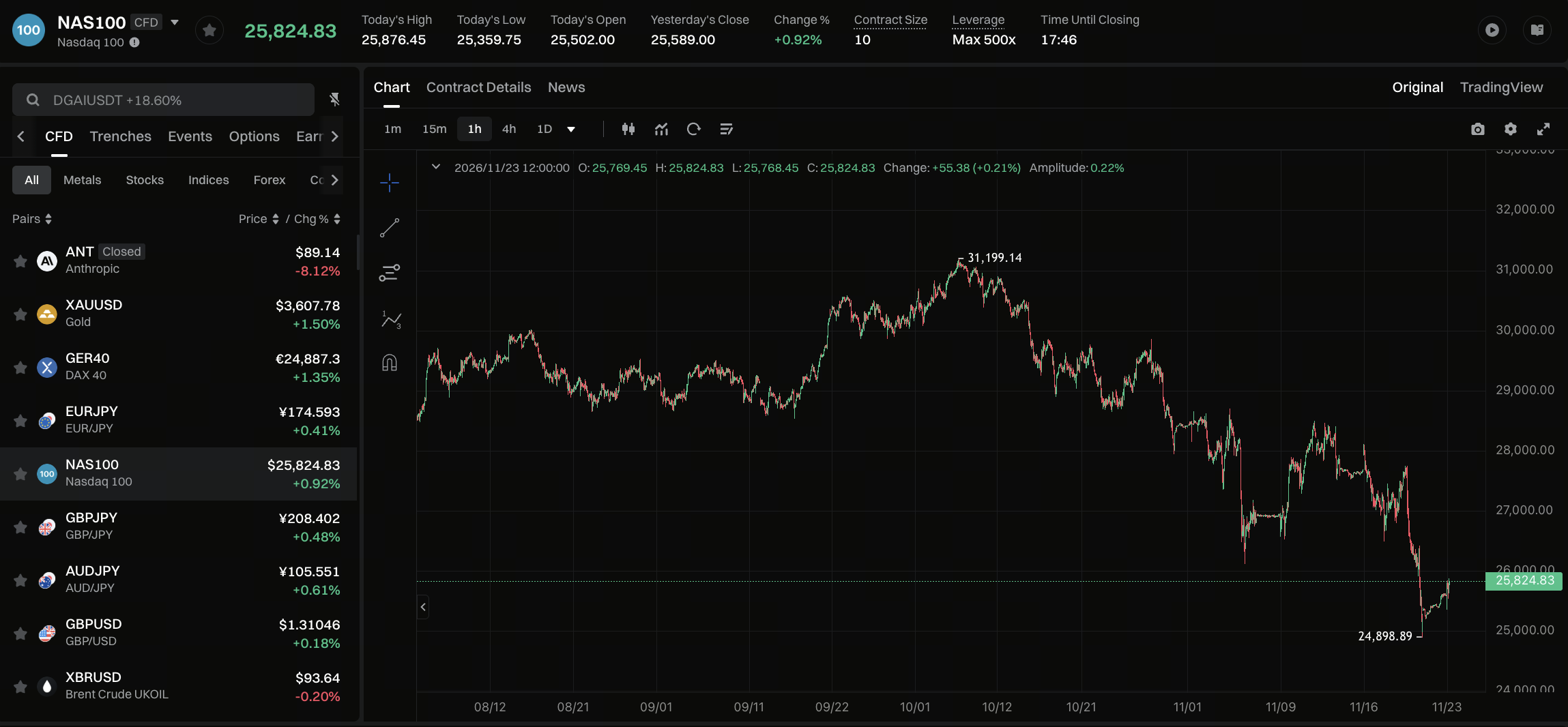
Notably, this downturn occurred against a backdrop of substantial AI infrastructure investment and continued earnings growth at some semiconductor companies. This suggests that the market's primary concern may have shifted from whether the AI industry can grow to whether that growth can generate sufficient profits and cash flow, as well as whether previous stock valuations had already over-reflected future expectations. This article analyzes why technology stocks experienced valuation repricing from the perspectives of AI capital expenditures, valuation multiples, the interest rate environment, institutional deleveraging, and transmission across the industrial chain. It also examines which market signals investors should monitor.
Key Takeaways
-
As of November 20, 2026, the Nasdaq 100 had fallen 19.8% from its October 6 high, approaching the technical bear market threshold.
-
The decline in technology stocks does not necessarily mean that AI demand has disappeared. More importantly, investors have begun reassessing the payback period for AI infrastructure investment.
-
High-valuation growth stocks are sensitive to future earnings expectations and the cost of capital. Even if revenue continues to grow, declining valuation multiples may still cause stock prices to fall.
-
AI chip, Neocloud, data center, and power equipment companies occupy different positions in the industrial chain and have been affected differently by the market correction.
-
Deleveraging by hedge funds and systematic trading strategies may amplify short-term declines, but institutional selling does not mean that the market has formed a long-term bottom.
-
Determining whether the market is stabilizing requires observing earnings expectations, capital flows, market breadth, credit risk, and volatility together rather than relying solely on the size of an index decline.
Why Did the Nasdaq Approach a Technical Bear Market in November 2026?
Since October 2026, U.S. technology stocks have gradually shifted from their previous uptrend into a correction. After November began, the high valuations of AI-related companies, the scale of infrastructure investment, and regulatory uncertainty became key market concerns, further increasing selling pressure on the technology sector.
On November 20, the Nasdaq Composite fell 5.28%, the S&P 500 fell 3.70%, and the Dow Jones Industrial Average fell approximately 1.93%. The Nasdaq 100 fell approximately 5.6%, bringing its cumulative decline from its October 6 high to 19.8%. Under the commonly used definition, a 10% decline from a high represents a technical correction, while a 20% decline marks entry into a technical bear market. The Nasdaq 100 was therefore very close to this threshold.
Technology stocks were a major source of the correction. On November 20, NVIDIA fell approximately 14%, AMD fell approximately 13.3%, Micron fell approximately 13.9%, and Broadcom fell approximately 12.2%. These companies are respectively involved in AI accelerators, memory chips, and related semiconductor businesses, indicating a significant decline in risk appetite toward the AI infrastructure industrial chain.
However, a technical bear market is merely a market condition defined by the size of a price drawdown. It does not directly indicate a recession or a collapse in corporate earnings. An index decline may result from deteriorating earnings expectations, previously excessive valuations, investors adjusting their positions, or declining market liquidity.
Therefore, determining the nature of this correction requires more than observing how close the Nasdaq is to the bear market threshold. It is also necessary to analyze whether the specific factors driving technology stocks lower are likely to persist.
Why Have Strong AI Earnings Failed to Prevent Stock Prices from Falling?
There is no inevitable relationship between AI companies' revenue growth and rising stock prices. Corporate earnings reports reflect business results that have already been achieved, while stock prices incorporate investors' expectations for revenue, profits, and cash flow over many years ahead.
Take NVIDIA as an example. The company's latest quarterly revenue continued to grow rapidly, reflecting strong demand for AI computing infrastructure. However, the market is not only focused on current GPU sales. It also evaluates future order growth, changes in gross margins, customer capital expenditures, and industry competition.
If investors had already expected a company to achieve strong growth, even an excellent earnings report may not be enough to drive a further increase in its valuation. Conversely, if the market believes that future growth may slow or that the capital investment required to achieve that growth will exceed expectations, the stock price may adjust downward.
For example, suppose a company currently has earnings per share of $10 and the market assigns it a price-to-earnings ratio of 40x, resulting in a stock price of $400. The following year, earnings per share increase to $15, but the market lowers the price-to-earnings ratio to 25x. The corresponding stock price would then be $375.
In this hypothetical scenario, the company's earnings per share increase by 50%, yet its stock price still declines by approximately 6.3%. This shows that earnings growth and changes in valuation multiples can move in opposite directions. For AI companies, market repricing does not necessarily mean that the value of the technology has been rejected. Rather, investors may no longer be willing to pay the same high premium for the same growth expectations.
Why Is AI Data Center Capital Expenditure Becoming a Source of Valuation Pressure?
In recent years, an important driver of AI industry growth has been the continued increase in computing infrastructure investment by major technology companies. Cloud computing platforms, model developers, and data center operators have purchased GPUs, servers, networking equipment, and power infrastructure, creating substantial demand for semiconductor and infrastructure companies.
However, capital expenditure itself does not equal investment returns. Companies must first pay for equipment, land, power, cooling, and financing when building data centers. Once these assets are operational, they must generate revenue through cloud computing services, AI inference, enterprise software, or other businesses.
If demand for AI services continues to grow and revenue is sufficient to cover equipment depreciation, energy costs, and financing costs, infrastructure investment may create a sustainable commercial cycle. Conversely, if computing supply expands faster than actual paid demand, some projects may face low utilization, price competition, or cash flow pressure.
This is an important change in the current market correction. Investors are beginning to focus more on whether AI investment can generate stable returns rather than simply monitoring how many GPUs major technology companies plan to purchase.
This issue is even more pronounced for Neocloud companies. Some computing operators need to purchase equipment through debt financing or other capital arrangements and then recover their investments through long-term computing contracts. If financing costs rise, equipment prices change, or customer demand falls short of expectations, their cash flow and balance sheets may come under greater pressure. Therefore, expanding AI data center investment can drive revenue growth across the industrial chain, but only stable commercial revenue and cash flow can provide lasting support for long-term valuations.
Why Can Interest Rate Expectations Amplify the Decline in High-Valuation Technology Stocks?
Stock valuations are influenced by both future earnings expectations and the rate of return required by investors. For technology companies that depend on strong growth over many years, changes in interest rates can have a significant effect on valuations.
All else being equal, the higher the return investors require, the lower the present value generally assigned to future cash flows. Companies that have not yet achieved stable profitability but are expected to deliver substantial future revenue growth are often more sensitive to this change.
In November 2026, the U.S. market faced uncertainty over inflation, monetary policy, and the future path of interest rates. Investors were concerned that interest rates might remain elevated for longer or even tighten further, which would affect the pricing of high-valuation growth stocks.
It is important to distinguish between the market rate environment and the direction of stock prices. Market interest rates do not always rise when stock markets fall. During concentrated sell-offs in risk assets, capital may flow into assets such as U.S. Treasuries, pushing Treasury prices higher and yields lower. During the global market correction on November 20, U.S. Treasuries did attract safe-haven buying.
This shows that pressure on technology stock valuations may stem from concerns about the future path of interest rates or from rising equity risk premiums, rather than from an increase in Treasury yields on that particular day.
Therefore, analyzing the impact of interest rates on AI stocks requires observing Federal Reserve policy expectations, Treasury yields, corporate financing costs, and investor risk appetite together. It is not appropriate to attribute a stock price decline simply to a single interest rate indicator.
Why Could Institutional Deleveraging Further Increase the Decline in Technology Stocks?
Market corrections are influenced not only by corporate fundamentals but also by the positions and trading strategies of institutional investors. During a prolonged uptrend, some hedge funds, quantitative strategies, and other institutional investors may gradually increase their exposure to technology stocks. When market volatility rises, these investors may reduce risk voluntarily or cut their positions because of model constraints, margin requirements, and risk control mechanisms.
For example, trend-following strategies typically adjust positions based on market prices and volatility. When stock indexes continue to decline, some strategies may shift from buying to selling, further increasing market supply.
Goldman's trading division noted in a market observation on November 20 that its panic indicator had risen to a level close to its maximum, while systematic trading strategies had already significantly reduced their equity exposure and could continue selling under certain market conditions.
This mechanism may create short-term feedback: falling stock prices push volatility higher, rising volatility prompts some institutions to reduce their risk exposure, and concentrated selling further depresses stock prices.
However, deleveraging does not mean that the market must continue to fall. As positions decline, potential selling pressure may gradually weaken. The key issue is whether the market can reestablish stable buying demand and whether investors are willing to assume risk at current valuation levels.
Therefore, institutional deleveraging can explain why short-term declines may be amplified, but it cannot be used on its own to predict a market bottom.
Why Could AI Chip, Neocloud, and Power Equipment Stocks Fall at the Same Time?
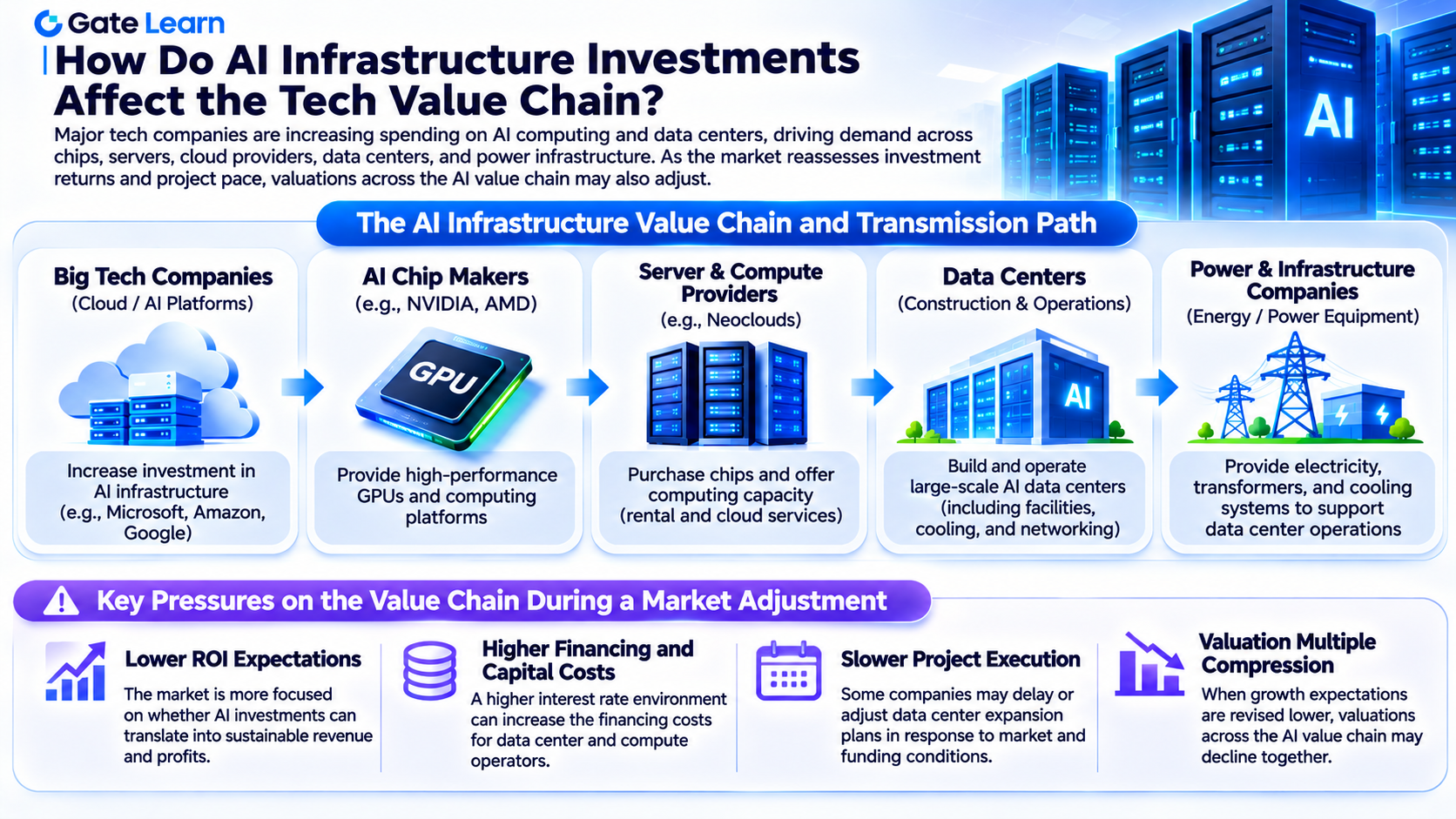
The AI infrastructure industrial chain covers multiple segments, including chip design, semiconductor manufacturing, server integration, computing rental, data center operations, power equipment, and energy supply. Although these companies have different sources of revenue, the market may broadly view them as beneficiaries of AI capital expenditure growth.
When investors are optimistic about the expansion of AI infrastructure, stocks across different segments of the industrial chain may receive valuation premiums at the same time. However, when the market becomes concerned about the returns on capital expenditure and the pace of construction, these companies may also face selling pressure simultaneously.
The primary impact on chip companies may come from customer purchasing expectations, product pricing, and future order growth. Neocloud companies need to pay greater attention to financing costs, equipment utilization, customer concentration, and their ability to fulfill contracts. Data center operators also face risks related to power access, construction costs, and project delivery timelines. For power equipment and energy companies, the market needs to determine whether incremental demand has translated into actual orders and whether related projects can be built as planned.
In early November 2026, concerns about restrictions on data center construction and regulatory changes increased in the U.S. market. Some investors began reassessing the pace of future project construction. These risks may spread across the industrial chain, but this does not mean that every company will experience the same actual impact.
Therefore, simultaneous declines in industrial chain stocks may reflect a broad reduction in exposure to the AI theme rather than a deterioration in the orders and operations of every company. For investors, the key is to distinguish between a broad adjustment caused by market sentiment and long-term risks resulting from changes in a specific company's fundamentals.
Does the Nasdaq Approaching a Bear Market Mean That the AI Investment Cycle Has Ended?
The Nasdaq 100 approaching a technical bear market indicates a significant change in the market's risk pricing for technology stocks, but it cannot directly be used to conclude that the AI industry investment cycle has ended.
Technological development, corporate capital expenditure, and stock prices operate on different cycles. Even if stock valuations decline, equipment orders that have already been signed, data centers under construction, and continued growth in demand for AI services will not immediately disappear because of a short-term market correction.
However, if the correction continues for an extended period, it may gradually affect companies' financing capabilities. For companies that need to continually raise funds to build infrastructure, falling stock prices and widening credit spreads may increase financing costs and affect subsequent capital expenditure plans.
There are also differences between major technology companies and highly leveraged computing operators. Companies with stable cash flow and strong balance sheets are generally better able to maintain long-term investment during periods of market volatility. Companies that depend on external financing may be more sensitive to changes in financial conditions.
Therefore, determining whether the AI investment cycle has undergone a fundamental shift requires monitoring whether cloud computing companies' capital expenditures, GPU orders, data center utilization, and AI service commercialization revenue show sustained changes.
Markets may price in future risks ahead of time, but a stock price decline itself cannot replace research into industry fundamentals.
Which Indicators Can Help Determine Whether U.S. Stocks Are Stabilizing?
During a rapid market correction, investors often try to use the panic index or oversold indicators to identify a bottom. However, a single indicator is unlikely to provide a reliable conclusion.
-
Market breadth can be monitored. If an index rebound is driven by only a few large technology stocks while most stocks continue to decline, the foundation for market stabilization may be relatively weak. Conversely, if more industries and individual stocks begin to recover, it may indicate that buying demand is expanding.
-
Corporate earnings expectations require attention. If analysts continue lowering their forecasts for technology companies' future revenue and profits, stocks may face further pressure even after valuation multiples decline.
-
Credit markets are worth monitoring. For AI infrastructure companies that require substantial external financing, bond spreads, financing costs, and debt refinancing conditions can reflect the market's assessment of corporate cash flow risk.
-
Macroeconomic conditions and monetary policy must also be considered. Future interest rate expectations, inflation data, and corporate earnings reports may all change how investors value technology stocks.
Therefore, a more appropriate way to determine whether the market is stabilizing is to assess price trends, earnings expectations, capital flows, and credit conditions together rather than simply using a particular decline threshold to determine the market's direction.
How Can Investors Use Gate Stock Trading to Monitor the AI Technology Stock Correction?
The current U.S. equity market correction provides a real-world example for understanding valuations across the AI industrial chain. Semiconductor companies such as NVIDIA and AMD, as well as companies related to cloud computing, data centers, and power equipment, may be affected by the same market sentiment, but their business models and sources of risk are different.
Gate Stocks trading services provide users with a channel for monitoring the U.S. stock market. Investors can visit the Gate TradFi stock section to view the stocks currently supported, market data, and trading rules, and conduct research using listed companies' earnings reports, capital expenditure plans, and industry data.
For example, when analyzing NVIDIA, investors can monitor data center revenue, gross margin, and customer purchasing expectations. When researching computing operators such as CoreWeave, they should place greater emphasis on debt financing, cash flow, and equipment utilization. When evaluating power equipment companies, they should focus on order execution, project construction, and profit margins.
Note that stock spot trading, stock perpetual contracts, and other derivatives differ in terms of asset rights, margin requirements, and trading risks. For highly volatile technology stocks, leveraged trading may further magnify gains and losses and create a risk of forced liquidation. The specific products supported and applicable trading conditions are subject to the actual page.
For investors, the significance of monitoring a market correction lies not only in seeking short-term trading opportunities but also in understanding how different companies' valuations are affected by growth expectations, the cost of capital, and market liquidity.
Summary
In November 2026, the Nasdaq 100 fell 19.8% from its high, approaching a technical bear market and reflecting a repricing of AI and technology growth stocks. The decline was not caused solely by the earnings report of any one company. Instead, it resulted from the combined effects of the returns on AI infrastructure investment, interest rate expectations, institutional deleveraging, and market risk appetite.
For AI companies, revenue growth remains important, but investors are increasingly focused on the capital investment, profit margins, and cash flow behind that growth. Even if technology demand continues to expand, stock prices may still undergo a significant correction if the market lowers its expectations for future earnings or reduces valuation multiples.
Therefore, determining whether the current U.S. equity market correction is nearing its end requires monitoring corporate earnings, industry investment, financial conditions, and market trading structure together. A technical bear market is a price condition, while the long-term value of the AI industry still needs to be validated through sustained commercialization and profitability.
FAQ
How Much Does the Nasdaq Need to Fall to Enter a Technical Bear Market?
A decline of 20% from a recent high is generally used as the standard for determining whether an index has entered a technical bear market. On November 20, 2026, the Nasdaq 100 closed 19.8% below its October 6 high, approaching but not yet reaching this threshold.
Why Can Stock Prices Fall Even When AI Companies' Revenue Is Growing?
Because stock prices reflect future earnings expectations and valuation levels. If the market lowers its forecast for future growth or reduces the price-to-earnings ratio it is willing to pay, stock prices may fall even if a company's revenue continues to grow.
Does the Current U.S. Stock Market Decline Mean That the AI Bubble Has Burst?
This cannot be determined solely from the index drawdown. It is necessary to consider AI service revenue, capital expenditures, computing demand, corporate cash flow, and valuation changes to distinguish deteriorating industry fundamentals from a market valuation adjustment.
Why Could AI Chip and Data Center Stocks Fall at the Same Time?
These companies are all related to the AI infrastructure investment cycle. When the market becomes concerned about slowing capital expenditures or rising financing costs, it may lower the valuations of multiple segments across the industrial chain at the same time.
Does Institutional Deleveraging Mean That U.S. Stocks Are About to Rebound?
Not necessarily. Reducing equity positions may ease some short-term selling pressure, but whether the market can sustain a rebound also depends on corporate earnings expectations, capital inflows, market liquidity, and macroeconomic conditions.
Which Signals Should Investors Monitor to Determine Whether U.S. Stocks Are Stabilizing?
Investors can monitor market breadth, technology companies' earnings expectations, credit spreads, institutional positioning, volatility, and changes in Federal Reserve policy together, rather than relying on a single technical indicator.