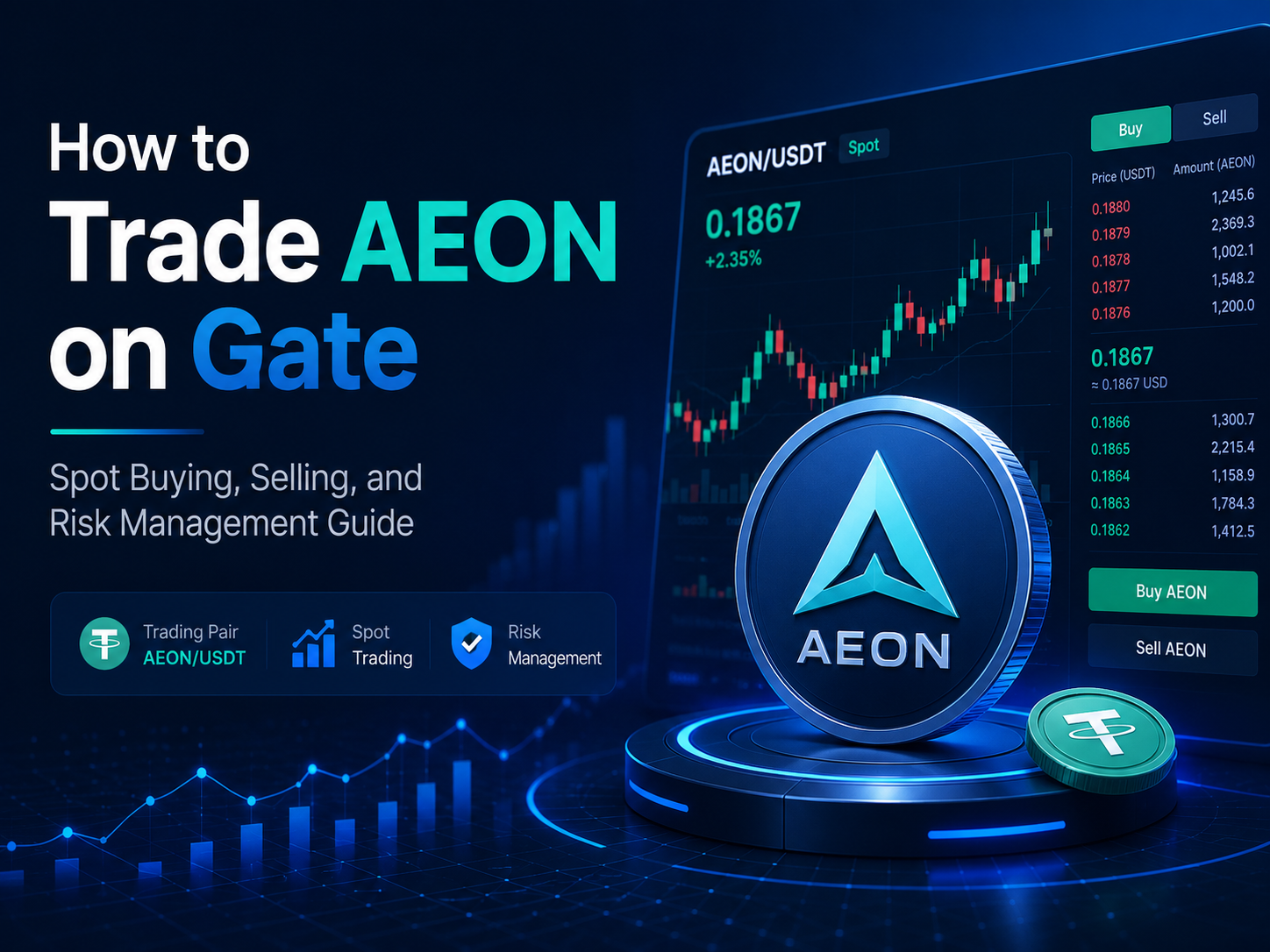
In the AEON/USDT pair, AEON is the base asset and USDT is the quote asset. Users spend USDT to buy AEON and receive USDT when they sell AEON. Spot trading does not normally involve borrowing, funding fees, or forced liquidation, but users can still face losses from price volatility, low liquidity, or operational mistakes.
Before placing an order, users should confirm the trading pair, order type, applicable fees, order book depth, and available balance. When depositing or withdrawing AEON, the supported network and address shown on Gate should always be treated as the primary reference.
What Do You Need Before Trading AEON on Gate?
Before trading, users need to register and log in to a Gate account and complete any identity verification required for their region, account status, or selected services. Verification requirements may affect fiat purchases, P2P access, deposit and withdrawal limits, and certain trading features.
Account security should also be configured before funds are deposited. Recommended measures include using a unique password, enabling two-factor authentication, setting a fund password and anti-phishing code, and reviewing login devices and security records.
Users should confirm that they are entering the AEON/USDT spot market. Gate may also display convert, derivatives, or other AEON-related products, but these products use different execution methods and carry different risks. A completed spot trade gives the user an actual AEON balance, while a derivative product generally represents a price position rather than direct token ownership.
Before placing an order, check the following:
-
The trading pair is AEON/USDT.
-
The page is labeled as a spot market.
-
The account has enough available USDT.
-
The bid-ask spread and order book depth are acceptable.
-
The selected order type is correct.
-
The applicable spot trading fee has been reviewed.
-
The supported AEON deposit and withdrawal networks have been confirmed.
Users should also verify the project name and token symbol. Similar asset names may exist, and an external transfer should never be based only on the ticker “AEON.” The network, token contract, and deposit address must all match.
How to Prepare USDT for Trading
AEON/USDT spot trading requires USDT as the payment asset. Users who already hold USDT can check whether it appears as an available balance in the account used for spot trading. If the funds are held in another account type or product, an internal transfer may be required.
Users who do not yet hold USDT may be able to obtain it through supported services such as quick buy, P2P, convert, or by selling another crypto asset. Available payment methods, quotes, limits, fees, and settlement times may vary by region and account.
When depositing USDT from an external wallet or another platform, open the USDT deposit page on Gate and review the supported networks. The same network must then be selected on the sending side before the Gate deposit address is copied and verified.
Using the same asset name is not enough. USDT transferred through one network cannot be assumed to arrive at an address generated for another network. A mismatch may prevent automatic crediting and can lead to permanent loss.
After the deposit arrives, confirm that the USDT balance is available for trading. USDT already committed to open orders, earn products, or margin positions may appear as frozen or unavailable.
How to Find the AEON/USDT Spot Pair
In the Gate app, open the trading section, select Spot, and search for “AEON” in the market selector. Choose AEON/USDT rather than a similarly named asset or a different product type.
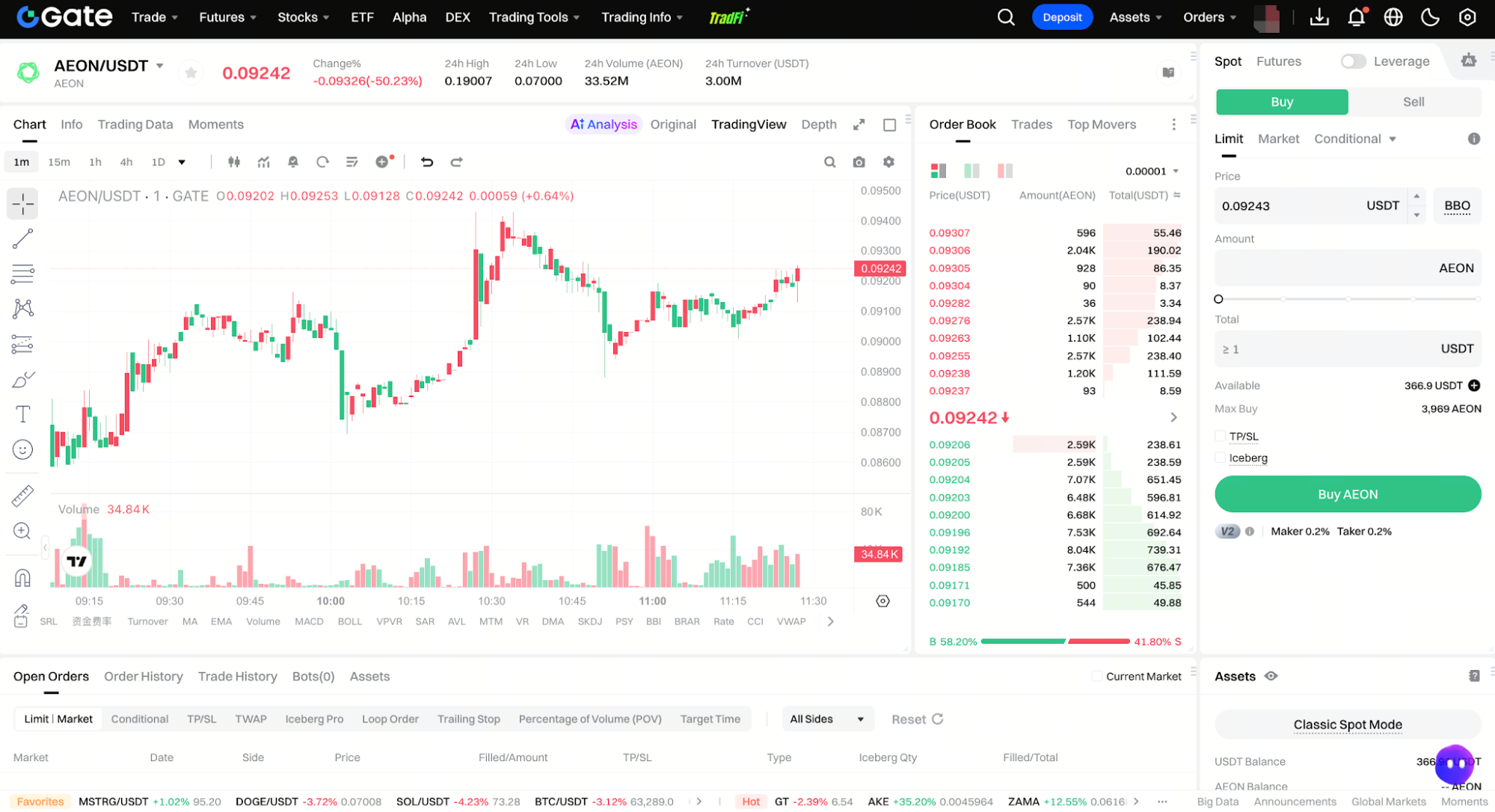
On the web platform, enter the spot trading market and search for AEON in the trading pair list. After opening the page, confirm the pair, quote asset, and product label again.
The AEON/USDT trading interface generally includes the following sections:
| Page Section |
Main Purpose |
| Price chart |
Displays AEON price movements across different timeframes |
| Order book |
Shows active buy and sell orders |
| Recent trades |
Displays recently completed transactions |
| Order panel |
Allows users to select buy or sell and choose an order type |
| Open orders |
Shows unfilled or partially filled orders |
| Order history |
Shows filled, canceled, or expired orders |
| Trade history |
Shows actual execution prices, quantities, and fees |
A price chart shows historical market movements, but it does not guarantee that a user can trade any quantity at the displayed price. Actual execution depends on the orders currently available in the order book.
The difference between the highest bid and the lowest ask is the bid-ask spread. A narrower spread usually indicates better liquidity, while a wider spread can increase the immediate cost of entering or exiting a position.
How to Buy AEON With a Market or Limit Order
A market order attempts to buy AEON immediately using the best available prices in the order book. Users usually enter the amount of USDT they want to spend, and the system matches the order against available sell orders.
The main advantage of a market order is speed. However, the entire order may not be filled at the last displayed price. If the order is large or market depth is limited, it may execute across several price levels, resulting in a higher average purchase price.
A limit order allows users to set the maximum price they are willing to pay. For example, if AEON is currently trading above the user’s preferred entry price, a lower buy limit order can be placed and left in the order book.
A limit order offers more price control but does not guarantee execution. The market may never reach the selected price, or only part of the order may be filled if other orders were submitted earlier at the same level.
| Comparison |
Market Order |
Limit Order |
| User sets the price |
No |
Yes |
| Execution speed |
Usually faster |
Depends on market conditions |
| Guaranteed execution |
More likely, but not absolute |
Not guaranteed |
| Price control |
Lower |
Higher |
| Main risk |
Slippage and average price deviation |
Waiting or partial fills |
| Typical use |
Small orders requiring quick execution |
Orders requiring price control |
Before confirming the order, review the buy direction, order type, price, AEON quantity, and estimated USDT cost. After execution, check the trade history for the actual average price and fee rather than relying only on the latest market price.
How to Check Order Status and AEON Balance
After an order is submitted, its status can be reviewed under Open Orders, Order History, and Trade History. Open Orders normally shows unfilled and partially filled orders, while Order History records completed, canceled, or expired orders.
A partial fill means only part of the order has been executed. For example, a limit order for 10,000 AEON may fill 3,000 AEON while the remaining 7,000 AEON stays open in the order book.
Canceling a partially filled order only removes the unfilled portion. The completed portion cannot be reversed, and the corresponding USDT has already been exchanged for AEON.
Once the order is filled, AEON appears in the account balance. Available AEON can be sold or used for other supported actions. AEON committed to a sell order may appear as frozen until the order is filled or canceled.
Users should also distinguish between the order price and the execution price. A limit price defines the acceptable boundary, but an order may be filled through several individual trades. The final result should therefore be checked in the trade history.
How to Sell AEON for USDT
To sell AEON, open the AEON/USDT spot page, select Sell, choose an order type, and enter the amount of AEON to be sold. After the order is filled, the AEON balance decreases and the USDT balance increases.
A market sell order matches available buy orders in the order book. It may be suitable for users who prioritize immediate execution, but the average selling price may be lower than the latest displayed price if liquidity is limited.
A limit sell order allows users to set the minimum price they are willing to accept. The order will only execute when matching demand is available at that price or higher.
Receiving USDT after selling AEON is not the same as withdrawing fiat currency. Users may continue holding USDT, use it for other spot trades, or access other supported conversion and withdrawal options.
During rapid market movements, users should avoid submitting repeated sell orders without reviewing Open Orders. A previous order may already be partially filled, and an additional order could result in selling more AEON than originally intended.
What Fees and Liquidity Factors Should AEON Traders Consider?
Spot trading fees are usually calculated based on the executed amount and the fee rate applicable to the account. Only the filled portion of an order incurs a trading fee. Unfilled or canceled quantities are not charged as if they had been completed.
The actual rate may depend on factors such as VIP level, trading volume, or platform promotions. Users should review their account fee schedule before trading and confirm the final fee in the execution record.
Maker and taker status depends on whether an order adds liquidity to or removes liquidity from the order book. A limit order that remains open generally acts as a maker order. A market order, or a limit order that executes immediately, generally acts as a taker order.
Trading costs also include:
-
Bid-ask spread: The difference between the highest bid and lowest ask.
-
Slippage: The difference between the expected price and the actual average execution price.
-
Market depth: The quantity available at different price levels.
-
Price impact: The movement in execution price caused by the size of an order.
The last traded price only reflects the most recent transaction. It does not mean that any order size can be executed at that price. Larger trades should be evaluated against the available order book depth.
Splitting an order or using limit orders can improve price control, but neither method guarantees a better final result. Multiple transactions may also increase operational complexity and total fees.
How to Verify the Network When Depositing or Withdrawing AEON
When depositing or withdrawing AEON, users should rely on the networks currently listed on the Gate asset page. AEON’s multichain payment architecture does not mean that every supported blockchain is automatically available for deposits and withdrawals on Gate.
To deposit AEON, open the AEON asset page, select Deposit, and review the supported networks and deposit address. The sending wallet or platform must use the same network.
To withdraw AEON, confirm that the receiving wallet or platform supports the selected network. Then verify the receiving address, withdrawal amount, and fee. Any required Memo, Tag, or additional identifier must also be included.
Before confirming an on-chain transfer, check:
-
The asset is AEON.
-
The sending and receiving networks match exactly.
-
The address is complete and has not been altered.
-
Any required Memo or Tag is included.
-
The token contract matches the displayed information.
-
The amount meets the minimum deposit or withdrawal requirement.
-
The withdrawal fee and expected received amount are acceptable.
-
Deposits or withdrawals are currently enabled.
For a new address or network, a small test transfer can reduce the impact of a mistake. Once a blockchain transaction has been broadcast and confirmed, it usually cannot be canceled, and recovery is not guaranteed.
Users should access deposit and withdrawal pages only through official Gate interfaces. Passwords, verification codes, private keys, and seed phrases should never be shared with anyone claiming to provide support.
What Are the Main Risks of Trading AEON?
The main risks of trading AEON include price volatility, changing liquidity, project execution, token supply uncertainty, cross-chain technology, and user error. Spot trading does not involve forced liquidation, but the value of the AEON position can still rise or fall sharply.
Liquidity directly affects execution. If the order book is shallow, a large market order may fill across multiple price levels, causing the average execution price to differ substantially from the displayed price. A limit order offers price control but may remain unfilled or only partially execute.
Several AEON token utilities are being introduced in phases. Universal payment gas is live, token buybacks are expected to scale with payment volume, validator staking and governance target the end of 2026, and CeDeFi yield and liquidity incentives do not yet have a confirmed launch date. Delays or changes in these features may affect market expectations.
Token supply is another factor. AEON has a total supply of 1 billion tokens, but the currently available official materials do not provide a complete vesting and release schedule for the Team, investors, Foundation, and Ecosystem Fund. Future changes in circulating supply therefore remain difficult to estimate precisely.
AEON’s cross-chain architecture also introduces risks involving validators, smart contracts, liquidity, and external blockchain networks. A delay, vulnerability, or network failure at one layer may affect payments or asset transfers, although it may not directly interrupt spot order matching on Gate.
| Risk Type |
Typical Impact |
| Price risk |
Rapid gains, losses, or reversals |
| Liquidity risk |
Wider spreads and greater slippage |
| Project execution risk |
Payment, staking, governance, or buyback delays |
| Supply risk |
Token unlocks may affect market supply and demand |
| Technical risk |
Cross-chain, node, or smart contract failures |
| Operational risk |
Incorrect pair, network, address, or order direction |
| Security risk |
Phishing, account compromise, or impersonation scams |
Risk management is less about predicting every price movement and more about limiting the impact of a mistake. Users should only trade with funds they can afford to lose, avoid using borrowed money or essential living expenses, and size the position according to their own risk tolerance.
Defining the investment amount, maximum acceptable loss, and exit conditions before buying can reduce impulsive decisions during volatile periods. Buying in stages does not guarantee a lower average cost, and stop orders do not guarantee execution at the selected price when liquidity is weak or prices gap sharply.
Summary
The basic process for trading AEON on Gate is to prepare an account and USDT, open the AEON/USDT spot market, select a market or limit order, and confirm the completed trade through the order and asset records.
Market orders prioritize speed but may produce slippage. Limit orders provide more control over price but do not guarantee execution. Selling AEON returns USDT rather than fiat currency.
Total trading costs include spot fees, bid-ask spreads, slippage, and price impact. Reviewing order book depth before trading can help users understand how an order may execute.
When depositing or withdrawing AEON, the asset, network, address, and token contract must all match. Multichain support at the project level does not mean that Gate supports every network for AEON transfers.
Users should also consider price volatility, liquidity, token supply, project development, cross-chain technology, and account security. Position sizing and disciplined account protection remain central to managing spot trading risk.
FAQ
Do Users Receive Actual AEON After Buying It on Gate?
Yes. Once an AEON/USDT spot order is filled, AEON appears in the user’s account balance and can be sold or transferred through a supported network.
What Is the AEON Spot Trading Pair on Gate?
The spot trading pair is AEON/USDT. Users spend USDT to buy AEON and receive USDT when they sell AEON.
Is a Market Order or Limit Order Better for Buying AEON?
A market order is better suited to users who prioritize quick execution, while a limit order is more suitable for users who want to control the maximum purchase price. Neither option removes execution risk.
Why Did an AEON Limit Order Not Fill After the Price Reached the Selected Level?
Other orders may have been submitted earlier at the same price, or there may not have been enough matching liquidity. The order may remain open or receive only a partial fill.
The USDT from the executed portion normally appears in the account balance after settlement. Any unfilled portion of a limit order remains open.
Can AEON Be Deposited to Gate Through Any Blockchain?
No. Users must select one of the networks currently supported on the Gate AEON deposit page. The sending network, receiving network, address, and token contract must all match.