XAUT (Tether Gold) is a gold-backed crypto asset issued by TG Commodities, S.A. de C.V., with each full token mapped to one fine troy ounce of LBMA London Good Delivery gold held in Switzerland. Macro moves that hit USD gold therefore transmit into XAUT’s reference value. Relative to physical bars, transferring a gold-backed token can be easier than transporting metal across vaults, reducing some logistics friction while leaving issuer and venue risks intact. Metal-side drivers follow the same channels in why gold prices fall; what changes for tokenized gold is how those drivers clear through venue liquidity and basis. Softer policy that can support gold is the conditional path in XAUT as an inflation and rate-cut hedge.
As of 30 September 2026 UTC, TG Commodities reported 827,417.630 oz (~25.7 tonnes) matching circulating XAUT 1:1 at about US$3.44B / US$4,157.41/oz (Tether Q3 2026 reserves update; BDO ISAE 3000R). Reserve accounting can stay 1:1 while secondary-market quotes still gap versus spot during stress.
Key Takeaways
- Rate-hike expectations pressure XAUT indirectly: higher real yields and a firmer USD typically weigh on gold spot, and XAUT tracks that USD gold complex when venue liquidity holds.
- A falling XAUT price does not by itself prove that vaulted ounces no longer back tokens; it usually means the gold reference moved, or that exchange basis widened.
- Selloffs can amplify gaps through thin books, mint/redeem friction (~25 bps issuer fee; large minimums on the issuer platform), forced liquidations, and perpetual funding when leveraged gold products are active.
- Spot XAUT, XAUT_USDT perpetuals, and gold CFDs share a gold theme but differ in leverage, funding, and settlement risk—wrappers matter in a rate-hike regime, especially when volatility rises.
- Useful monitors include real Treasury yields, the US Dollar Index (DXY), XAUT–spot basis, ETF gold flows as a demand proxy, and perpetual funding—none of which is a trading signal by itself. Gold-backed tokens can still look easier to move than bars while remaining sensitive to the same rate path.
What Moves Tether Gold (XAUT) When Gold Falls?
Rate hikes usually pressure XAUT lower because Tether Gold tracks the price of gold, and higher policy rates tend to lift real yields and strengthen the USD, both of which weigh on non-yielding metal. XAUT’s market price is anchored to the international USD gold complex because each token claims one fine troy ounce of allocated LBMA gold. When spot gold declines, secondary-market XAUT tends to decline in the same direction. Correlation is typically high across calm periods; short windows of stress can widen the gap without changing the ounce-mapping rule. In broader selloffs, crypto assets can fall harder than gold-linked tokens, and during downturns in riskier cryptocurrencies some investors rotate into Tether Gold for relative stability and capital value preservation, unlike more speculative coins.
For sophisticated retail crypto traders, investors, and institutional users comparing tokenized gold exposure with other crypto-financial products, the key is separating a macro move in gold from token structure and market plumbing. Three layers separate “gold fell” from “my XAUT quote fell”:
-
Macro layer — real yields, Fed path, and USD strength shift the opportunity cost of holding non-yielding metal, and rate expectations can reprice quickly when markets shift from cut pricing toward hike pricing alongside broader risk-asset stress.
-
Reference layer — issuer reserves and attestations keep token supply matched to reported ounces; that is accounting, not a day-trading peg.
-
Venue layer — on exchanges, bid-ask, depth, inventory warehousing, and derivative funding decide how closely XAUT prints track spot, including 24/7 crypto books that clear outside traditional bullion hours.
That distinction matters when comparing spot, perpetuals, or CFD-style products, using XAUT as collateral, or judging whether a drop reflects gold repricing, thin venue liquidity, or token-specific stress. Over time, gold-backed XAUT can still be easier to size and move than transporting allocated bars, but rate-driven volatility can make interpreting short windows more challenging. Useful monitors when Fed policy shifts include backing and arbitrage mechanics, USD and real-yield signals, and whether XAUT trades away from spot in stressed markets even without any change in its gold-backed ounce map. Reserve accounting and pricing logic follow how XAUT is pegged to physical gold. Holders who confuse layer 2 with layer 3 may misread a discount as “depeg” when the metal itself simply repriced.
How Do Rate-Hike Expectations Transmit to XAUT?
Rate-hike expectations transmit to XAUT through the same real-yield and dollar channels that pressure gold, then through token venue liquidity.
| Driver |
Transmission |
Implication for XAUT |
| Higher expected policy rates |
Raises carry advantage of USD cash / T-bills versus non-yielding gold |
Spot gold bids can soften; XAUT tends to follow the USD gold path if books stay orderly |
| Rising real yields |
Nominal yields rise faster than inflation expectations (or inflation cools while yields stay firm) |
Classic gold headwind; ounce-linked XAUT inherits that pressure |
| Stronger USD / risk rotation |
Hawkish Fed pricing often lifts DXY; risk assets may also force gold sales for cash |
USD gold quote can fall even if local-currency gold is mixed; exchange XAUT still references the USD complex |
| Crowded leverage unwind |
Futures, ETFs, and crypto gold perps deleverage together |
Venue XAUT can gap wider than spot; funding and liquidations add noise beyond the macro move |
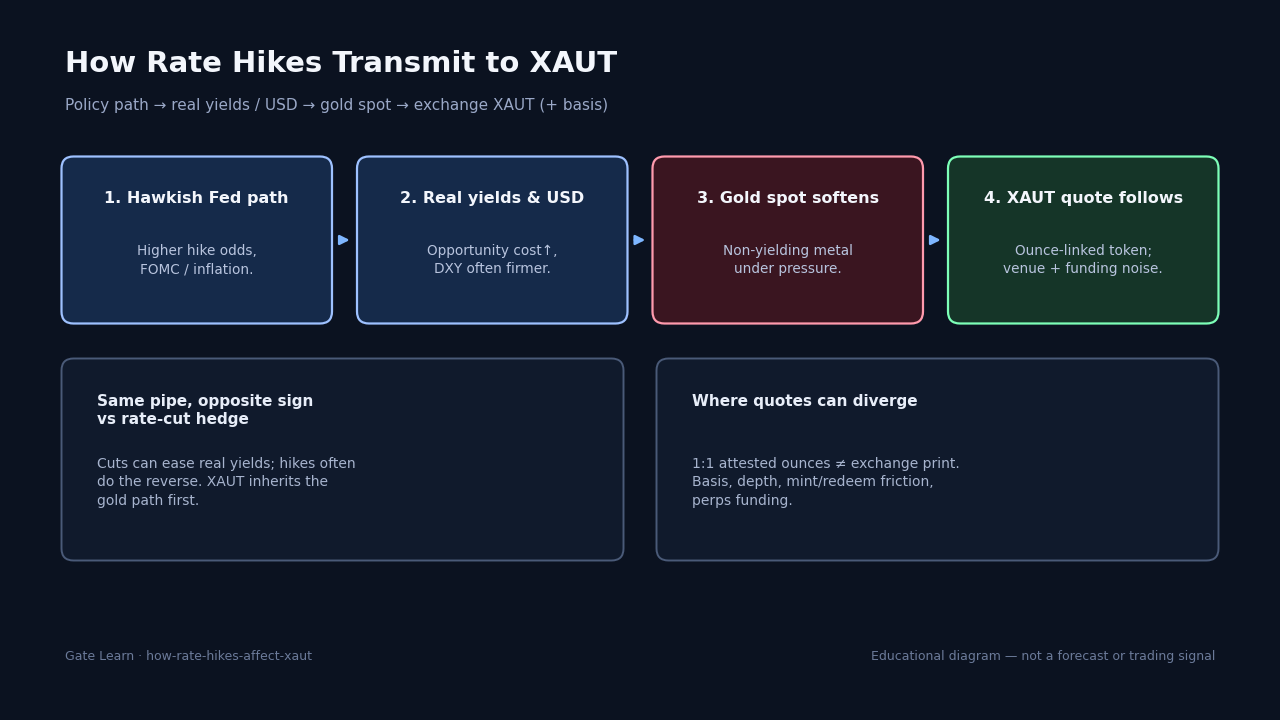 Figure 1. How rate-hike expectations can transmit to XAUT via real yields and gold spot: hawkish path → real yields / USD → gold price → token tracking (+ venue basis).
Hawkish Federal Reserve communication, hotter inflation prints that lift hike odds, or a term-premium jump can all activate this table. The reverse—cut expectations that ease real yields—is the supportive path for gold-linked tokens, and it also helps explain why some investors hold gold in a broader portfolio because it has historically shown negative correlation to stocks. Neither path guarantees a one-way move: geopolitical demand, central banks buying, or a sudden USD fade can offset hike pressure for a time.
Why Can Exchange XAUT Diverge From Spot Gold in a Selloff?
Exchange XAUT can trade at a premium or discount to spot gold even while attested reserves stay 1:1, because secondary markets clear inventory under friction across exchanges, not under an instantaneous arbitrage bot with unlimited capital.
Structural frictions include:
- Issuer fees and size gates — TG Commodities commonly charges about 25 basis points on official buy/redeem against the stated Swiss gold-market price, with platform purchase minimums often around 50 XAUT; after KYC, physical redemption typically requires full London Good Delivery bar increments under Tether Gold FAQ terms. Those bands set soft bounds for how far rational arbitrageurs lean before costs erase the edge.
- Inventory and settlement delay — Market makers who warehouse tokens face opportunity cost when gold volatility rises and capital is scarce; wider quotes appear before arb closes the gap, reducing the chance that every print matches LBMA at the same time.
- Order-book liquidity — Thin depth turns ordinary spot moves into larger XAUT prints, and thin books can worsen intraday gaps during selloffs; stop cascades and cross-margin positions that get liquidated elsewhere in crypto can spill into gold-token books.
- Derivative overlay — Perpetual contracts tied to XAUT add funding and liquidation dynamics that pure vaulted bullion never experiences; leveraged books can be liquidated faster than holders can move physical metal.
A temporary discount during a gold selloff therefore usually means “venue stress plus metal weakness,” not proof that ounces disappeared; in some of the worst stress, cascading liquidations are part of the venue effect. Dated market coverage in November 2026 illustrated how a sharp gold drawdown can compress the mark-to-market value of gold inventories even while gold-backed token reserve accounting stays intact. Transporting bars under that kind of volatility is operationally harder; transferring XAUT on-chain can look easier, yet basis can still widen. Conversely, a premium can persist when mint capacity or MM balance sheets are constrained. On-chain transfer records and bar-serial lookup on Tether Gold help verify claims; they do not force exchange prices to equal LBMA prints every minute, including overnight 24/7 sessions.
Spot XAUT vs XAUT Perpetuals vs Gold CFDs Under Higher Rates
The same hawkish macro can hit three wrappers differently because payoff design differs.
| Wrapper |
What you hold |
Rate-hike relevance |
Extra risks versus ounce claims |
| Spot XAUT |
Tokenized claim on LBMA ounces |
Follows gold spot via secondary markets |
Issuer, custody, chain, basis to spot |
| XAUT_USDT perpetual |
Leveraged derivative on XAUT mark |
Amplifies gold moves; funding can flip with positioning |
Liquidation, funding, mark-price divergence |
| Gold CFD / TradFi gold product |
Contract exposure to gold indices or spot references |
Tracks gold theme on CFD rails |
Counterparty, overnight financing, platform rules |
In a rate-hike environment, spot XAUT answers “how does my digital ounce claim reprice?” Perpetuals answer “how does leveraged gold-token exposure behave when funding and liquidations dominate?” During broad risk-asset stress, leveraged positions across crypto-linked products are typically more vulnerable to being liquidated than unlevered spot XAUT, and large institutions can sell both gold-linked and crypto-linked exposures when they need cash—relevant for perpetual users rather than simple ounce claims. Holding gold-backed spot tokens can be easier than transporting bullion when books stay orderly, but higher rates still hit the shared gold beta. CFDs answer a similar leveraged question on non-crypto rails and typically lack true 24/7 settlement. Comparing wrappers is about risk surface and settlement form—not about picking a guaranteed winner when yields rise, and that distinction also matters when choosing between unlevered spot exposure and leveraged products over a multi-year horizon. Custody and access versus brokerage gold funds differ further in XAUT vs gold ETF in a rate-hike environment.
What Should Holders Monitor When Rates and Gold Move Together?
Monitoring works best as a checklist of mechanisms, not as a prediction stack.
| Indicator |
Why it matters for XAUT |
| Fed path / FOMC pricing |
Shifts expected policy rates that feed real yields |
| US real Treasury yields |
Primary opportunity-cost gauge for non-yielding gold |
| US Dollar Index (DXY) |
Affects international USD gold demand |
| Spot gold vs exchange XAUT |
Basis shows venue friction versus metal move |
| Gold ETF flows |
Proxy for broader investment demand / outflows |
| Perpetual funding & OI (if trading perps) |
Shows leverage overlay stress on top of spot |
As of late November 2026, after the past few months of public market coverage, reports linked gold’s softer stretch to hawkish hike odds, firmer USD yields, and liquidity-driven selling alongside risk-asset stress. Even as gold sold off that November, XAU₮ reserves were expanding by 59% year over year into the third-quarter attestation window, and the gold-backed tokens represented about $3.44 billion in market value. Those dated reports illustrate the transmission channels; they are not a forecast that the same mix repeats. Holders still separate (1) metal repricing, (2) token basis, and (3) product wrapper before judging what “XAUT fell” means for their specific holding. Separating vaulted backing from exchange prints takes a short checklist: attestations first, then basis, then whether leveraged books were liquidated around the same window.
Summary
Rate hikes affect XAUT by first changing the macro price of gold—through real yields and the dollar—and then by clearing that move through crypto venues that add basis, depth, and funding noise. Token rails can make exposure easier to rebalance than shipping metal, without removing the rate channel itself. One XAUT still maps to one fine troy ounce of LBMA London Good Delivery gold under TG Commodities’ reserve design, with backing held in independent Swiss vaults; keep XAUT attested ounces separate from any larger corporate gold inventory figures. A weaker quote usually reflects a weaker USD gold complex or temporary market microstructure, not an automatic reserve failure. Spot tokens, perpetuals, and CFDs share a theme but not the same risk stack. Metal-side drivers match why gold prices fall; the supportive policy path follows XAUT as an inflation and rate-cut hedge. Stressed token pricing can still diverge from traditional gold markets when on-chain liquidity thins outside standard trading hours.
FAQ
Do Fed rate hikes always make XAUT fall?
No. Higher expected policy rates and rising real yields often pressure gold and, in turn, XAUT, but safe-haven demand, central-bank buying, a softer dollar, or sticky inflation that fails to lift real yields can offset that path. Outcomes depend on which channel dominates, not on the word “hike” alone.
Why is XAUT falling if gold is a safe haven?
Safe-haven branding does not freeze the opportunity cost of holding non-yielding metal. When real yields and the USD rise, or when investors sell liquid assets to raise cash, including stocks or other investments, gold and gold-linked tokens can decline even during broader stress. XAUT inherits that metal move plus venue basis.
Does a lower XAUT digital token price mean the gold peg broke?
Not necessarily. XAU₮ is a digital token backed by physical gold under TG Commodities’ reserve design; ounce-backing is an issuer reserve and attestation relationship rather than proof that every exchange price will match spot at each point in time. Secondary-market prices can discount or premium to spot while reported ounces still match circulating tokens 1:1. Gold remains a familiar store of value theme, but XAUT holders still face venue basis. Persistent unexplained gaps warrant checking attestations, contract addresses, and venue liquidity—but a selloff print alone is not proof of broken reserves. Holders can still review issuer FAQs for institutions and retail eligibility on Tether Gold’s product rails without treating marketing pages as price forecasts.
Is buying XAUT after gold drops the same as buying cheaper physical gold?
Not exactly. Both exposures reference gold’s USD price path, but XAU₮ also differs from holding physical gold bars because tokenized ownership can be easier than transporting, assaying, and storing metal, while adding issuer, custody, smart-contract, and exchange-liquidity risks, plus mint/redeem frictions. Moving gold-backed tokens on-chain 24/7 is often easier than transporting bars across jurisdictions, reducing some operational drag without removing rate-driven volatility. A lower token print can still embed a wide basis versus LBMA spot at the same time.
How is this different from the rate-cut hedge story?
Rate-cut expectations can support gold by lowering real yields and the carry advantage of cash; rate-hike expectations often do the opposite. Both stories travel through the same real-yield and dollar pipes; only the sign of the policy shock changes. Token venue risks apply in either regime. Interpreting which regime dominates can be challenging when volatility spikes and when holders must decide whether to hold through funding noise versus metal moves.