Financial markets do not always wait until a central bank formally announces its rate decision before they begin adjusting. When investors believe the Federal Reserve may raise interest rates at a future meeting, bonds, foreign exchange, stocks, and other risk assets often reflect this possibility in advance. In other words, markets trade not only on current interest rate levels, but also on assessments of the future monetary policy path.
The "expectation of a December Federal Reserve rate hike" is therefore a market expectation, not a policy action that has already occurred. It may stem from inflation data coming in above expectations, a resilient labor market, rising energy prices, or changes in Federal Reserve officials' comments and market interest rate pricing. Different participants do not always interpret this information in the same way, and market expectations continue to adjust as new data emerges.
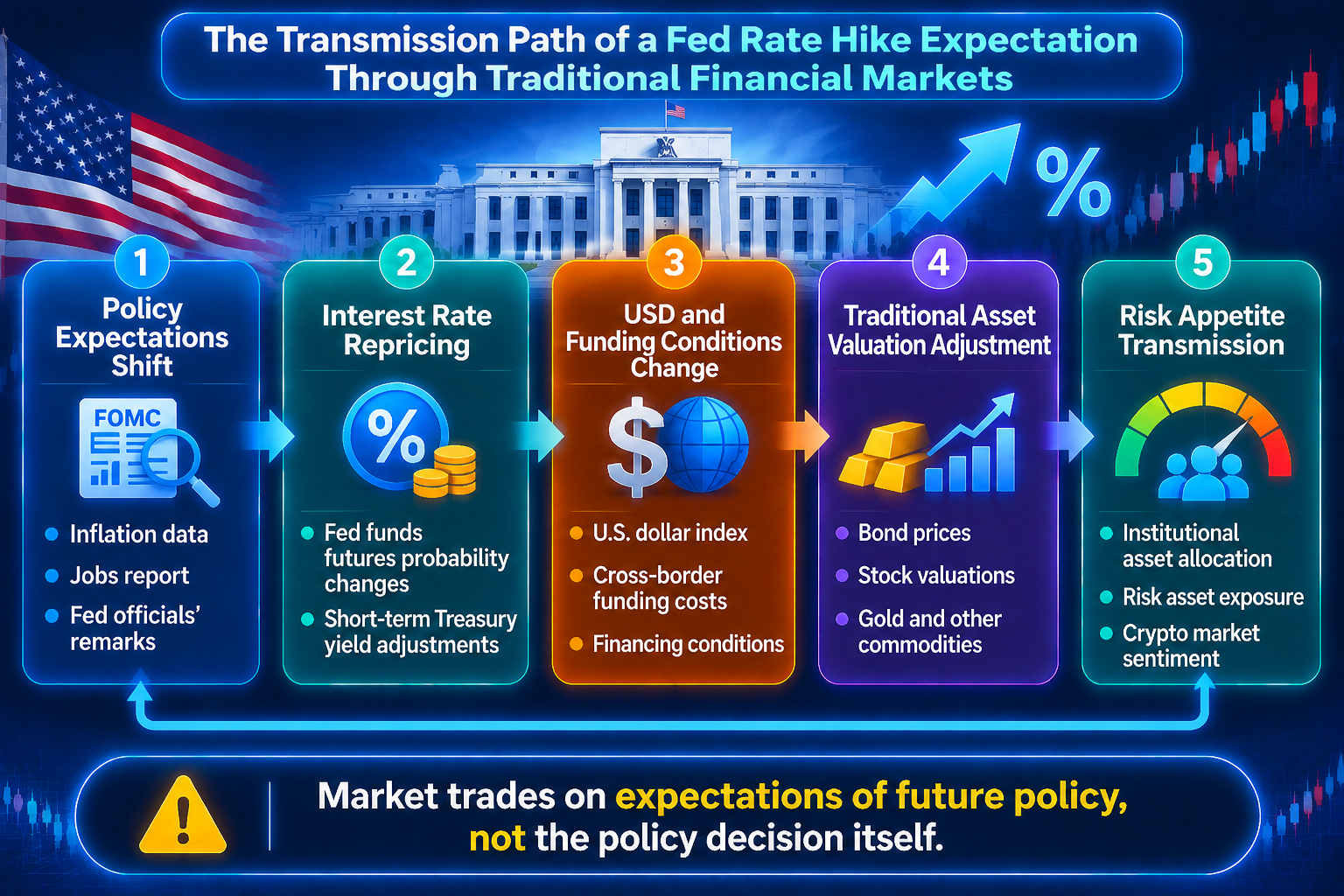
In traditional financial markets, the impact of rate hike expectations is typically transmitted through interest rates, exchange rates, financing costs, and asset valuations. In crypto markets, these changes may also affect investors' risk appetite, stablecoin allocations, and leveraged trading activity. To understand this macroeconomic linkage, it is first necessary to clarify why the market reassesses the Federal Reserve's policy path.
Key Takeaways
-
Rate hike expectations do not equal an official rate hike: Market pricing, economist forecasts, and the Federal Reserve's final decision are three different types of information
-
Treasury yields are an important transmission channel: Changes in interest rate expectations affect bond pricing and alter the relative appeal of stocks and other assets
-
The US dollar and global liquidity are interconnected: Changes in US interest rate expectations may affect the dollar exchange rate and cross-border capital allocation
-
Risk asset valuations may come under pressure: When markets demand higher rates of return, assets with a higher proportion of long-term cash flows may face valuation adjustments
-
Crypto markets are not driven by interest rates alone: Macroeconomic policy is one factor. Industry capital flows, market structure, and on-chain activity must also be considered
Why Do Rate Hike Expectations Affect Financial Markets in Advance?
Financial markets are forward-looking. Bond investors adjust bond prices based on expected future interest rate changes, stock investors reassess the discounted value of companies' future earnings, and foreign exchange traders compare interest rate levels and policy paths across economies. Therefore, even if the Federal Reserve has not made a new interest rate decision, relevant assets may begin to move as soon as the market believes the probability of a rate hike has increased.
Take the Federal Reserve's December 2026 meeting as an example. The market's assessment of the policy path has changed significantly recently. According to an Investing.com report based on CME FedWatch data, as of November 10, 2026, the market's priced-in probability of a 25-basis-point rate hike in December had risen to 88.8%, up from approximately 72% one week earlier. By November 16, Investing.com's Fed Rate Monitor showed that the market's priced-in probability of the target rate range rising to 4.00%–4.25% was 94.3%. These figures reflect futures market pricing at specific points in time. They are not commitments from the Federal Reserve and do not mean that the final outcome has been determined.
Economist surveys provide another perspective. A Reuters survey published on November 10 polled 101 economists, 56 of whom expected the Federal Reserve to raise rates by 25 basis points in December. Futures market pricing and economist surveys are not the same type of indicator: The former reflects probability estimates formed by financial market participants based on contract prices, while the latter reflects the views of surveyed economists. Considering both together can help assess whether market expectations are concentrated and whether differences exist among participants.
Therefore, analyzing rate hike expectations requires more than looking at a single probability figure. More important is to observe the direction and speed of changes in expectations, as well as whether they continue to be supported by inflation, employment, and statements from Federal Reserve officials. A policy change that the market has already fully priced in may affect asset prices very differently from an unexpected policy development.
How Do Treasury Yields Change Asset Valuations?
Treasury yields are an important window into Federal Reserve policy expectations, particularly short-term Treasury yields, which are more sensitive to the policy rate. When investors expect interest rates to rise in the future, short-term bond yields typically come under upward pressure. Long-term yields, however, are also affected by economic growth expectations, inflation expectations, term premiums, and Treasury supply and demand. As a result, they do not necessarily move in sync with short-term yields.
Changes in yields further affect stock valuations. Stock prices depend not only on a company's current profits, but also on how much investors are willing to pay for its future cash flows. When the risk-free rate rises, the present value of future cash flows may decline, and investors may also demand greater risk compensation. This change is particularly relevant for companies whose earnings depend more heavily on future growth and whose valuations are more sensitive to interest rates. Bank of America's analysis of interest rates and the stock market also points out that higher bond yields increase the appeal of bonds relative to stocks and may change the valuation levels investors are willing to pay for companies' future earnings.
However, rising yields do not necessarily mean that all stocks will decline. If rate hike expectations stem from stronger-than-expected economic growth, corporate earnings expectations may also improve. If rate hike expectations are driven primarily by persistently high inflation while the growth outlook weakens, concerns about valuations and earnings may increase at the same time. When assessing asset reactions, it is necessary to distinguish the reasons behind interest rate changes rather than observe yields alone.
In the bond market, it is also important to note that prices and yields generally move in opposite directions. When the market demands higher yields, the prices of existing fixed-coupon bonds generally need to decline so that their yields align with new market levels. Therefore, rate hike expectations may affect bond holding valuations, equity risk premiums, and corporate financing costs at the same time, creating a cross-asset repricing process.
The Relationship Between a Stronger US Dollar and Global Capital Allocation
Changes in US interest rate expectations may also affect global financial markets through the exchange rate channel. When the expected return on US assets rises relative to that of assets in other economies, US dollar-denominated assets may become more attractive on a relative basis, and the dollar may receive support. However, exchange rates are not determined by interest rate differentials alone. Policy changes by other central banks, global risk sentiment, trade conditions, and safe-haven demand also affect the dollar's performance.
A stronger dollar may increase the foreign exchange costs for non-US dollar investors holding dollar-denominated assets and may also increase pressure from some dollar-denominated commodities and cross-border financing. For emerging markets, if dollar appreciation occurs alongside tighter global financing conditions, foreign currency debt burdens, capital flows, and local currency exchange rates may face additional pressure. The impact will not be identical across economies because their foreign exchange reserves, current account conditions, and policy space differ.
Market developments in mid-November 2026 provide an example. A Reuters report on November 12 noted that US inflation data and hawkish comments from Federal Reserve officials pushed the dollar and US Treasury yields higher, while market pricing for a December rate hike also increased. This type of correlation shows that markets may adjust their views on US interest rates, the dollar, and other assets at the same time. However, it does not mean that every increase in the dollar is caused solely by rate hike expectations.
For crypto markets, the dollar and US interest rate expectations are important macroeconomic variables to monitor, but they are not direct price-determination formulas. A stronger dollar may change some investors' willingness to allocate to risk assets, but Bitcoin and other digital assets are also affected by spot demand, ETF capital flows, derivatives positioning, stablecoin liquidity, and industry events. Macroeconomic factors are better used as part of an analytical framework rather than as a standalone tool for predicting price direction.
How Do Rate Hike Expectations Affect Crypto Assets?
Crypto assets are generally considered among the higher-volatility risk assets. When the market expects interest rates to remain high or rise further, investors may reassess the expected returns of cash, short-term bonds, and high-risk assets. If risk-free yields increase, some capital may become less willing to allocate to highly volatile assets. At the same time, higher financing costs may affect the use of leverage by institutional investors and traders.
This impact may also be transmitted through dollar liquidity and market risk appetite. If rate hike expectations push the dollar higher and tighten financial conditions, some investors may reduce their risk exposure, which could affect demand for major crypto assets such as Bitcoin and Ethereum. However, this transmission is not always linear. If the market has already fully priced in a rate hike, the policy announcement may instead trigger a "sell-the-news" reaction. If the size of the rate hike or subsequent guidance exceeds market expectations, the price adjustment may be more pronounced.
It is also necessary to distinguish macroeconomic interest rates from the internal capital structure of the crypto market. Stablecoin supply, net inflows to and outflows from exchanges, spot trading volume, perpetual contract open interest, and funding rates can all help analyze the crypto market's own funding conditions. Macroeconomic rate expectations can explain why risk appetite changes, but they cannot replace analysis of internal market supply and demand.
From this perspective, expectations of a December Federal Reserve rate hike are not a signal that can independently determine whether Bitcoin will rise or fall. A more reasonable approach is to place US interest rates, the dollar, Treasury yields, and spot and derivatives data from the crypto market within the same analytical framework, and observe whether macroeconomic pressure is translating into actual changes in capital flows.
Gate TradFi: Observing the Intersection of Traditional Finance and Crypto Markets
Gate's multi-asset trading offering provides users with an entry point for observing the relationship between traditional financial markets and crypto assets. Through Gate TradFi, users can view markets for traditional financial assets supported on the platform, including stocks, foreign exchange, precious metals, indexes, and commodities, and compare price movements across different asset classes with those in crypto markets. For users studying Federal Reserve policy expectations, this cross-market perspective can help them understand the different reactions that may occur in the dollar, gold, stock indexes, and crypto assets.
It is important to note that Gate TradFi involves different product types and trading mechanisms. For example, contracts for difference (CFDs) provide trading exposure to changes in the price of an underlying asset and do not constitute direct ownership of the corresponding stock or other underlying asset. When reviewing the relevant markets, users should first confirm the specific product type, settlement method, trading hours, leverage, and fee rules. They should not assume that the price performance of different products represents exactly the same asset ownership experience. Gate's official information on TradFi Products and Trading Methods provides further details.
For crypto traders, the value of Gate lies not in predicting the Federal Reserve's policy outcome, but in helping users observe how macroeconomic variables are reflected in asset prices across multiple markets. Combining interest rate and exchange rate movements in traditional financial markets with spot prices, trading volume, and derivatives data in crypto markets can create a more complete framework for observing market conditions.
Which Indicators Should You Continue to Monitor When Assessing Rate Hike Expectations?
First are inflation and employment data. The Consumer Price Index (CPI), Personal Consumption Expenditures price index (PCE), and nonfarm payrolls data can help the market assess whether inflationary pressure is persistent and whether the labor market is overheating. Monthly data may be affected by energy, housing, or seasonal factors. Therefore, it is necessary to consider trends across several consecutive months along with core inflation indicators.
Second are public comments from Federal Reserve officials and policy statements. Officials' comments on inflation risks, employment conditions, and the restrictiveness of policy may change the market's understanding of the next meeting and the subsequent policy path. However, an individual official's comments do not constitute the committee's final decision. Analysis should distinguish between personal views, voting positions, and official policy statements.
Third are interest rate futures, US Treasury yields, and the US Dollar Index. Interest rate futures can be used to observe changes in market pricing for different policy outcomes. Short-term Treasury yields are more closely related to policy rate expectations, while long-term yields contain more complex information about growth and inflation. The US Dollar Index can serve as a supplementary indicator of the dollar's relative strength. Divergence among these indicators may also suggest that the market has differing views on growth, inflation, or the policy path.
Finally, there is the performance of risk assets themselves. Sector rotation in the stock market, credit spreads, gold prices, and spot trading volume, funding rates, and open interest in crypto markets can all help determine whether macroeconomic expectations have already translated into actual trading activity. When indicators move consistently, the macroeconomic signal may be clearer. When indicators conflict with one another, more uncertainty should be retained.
FAQ
Has the Federal Reserve's December Rate Hike Been Confirmed?
No. Interest rate futures and economist surveys reflect estimates of future policy, not an official Federal Reserve decision. The final outcome will still depend on subsequent economic data, policy discussions, and the FOMC's vote.
Why Do Asset Prices Adjust Before an Official Rate Hike?
Because asset prices are forward-looking. Investors adjust their bond, stock, and foreign exchange positions in advance based on expectations for future interest rates, inflation, and economic growth. Policy expectations themselves can therefore drive market price movements.
Are Federal Reserve Rate Hike Expectations Always Negative for Bitcoin?
Not necessarily. Higher interest rates and a stronger dollar may put pressure on risk appetite, but Bitcoin's price is also affected by spot demand, capital flows, market positioning, and industry factors. If a rate hike has already been fully priced in, the market's reaction after the actual decision may differ from its previous trend.
Which Indicator Should Be Prioritized?
No single indicator can fully reflect policy expectations. Inflation and employment data can be used as fundamental indicators, while interest rate futures, Treasury yields, and the US Dollar Index can be used as market pricing indicators. These can then be cross-checked against trading activity and capital flow data from risk assets.