As the AI industry gradually shifts from competition between individual models to competition between broader AI ecosystems, AI Crypto projects are attempting to address the heavy centralization of AI resources. They also aim to build an open AI economy through Web3 architecture, allowing developers, businesses, and users to participate collectively in the construction of AI networks.
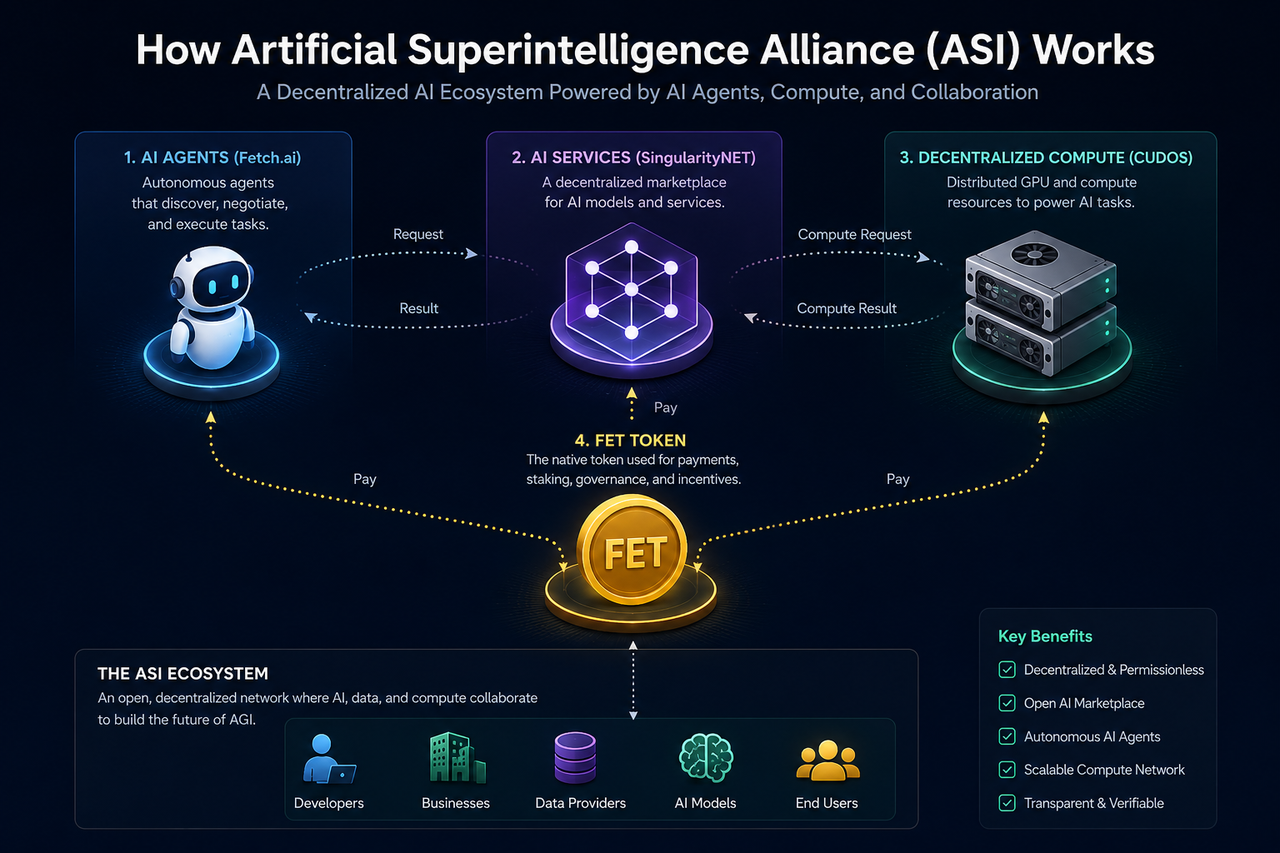
The operating mechanism of the Artificial Superintelligence Alliance (ASI) is mainly built around three core components: AI Agents, an AI services network, and decentralized computing power. Fetch.ai is primarily responsible for AI Agent infrastructure, SingularityNET provides the AI Marketplace and AI service layer, while CUDOS supplies the underlying GPU computing power and distributed computing resources. Together, these three components allow ASI to form a complete AI collaboration network, enabling AI Agents to automatically discover resources, call models, and complete on-chain collaboration.
How Do AI Agents Work in ASI?
AI Agents are among the most important components of the ASI ecosystem. They can be understood as software based intelligent agents capable of completing tasks autonomously. These Agents do not require constant human intervention. Instead, they can make decisions, search for resources, and complete interactions based on defined objectives. For example, in an automated logistics system, an AI Agent can independently identify the most efficient transportation route and coordinate warehousing, payment, and delivery processes with other Agents. Within the Fetch.ai network, Agents can perform data queries, service matching, automated transactions, resource scheduling, and AI inference calls. Compared with traditional automation programs, AI Agents place greater emphasis on autonomous collaboration.
The Agentverse platform launched by Fetch.ai further lowers the barrier to developing AI Agents. Developers can quickly create Agents and deploy them to a decentralized network. Once deployed, these Agents can automatically discover services, communicate with other Agents, execute on-chain transactions, and call AI models.
How Do SingularityNET and CUDOS Support the ASI Ecosystem?
SingularityNET’s role in the ASI ecosystem is closer to that of an open AI services marketplace. Developers can upload AI models to the network and make them available for other users to call, including services such as image recognition, natural language processing, data analysis, and AI APIs. This means AI no longer has to depend on a single centralized platform, but can circulate freely within an open network. Compared with traditional AI cloud platforms, SingularityNET places greater emphasis on sharing AI capabilities and enabling open collaboration, which is why it has attracted significant attention in the fields of AGI and decentralized AI.
At the same time, CUDOS is responsible for providing the underlying computing resources. Running AI models depends heavily on GPU computing power, yet most of today’s computing resources remain concentrated in the hands of large technology companies. CUDOS aims to provide developers with more open AI inference and training resources through a distributed GPU network. Within the ASI network, CUDOS supports GPU scheduling, distributed cloud computing, and high performance AI inference, giving the entire ecosystem not only AI services but also a complete foundation of underlying computing capability.
The Role of FET in the ASI Ecosystem
As ASI’s core token, FET also serves as the medium of value settlement across the entire ecosystem. When users call AI services, deploy Agents, or use GPU computing power, they need to pay in FET. At the same time, FET supports transaction settlement between Agents, network governance, staking, and ecosystem incentives. For example, after an AI Agent automatically completes a task, the system can use FET to settle payments and allocate resources automatically.
Because most activities within the ASI ecosystem rely on FET for value transfer, FET is not merely an ordinary token. It is a foundational tool for the entire AI Economy.
What Is the Complete Operating Process of ASI?
A typical ASI workflow usually begins with a user request. For example, a company may want AI to automatically analyze market data and execute a trading strategy. After the system receives the request, an AI Agent automatically searches for available resources, including AI models, data services, and GPU computing power. The Agent then calls AI services from SingularityNET and obtains computing resources through CUDOS to complete the task.
Once the task is completed, the results are automatically returned to the user, while FET handles the fee settlement generated throughout the process. The entire workflow does not require coordination by a centralized platform. Instead, it is completed through automatic collaboration between the blockchain network and AI Agents. This model is seen as an important direction for the development of Web3 AI infrastructure because it can reduce dependence on a single platform and improve the openness of AI networks.
Traditional AI platforms are usually controlled by large technology companies, with models, data, and computing resources mostly concentrated on centralized servers. By contrast, ASI places greater emphasis on openness, community collaboration, and resource sharing. Developers do not need to rely entirely on large technology companies to access AI models, GPU computing power, and data resources.
This decentralized model means AI services can circulate freely within an open network, while users can also participate in ecosystem governance and resource allocation. As a result, ASI is viewed as an important exploration of Web3 AI infrastructure. Its goal is not only to build an AI network, but also to establish an open AI Economy.
What Challenges Does ASI Face?
Although ASI has a strong technical narrative, decentralized AI is still at an early stage. First, the AI industry itself has extremely high requirements for GPU computing power, while distributed computing networks still need further development. Second, large scale collaboration among AI Agents still faces challenges in terms of efficiency and stability. In addition, AI regulation, data privacy, and model security issues may also affect the long term development of decentralized AI.
At the same time, ASI must also compete with OpenAI, Google DeepMind, and other AI Crypto projects. How it balances an open ecosystem with real world commercialization will be a key question for ASI’s future development.
Conclusion
ASI is building open AGI infrastructure through AI Agents, decentralized computing power, and an AI Marketplace. Fetch.ai provides the AI Agent network, SingularityNET is responsible for the AI services marketplace, and CUDOS supplies GPU computing support. Together, these three components form a complete Web3 AI ecosystem, allowing AI models, data, and computing resources to operate collaboratively within a decentralized network.
As the concepts of AI Agents, AGI, and Web3 AI continue to develop, ASI may become one of the important infrastructure layers of the future AI Economy.
FAQs
What Is ASI’s Core Function?
ASI’s core function is to establish a decentralized AI network where AI Agents, computing resources, and AI services can collaborate freely.
What Role Do AI Agents Play in ASI?
AI Agents can automatically execute tasks, search for resources, call AI services, and complete on-chain interactions.
Why Is Fetch.ai Important?
Fetch.ai provides AI Agent infrastructure and serves as an important technical layer of the ASI ecosystem.
How Is the FET Token Used?
FET is used for AI service payments, Agent transactions, network governance, and ecosystem incentives.
What Is CUDOS Responsible for in ASI?
CUDOS provides GPU computing power and distributed computing resources, supporting the operation of AI models.
ASI places greater emphasis on open AI networks and decentralized resource sharing, while traditional AI platforms are usually controlled by centralized companies.