For users tracking airdrop eligibility, Token Generation Events (TGEs), exclusive campaigns, or recent Gate Alpha activity, the key issue is that Alpha Points measure recent qualifying participation rather than lifetime activity. The 15-day calculation continually adds newly earned points while removing expired or consumed points. Understanding that lifecycle makes it easier to estimate which points remain usable, distinguish normal expiry from reward deductions, and avoid treating the current total as a permanent cumulative balance.
The following sections explain how Gate Alpha Points enter and leave the 15-day window, how daily calculations and airdrop deductions affect cumulative and potential rewards, and why recent Gate account activity on Gate platform, not lifetime digital asset activity, drives the changing balance.
Key Takeaways
-
Gate Alpha Points operate on a rolling 15-day window. Each day's allocation expires 15 days after its snapshot date.
-
Total points are dynamic. The current balance is calculated based on qualifying balance points and trading volume points over the past 15 days, minus points consumed during that period.
-
A falling balance does not necessarily mean an error. Expiring points can outweigh newly earned points.
-
Airdrop rewards consume points separately from expiry. When participation is confirmed, the oldest available points are deducted first.
-
Snapshot timing matters. The current daily snapshot is 07:59:59 UTC+8, with points data updated before 10:00 UTC+8.
What Gate Alpha Points Expiry Actually Means
Gate Alpha Points measure user activity within the Gate Alpha ecosystem and help determine eligibility for benefits such as TGEs and Alpha token airdrops. The Gate Alpha Points system places this activity metric within the wider reward structure, including balance-based and trading-based participation.
Expiry is therefore part of the design rather than an exceptional penalty. Instead of accumulating every point ever earned, the points system continually looks backward across the most recent 15 daily calculation periods.
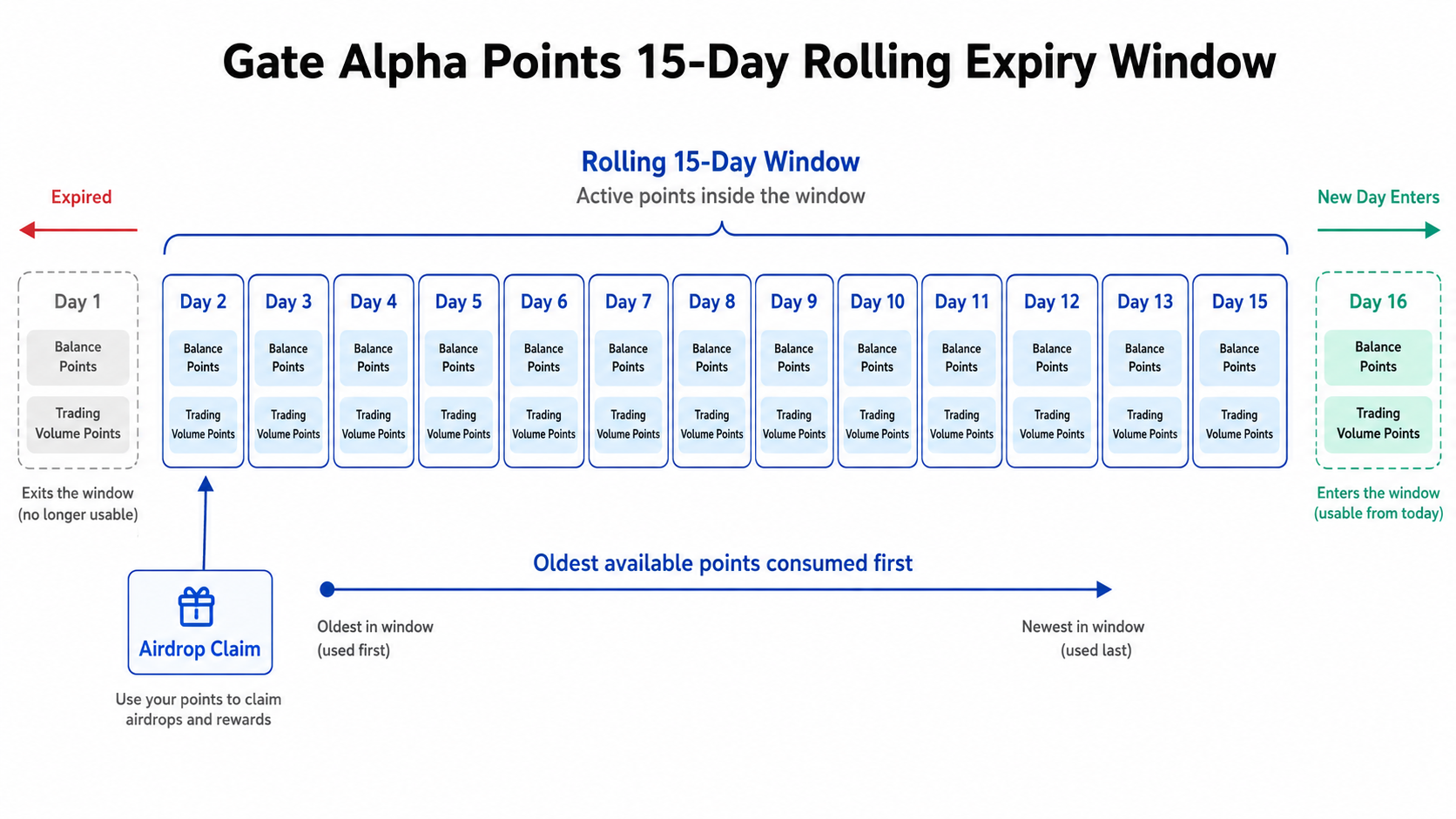
If points were generated at a particular daily snapshot, they remain inside the active window until their 15-day lifespan ends. A new day's points then enter while an older day's points can leave. Points are updated daily based on activity falling within this moving window.
Gate Alpha itself is broader than the points system. It supports search and trading for emerging on-chain tokens and allows users to access assets across multiple blockchain ecosystems from a unified interface. Earlier product material describes one-click USDT purchases of assets across chains such as Ethereum, Solana, BNB Chain, and Base without manually switching wallets or configuring separate on-chain workflows.
How the Gate Alpha Points 15-Day Rolling Window Works
The simplest way to understand Gate Alpha Points expiry is to picture 15 daily containers. Each container represents one snapshot cycle and holds the balance points and trading volume points generated for that day.
When another day arrives, a new container enters the calculation. Once the oldest container falls outside the permitted 15-day window, its points expire automatically. The current Help Center defines the points balance as:
Current Alpha Points = 15-day trading volume points + 15-day balance points − 15-day points consumed
Expired points are no longer included.
This is why points earned and current total points are not the same thing. A user may historically have accumulated far more points than the balance currently displayed because older activity has already expired.
The Gate Alpha Points earning and usage mechanics provide context for how qualifying activity can create points; the rolling window determines how long those points continue contributing to the balance.
Balance Points and Trading Volume Points Inside the Window
The current rolling total consists primarily of balance points and trading volume points. Only eligible Alpha assets count toward daily balance points, and current rules cap asset balance points at three points. Trading volume points are generated from qualifying transactions in the Alpha Featured section.
Under the current rule, the first $4 purchased each day earns one point, and every doubling of qualifying purchase volume earns another point: $8 equals two volume points, $16 equals three, and so forth. Although buy and sell transactions are included when determining trading volume, selling Alpha tokens does not itself earn Alpha Points.
This differs from the original system launched in late July 2025. The July 29 launch announcement stated that a first daily purchase of at least 2 USDT generated one Alpha Point, followed by additional points as purchase volume doubled. That older rule is sometimes summarized incorrectly as “one point for every 2 USDT deposited”; it referred to qualifying purchase volume, not simply depositing USDT.
The Gate Alpha incentives and rewards framework helps place those changing mechanics in context. Current Help Center rules should take priority when reconciling a live balance.
A Worked Gate Alpha Points Expiry Example
Assume a user has 75 Alpha Points across the 15 active daily snapshots, including 10 points belonging to the oldest snapshot date.
When another daily cycle arrives, those 10 points expire. If the user earns six new points and spends none, the simplified balance changes as follows:
| Event |
Point Change |
Running Total |
| Starting rolling balance |
— |
75 |
| Oldest daily points expire |
-10 |
65 |
| New eligible points enter |
6 |
71 |
| Points consumed for rewards |
0 |
71 |
The key result is that earning more points does not necessarily make the total rise. New points compete mathematically with points leaving the opposite side of the rolling window.
If 12 new points entered while 10 expired, the total could rise to 77. If no new points entered, it could fall to 65. Consistent activity can therefore maintain a higher rolling score, but additional trading may involve market risk, gas fees, and other execution costs.
Why Did My Gate Alpha Points Decrease?
Three mechanisms explain most declines.
First, older points may have expired. Points reach expiry exactly 15 days after their snapshot date, and Daily Points Details shows points generated within the current window and points approaching expiration.
Second, points may have been spent on rewards. Participation in points-based airdrops is optional, but claiming requires the user to manually confirm participation. Once confirmed, the required points are immediately consumed.
Third, the balance may have passed through its daily update. The Alpha Points dashboard displays the current points environment, while the Help Center specifies the snapshot and calculation schedule.
Expiry is therefore time-based; spending is action-based; and the displayed balance is update-based. Separating these three causes makes troubleshooting much easier.
How Airdrop Rewards Consume Gate Alpha Points
When users redeem Alpha Points for an eligible token airdrop or other points-based reward, the oldest available points are consumed first. The deduction occurs after the user confirms the claim and is reflected in total-point statistics the following day.
Individual events can set their own eligibility thresholds. For example, the RION Alpha Points airdrop launched in August 2025 required at least 65 Alpha Points, consumed 10 points per successful claim, and operated within a defined claim window. Unclaimed rewards were forfeited after that event window. The 65-point level was therefore a requirement for that specific campaign, not a universal minimum for every Alpha airdrop.
The Gate Alpha Points launch framework connects trading activity with airdrop access, but meeting a threshold does not guarantee rewards. Current rules state that allocations can be limited and claimed on a first-come, first-served basis.
Daily Snapshot Timing and the Single-Account Rule
The snapshot date determines the lifespan of each daily allocation. The current Help Center places the daily snapshot at 07:59:59 UTC+8 and updates points before 10:00 UTC+8. A transaction completed before the cutoff belongs to the preceding calculation cycle.
Only the main account earns Gate Alpha Points directly. Sub-account balances and eligible Gate trading activity are combined with the main account for calculation, preventing users from splitting assets across accounts simply to generate more points.
This means two active users with similar total trading volume can still have different totals because their eligible assets, purchase volume, snapshot timing, consumed points, and expiring points may differ.
Gate Alpha Points vs. Binance Alpha Points
Gate Alpha Points and Binance Alpha Points are separate systems even though both currently use rolling 15-day calculations. Treating them as interchangeable can create confusion when comparing balance points, volume points, eligible tokens, wallets, or reward rules.
Binance Alpha Points are calculated from eligible holdings and purchases of Binance Alpha tokens across the Binance exchange and Binance Wallet ecosystem. Total Binance Alpha Points combine daily balance and volume points over the past 15 days. Binance's rules also distinguish its centralized exchange, Binance's spot market, and Binance Wallet (Keyless): only qualifying trades through the Binance centralized exchange or Binance Keyless Wallet count toward Alpha volume, while imported or exported wallets do not qualify and re-imported wallets are no longer considered keyless.
Binance Alpha also uses its points for exclusive campaigns, TGEs, and airdrops involving early-stage projects. Some Binance Alpha tokens may later be considered for Binance's spot market or other future listings, but inclusion in Binance Alpha does not guarantee a future exchange listing.
These similarities make “Alpha Points” a useful category comparison across the crypto space, but each platform's current rules, eligible assets, snapshot times, and consumption mechanics must be checked independently.
Current Gate Alpha Points vs. Earlier Activity Points
Not every historical Gate Alpha points campaign followed today's rolling mechanism.
An earlier Alpha Points Carnival began on May 29, 2025, before the current Gate Alpha Points System launched on July 29. During that campaign, users could accumulate event-specific Alpha Points through Gate Alpha trading, inviting friends to complete their first transaction, and other tasks to earn rewards from a token mystery-box prize pool. Those activity points belonged to the campaign period rather than today's ongoing rolling calculation.
The Gate Alpha platform and earlier points reward mechanism provides useful historical context. The same May 2025 campaign introduced zero platform trading fees for Alpha transactions, while public-chain gas fees could still apply.
Gate Alpha's product scope has also evolved. By August 2025, the service had introduced full on-chain token search and trading, allowing users to search emerging projects by token name or contract address. Assets appearing in Alpha do not necessarily reflect an endorsement or guarantee of future listings on the main spot market.
Risks and Limitations of Earning More Alpha Points
Gate Alpha Points are an eligibility and user-activity metric, not cash, a permanent reward balance, or an investment asset. More points can increase eligibility for some campaigns but do not necessarily reflect better investment opportunities or future returns.
Trying to maintain more Alpha Points through increased trading exposes users to the volatility of emerging projects, possible gas fees, execution costs, and rapid token listings. The convenience of one-click multi-chain trading does not remove the underlying risk of the tokens being traded.
Special events can also award additional points for designated tokens, but each campaign may use different thresholds, prize pools, claim periods, and eligibility conditions. Current Help Center rules expressly allow event-specific multiplied or bonus points.
For that reason, Alpha Points should be used to understand eligibility rather than to make investment decisions. Users should conduct their own research into eligible tokens, token generation events, liquidity, contract risks, and market conditions instead of assuming that points, airdrop access, or rapid listing automatically makes an asset attractive.
Conclusion
Gate Alpha Points expiry is an integral part of the current points system. Daily points remain active for 15 days after their snapshot date, after which they automatically leave the rolling total. New balance points and volume points can enter at the same time, while manually confirmed airdrop claims can consume existing points using the oldest points first.
That mechanism explains why total Alpha Points may rise, remain stable, or decrease even for active users. The most reliable way to interpret a balance is to examine daily snapshot dates, points approaching expiry, newly earned points, and reward deductions together rather than viewing the figure as a permanent cumulative score.
Rules have already changed since the system launched in late July 2025, and individual airdrops can apply different thresholds. Current Help Center rules and the terms of the specific reward event should therefore take precedence over historical campaign examples.
FAQs
Do Gate Alpha Points expire?
Yes. Each Gate Alpha Point automatically expires 15 days after its snapshot date under the current rules. Total points therefore represent recent eligible activity rather than every point historically earned.
Why did my Alpha Points drop even though I did not spend them?
Older daily points may have reached the end of their 15-day lifespan. If more points expire than enter through new eligible activity, the displayed total falls even without a reward claim.
Can Gate Alpha Points be earned by completing tasks?
The current rolling system primarily calculates points from eligible balances and Alpha trading activity, with special event rules able to award extra points. Earlier campaigns also used tasks and activities such as inviting friends, so historical task-based earning rules should not automatically be applied to today's calculation.
Which points are used first when claiming an airdrop?
The oldest available Gate Alpha Points are consumed first. Claiming requires the user to confirm participation during the applicable event window, after which the deduction is reflected in total statistics the following day.
Is 65 Alpha Points the minimum for every Gate Alpha airdrop?
No. A 65-point minimum applied to the RION airdrop in August 2025, but thresholds vary by event. Current rules allow different projects and campaigns to set their own eligibility requirements.
Are Gate Alpha Points and Binance Alpha Points the same?
No. They are separate points systems operated within different ecosystems. Both currently use 15-day rolling calculations, but their balance rules, eligible trading activity, wallets, snapshot timing, campaign conditions, and token eligibility are platform-specific.
Disclaimer
This content is for educational purposes only and does not constitute financial, investment, trading, or legal advice. Alpha Points rules, eligibility requirements, fees, supported assets, and event conditions can change. Digital assets, particularly early-stage tokens, can be highly volatile. Verify current product and event terms and conduct your own research before making investment or trading decisions.







