Perpetual contracts are one of the most representative trading instruments in the cryptocurrency derivatives market. Unlike traditional futures, they have no fixed expiration date. Traders can use margin to establish long or short positions and rely on the funding rate mechanism to maintain a connection between the contract price and the reference asset price. As trading platforms, market-making mechanisms, and risk management systems have gradually matured, perpetual contracts have expanded from digital assets such as Bitcoin and Ethereum to a broader range of trading instruments.
The impact of this product structure is not limited to the cryptocurrency market. In recent years, perpetual derivatives based on stocks, commodities, and other traditional assets have attracted increasing attention. Single-Stock Perpetual Contracts (Single-Stock Perps / Equity Perps) are a typical example. They attempt to apply the perpetual contract structure familiar from crypto markets to the stock price of a single listed company.
However, expanding across asset classes is not as simple as replacing a trading symbol. Crypto assets typically feature continuous trading, on-chain settlement, or digital asset collateral, while stock markets are influenced by trading hours, securities regulation, corporate actions, and traditional clearing systems. When perpetual contracts shift from crypto assets to stocks, their existing mechanisms can still provide a foundation for design, but their price sources, risk parameters, trading continuity, and regulatory boundaries all require reassessment.
Therefore, understanding Single-Stock Perps requires more than knowing that they are stock derivatives with no expiration date. It is also important to understand which mechanisms come from crypto perpetual contracts and which components must be redesigned to reflect the characteristics of traditional financial assets.
What Are the Core Mechanisms of Crypto Perpetual Contracts?
The basic structure of a crypto perpetual contract includes the reference price, contract market price, margin, funding rate, and liquidation mechanism. Traders deposit eligible collateral into their accounts and establish positions according to the margin rules set by the trading venue. Long positions generally profit when the contract price rises, while short positions generally profit when the price falls. Actual profit and loss must also account for costs such as trading fees and funding fees.
Perpetual contracts have no fixed expiration date, so other mechanisms are needed to maintain the connection between the contract price and the reference price. The funding rate is one of the most common mechanisms. When the contract price trades at a premium or discount relative to the reference price, the funding rate may prompt long and short position holders to make periodic payments, affecting holding costs and trading behavior. The direction, calculation method, and settlement interval of the funding rate depend on the rules of the specific platform.
The reference price mechanism provides a basis for risk management. A trading platform may aggregate price data from multiple markets to calculate an index price or mark price for determining unrealized profit and loss and triggering liquidations. This can help reduce the impact of short-term abnormal trades in a single market on liquidation prices, but it cannot completely eliminate risks caused by insufficient liquidity, data delays, or extreme market conditions.
The liquidation mechanism is an important component of risk control for margin-based derivatives. When an account's equity is insufficient to meet the maintenance margin requirement, the platform may automatically reduce or close positions to control risk exposure. The higher the leverage, the more significant the impact of price fluctuations on margin generally becomes. Therefore, although perpetual contracts have no expiration date, they remain subject to margin requirements and liquidation rules.
Why Have Perpetual Contracts Expanded from Crypto Assets to Stocks?
First, perpetual contracts have developed a relatively mature trading framework. The crypto market has long had demand for long and short trading, leveraged exposure, and around-the-clock risk management tools. In response, trading platforms have developed mechanisms such as funding rates, mark prices, margin, and automatic liquidation. These mechanisms have some degree of portability and provide a reference for designing derivatives for other asset classes.
Second, stock prices have broad market interest. Investors may want to establish short-term exposure to large listed companies, industry leaders, or specific corporate events without necessarily purchasing the underlying stock directly. The long and short structure of perpetual contracts can provide a derivatives-based way to participate, using stock prices as the reference for contract trading.
Third, the infrastructure of digital asset markets and traditional financial markets is becoming increasingly interconnected. Trading platforms, market makers, clearing institutions, and traditional financial institutions are paying more attention to cross-asset derivatives, tokenized assets, and on-chain trading infrastructure. This does not mean that all stock perpetual contracts must be issued or settled on a blockchain. Rather, it indicates that trading mechanisms developed in crypto markets are influencing the design of a broader range of financial products.
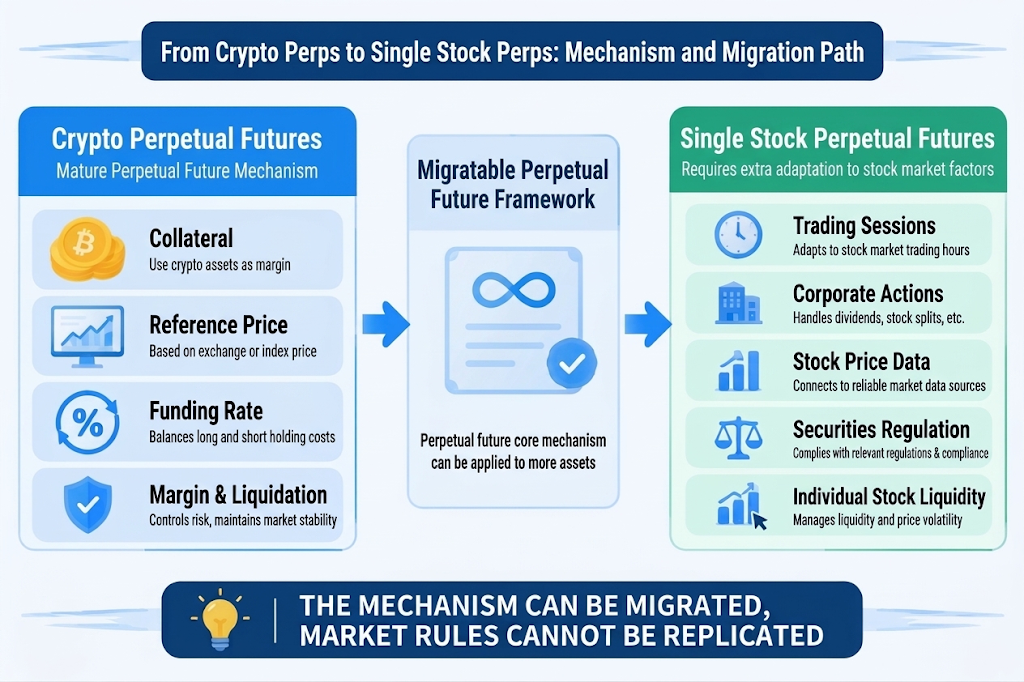
However, the portability of a product mechanism does not mean that market structures can be directly replicated. Stocks have trading hours, corporate actions, and regulatory characteristics that differ from those of crypto assets. Stock perpetual contracts must address questions such as how to determine the reference price, how to handle trading halts, how to adjust for dividends and stock splits, and how to manage collateral. Only when these components are clearly addressed can perpetual contracts adapt to the actual operating environment of traditional stock markets.
From Crypto Perpetuals to Single-Stock Perpetuals: Which Mechanisms Remain Unchanged?
At the contract level, the most obvious continuation is the structure without a fixed expiration date. Whether the reference asset is a digital currency or a stock, perpetual contracts allow traders to hold positions continuously as long as they meet margin requirements, without having to roll them over according to a traditional futures expiration date. This design reduces the complexity of maturity management but also makes funding rates an important component of holding costs.
The long and short structure is also similar. Traders do not need to hold the underlying asset directly to establish directional exposure based on their view of the price. For participants who want to express a bullish or bearish view, this structure can provide two-way trading. However, a contract position is not equivalent to ownership of the underlying asset. The trader's rights and obligations depend on the derivatives contract.
Margin and liquidation mechanisms are also core components. Traders must provide initial margin according to the rules of the trading venue and maintain sufficient account equity. When price movements cause the margin level to fall below the required threshold, a position may be partially or fully liquidated. Different assets have different volatility, liquidity, and price gap characteristics. Therefore, even when the same leverage multiple is used, the level of risk may differ significantly.
The funding rate mechanism can also be carried over, but its parameters cannot be copied mechanically. In crypto asset markets, funding rates are affected by trading sentiment, market supply and demand, funding costs, and platform calculation rules. Stock perpetual contracts must also account for spot trading hours, dividend expectations, corporate actions, and the availability of reference prices. The funding rate must be designed to match the price formation mechanism of the specific stock market.
From Crypto Perpetuals to Single-Stock Perpetuals: Which Components Need to Be Redesigned?
One of the most important differences is the source of the reference price. Crypto assets typically trade continuously across multiple digital asset venues, and some also have on-chain markets that can provide relatively continuous price data. Stock markets, by contrast, have regular trading hours, pre-market and after-hours trading, trading halts, and quotation differences across trading venues. Stock perpetual contracts must clearly specify which type of price is used as the reference and how price updates are handled when the spot market is closed.
Oracles and price data services are especially important in this process. For stock derivatives that use on-chain infrastructure, an oracle may be responsible for transmitting traditional stock market prices on-chain. For contracts offered by traditional trading venues, the price index and mark price systems also require reliable data sources. Regardless of the architecture, data delays, quotation interruptions, abnormal prices, and concentration among data sources may affect contract pricing and the fairness of liquidations.
Collateral management must also be reassessed based on the asset class. Crypto perpetual contracts typically use stablecoins or other digital assets as margin, and the collateral itself may experience price volatility, depegging, or insufficient liquidity. Stock derivatives in traditional financial markets may instead be subject to different margin rules, eligible collateral requirements, and customer asset segregation systems. Whether collateral can be used across asset classes depends on the trading venue and regulatory framework. It is not an inherent feature of perpetual contracts.
In addition, stock corporate actions require dedicated handling mechanisms. Cash dividends, special dividends, stock splits, reverse splits, mergers, delistings, and trading halts may all change the price or tradability of the underlying stock. Contract rules must specify in advance how these events affect the reference price, position value, and settlement arrangements. Crypto assets do not have a fully corresponding corporate action system, so stock perpetual contracts cannot simply adopt all the risk parameters of crypto contracts.
What Is the Difference Between Single-Stock Perpetual Contracts and On-Chain Synthetic Assets?
Single-stock perpetual contracts and on-chain synthetic stocks may both give users exposure to stock prices, but their product structures are different. Single-stock perpetual contracts are generally centered on derivatives contracts. Traders use margin to establish long or short positions, and profit and loss are determined by changes in the contract price, funding rates, and liquidation rules. They do not necessarily require the issuance of an on-chain token representing a stock.
On-chain synthetic assets may use collateral, debt positions, oracles, and protocol risk parameters to maintain tracking of an asset's price. Users hold a synthetic asset issued or managed by a protocol. In addition to the reference price itself, its risks may include insufficient collateralization, protocol liquidations, oracle failures, and smart contract vulnerabilities.
The trading methods and parties bearing the risks may also differ. For perpetual contracts provided by a centralized trading venue, the trading platform generally handles order matching, margin management, and liquidation execution. On-chain synthetic assets may rely on smart contracts to automatically execute collateralization, liquidation, and asset conversion. There is no single architecture, so the analysis of a product must return to its actual contract and settlement rules rather than relying solely on names such as "stock token" or "perpetual contract."
More importantly, price exposure is not the same as stock ownership. Whether using single-stock perpetual contracts or synthetic stocks, users should confirm whether the product grants shareholder rights, whether it is backed by physical stocks, how corporate actions are handled, and whom they can hold responsible if the protocol or issuer faces risks.
Market Structure and Risk Boundaries of Single-Stock Perpetual Contracts
After perpetual contracts expand into the individual stock market, liquidity becomes a key factor in whether the product can operate reliably. Trading activity in crypto markets is often concentrated in a small number of major assets, while individual stock liquidity varies more widely. Large listed companies may have deep spot markets, but the trading volume, bid-ask spreads, and price continuity of small- and mid-cap stocks may differ significantly. If the derivatives market has insufficient liquidity, large trades may incur high slippage and amplify price deviations.
Differences in trading hours also affect market structure. Crypto markets generally trade around the clock, while spot stock markets have regular trading hours, holidays, and temporary trading halts. If stock perpetual contracts remain tradable when the spot market is closed, market participants must determine what information the contract price is based on at that time and what price adjustments may occur when the spot market reopens.
Liquidation and risk management must adapt to the volatility characteristics of individual stocks. A single stock may gap sharply in response to earnings reports, regulatory decisions, litigation, mergers and acquisitions, or unexpected announcements. Compared with continuous and gradual price movements, gap markets may create a larger difference between the liquidation price and the price at which a position can actually be executed. Trading venues need to clearly define risk limits, margin parameters, procedures for handling abnormal market conditions, and forced deleveraging mechanisms.
The regulatory framework is also an important part of the market structure. Stock-related derivatives may involve both securities and futures regulation. Different jurisdictions have different requirements for trading venues, customer eligibility, margin, and disclosures. Regulatory authorization does not mean that a product can be offered in all regions, nor does it mean that the contract terms and customer protection standards of different platforms are identical. Traders should confirm the legal framework applicable in the product's jurisdiction and whether they meet the eligibility requirements.
Gate Stock Contracts and TradFi: Extending Perpetual Contract Mechanisms to Traditional Asset Markets
Single-stock perpetual contracts reflect the expansion of crypto market derivatives mechanisms into traditional stock assets. Gate Stock Contracts are a specific example of this direction. They apply trading mechanisms such as margin, long and short positions, and perpetual contracts to stock-related instruments, allowing users to participate in price movements of traditional stock assets through derivatives. At the same time, Gate TradFi extends the scope of trading beyond stocks to multiple types of traditional financial assets, demonstrating the further expansion of digital asset trading platforms in terms of asset coverage and trading mechanisms. Together, they reflect the connection between crypto trading infrastructure and traditional financial markets. However, stock contracts are specific contract products, while TradFi is a broader framework for traditional asset trading services.
From the perspective of crypto perpetual contract mechanisms, Gate Stock Contracts retain core elements such as margin trading, long and short positions, funding rates, and liquidations. However, traditional stock assets operate in a market environment different from that of crypto assets. Trading hours, liquidity distribution, corporate actions, and the methods used to reference the underlying price may all affect contract pricing and risk management. The other traditional assets covered by Gate TradFi may also use different trading rules depending on their asset classes and product designs. Therefore, it should not be assumed that all TradFi products use the same perpetual contract structure, nor should rules from crypto markets be applied indiscriminately to all traditional assets.
From the broader perspective of market development, Gate Stock Contracts demonstrate a specific path for extending perpetual contract mechanisms to stock assets, while Gate TradFi represents the platform's broader direction of building trading services around multiple traditional assets. What matters is not only the increase in the number of trading instruments, but also how margin, funding rates, price references, and liquidation mechanisms adapt to the market structure of different assets. For users, understanding which mechanisms come from crypto perpetual contracts and which rules need to be adjusted based on the characteristics of traditional assets is an important basis for assessing the structure and risk boundaries of these products.
FAQ
Did Single-Stock Perpetual Contracts Develop from Crypto Perpetual Contracts?
Their product design draws on perpetual contract mechanisms widely used in crypto markets, including structures such as no fixed expiration date, long and short positions, margin, funding rates, and liquidations. However, single-stock perpetual contracts are derivatives related to stock prices and must adapt to the price sources, corporate actions, and regulatory requirements of stock markets.
Do Single-Stock Perpetual Contracts Necessarily Run on a Blockchain?
Not necessarily. "Perps" describes the contract structure of perpetual derivatives and does not necessarily mean that trading, matching, or settlement must take place on a blockchain. Specific products may be offered by traditional trading venues or may incorporate on-chain infrastructure. Their actual architecture must be assessed individually.
Why Do Stock Perpetual Contracts Need Oracles or Price Indices?
Contracts require reliable reference prices for pricing, profit and loss calculations, and risk management. When an on-chain system is used, an oracle may transmit stock market data. When a traditional trading venue provides the product, it may use its own price index and mark price system. The key considerations are whether the data source, update frequency, and handling of abnormal conditions are transparent and reliable.
Can the Funding Rate Mechanism of Crypto Perpetual Contracts Be Used Directly for Stocks?
The mechanism can serve as a reference, but its parameters and calculation method must be adapted to the stock market. Stock trading hours, dividends, corporate actions, and spot liquidity may all affect the relationship between the reference price and the contract price. Therefore, crypto asset funding rate parameters cannot simply be copied.
What Is the Difference Between Single-Stock Perpetual Contracts and Tokenized Stocks?
Single-stock perpetual contracts are generally derivatives contracts that reference stock prices, while tokenized stocks may represent an on-chain asset or rights arrangement. The two may differ significantly in asset ownership, issuance structure, settlement method, regulatory characteristics, and the parties bearing the risks. The specific product documentation should be reviewed to determine the applicable details.