In 2026, CoreWeave further expanded its debt financing backed by GPU infrastructure and customer contracts. In March, the company completed an $8.5 billion delayed draw term loan facility, part of which received investment-grade credit ratings. In May, the company completed another $3.1 billion loan backed by high-performance computing infrastructure. These financing arrangements show that GPUs are no longer merely hardware used to provide computing services. They are also becoming important collateral assets for financial institutions evaluating AI infrastructure projects.
The core logic of GPU-backed financing is to combine computing equipment that may generate revenue in the future with customer contracts to fund current infrastructure construction. This model can help computing companies accelerate expansion, but it also closely links equipment value, customer demand, financing costs, and debt repayment. Understanding CoreWeave's financing approach requires analyzing how GPUs serve as loan collateral, how customer contracts support debt repayment, and what financial risks may arise from highly leveraged expansion.
Key Takeaways
-
GPU-backed financing is a form of asset-backed financing that typically uses GPU servers, related infrastructure, and cash flows generated by specific customer contracts as loan collateral.
-
CoreWeave uses this model primarily to obtain funding for construction as customer demand for computing capacity grows, reducing its reliance on equity financing for expansion.
-
A delayed draw term loan (DDTL) allows a company to use its financing commitment in stages based on equipment procurement and deployment progress, rather than drawing all the funds at once.
-
Customer contracts can make loan cash flows more predictable, but the contract value does not equal cash already received and cannot eliminate customer default or project delivery risks.
-
GPU technology cycles, the value of used equipment, computing rental prices, and interest rate changes can all affect loan security.
-
For investors, an increase in GPU financing may indicate that the company has access to more capital support, but it may also mean higher future interest expenses and debt repayment pressure.
Why Does CoreWeave Need Debt Financing to Expand Its GPU Capacity?
CoreWeave's primary business is providing GPU cloud services to AI model developers, technology companies, and other customers with significant computing needs. Unlike a typical software subscription business, computing services require substantial physical equipment. The company must not only purchase GPUs from suppliers such as NVIDIA, but also build server clusters, network systems, storage facilities, and related power and cooling infrastructure.
These investments typically occur before customers actually use the computing capacity and pay for the services, creating significant upfront capital requirements. Even when a company has secured long-term customer contracts, it must invest first to purchase and deploy equipment before gradually converting those contracts into actual revenue.
This time gap between capital investment and revenue collection is an important reason CoreWeave uses debt financing. If the company relied entirely on operating cash flow for expansion, it might have to wait for existing operations to generate sufficient cash before purchasing the next batch of equipment, limiting the speed at which it can deliver computing capacity. Issuing stock on an ongoing basis can also raise funds, but it may dilute existing shareholders' equity.
Debt financing provides another option: The company can use computing assets it already owns or plans to purchase, together with related customer contracts, to obtain funding for a new round of infrastructure construction and then gradually repay the debt with future service revenue.
This model resembles traditional infrastructure financing in several ways. Airlines can use aircraft to obtain financing, and energy companies can arrange loans around power generation equipment and long-term power purchase agreements. AI computing companies are attempting to convert GPU clusters and the revenue generated by computing services into financeable assets. However, GPUs typically become technologically outdated faster than aircraft and large-scale energy facilities, and their future rental prices are more susceptible to changes in chip performance. Whether CoreWeave can continue using debt to support expansion depends not only on customer demand, but also on whether financial institutions recognize the value of the relevant assets and their future cash flows.
What Is GPU-Backed Financing? How Do Financial Institutions Evaluate Computing Assets?
GPU-backed financing is generally a form of asset-backed lending. The borrowing company uses GPU servers and related equipment as collateral. Some financing structures also include specific customer contracts, accounts receivable, or related cash flows. After providing the funds, the lender expects the company to purchase, deploy, and operate the computing equipment as agreed, using business revenue to pay interest and repay principal. If the borrower fails to fulfill its contractual obligations, the lender may take enforcement or recovery action against the relevant assets or cash flows under the collateral agreement. The scope of collateral, priority of claims, and recourse arrangements may differ among financing projects, so not all GPU-backed loans should be considered to have the same structure.
When evaluating these loans, financial institutions typically look beyond the purchase price of the GPUs. Equipment models, expected useful life, deployment locations, customer contract terms, equipment utilization, and future resale value can all affect financing terms. For example, a GPU cluster already linked to a long-term customer contract may have clearer revenue prospects than equipment for which customer demand has not yet been established. If the customer has strong payment capacity and the contract covers a longer portion of the equipment's operating life, the lender may find it easier to assess future cash flows. However, the contract may still be affected by delivery schedules, service quality, and the counterparty's credit profile. It cannot simply be treated as risk-free revenue.
GPU assets also have a distinctive characteristic: They are both productive equipment that generates revenue and collateral that a lender may be able to liquidate in the event of default. When a new generation of chips is introduced, the market competitiveness and secondhand prices of older equipment may decline. Even if the servers continue to operate normally, their economic value may not remain stable. Lenders must assess both the cash that the equipment can generate while operating continuously and the value that can be recovered if a default occurs. This dual dependence gives GPU-backed financing a different risk profile from that of a standard corporate credit loan.
How Does CoreWeave's GPU-Backed Financing Work?
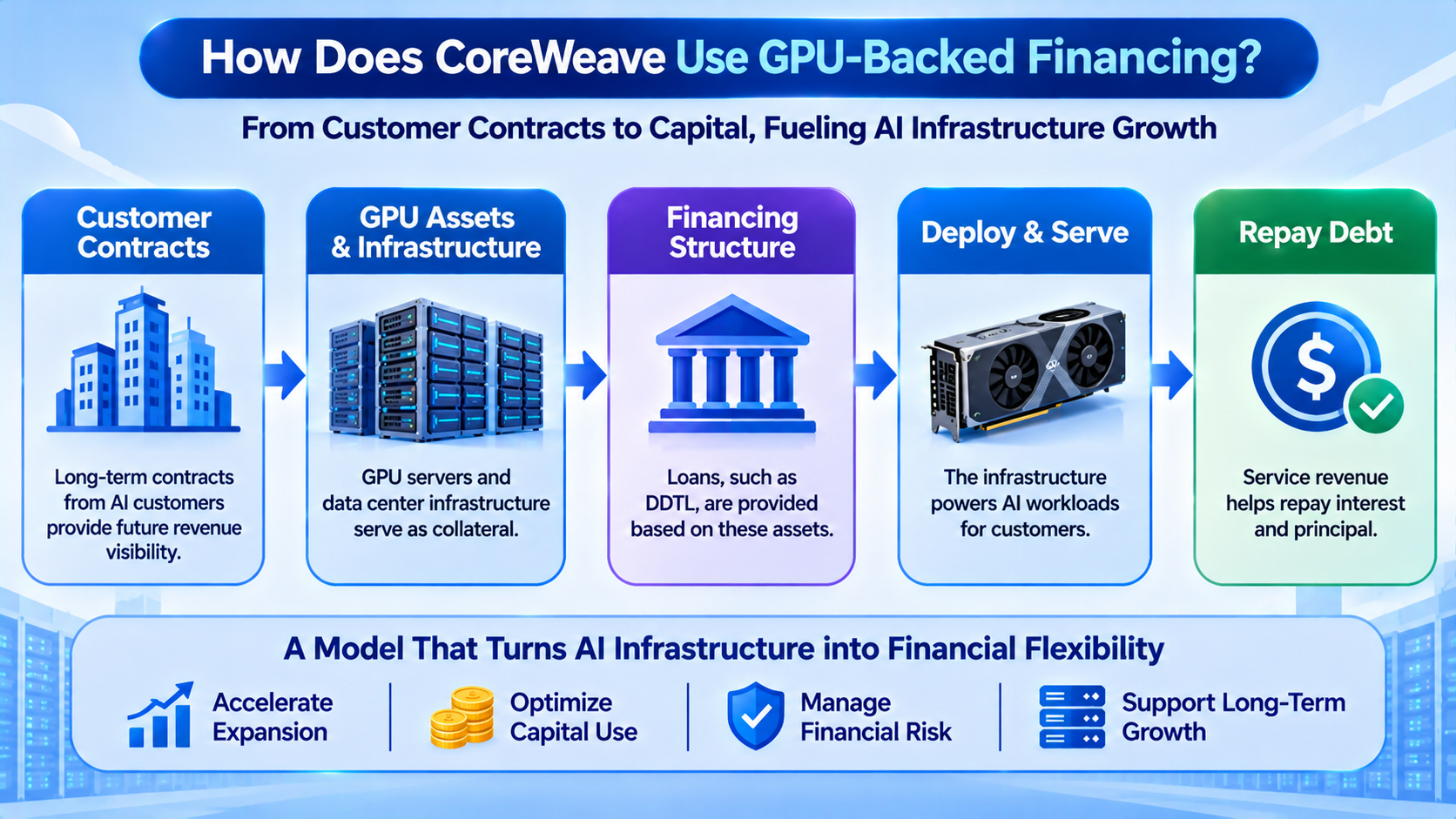
CoreWeave's financing arrangements can be understood through two transactions completed in 2026. The DDTL 4.0 facility completed in March had a total commitment of $8.5 billion and was credit-supported by high-performance computing infrastructure and related customer contracts. Its initial borrowing capacity was approximately $7.5 billion and could increase further as the underlying assets met specified conditions.
The facility included both floating-rate and fixed-rate portions. The floating rate was SOFR plus 2.25 percentage points, while the fixed-rate portion was approximately 5.9%, with a maturity date in March 2032. Moody's and DBRS assigned the relevant financing A3 and A (low) ratings, respectively, making it an example of GPU infrastructure-backed financing with investment-grade ratings.
The DDTL 5.0 facility completed in May used a different credit structure. This $3.1 billion facility was primarily used to support the procurement and deployment of infrastructure associated with two customer contracts. Its final floating-rate pricing was SOFR plus 4.50 percentage points, and its term was approximately five and a half years. Unlike the earlier investment-grade financing, this project received ratings of Ba2 from Moody's and BB+ from Fitch, which are non-investment-grade ratings. The difference in pricing between the two facilities shows that even when collateral assets are both related to GPUs, customer credit quality, project cash flows, loan term, and financing structure can still affect the cost of funds.
In practice, CoreWeave may use special-purpose financing entities to hold the relevant assets and incur the debt, while the loan proceeds are used to purchase or deploy computing equipment associated with specific customer contracts.
As the equipment becomes operational, customer payments for services become an important source of cash flow supporting loan repayment. Some financing arrangements use limited-recourse or non-recourse structures, concentrating the lender's primary recovery rights on the specific financing entity and its assets rather than automatically covering all assets of the parent company. However, structural risk isolation does not mean the group is completely unaffected. If a project's performance falls short of expectations, the company may still face business disruption, higher financing costs, or reduced access to future financing.
Why Are Delayed Draw Term Loans Suitable for AI Computing Infrastructure?
A delayed draw term loan (Delayed Draw Term Loan, DDTL) allows a borrower to draw funds in stages during an agreed period, subject to specified conditions. Unlike a loan in which the entire amount is provided at once, the company can use the relevant portion of the commitment when it purchases equipment, completes project construction, or satisfies asset-related conditions.
This mechanism is suitable for businesses with clearly phased capital requirements, particularly AI infrastructure projects that deploy GPU clusters gradually in line with customer contracts. The company does not have to draw the full principal before all equipment has been delivered. This may reduce the interest burden on funds that have not yet been put to use, although the company may still need to pay commitment fees and other related costs.
CoreWeave's financing structure reflects this characteristic. GPU procurement typically requires consideration of equipment supply, data center readiness, network configuration, and customer delivery schedules, and actual deployment may take several months. If drawdowns can be aligned with equipment procurement, the company can manage its cash use more efficiently and avoid leaving loan proceeds idle for an extended period. A $2.6 billion DDTL 5.5 facility disclosed in August 2026 was also explicitly intended to support capital expenditures required by specific customer contracts, including the purchase of GPU servers and related infrastructure. The loan matures in September 2031, and the applicable spread for SOFR loans is 5.50 percentage points.
The flexibility of a DDTL does not mean that funds can be drawn unconditionally. The loan agreement may require the company to satisfy conditions related to asset delivery, collateral coverage, financial metrics, or other commitments. If GPU deployment is delayed, customer contracts change, or the project fails to meet the loan conditions, the company may not be able to obtain all the funds according to the original plan. For rapidly expanding computing companies, this financing mechanism can improve capital efficiency, but it also requires coordination among project construction, equipment procurement, and financing arrangements. A significant delay at any one stage may affect subsequent equipment delivery and revenue recognition.
Why Can Customer Contracts Provide Important Credit Support for GPU Financing?
The market value of GPU servers changes as technology develops. However, when equipment is already linked to clear, long-term customer demand, lenders can use the contract terms to assess future revenue. For a computing service provider such as CoreWeave, customer contracts may specify computing capacity, service terms, pricing, and delivery requirements, providing a basis for financial institutions to forecast project cash flows.
Compared with a business that relies entirely on future spot demand for computing capacity, computing facilities backed by contracts are generally easier to model for revenue forecasting. Financial institutions can further analyze whether contract revenue is sufficient to cover equipment operating costs, interest, and principal repayment.
The quality of a customer contract is more important than its total value. A long-term contract may improve revenue visibility, but lenders must still consider whether the customer has the ability to continue making payments, whether the contract includes early termination provisions, and whether the service provider can deliver computing capacity as agreed.
Large AI customers may have strong financing capabilities, but their businesses are also affected by model competition, capital market conditions, and changes in computing demand. For lenders, customer contracts are not an absolute safeguard independent of the GPU assets. They must be evaluated together with equipment value, project costs, and the credit profile of the borrower.
Customer concentration also affects financing risk. If a computing cluster primarily serves one large customer, the related contract may provide a relatively clear source of revenue, but the project may also depend heavily on that customer's continued operations and ability to perform. If the contract ends and cannot be renewed promptly, the equipment may need to find new rental demand, and the new rental price may be lower than the original level. GPU financing effectively links customer credit risk with equipment residual-value risk: Customer contracts help the company obtain funding, while the future economic value of the equipment determines the scope for refinancing and asset disposal after the contracts end.
Why Can GPU Technology Updates Affect Debt Repayment Capacity?
An important risk in GPU-backed financing is that the economic value of computing equipment may change rapidly as technology advances. New-generation GPUs typically offer higher computing performance, memory bandwidth, or energy efficiency, reducing the competitiveness of older models for certain workloads. Even if older GPUs remain suitable for inference, model fine-tuning, or other computing tasks, their market rental prices may be affected as the supply of newer equipment increases. For companies that rely on equipment rental revenue to repay loans, technological progress can create new demand for computing capacity while also reducing the future earnings potential of existing equipment.
Accounting depreciation must be distinguished from changes in actual market value. Accounting depreciation is the process by which a company allocates the cost of equipment over time according to its established accounting policies. Market value, by contrast, depends on equipment performance, demand, remaining useful life, and secondhand market conditions.
A batch of GPUs may experience a significant change in market price after a new model is introduced even if it has not yet been fully depreciated for accounting purposes. Conversely, if an older model remains suitable for certain cost-sensitive computing tasks, its actual use value may exceed some market expectations. Financial institutions need to assess the equipment's cash-generating capacity throughout the loan term rather than determining collateral value solely based on its original purchase price.
Technology updates may also create refinancing risk. Suppose a loan's repayment plan is based on GPUs continuing to generate stable revenue, but rental prices fall significantly after the customer contracts expire. The project's cash flow available for debt service may then decline. If the lender also lowers the valuation of the collateral assets, the borrower may need to provide additional collateral, repay part of the debt early, or accept higher financing costs. The central challenge of GPU asset-backed loans is not that equipment will necessarily lose value quickly, but whether the loan term, customer contract terms, and GPUs' actual economic lives remain reasonably aligned.
How Does GPU-Backed Financing Change CoreWeave's Financial Structure?
Asset-backed financing can help CoreWeave expand its computing capacity without relying entirely on new equity capital, but this method of expansion also increases the company's debt burden. Loan proceeds are used to purchase GPUs and related infrastructure. Once the new equipment becomes operational, it generates revenue, and the company uses operating cash flow to repay the debt. If project revenue covers operating costs, interest, and principal and continues generating returns after the loan matures, debt financing may improve the efficiency of shareholder capital. Conversely, if customer demand falls below expectations or equipment becomes operational later than planned, the company must still meet its debt obligations, which may increase financial pressure.
CoreWeave's debt level has become an important indicator for evaluating its business model. In the first half of 2026, the carrying amount of debt on the company's balance sheet increased from approximately $21.4 billion at the end of 2025 to approximately $35.1 billion. These figures reflect the capital support required for its rapid expansion, but the carrying amount of debt cannot be equated directly with all future payment obligations. Long-term leases, equipment purchase commitments, and other contractual arrangements also require separate analysis.
For investors, an increase in debt alone is not enough to conclude that the company's financial condition has deteriorated. They must also observe whether the new funds are converted into computing assets that are delivered on schedule and how much operating cash flow those assets can generate.
Financing costs are another key variable. The different loan projects CoreWeave completed in 2026 have different interest rates, ratings, and repayment terms, showing that financial institutions do not treat all GPU assets as having the same credit quality. Investment-grade financing may help the company obtain funds at a lower cost, while projects with higher credit risk may require a wider spread. As debt increases, even a moderate change in the average financing rate may affect future interest expenses. The company must continue improving project execution, customer contract quality, and asset utilization to reduce financing costs and avoid relying excessively on new debt to sustain expansion.
How Should Investors Assess CoreWeave's GPU Financing Risk?
Analyzing CoreWeave's financing model requires evaluating business growth together with its debt repayment capacity rather than focusing only on new contracts or financing amounts.
Investors should monitor whether the customer contracts the company has signed can be converted into actual revenue as planned, including the timing of GPU deliveries, data center commissioning, and customer usage. Long-term contracts can provide revenue visibility, but if project construction is delayed, the related revenue may be realized later than expected while financing costs may already have begun to accrue. Investors should also distinguish between contract backlog, recognized revenue, and cash actually received, rather than treating the total value of future contracts as funds available for debt repayment.
Investors should analyze the relationship between cash flow and capital expenditures. CoreWeave may continue investing heavily in equipment purchases during a period of rapid business growth. Even if revenue and operating cash flow improve, free cash flow may still be affected by high capital expenditures. For an asset-intensive computing company, negative short-term free cash flow does not necessarily mean the business lacks value. However, if the company relies on new financing over an extended period to cover existing debt and equipment purchases, the sustainability of its capital structure requires further evaluation. Debt maturities, cash balances, available financing capacity, interest expenses, and future equipment purchase obligations are all important information for assessing funding pressure.
Investors should also monitor the operating performance of the GPU assets themselves. Equipment utilization, rental prices per unit of computing capacity, customer contract renewals, and the ability to reuse older equipment can all affect future cash flow. If demand for AI computing continues to grow and equipment deployment becomes more efficient, GPU-backed financing may help CoreWeave build a larger revenue base. If new-generation chips rapidly replace older equipment or customers reduce purchases, leverage may amplify operating volatility. The key to assessing CoreWeave's long-term value is not how much the company can borrow, but whether the assets created through each round of financing can generate sufficient cash returns throughout their useful lives.
How Can You Trade CoreWeave (CRWV) on Gate and Monitor Its Financing Risk?
CoreWeave went public on the Nasdaq in March 2025 under the ticker CRWV. Investors can monitor CoreWeave's market performance through Gate's stock and related TradFi trading services and choose how to participate based on the products actually available on the platform. Gate provides access to CRWV-related stock, contracts for difference (CFDs), and perpetual contract trading. These products differ in asset type, trading hours, margin requirements, and risk structure. Stock trading and derivatives trading should not be treated as the same. In particular, CFDs and perpetual contracts are primarily used to participate in price movements of the underlying asset and do not represent direct ownership of CoreWeave stock or entitlement to corresponding shareholder rights.
When monitoring CRWV on Gate, investors can analyze the company's financing developments together with changes in its share price. GPU-backed financing can help CoreWeave expand its computing capacity, but new debt may also increase future interest expenses and debt repayment pressure. When evaluating CRWV's market performance, investors can consider quarterly revenue, customer contracts, and GPU deployment progress together with debt balances, financing rates, capital expenditures, and operating cash flow to assess how the market views its expansion model. Traders using CFDs or perpetual contracts must also consider leverage, margin, funding fees, and potential forced liquidation risks. They should avoid equating long-term expectations for the company's growth directly with short-term price movements.
Different CRWV trading products on Gate may be subject to different trading rules, fees, and regional restrictions. Refer to the applicable product page for current availability. Regardless of the trading method selected, understanding CoreWeave's financing structure and its effect on cash flow can help provide a more comprehensive assessment of the AI computing company's operating risks and market valuation.
Summary
CoreWeave's use of GPU-backed financing is one financing option arising from the capital-intensive nature of AI computing infrastructure. The company must purchase large quantities of computing equipment in advance and gradually recover its investment through long-term customer contracts and computing services. Using GPU servers, related infrastructure, and contractual cash flows as loan support can help the company obtain construction funding as customer demand grows, reducing its reliance on equity financing. The completion of multiple delayed draw term loans in 2026 also shows that financial institutions are attempting to treat high-performance computing infrastructure as a separately assessable financing asset.
This model also changes the risk structure of AI computing companies. GPUs determine not only how much computing service a company can provide, but also how lenders assess collateral value and debt repayment capacity. Customer contracts can improve revenue visibility, but they cannot fully eliminate the risks associated with equipment depreciation, delivery delays, customer defaults, and changes in financing costs. As GPU technology advances rapidly, the degree of alignment among loan terms, equipment economic lives, and customer contract terms will continue to affect the stability of the financing structure.
For investors, CoreWeave's expanding financing scale reflects both the capital required to build AI infrastructure and the company's need to manage more complex debt obligations. Key indicators in the future will include not only revenue growth and the value of new contracts, but also equipment utilization, cash flow, capital expenditures, debt maturities, and financing costs. GPU asset-backed financing can become an effective tool for supporting long-term growth only when the new computing capacity consistently generates enough cash flow to cover the related costs and debt obligations.
FAQ
What Is GPU-Backed Financing?
GPU-backed financing is a form of financing that uses GPU servers and related computing infrastructure as loan collateral. Some projects also include customer contracts and their cash flows in the credit support structure. The company uses the loan proceeds to purchase or deploy equipment and then repays the debt with revenue from computing services.
Why Doesn't CoreWeave Rely Entirely on Stock Issuance?
Debt financing can help a company raise construction funding without immediately issuing a large amount of new stock, reducing equity dilution pressure. However, debt requires interest and principal payments and does not necessarily have a lower financing cost than equity financing.
How Does a DDTL Differ From a Regular Loan?
A DDTL allows a company to draw funds in stages during an agreed period, subject to specified conditions. It is more suitable for businesses in which equipment procurement and project construction follow a defined schedule. Actual drawdowns must still satisfy the relevant conditions in the loan agreement.
Is GPU-Backed Financing a Form of Securitization?
Not necessarily. A GPU-backed loan is a form of asset-backed financing, but asset-backed loans and asset securitization are not the same. Securitization generally involves packaging assets or cash flows and issuing securities. The specific classification depends on the transaction structure.
Why Do Customer Contracts Affect GPU Loan Interest Rates?
Customer contracts can help lenders forecast future revenue, but customer credit quality, contract terms, payment conditions, and project delivery risks also affect loan security. More stable contractual cash flows are generally favorable for financing assessments, but they do not guarantee a lower interest rate.
Can GPU Upgrades Create Risks for Collateralized Loans?
They can. If the rental price or resale value of older equipment declines significantly, project cash flow and collateral value may be affected. However, older GPUs may still be used for inference and other computing tasks. The actual risk depends on equipment use, contract terms, and loan conditions.
Does an Increase in CoreWeave's Debt Mean Its Stock Price Will Definitely Decline?
An increase in debt may raise financial leverage and operating risk, but it does not directly imply that the stock price will inevitably decline. Investors should consider revenue growth, cash flow, financing costs, asset utilization, and market valuation together.