Summary:
Buying the dip refers to a trading strategy in which investors purchase stocks after a significant price decline, hoping to profit from a subsequent recovery. In the US stock market, buying the dip is often associated with oversold rebounds, valuation adjustments, and shifts in market sentiment. For long-term investors, market declines may create opportunities to acquire quality assets at lower prices. However, for short-term traders, a substantial price drop does not necessarily mean that the downward trend has ended.
In early November 2026, US technology stocks experienced a significant correction, followed by a rapid rebound. Valuation concerns surrounding AI-related stocks, expectations for corporate capital expenditure, and changes in market risk appetite have brought investors back to a familiar question: When a stock has just experienced a sharp decline, is buying immediately more advantageous than waiting for the market to stabilize? In reality, short-term rebounds may be driven by short covering, oversold recovery, or capital reallocation. They do not necessarily indicate that corporate earnings expectations or market risks have improved.
Understanding the risks of buying the dip requires distinguishing between a price rebound and a trend reversal, assessing whether the forces driving the recovery are sustainable, and considering valuations, trading volume, market breadth, and macroeconomic conditions. Against the backdrop of recent US stock market volatility, this article examines why stocks can rebound rapidly after a sharp sell-off and why, under certain market conditions, buying too early may carry greater risks than waiting for trend confirmation.
Key Takeaways
-
A rapid rebound after a US stock market sell-off may be driven by short covering, oversold recovery, and changes in liquidity. It does not necessarily mean the downtrend has ended.
-
The main risk of buying the dip is the difficulty of identifying the actual market bottom. Investors may buy during a temporary rebound only to face a deeper decline afterward.
-
Chasing a rally is not necessarily safer than buying the dip. The risks of both strategies depend on entry price, fundamentals, market trends, and position management.
-
A large stock price decline does not automatically mean a valuation is reasonable. If corporate earnings expectations deteriorate, a stock may remain expensive even after falling substantially.
-
Assessing whether a rebound can continue requires consideration of trading volume, market breadth, earnings expectations, credit conditions, and macroeconomic data.
-
For long-term investors, gradual allocation and risk budgeting are generally more important than predicting the exact day of the market bottom.
Why Did US Stocks Rebound Quickly After a Sharp Sell-Off in November 2026?
In early November 2026, the US stock market experienced a significant adjustment in risk appetite. On November 5, the Nasdaq Composite fell approximately 5.5%, the S&P 500 declined around 4.4%, and the Dow Jones Industrial Average dropped roughly 3.4%. Technology and semiconductor stocks were among the hardest-hit sectors, with the Philadelphia Semiconductor Index falling approximately 12% that day.
Several factors contributed to the market correction. The results of the US midterm elections prompted investors to reassess the policy environment surrounding AI data center construction. Some market participants were concerned that future approval processes, energy supply, and regulatory conditions could affect capital expenditure plans among related companies. At the same time, AI-related stocks had accumulated high growth expectations, making the market increasingly sensitive to valuations and companies' ability to deliver on earnings projections.
However, the market did not continue falling in a straight line. The Nasdaq and S&P 500 rebounded on November 6, and the recovery accelerated on November 9. The S&P 500 rose approximately 2.3%, the Nasdaq gained around 2.7%, and the Dow Jones advanced roughly 2.2%. Falling oil prices eased some inflation concerns, while corporate earnings and improving risk appetite also supported equities.
This rapid shift from concentrated selling to strong upward momentum can lead investors to two very different conclusions. Some believe the previous decline was an overreaction and that the market is returning to an uptrend. Others worry that the rebound is merely a temporary recovery within a broader decline.
The key difference between these interpretations is whether the price recovery has sufficient fundamental and capital-flow support.
If corporate earnings expectations, financing conditions, and investor risk appetite have not materially improved, a short-term rally may primarily reflect price normalization after selling pressure has eased. Conversely, if market concerns gradually subside and corporate earnings remain stable, the rebound may develop into a more sustained upward trend.
Therefore, a rebound after a sharp sell-off does not by itself prove that the market has reached its bottom. Investors need to understand the specific mechanisms driving the recovery.
Why Do US Stocks Experience Technical Rebounds After Sharp Declines?
A technical rebound generally refers to a recovery in an asset's price after a substantial decline, driven by short-term trading dynamics, capital flows, or changes in market sentiment. It does not necessarily mean that corporate fundamentals have improved, nor does it automatically signal a reversal in the long-term trend.
Concentrated selling can cause short-term selling pressure to be released ahead of schedule. When negative news suddenly hits the market, some investors rapidly reduce their positions. Stop-loss orders and risk management mechanisms may also increase short-term selling demand. If a large number of sell orders are executed within a limited period, prices may temporarily move away from valuation levels that some investors consider reasonable.
As this wave of concentrated selling gradually subsides, additional selling pressure may weaken. Even without significant new positive developments, prices can rebound as supply and demand conditions change.
Some investors may also begin buying again after a substantial decline. For investors who have been following a particular stock over the long term, a lower price may improve its expected return potential. For example, if a company's earnings outlook remains largely unchanged but its share price falls because of broader market panic, some investors may consider its valuation more attractive and increase their buying activity.
Trading strategies can further amplify a rebound. Some quantitative strategies, short-term traders, and market makers adjust their positions according to price volatility, portfolio risk, and liquidity conditions. When short-term volatility becomes excessive, these participants may rebuild positions once prices begin to stabilize.
It is important to note that a technical rebound does not require all investors to become optimistic about the market again. Prices can rise simply because short-term selling decreases while buying demand increases.
A technical rebound therefore reflects an improvement in short-term supply and demand conditions. A genuine trend reversal, by contrast, generally requires more sustained capital support and confirmation from underlying fundamentals.
What Is Short Covering, and Why Can It Amplify a US Stock Market Rebound?
Short covering refers to the process in which investors who previously established short positions by selling borrowed shares buy back those shares to close their positions.
In a short sale, investors typically borrow shares and sell them, hoping to repurchase them at a lower price in the future and profit from the difference. If the stock falls as expected, short sellers may choose to buy back the shares at a certain stage to lock in their gains.
This means that buying demand can emerge even when investors remain pessimistic about a stock's long-term prospects. For example, if a stock falls from $100 to $70, some short sellers may believe that the decline has already achieved their trading objectives and begin buying back shares. At the same time, other investors may attempt to buy the stock because its valuation has declined. These two sources of buying demand can jointly drive a rebound.
If prices rise rapidly, short sellers who have not yet closed their positions may worry about mounting losses and accelerate their purchases, either voluntarily or under pressure. Under certain conditions, this can contribute to a short squeeze.
However, short covering is fundamentally different from long-term investment demand. Its primary purpose is to close an existing trade, not to maintain or increase a long-term allocation to the stock. As short positions are gradually closed, this source of buying demand may diminish. If corporate fundamentals have not improved and the market lacks new long-term capital, the rebound may lose part of its support.
Therefore, investors should not assume that a rapid rise in stock prices means institutional investors are consistently increasing their holdings. The increase may come from new long positions, short covering, or a combination of both.
What Is the Difference Between a Technical Rebound and a Trend Reversal?
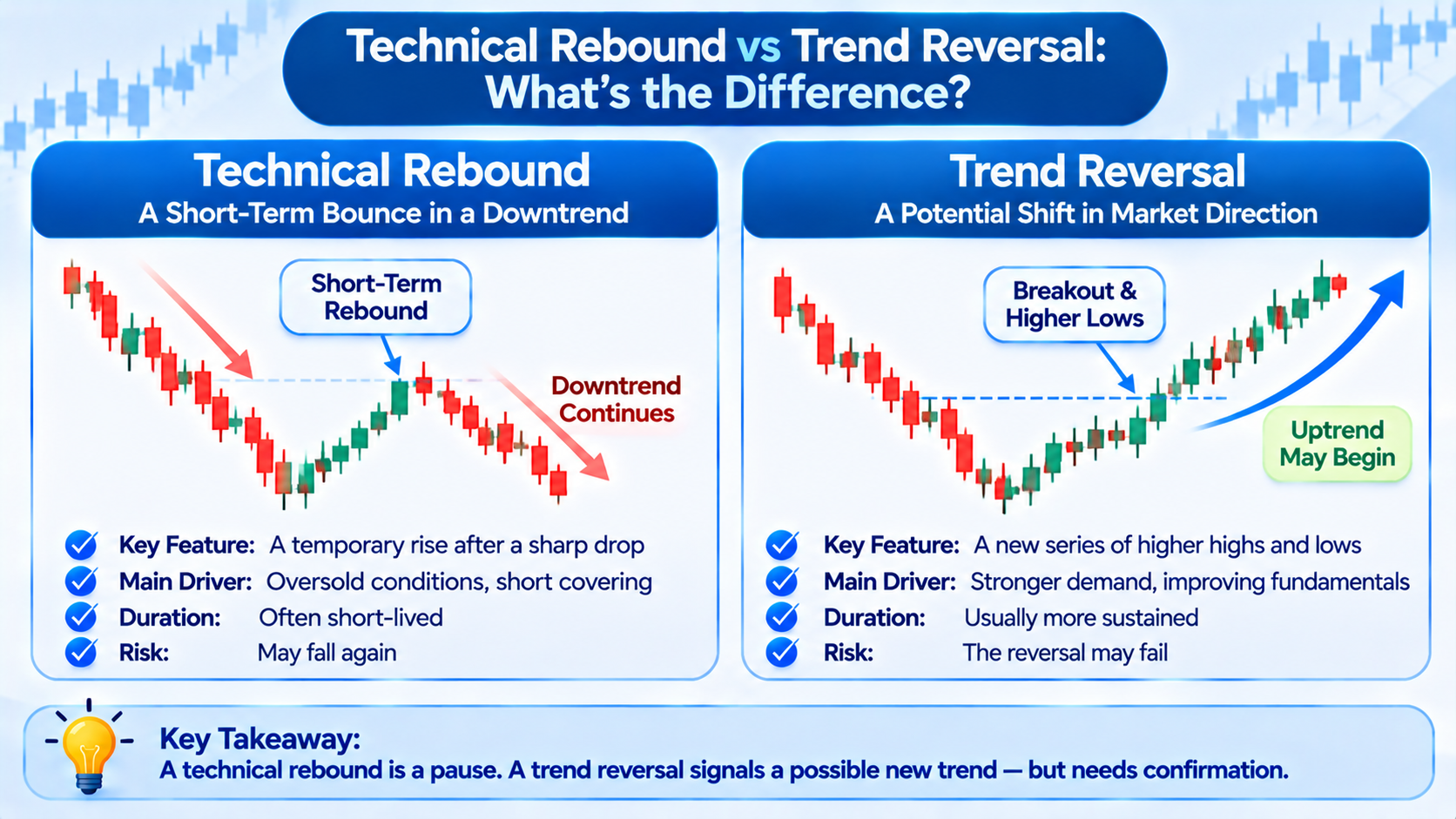
Both technical rebounds and trend reversals involve rising stock prices, but their market implications are different. A technical rebound usually occurs within an existing downtrend. Prices may recover rapidly over a short period, but there may not yet be sufficient evidence that the previous trend has ended.
A trend reversal, by contrast, indicates a more sustained change in the market's previous price direction. For example, a stock may have repeatedly formed lower highs and lower lows. If it subsequently begins establishing higher lows and breaks above an important previous price range, this may indicate that its market structure is improving.
However, price patterns provide only reference points and cannot independently confirm a trend reversal.
Content temporarily unavailable outside the Lark document.
Historically, even bear markets can feature extremely strong single-day rallies. During the 2008 financial crisis, the S&P 500 experienced a notable rebound toward the end of October before continuing to decline. Charles Schwab's analysis of bull traps notes that the S&P 500 fell approximately 25% between its closing high on November 4, 2008, and its closing low on November 20.
This demonstrates that a substantial rebound does not necessarily mean market risks have disappeared. Investors should pay more attention to whether rising prices are supported by subsequent earnings expectations, broader market participation, and sustained capital demand, rather than simply comparing the percentage gain on the day of the rebound.
Why Can a Stock Remain Overvalued Even After a Major Price Decline?
Investors buying the dip may develop an intuitive assumption: if a stock has already fallen 30% or 40% from its high, its current price must be cheaper than before. This may be true in terms of the absolute share price, but a lower price does not necessarily mean that the stock has sufficient valuation support or a meaningful margin of safety.
Stock valuations depend not only on current prices but also on the profits and cash flows a company is expected to generate in the future. Consider the price-to-earnings ratio (P/E Ratio). Suppose a company's share price is $200 and its expected earnings per share over the next year are $5. Its forward P/E ratio is 40.
If the share price falls to $150 while expected earnings per share remain unchanged, the forward P/E ratio declines to 30. However, if the market simultaneously reduces its earnings-per-share forecast for the next year to $3, the forward P/E ratio would still be 50, even after the stock has fallen 25%. This means that although the stock is cheaper than before in absolute price terms, it may actually be more expensive relative to its revised earnings expectations.
This is particularly important for high-growth technology stocks. Some AI, semiconductor, and cloud computing companies may already have high future growth expectations priced into their shares. When investors begin questioning whether growth rates, returns on capital expenditure, or profit margins can meet previous expectations, stock prices may need to be repriced.
Interest rate changes can also affect equity valuations. For growth companies expected to generate a large proportion of their profits many years in the future, markets tend to pay close attention to the present value of future cash flows. When risk-free rates or investors' required risk premiums rise, the amount investors are willing to pay for distant future earnings may decline.
As a result, a stock may continue falling even if its fundamentals have not deteriorated significantly, simply because valuation standards have changed. This is why buying the dip based solely on the percentage decline can be risky in markets where valuations remain elevated and earnings expectations are still vulnerable to downward revisions.
Why Can Buying the Dip Be Riskier Than Buying After a Rebound Is Confirmed?
The main difference between buying the dip and chasing a rally lies in when investors enter the market and what they use as the basis for their decisions.
Buying the dip typically occurs after prices have declined substantially but before the trend has clearly improved. Investors aim to enter at a lower cost and profit from a future rebound. Chasing a rally generally occurs after prices have already risen, with investors seeking to benefit from further gains in an existing upward trend.
Both strategies involve risks, but buying too early in a prolonged downtrend can present several specific challenges.
-
The market bottom is difficult to predict. Suppose a stock falls from $100 to $70. An investor believes the decline is already substantial enough and buys the shares. However, if the company's earnings outlook continues to deteriorate, the price may fall further to $50. Although the purchase price is below the previous high, the investor still faces a significant loss.
-
Capital may be deployed too early. If investors commit most of their available capital after the first major decline, they may have little flexibility to adjust their positions if the market falls further. Even if a more attractive entry price appears later, they may no longer have sufficient funds to increase their allocation.
-
Psychological pressure can affect subsequent decisions. Holding a losing position during a prolonged decline can force investors to repeatedly decide whether to cut losses or add to their positions. Without a clearly defined investment horizon and risk budget, they may abandon their original plans in response to short-term price fluctuations.
By comparison, waiting for further improvements in price action and fundamentals before buying may reduce some of the risks associated with incorrectly identifying a trend. The trade-off is that the entry price may be higher. It is important to emphasize that chasing a rally is not inherently safer than buying the dip. Investors who buy at excessively high prices late in a rebound, or use excessive leverage out of fear of missing out, can face substantial losses as well.
Therefore, the idea that "buying the dip may be riskier than chasing a rally" applies particularly to situations where the market remains in a downtrend, fundamentals have not stabilized, and investors are trying to predict the exact bottom. It is not a universal rule for every market environment.
How Can Trading Volume and Market Breadth Help Assess the Quality of a US Stock Market Rebound?
To determine whether a US stock market rebound is sustainable, investors can look beyond the gains in major indexes and examine trading volume and market breadth.
Trading volume reflects the level of stock trading activity over a given period. When the market rebounds significantly, changes in volume can help investors assess the level of market participation. However, an increase in volume alone does not prove that buying pressure is stronger, because every completed trade involves both a buyer and a seller.
It is more meaningful to analyze trading volume alongside price movements, trading direction, and the preceding market environment. For example, if a stock experiences consistently high volume during a decline but trading activity weakens noticeably during the subsequent rebound, this may indicate that the recovery has not attracted sufficiently broad participation. However, this pattern may also be influenced by trading hours, news events, and market structure, so it should not be used as the sole basis for determining a trend.
Market breadth measures how widely gains are distributed across stocks. Since major indexes such as the S&P 500 and Nasdaq are significantly influenced by large technology companies, gains in a small number of heavily weighted stocks can push indexes higher even when many small- and mid-cap stocks perform poorly.
Investors can therefore examine the number of advancing versus declining stocks, the ratio of stocks reaching new highs to those reaching new lows, and performance differences between equal-weighted and market-cap-weighted indexes. If a rebound is driven primarily by a handful of large-cap stocks while most constituents remain weak, the market's overall participation may be limited.
Conversely, if large technology companies, smaller businesses, and stocks across multiple sectors rise together, this generally indicates broader market participation. However, improving market breadth does not guarantee that a rebound will continue. Some short-term oversold rallies can also produce widespread gains, so further confirmation from earnings expectations and macroeconomic conditions remains necessary.
How Can Investors Determine Whether a US Stock Market Rebound Has Fundamental Support?
The long-term performance of the stock market is generally closely related to corporate earnings, the cost of capital, and broader economic conditions. Assessing whether a rebound is sustainable therefore requires examining the fundamentals behind rising prices.
-
Corporate earnings expectations. If the previous market decline was primarily driven by concerns about slowing corporate earnings, investors should examine whether analysts are continuing to lower their forecasts and whether the latest financial results and management guidance support previous growth expectations. For example, AI infrastructure companies may continue to report strong revenue growth, but their valuations could still come under pressure if the market becomes concerned about longer payback periods for capital expenditure, weaker-than-expected customer demand, or rising financing costs.
-
Macroeconomic conditions and interest rates. US Treasury yields, inflation data, labor market conditions, and expectations for Federal Reserve policy all influence how investors price equity risk. If a stock market rebound is mainly driven by short-term changes in interest rate expectations while corporate earnings prospects continue to deteriorate, the recovery may face renewed challenges.
-
Credit markets and corporate financing conditions. For companies that require ongoing capital investment, higher financing costs can affect future investment plans and cash flows. This is particularly relevant to capital-intensive sectors such as AI data centers, cloud computing infrastructure, and other industries where financing conditions are directly linked to expansion capacity.
-
Whether market gains depend on a single event. For example, falling oil prices provided some support during the US stock market rebound on November 9. However, a single decline in oil prices does not guarantee sustained improvement in inflation or independently prove that corporate earnings prospects have fundamentally changed.
Determining whether a US stock market rebound has fundamental support therefore requires observing whether the improvements persist, rather than interpreting positive news on a single trading day as confirmation of a long-term trend reversal.
How Can Retail Investors Reduce Trading Risks When Buying the Dip or Chasing a Rally?
For retail investors, reducing risk is less about accurately predicting the market's highest or lowest point and more about establishing a decision-making framework that matches their investment objectives.
-
Distinguish between long-term investing and short-term trading. Long-term investors focus more on corporate earnings capacity, valuation levels, and long-term asset allocation. For these investors, a market decline may create opportunities to build positions gradually, but their investment horizon, funding needs, and risk tolerance still need to be considered. Short-term traders, by contrast, need to pay closer attention to price volatility, liquidity, and execution risks. Since short-term market movements are more easily affected by news and capital flows, relying solely on the size of a price decline to determine when to buy can be highly uncertain.
-
Avoid committing all available capital at a single price level. Gradual buying can reduce the risk of entering the market at an unfavorable moment with a single large purchase. However, it cannot eliminate losses caused by a prolonged decline. If an investment's fundamentals continue to deteriorate, repeatedly adding to the position may increase risk exposure.
-
Pay attention to position sizing. Even if investors have strong confidence in a stock's long-term prospects, they need to consider how a decline in a single asset could affect their overall portfolio. Excessive concentration in one sector or highly volatile stocks may expose a portfolio to larger drawdowns than expected.
-
Avoid blindly increasing leverage in highly volatile markets. When stock prices fall rapidly, leverage can magnify losses and force investors to close positions before the market has stabilized. Even if their long-term market direction proves correct, short-term margin pressure may prevent them from maintaining their positions.
-
Establish investment criteria that can be verified. If the reason for buying is that a company's valuation has become attractive, investors should continue monitoring whether earnings and cash flows support that assessment. If the rationale is that market conditions are improving, they should examine whether price structure, market breadth, and relevant risk indicators continue to confirm that view.
Vanguard's investor education materials also emphasize that accurately timing market exits and reentries is extremely difficult. Investors should consider market volatility in the context of their long-term asset allocation objectives.
Therefore, rather than trying to determine whether a particular day marks the market bottom, establishing a clear investment horizon, position limits, and risk management rules is generally more useful when navigating a volatile market.
How Can Investors Use Gate Stock Trading to Monitor US Market Rebounds and Risks?
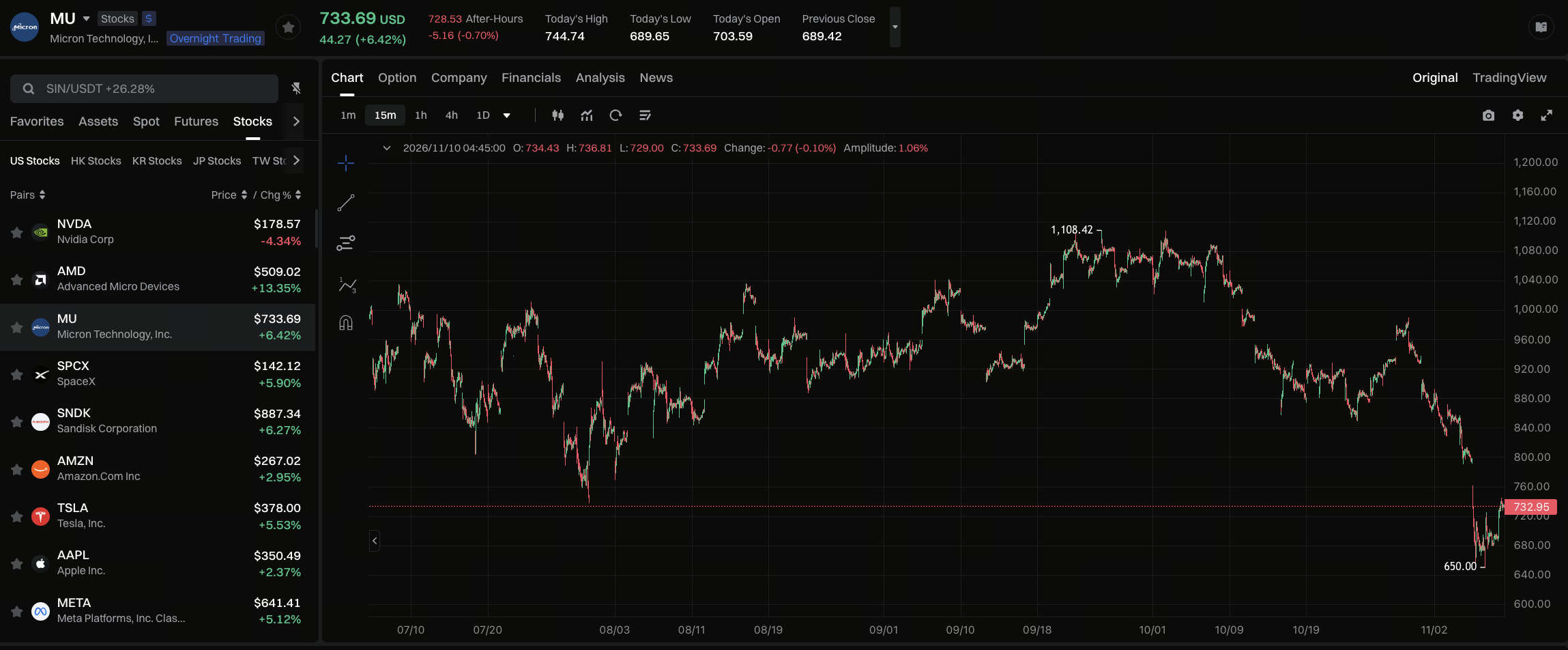
For investors looking to participate in the US stock market, assessing whether a rebound after a sharp sell-off is sustainable requires examining stock prices, corporate fundamentals, and market risks together. Gate Stock Trading provides users with a channel to follow and participate in relevant equity market activity. Investors can use the stocks supported by the platform to observe how different companies perform during market corrections and subsequent rebounds.
For example, when technology stocks such as NVIDIA and AMD experience significant volatility, investors can monitor their price movements, earnings performance, and industry expectations, while comparing valuations and earnings growth across different companies. Users planning to establish positions during a rebound should also confirm the trading rules, trading hours, fees, and risk characteristics of the specific products they intend to use. In particular, they should distinguish between actual stock ownership and derivatives-based price exposure, as the two may differ in asset ownership rights, leverage mechanisms, and risk exposure.
Gate provides a trading entry point for users seeking access to relevant markets, but it does not replace independent investment judgment. Whether choosing to buy after a decline or waiting for further trend confirmation, investors should manage their positions according to their risk tolerance and avoid making trading decisions based solely on short-term price movements.
Gate's stock product information has also been verified: users can currently trade US stocks and ETFs using USDT. The platform supports limit orders and extended trading hours. These practical features can be incorporated naturally into the discussion without emphasizing product advantages or making comparisons with other platforms.
Conclusion
In early November 2026, US stocks experienced a sharp decline followed by a rapid rebound, reflecting swift changes in market risk appetite, policy expectations, and trading behavior. For investors, this type of market movement may create new allocation opportunities while also concealing downside risks that have yet to fully materialize.
A rebound after a sharp US stock market sell-off may be driven by oversold recovery, short covering, and short-term buying demand. However, these factors do not necessarily indicate that corporate earnings prospects or macroeconomic conditions have improved. If rising prices lack sustained capital support, the market may enter another correction.
Buying the dip can be riskier than waiting for a rebound to be confirmed because investors must accept the possibility of further losses before the trend becomes clear. This is particularly relevant when corporate earnings expectations are declining, valuations remain elevated, or market liquidity is insufficient. A substantial drop in share prices does not necessarily mean that a sufficient margin of safety has emerged.
However, chasing a rally also involves the risk of overpaying or entering at an unfavorable time. Neither strategy is inherently superior. What matters is whether the investment rationale, risk budget, and investment horizon are aligned.
Therefore, assessing whether a US stock market rebound is worth participating in requires more than measuring how far prices have risen from their lows. Investors should consider earnings expectations, valuations, market breadth, liquidity, and macroeconomic conditions together. For retail investors, avoiding excessive reliance on short-term price predictions and managing risk through appropriate position sizing and diversification are more important than accurately guessing the market bottom.
FAQ
Why do US stocks rebound quickly after a sharp sell-off?
A rapid rebound may occur because concentrated selling pressure eases, some investors begin buying, short sellers cover their positions, or new positive market expectations emerge. A quick recovery does not necessarily mean the downtrend has ended.
What is a technical rebound in the US stock market?
A technical rebound refers to a recovery in stock prices after a significant decline, driven by short-term changes in supply and demand, oversold conditions, or trading behavior. It does not necessarily involve an improvement in fundamentals.
What is a bull trap?
A bull trap occurs when prices temporarily rise during a downtrend, leading some investors to believe that an upward trend has begun, only for prices to resume falling afterward.
Is a stock worth buying after it has fallen 30%?
Not necessarily. A large decline does not mean that a stock is fairly valued. If corporate earnings expectations have also fallen, the stock may remain expensive and face further downside risk.
Which carries greater risk: buying the dip or chasing a rally?
There is no universal answer. In a persistent downtrend where market conditions have not stabilized, buying too early may expose investors to further losses. Chasing a rally when valuations are excessive or prices are already near the end of a rebound can also result in substantial losses.
How can investors determine whether a US stock market rebound is sustainable?
Investors can examine corporate earnings expectations, valuations, trading volume, market breadth, interest rate conditions, and credit market developments. No single indicator can guarantee an accurate assessment.
Should retail investors buy all at once when US stocks decline?
Whether to invest all at once depends on the investor's time horizon, risk tolerance, and asset allocation plan. Gradual buying can reduce the risk of concentrating an investment at an unfavorable entry point, but it does not guarantee returns or protect against further market declines.