As cryptocurrency scams become more sophisticated, relying on a website’s appearance or a token’s popularity is no longer sufficient.
Fraudulent projects may imitate legitimate exchanges, promote tokens with hidden trading restrictions, or trick users into signing transactions that grant access to their digital assets.
According to Scam Sniffer’s research, wallet-drainer phishing attacks targeting EVM-compatible blockchains caused approximately $494 million in losses in 2024. Its subsequent report estimated that losses from this category declined to approximately $84 million in 2025.
Although these figures cover a specific category of phishing attacks rather than all cryptocurrency fraud, they demonstrate the financial risks associated with malicious wallet interactions.
Several tools can help users identify potential threats before signing transactions or purchasing unfamiliar tokens.
This guide compares some of the top crypto scam detectors and security tools available now and explains what each tool does, which threats it can help identify, and where its limitations lie.
Key Takeaways
-
Crypto scam detectors help identify suspicious websites, token contracts, wallet approvals, and potentially malicious transactions.
-
No all-in-one scam detector offers full coverage of scams.
-
No scam detector can guarantee that a cryptocurrency, website, or transaction is safe.
What Is a Crypto Scam Detection Tool?
A crypto scam detector is a tool or security service designed to identify potential fraud or security risks involving cryptocurrency.
Depending on its capabilities, a scam detector may examine:
-
Website URLs associated with phishing attempts
-
Smart contract code and token permissions
-
Suspicious wallet transactions
-
Token liquidity and trading restrictions
-
Wallet approvals granted to third-party contracts
-
Addresses associated with reported malicious activity
-
Fake messages containing common scam patterns
Some tools operate as browser extensions and provide warnings before users approve transactions.
Others allow users to enter a token contract address or suspicious URL for analysis, while some also accept submissions through an app or let users describe the situation for review.
There are also security services that integrate directly into cryptocurrency wallets and decentralized applications.
What Can Crypto Scam Detectors Identify?
Different tools specialize in different threats.
| Threat |
How Detection Tools May Help |
| Phishing websites |
Check URLs against threat intelligence and reputation data |
| Wallet drainers |
Analyze suspicious transaction requests and signatures |
| Malicious tokens |
Examine contract permissions and known risk indicators |
| Honeypot tokens |
Test whether a token can be bought and sold under simulated conditions |
| Risky wallet approvals |
Display existing permissions and support revocation |
| Fake investment messages |
Analyze language patterns, sender information, links, and common scam indicators |
| Suspicious wallet addresses |
Check known malicious-address databases |
| Fake NFT interactions |
Identify suspicious contracts or unexpected asset transfers |
No individual tool covers every category equally well, and different tools may weigh different signals when assessing risk.
For example, a token contract scanner may detect suspicious trading restrictions but cannot determine whether a person contacting you on Telegram is impersonating a legitimate investment adviser.
How We Selected These Crypto Scam Detectors
The tools in this guide were selected based on their documented capabilities and relevance to common cryptocurrency security risks.
The evaluation considered six factors.
-
Threat coverage: Whether the tool addresses phishing, malicious tokens, wallet drainers, risky approvals, or other relevant threats.
-
Supported networks: Whether the tool supports blockchain networks commonly used for cryptocurrency trading and decentralized applications.
-
Ease of use: Whether users can understand the results without extensive technical knowledge, especially when they need a quick check before acting.
-
Transparency: Whether the provider explains its product capabilities and limitations.
-
Accessibility: Whether the tool is available to individual users, developers, or institutional customers.
-
Practical relevance: Whether the tool can help users make more informed decisions before interacting with unfamiliar cryptocurrency websites, tokens, or smart contracts, with clear results and practical next steps.
The list is not based on independent laboratory testing or a verified ranking of detection accuracy.
Product availability, supported networks, and pricing may change.
10 Best Crypto Scam Detectors in 2026
The following tools address different aspects of cryptocurrency security.
1. Scam Sniffer
Best for: Detecting crypto phishing websites and suspicious wallet interactions
Scam Sniffer is a Web3 security platform focused on identifying cryptocurrency phishing attempts and potentially malicious wallet interactions.
Its browser extension helps users recognize suspicious websites before interacting with them.
The platform combines website threat intelligence with security checks designed for cryptocurrency-related risks.
Scam Sniffer also publishes research on wallet-drainer activity and emerging phishing techniques, giving it a solid research track record.
Key features:
-
Cryptocurrency phishing website detection
-
Browser-based security warnings
-
Threat intelligence related to wallet drainers
-
Detection of suspicious Web3 interactions
-
Research on cryptocurrency phishing activity
Scam Sniffer focuses specifically on threats affecting cryptocurrency users rather than general internet security, helping users stay in control before interacting with risky Web3 sites.
This makes it relevant to users who frequently visit decentralized applications, NFT marketplaces, and unfamiliar Web3 websites.
However, the extension cannot guarantee that every malicious website or transaction will be detected. Users should continue verifying URLs and reviewing wallet requests independently.
2. Pocket Universe
Best for: Understanding wallet transactions before signing
Pocket Universe is a Web3 security tool that helps users understand the potential effects of cryptocurrency transactions.
Its browser extension provides transaction previews and warnings about suspicious activity.
For example, when a user interacts with a decentralized application, Pocket Universe may display the assets expected to move as a result of the proposed transaction.
This can help users recognize unexpected token transfers or dangerous permissions.
Key features:
-
Transaction simulation
-
Wallet interaction previews
-
Warnings about potentially malicious transactions
-
Detection of suspicious asset movements
-
Browser extension protection
Pocket Universe emphasizes explaining transaction outcomes before users approve them. This is particularly relevant when interacting with unfamiliar decentralized applications.
But the transaction simulations may not identify every possible attack. Browser compatibility, supported networks, and mobile functionality can differ.
If you're a DeFi traders, NFT users, and individuals who frequently sign smart contract transactions, this tool might be for you.
3. Token Sniffer
Best for: Checking suspicious cryptocurrency tokens
Token Sniffer is a token analysis platform that examines smart contracts for potential scam indicators.
The platform is operated by Solidus Labs and provides automated contract analysis and token risk information. Users can search for supported tokens using their contract addresses. The results may help identify suspicious contract characteristics and other risk indicators.
Key features:
Token Sniffer provides a straightforward way to examine unfamiliar tokens before trading them. This is especially relevant when researching newly launched tokens that have limited public information, as it can offer a useful second opinion before placing a trade.
Users should take note that most automated contract analysis cannot establish whether a token is legitimate. Truth is, a token may pass certain checks while still exposing users to financial or security risks, so traders should also weigh liquidity, project claims, and broader money risk.
Token Sniffer’s own terms acknowledge that automated scanning results may be incomplete or inaccurate.
4. GoPlus Security
Best for: Token security checks and blockchain risk intelligence
GoPlus Security provides security intelligence tools and APIs for the Web3 ecosystem.
Its offerings include token security analysis, malicious-address information, and other risk-related services that help platforms build smarter risk checks.
Developers can integrate these capabilities into wallets, applications, and blockchain analytics systems.
GoPlus also provides tools relevant to individual users researching token risks.
Key features:
-
Token security analysis
-
Malicious-address detection
-
Approval risk analysis
-
NFT-related security information
-
Decentralized application security data
-
Transaction simulation APIs
GoPlus covers several security categories through a common intelligence infrastructure, and its threat intelligence has evolved to cover several Web3 risk categories.
Its documented APIs make it relevant to both individual research and application-level security integration.
If you're a token traders, developers, wallet providers, and platforms seeking security intelligence, this platform may be for you.
5. Honeypot.is
Best for: Checking whether a token may restrict selling
Honeypot.is is a cryptocurrency token analysis tool focused on detecting potential honeypot behavior.
A honeypot token may allow users to purchase an asset while restricting or preventing them from selling it.
This can create a situation where traders can enter a position but cannot exit normally.
Honeypot.is analyzes supported token contracts and simulates buy and sell transactions to identify potential restrictions.
Key features:
-
Honeypot token detection
-
Simulated buy and sell transactions
-
Token contract checks
-
Trading restriction analysis
-
Support for selected EVM-compatible networks
The platform addresses a specific risk associated with newly launched or unfamiliar tokens. It can help traders identify suspicious trading behavior before committing funds.
Still, users should take note that even a successful simulation does not guarantee that a token will remain sellable. This is because the contract behavior, liquidity, and market conditions may change. The platform also does not provide comprehensive protection against phishing or wallet-draining signatures.
Though, the platform works best for meme-coin traders and users researching unfamiliar tokens on supported decentralized exchanges.
6. Revoke.cash
Best for: Reviewing and removing risky wallet approvals
Revoke.cash is a wallet permission management tool. When users interact with decentralized applications, they may grant smart contracts permission to spend certain tokens. Some permissions remain active after the original transaction is completed.
Revoke.cash allows users to inspect existing approvals and revoke permissions they no longer need.
Key features:
-
Wallet approval inspection
-
ERC-20 token permission management
-
NFT approval management
-
Approval revocation
-
Multi-chain wallet permission review
This tool addresses an important aspect of wallet security that users may overlook. That is when user disconnect a wallet from a website, it does not necessarily revoke previously granted token approvals. The tool helps reviewing and removing unnecessary permissions can reduce exposure to certain approval-related risks.
That said, Revoke cash is primarily a preventive wallet management tool. It cannot recover cryptocurrency that has already been stolen. Revoking approvals also does not resolve a compromised private-key. Users also generally need to pay the relevant blockchain network fee when submitting revocation transactions.
Best suited for: Users who frequently connect self-custody wallets to decentralized applications.
7. VirusTotal
Best for: Checking suspicious cryptocurrency website links
VirusTotal is a cybersecurity analysis platform that aggregates information from multiple security engines and data sources.
Users can examine URLs, domains, files, and other security indicators, including suspicious files before opening them or assessing whether a download may be risky.
For cryptocurrency users, VirusTotal can be useful when evaluating suspicious links received through email, messaging applications, or social media.
For example, a user who receives a link claiming to be a cryptocurrency exchange login page can check whether the URL has been associated with malicious activity and use it as a quick second opinion on possible online scams.
Key features:
-
URL security analysis
-
Domain reputation information
-
File analysis
-
Multiple security-engine results
-
Historical threat information
VirusTotal provides security information from multiple sources rather than relying on a single detection system. This can help users investigate potentially suspicious websites.
-
Bitdefender Scamio
Best for: Identifying suspicious messages and social engineering
Bitdefender Scamio is an AI-assisted scam detection service.
It allows users to submit suspicious messages, links, screenshots, images, qr codes, and other information for analysis, and in supported interfaces you can drag and drop screenshots or images.
Users can upload suspicious content, describe the situation, or use the service for a quick second opinion before responding. Once logged in to a Bitdefender account, users can interact with the service directly.
Scamio is designed to help identify common scam patterns across different communication channels by analyzing messages against Bitdefender's database of known scams.
Although it is not cryptocurrency-specific, it can be useful when assessing messages involving fake investments, suspicious payment requests, or impersonation attempts.
Key features:
-
Suspicious message analysis
-
Link checking
-
Screenshot analysis
-
AI-assisted scam assessment
-
Guidance on potential warning signs
Scamio addresses social engineering rather than focusing exclusively on blockchain transactions.
Because Scamio cannot verify the legitimacy of every investment opportunity or determine whether a smart contract is safe, users should avoid submitting sensitive personal information, account credentials, or recovery phrases. Users can also share feedback as the service continues to improve.
9. Blockaid
Best for: Transaction security integrated into cryptocurrency wallets
Blockaid provides Web3 security infrastructure designed to identify potentially malicious transactions, applications, and on-chain activity.
Its technology includes transaction simulation and security assessment capabilities.
Rather than operating primarily as a standalone consumer scam checker, Blockaid provides security services that can be integrated into cryptocurrency wallets and other applications.
These integrations may help users receive warnings before approving suspicious transactions.
Key features:
-
Transaction simulation
-
Malicious transaction detection
-
Decentralized application security checks
-
Token-related threat detection
-
Security intelligence integration
-
On-chain monitoring capabilities
Blockaid focuses on identifying risks at the point where users interact with blockchain applications. Its technology can provide security information directly within supported wallet interfaces.
10. Google Safe Browsing
Best for: Checking whether a website has known security risks
Google Safe Browsing is a website security service that helps identify potentially dangerous web pages.
Its technology is used to warn users about certain phishing, malware, and other unsafe websites.
Google also provides a site-status checking tool through its Transparency Report.
Cryptocurrency users can use this information when evaluating suspicious websites.
Key features:
-
Phishing website detection
-
Malware-related website warnings
-
Website safety checks
-
Browser security integration
-
Site-status information
Google Safe Browsing provides a general layer of website security that can complement cryptocurrency-specific tools. It is particularly useful for identifying known malicious websites.
Due to technology advancement, newly created phishing websites may also avoid immediate detection.
Which Crypto Scam Detector Should You Use?
The most appropriate tool depends on the type of threat.
If You Are Worried About Fake Crypto Websites
Consider Scam Sniffer, VirusTotal, or Google Safe Browsing.
These tools can help identify suspicious websites or known phishing threats.
However, users should still verify website addresses through official sources.
If You Trade Newly Launched Tokens
Consider Token Sniffer, GoPlus Security, or Honeypot.is.
These tools can help identify suspicious contract characteristics, trading restrictions, and other risk indicators.
They cannot guarantee that a token is legitimate or that its price will remain stable.
If You Frequently Use DeFi Applications
Consider Pocket Universe or a wallet that integrates transaction security technology such as Blockaid.
Transaction previews and security warnings can help users understand potentially dangerous interactions.
If You Have Connected Your Wallet to Many Applications
Consider Revoke.cash.
Reviewing and removing unnecessary approvals can reduce exposure to certain smart contract permission risks.
If You Receive Suspicious Investment Messages
Consider Bitdefender Scamio.
It can help identify common scam patterns in messages and links. It can also be useful when you get suspicious phone calls or messages and want a quick second opinion.
However, an automated assessment should not replace independent verification.
How to Check Whether a Crypto Token Is a Scam
Before purchasing an unfamiliar token, users can perform several checks.
Step 1: Verify the Contract Address
Confirm that the contract address matches the project’s official information.
Tokens may share similar names and symbols.
Searching by token name alone can lead to the wrong contract.
Step 2: Review Contract Risk Indicators
Use a token security tool to examine available contract information.
Potential warning signs may include:
-
Unusual transfer restrictions
-
Excessive or changeable transaction fees
-
Administrative permissions that allow important contract changes
-
Suspicious token distribution
-
Other contract-related risk indicators
The significance of these findings depends on the token’s design.
Step 3: Check Whether Selling Is Restricted
For supported tokens, a honeypot detector may help assess whether selling is possible under simulated conditions.
However, passing a simulation does not guarantee future sellability.
Step 4: Examine Liquidity and Token Distribution
Review available liquidity and the concentration of token holdings.
A token with limited liquidity or highly concentrated ownership may expose traders to additional risks.
However, these characteristics do not independently establish fraud.
Step 5: Verify the Project’s Claims
Review official documentation, public disclosures, and available information about the project.
Be cautious of guaranteed profits, pressure to invest immediately, or requests to transfer funds to personal wallets, since even careful users can get caught when scammers create urgency.
Step 6: Review Wallet Permissions
Before approving a transaction, examine what permissions the application is requesting.
Avoid signing transactions that you do not understand.
If the requested permissions appear inconsistent with the intended action, do not proceed.
How to Detect a Crypto Phishing Website
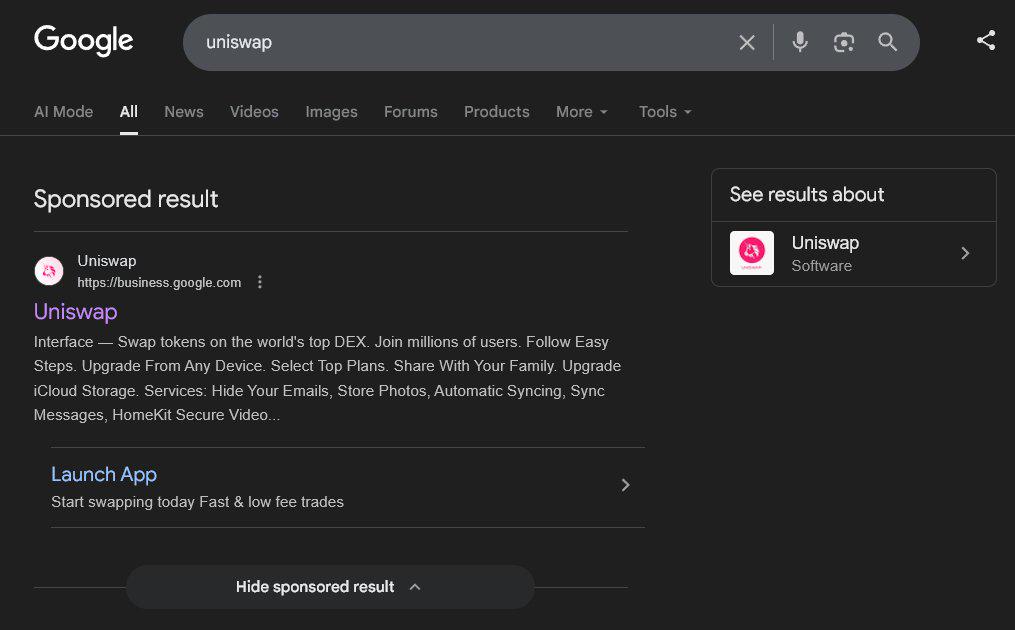
Phishing websites often imitate legitimate cryptocurrency exchanges, wallets, or decentralized applications.
They may use similar branding, website layouts, or domain names.
For example, phishing site as portrayed below uses a 1-1 replica technique, prying on careless users who did not notice the unusual URL.
Before interacting with an unfamiliar website, consider the following checks.
Verify the domain: Compare the website address with the official address published by the service.
-
Avoid unsolicited links: Be cautious of links received through unexpected messages, advertisements, or social media accounts, including texts claiming a courier is trying to deliver a package and asking you to download a tracking tool.
-
Check website reputation: Use a URL security tool to look for known malicious activity, especially because modern scams often imitate legitimate brands more convincingly.
-
Review wallet requests: A website requesting unexpected token approvals or signatures may present additional risk.
-
Avoid entering recovery phrases: Legitimate exchange login pages and ordinary decentralized applications do not require users to enter self-custody recovery phrases.
-
Check for impersonation: Scammers may create fake support accounts or imitate official announcements, and phishing sites may also be pushed through fake messages or suspicious phone outreach.
A website using HTTPS is not automatically legitimate.
HTTPS merely indicates that the connection is encrypted, not that the website operator is trustworthy.
What Is a Crypto Wallet Drainer?
A crypto wallet drainer is a malicious mechanism designed to transfer cryptocurrency or other digital assets from a victim’s wallet.
Wallet drainers frequently rely on phishing websites and deceptive transaction requests.
For example, a fraudulent website may claim that users are eligible for a token airdrop.
When users connect their wallets, the website may request a transaction or signature that grants the attacker permission to transfer assets.
Some attacks exploit token approvals, while others use different transaction or signature mechanisms.
How Can Users Reduce Wallet-Drainer Risks?
Users should:
-
Verify decentralized application websites before connecting wallets.
-
Review transaction details and requested permissions.
-
Avoid signing unfamiliar messages or transactions.
-
Use supported transaction simulation and security warnings.
-
Review existing token approvals.
-
Keep recovery phrases and private keys confidential.
-
Consider separating long-term holdings from wallets used for frequent DeFi interactions.
No security tool can guarantee protection against every wallet-drainer technique.
What to Do If a Crypto Scam Detector Flags a Transaction
If a security tool identifies a potentially malicious transaction, users should avoid approving it until the warning is understood.
Review the Warning
Determine whether the tool is flagging:
-
A suspicious website
-
A malicious contract
-
An unexpected asset transfer
-
An unusual token approval
-
A known malicious address
-
Another risk indicator
Verify the Intended Action
Compare the requested transaction with what you intended to do.
For example, a simple token swap should not unexpectedly require unrelated permissions without a clear explanation.
Check Another Source
Where appropriate, use a second independent tool to get a second opinion on the relevant contract, address, or website.
However, agreement between multiple scanners does not guarantee safety.
Cancel the Interaction if Necessary
If the transaction remains suspicious or unclear, do not approve it.
If you previously granted permissions to a suspicious contract, review whether those approvals should be revoked.
Secure the Wallet if Compromise Is Suspected
If a recovery phrase or private key may have been exposed, treat the wallet as compromised.
Revoking token approvals alone is not sufficient to address private-key compromise.
Consider transferring remaining assets to a newly secured wallet using a trusted device and appropriate precautions.
How Gate Users Can Reduce Crypto Scam Risks
Cryptocurrency users may encounter different security risks depending on whether they hold assets on a centralized exchange or interact with self-custody wallets and decentralized applications.
Gate users can take several precautions when moving between these environments.
Protect Your Gate Account
Use a strong, unique password and enable supported two-factor authentication methods.
Review the account-security options available in the current Gate interface.
These may include additional verification like a two-factor authentication and other protections designed to reduce unauthorized account activity.
Users should follow the latest instructions provided through Gate’s official interface upon signing up an account.
Verify External Wallet Addresses
Before withdrawing cryptocurrency from Gate to an external wallet, confirm the destination address and blockchain network.
Sending assets to an incorrect address or unsupported network can result in permanent loss.
Check Unfamiliar Tokens Before Trading
If you are researching a token on a decentralized exchange, consider using contract analysis tools to review potential risks.
A token’s availability on a trading platform does not eliminate its market, technical, or security risks.
Review DeFi Wallet Permissions
If you use a self-custody wallet to interact with decentralized applications, review existing approvals periodically.
Unnecessary permissions may create additional exposure if an approved contract is compromised or malicious.
Beware of Fake Gate Websites and Support Accounts
Fraudsters may impersonate cryptocurrency exchanges through fake websites, social media accounts, or messaging applications.
Always access Gate through its official website or application.
Do not disclose account passwords, verification codes, private keys, or recovery phrases to unsolicited contacts.
Report Scams and Suspicious Activity
If you suspect unauthorized activity involving your Gate account, contact official Gate support promptly, and report scams through official channels when relevant.
Provide relevant information about the incident without disclosing sensitive credentials, as details may also help affected organizations and relevant authorities.
Reporting an incident does not guarantee that cryptocurrency transactions can be reversed or assets recovered. Even so, a fast report can help protect other consumers.
Limitations of Crypto Scam Detectors
Crypto scam detectors provide useful information, but their results should be interpreted carefully.
False Negatives
A malicious website or contract may not be identified by a security tool.
New scams and previously unknown attack techniques can evade detection.
False Positives
A legitimate transaction or contract may be flagged because of unusual behavior or incomplete information.
Users should investigate warnings rather than treating every alert as definitive proof of fraud.
Limited Blockchain Coverage
Some tools support only selected blockchain networks.
A tool designed for EVM-compatible networks may not provide equivalent coverage for Solana, Bitcoin, or other ecosystems.
Changing Smart Contract Behavior
Some contracts contain administrative permissions that allow their behavior to change.
A token that appears sellable during one test may behave differently later.
Incomplete Transaction Simulation
Transaction simulations estimate the effects of proposed transactions under specific conditions.
They may not account for every possible state change or attack.
Social Engineering
Technical scanners cannot reliably identify every fraudulent investment pitch, impersonation attempt, or deceptive relationship, and social engineering also affects users through online scams beyond blockchain-native threats.
Users must continue evaluating the legitimacy of the people and organizations they interact with, since even careful users and their family members can become victims of persuasive impersonation or investment schemes.
Conclusion
Crypto scam detectors can help users identify suspicious websites, malicious tokens, dangerous wallet permissions, and potentially fraudulent transactions.
However, different tools address different threats.
The most effective approach is to understand what each tool checks, recognize its limitations, and verify unfamiliar cryptocurrency interactions before approving them.
FAQ
Are Crypto Scam Detectors Free?
Some tools provide free access to basic functionality, while others offer paid features or enterprise services.
Users should check current pricing and availability through official product websites.
Can a Crypto Scam Detector Identify a Fake Token?
Some tools can identify suspicious token contract characteristics and known scam indicators.
However, automated analysis cannot guarantee that a token is legitimate.
How Can I Check Whether a Crypto Website Is Fake?
Verify the domain through official sources and consider checking it with Scam Sniffer, VirusTotal, or Google Safe Browsing.
A website that passes these checks is not necessarily safe.
Can Crypto Scam Detectors Prevent Wallet Drainers?
Some tools can warn users about suspicious websites, transaction requests, or wallet permissions.
However, no tool can prevent every wallet-drainer attack.
Should I Use More Than One Crypto Scam Detector?
Using complementary tools can provide additional information about different risks.
For example, a user may combine website phishing checks, token contract analysis, and wallet approval reviews.
However, multiple tools do not guarantee protection.