Over the past few years, discussions about real-world asset (RWA) tokenization have largely focused on one question: how can traditional financial assets be represented on a blockchain? From tokenized government bonds and money market funds to stocks and other securities, the market has increasingly explored the use of blockchain to record asset rights, improve transfer efficiency, and expand access to financial products. However, once an asset has been tokenized, a new set of questions emerges: How are trades matched? How do counterparties confirm their obligations? How are securities and funds delivered? And who is responsible for resolving discrepancies when something goes wrong?
These questions go beyond asset issuance and concern the infrastructure that supports financial markets. Traditional securities markets rely on a combination of trading venues, clearing organizations, custodians, settlement systems, and regulatory frameworks. For blockchain technology to enter this environment, it must meet requirements involving reliability, transaction processing capacity, participant access controls, predictable costs, and compatibility with existing institutions. The ability to issue tokens alone is not enough to support a mature securities market.
The decision by an NYSE-affiliated tokenized securities platform to use Avalanche as the core ledger technology for its clearing infrastructure provides a useful example of this shift. It reflects how institutional blockchain adoption is expanding from putting assets on-chain to exploring whether parts of the infrastructure required to operate financial markets can also function on-chain. This does not mean that blockchain will replace every component of traditional securities markets. Rather, it shows that financial institutions are reassessing the role blockchain can play in post-trade processing.
Key Takeaways
-
RWA development is expanding from issuance to settlement: Asset tokenization is only the first step. Transaction records, clearing obligations, and final settlement are equally important to building a complete market for tokenized securities.
-
Avalanche serves as ledger infrastructure: For the NYSE-affiliated platform, Avalanche is intended to provide core ledger technology for clearing organizations. It is not directly replacing the NYSE’s trade-matching system.
-
Trading, clearing, and settlement are different processes: Trading matches orders and establishes executions; clearing confirms the obligations of counterparties; settlement completes the delivery of securities and funds.
-
Institutional blockchains require controllability: Performance, reliability, cost predictability, participant access, and regulatory compatibility are all important considerations when financial institutions select an underlying network.
-
Technology adoption does not automatically increase token value: Avalanche’s adoption does not establish that AVAX is a securities settlement asset, a required platform payment method, or mandatory transaction collateral.
-
Gate’s related services follow a different product path: Gate’s tokenized stocks, stock trading, and TradFi services offer examples of how traditional assets connect with crypto markets, but they should not be confused with the clearing infrastructure of the NYSE-affiliated platform.
Why Is RWA Moving Beyond Asset Tokenization Toward Settlement Infrastructure?
The basic idea behind RWA tokenization is to represent real-world assets or related rights as digital tokens, allowing them to be recorded, transferred, and managed on a blockchain. Once traditional financial assets enter an on-chain environment, they can benefit from more flexible digital representation and may gain improvements in asset transfer, information synchronization, and post-trade processing efficiency. However, tokenization does not automatically resolve every challenge in financial markets. Digitizing an asset and managing the complete process of trading that asset are two different things.
Consider a stock or fund share represented as a token. Even after tokenization, the market still needs to address order matching, trade confirmation, clearing, custody, and final settlement. When a buyer and seller complete a transaction, the system must do more than record the price and quantity. It must also establish what each party is obligated to deliver, whether both parties are able to fulfill those obligations, and whether the securities and funds can be transferred according to the applicable rules. If these processes continue to rely on disconnected systems, tokenization may change the format in which an asset is recorded without fundamentally transforming post-trade operations.
The development of RWA infrastructure can therefore be understood through three increasingly advanced layers. The first is asset representation: mapping securities, fund shares, or other rights to on-chain tokens. The second is trading and circulation: enabling participants to submit orders, transfer assets, and establish market prices under defined rules. The third is clearing and settlement: accurately recording trade outcomes and completing the delivery of assets and funds according to established procedures. Only when these layers work together can tokenized securities begin to form a more complete market infrastructure.
The NYSE-affiliated platform is a notable example because its focus extends beyond token issuance to the use of blockchain in clearing and settlement infrastructure. According to information disclosed by Avalanche, the platform plans to use Avalanche as its core ledger technology to support on-chain clearing and settlement of tokenized securities for the relevant clearing organizations. Its design goals include around-the-clock trading, clearing, and settlement, subject to applicable regulatory approvals.
Trading, Clearing, and Settlement: Which Parts Can Blockchain Change?
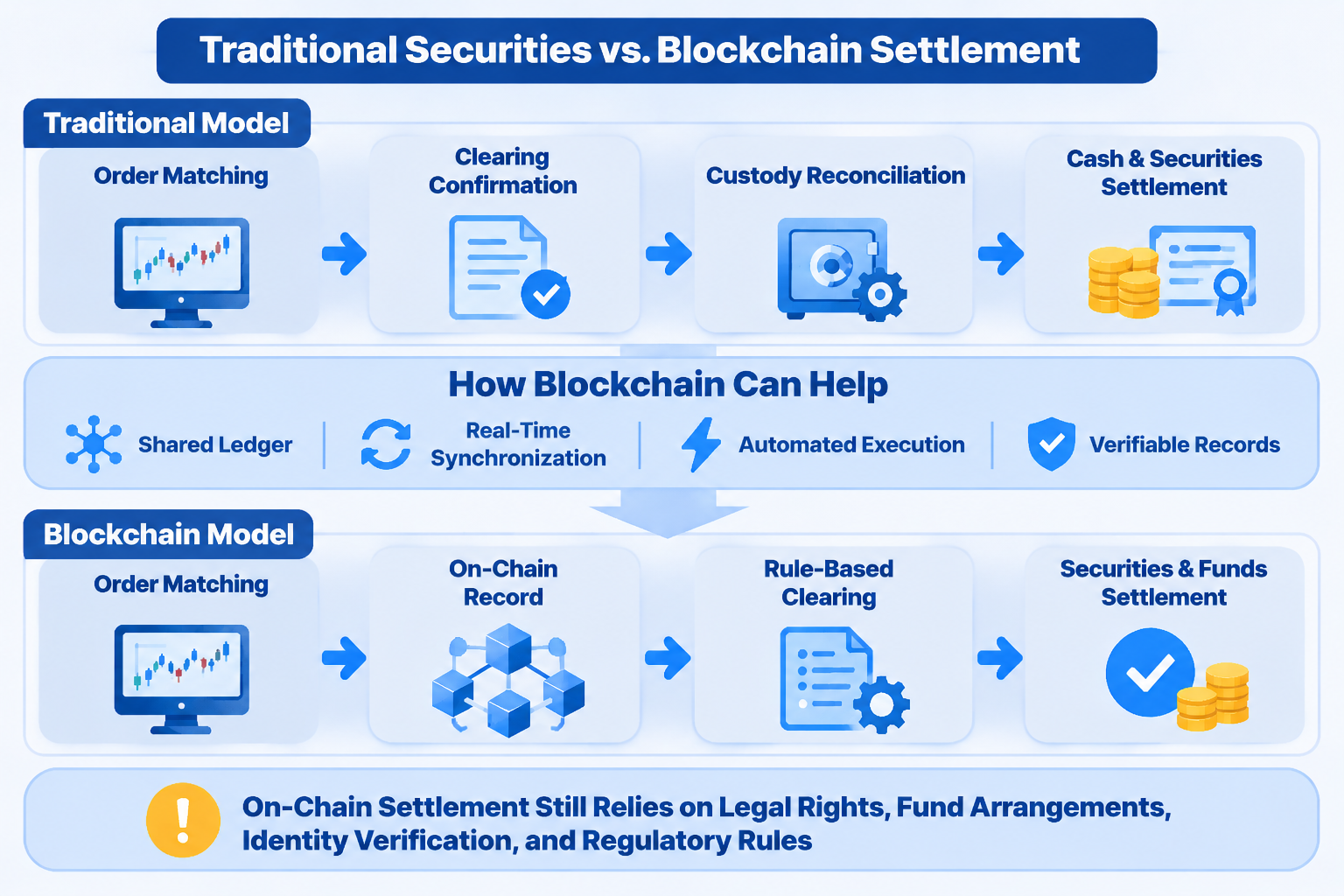
To understand this development, it is important to distinguish three key stages of the securities market. Trading is the process through which buyers and sellers reach an agreement. The trading system processes orders and determines execution prices and quantities. Clearing takes place after execution. It confirms the rights and obligations of counterparties, calculates the securities and funds to be delivered, and manages related risks. Settlement is the final delivery stage, in which securities and funds are transferred according to the trade results. These processes are connected, but they are not interchangeable.
In traditional markets, different institutions and systems may be responsible for these stages. Trading venues handle order matching, clearing organizations confirm transaction obligations, and custody and settlement systems manage asset delivery. Because these systems need to exchange data and reconcile transaction states, post-trade processing can involve multiple steps and time windows. Different markets, asset classes, and jurisdictions may also apply different settlement cycles, account structures, and operating rules.
The potential value of blockchain ledgers lies in providing multiple participants with a shared, verifiable record of transaction states that can be updated according to predefined rules. If a clearing organization uses an on-chain ledger to record trade outcomes and related obligations, it may reduce inconsistencies between separate systems and make transaction status easier to verify. Smart contracts can also execute certain operations when predefined conditions are met, potentially reducing manual processing and repetitive reconciliation.
However, recording a transaction on a ledger does not mean that all clearing risks disappear automatically. Securities delivery must still satisfy legal requirements for the transfer of ownership. Payments require valid funding arrangements, and participant identities and permissions must remain controlled. If network failures, transaction disputes, asset freezes, or operational errors occur, the platform still needs clear procedures for handling them. Blockchain can change certain recording, coordination, and execution processes, but it does not automatically eliminate the roles of clearing organizations, custodians, or regulatory frameworks.
Why Is Avalanche’s Dedicated Infrastructure Suitable for Institutional Markets?
Institutional financial markets have requirements that differ significantly from those of ordinary public blockchain applications. A network designed for open DeFi applications may prioritize permissionless participation, asset composability, and developer innovation. Clearing infrastructure, by contrast, must handle financial transactions involving legal rights and funding risks. It therefore needs to place particular emphasis on system stability, participant permissions, transaction processing capacity, and operational costs. For institutions, the ability to operate reliably under established market rules is often more important than optimizing a single performance metric.
Avalanche’s architecture allows institutions to build dedicated blockchain infrastructure around specific business requirements. For financial market operators, this means they can configure network participation, operating environments, and relevant parameters according to their business needs, rather than placing every process directly on a fully open public network with uniform participation rules. Dedicated infrastructure can help operators manage capacity, performance, and participant access more effectively, while making it easier to align network rules with institutional compliance and operational requirements.
The NYSE-affiliated platform initiative illustrates this approach. Avalanche’s selection was not simply based on blockchain’s ability to process transaction records. Performance, reliability, cost predictability, and participant control were also highlighted as important considerations. NYSE-related public statements have emphasized requirements such as a fast and reliable ledger, controlled network participation, predictable costs, and a mature developer ecosystem. Avalanche has likewise presented its dedicated infrastructure and institutional operating capabilities as important parts of the technical context behind the initiative.
Nevertheless, a dedicated blockchain is not inherently risk-free. Network operators still need to assess validator structures, node distribution, disaster recovery capabilities, permission management, and system upgrade procedures. Excessive participant concentration may create new operational dependencies. Inadequate interfaces between dedicated networks, other blockchains, and traditional systems may also limit asset mobility and transaction efficiency. When selecting an underlying network, institutions therefore need to evaluate the complete technical and operational framework rather than focusing on throughput or transaction speed alone.
24/7 Trading and Settlement: What Does an Always-On Market Mean?
Traditional securities markets generally operate within defined trading hours and are subject to holidays and regional market schedules. For cross-border investors, differences in trading hours can complicate funding arrangements and transaction management. If securities can be traded and settled more flexibly in an on-chain environment, this could theoretically reduce some of the delays caused by operating hours and allow participants in different regions to complete transactions across a wider range of time windows.
However, 24/7 trading and 24/7 settlement are not simply matters of extending traditional market hours. An always-on market requires trading, clearing, payments, custody, and risk management systems to operate beyond conventional business hours. If the trading system remains open around the clock but payment systems or asset custody processes are still restricted by traditional operating schedules, transactions may be executed before the corresponding asset delivery can take place.
Blockchain ledgers can provide a technical foundation for around-the-clock settlement. When the relevant rules are satisfied, counterparties can record delivery processes through on-chain state updates. If both funds and securities meet predefined conditions, the platform may also explore settlement arrangements that bring their delivery closer to simultaneous execution. Such mechanisms could reduce certain timing gaps and operational friction in post-trade processing. Their effectiveness, however, depends on how assets are issued, how payments are funded, how participants are identified, and how regulatory requirements are implemented.
The NYSE-affiliated platform has identified 24/7 trading, clearing, and settlement as design goals. These should be understood as planned capabilities rather than proof that a fully operational around-the-clock securities market is already in place. The platform remains subject to regulatory approvals, and its launch arrangements, supported assets, and actual operating mechanisms should be assessed against future official disclosures.
What Challenges Does RWA Infrastructure Still Face On-Chain?
The first challenge is the relationship between legal rights and on-chain records. Tokenized securities must clearly establish whether a token represents direct ownership of a security, a beneficial interest, or another form of economic exposure linked to the security’s price. Different structures involve different legal responsibilities, shareholder rights, transfer restrictions, and bankruptcy treatment. Even if an on-chain record accurately reflects a token balance, the record alone does not establish that its holder possesses all the legal rights associated with a traditional security.
The second challenge involves regulation and participant access. Securities markets include multiple parties, such as issuers, investors, brokers, clearing organizations, custodians, and regulators. Platforms must address identity verification, investor eligibility, trading restrictions, anti-money laundering requirements, and market surveillance. A dedicated blockchain can enforce technical access permissions, but technical permission management is not equivalent to satisfying every regulatory obligation across all jurisdictions.
The third challenge is liquidity and market interoperability. If tokenized securities are distributed across different blockchains and trading platforms, liquidity may become fragmented, prices may diverge, and cross-chain transfers may become more complicated. Even a high-performance underlying ledger cannot independently create sufficient buying and selling demand. Market depth, market-making capacity, issuance size, and investor participation remain essential factors in determining whether tokenized securities can support sustained trading activity.
Finally, there are challenges involving system security and operational resilience. Financial market infrastructure must be able to address cyberattacks, software vulnerabilities, node failures, key management risks, and extreme market volatility. On-chain transaction records may be verifiable, but immutability does not mean that every error can be corrected automatically. Platforms still need emergency procedures, permission recovery mechanisms, dispute resolution processes, and business continuity plans.
Gate and Tokenized Securities: Different Paths from Infrastructure to Market Access
The relationship between the NYSE-affiliated platform and Gate is best understood in the broader context of the convergence between traditional finance and crypto markets, rather than as an indication that the two offer the same type of product. The NYSE-affiliated platform focuses on introducing Avalanche into clearing infrastructure and providing ledger technology for the post-trade processing of tokenized securities. Gate, by contrast, offers users access to traditional financial assets and related price exposure through different product categories, including stock trading, tokenized stocks, and TradFi.
For example, Gate Tokenized Stocks offers tokenized stock-related products such as xStocks and Ondo Stocks. These products allow users to access the price performance of certain traditional stocks or ETFs through a crypto trading environment. Tokenized Stocks generally involve specific arrangements for issuers, underlying assets, custody, and price tracking. They should not automatically be treated as equivalent to holding actual shares in a traditional brokerage account. Gate’s stock trading services represent another product path, and the platform’s official materials distinguish stock trading from on-chain tokenization models.
These product categories serve different purposes from the clearing infrastructure of the NYSE-affiliated platform. The former primarily concerns how users obtain trading access or economic exposure related to traditional assets. The latter focuses on how securities transactions are recorded, cleared, and settled after execution. This distinction matters when assessing the development of RWA markets: asset issuance, trading access, and clearing and settlement operate at different layers of the market. The fact that they all involve blockchain or tokenization does not mean they share the same legal structure or risk profile.
From an industry perspective, traditional financial institutions exploring on-chain clearing and trading platforms offering tokenized stocks and multi-asset services represent different forms of innovation within the same broader trend. The future development of mature RWA markets will depend on coordination among asset rights, regulatory frameworks, trading liquidity, and underlying infrastructure, rather than adoption by any single project or network alone.
FAQ
Why Did the NYSE-Affiliated Platform Choose Avalanche?
Avalanche is intended to provide core ledger technology for the platform’s clearing organizations. Public disclosures have highlighted factors such as performance, reliability, cost predictability, participant control, and suitability for institutional infrastructure. Actual platform operations remain subject to regulatory approvals and other applicable requirements.
Will Avalanche Handle Trade Matching for the Platform?
Current public information emphasizes Avalanche’s role in providing core ledger technology for clearing organizations and supporting clearing and settlement infrastructure. It does not establish that Avalanche will replace the NYSE’s trade-matching system.
Does Tokenized Securities Mean 24/7 Trading Is Guaranteed?
Tokenized securities can be designed to support broader trading hours. However, genuine around-the-clock trading and settlement depend on whether trading venues, clearing systems, payment arrangements, custody services, and regulatory frameworks can operate together.
Does Avalanche’s Adoption Mean AVAX Must Be Used for Securities Settlement?
No such conclusion can be drawn. The platform announcement confirms Avalanche’s role as core ledger technology, but does not establish that AVAX is a securities settlement asset or a required payment method for the platform. Network adoption and token value capture must be analyzed separately.
Will RWA Eventually Replace Traditional Securities Market Infrastructure?
A more reasonable interpretation is that blockchain may gradually participate in certain recording, clearing, and settlement processes within traditional markets. Securities law, investor protection, regulatory responsibilities, and market operations will still require coordination between established financial institutions and emerging technologies.
How Are Gate Tokenized Stocks Different from the NYSE-Affiliated Platform?
Gate Tokenized Stocks primarily provide users with a crypto-based trading channel for tokenized products linked to specific stocks or ETFs. The NYSE-affiliated platform, by contrast, focuses on clearing infrastructure for tokenized securities. The two differ in product positioning, legal structure, and system responsibilities.