Anthropic IPO created several ways to gain exposure to the company after listing. A direct ANT stock position follows the traditional shareholder path. Tokenized stock products ANTX, ANTON, and ANTG provide tradable exposure in tokenized stock markets. ANT perpetual futures and ANT CFDs add leverage and short-side capability.
The right asset depends on ownership rights, dividend economics, trading access, fees, custody, and regional eligibility. The headline distinction is between shareholder-account exposure, issuer-backed tokenized products, and contract exposure. Direct ANT stock gives the closest connection to the listed share. ANTX and ANTON use issuer structures backed by underlying stock. ANTG is Gate’s tokenized security spot trading pair. Derivatives track price movement without conferring shareholder rights.
Anthropic’s IPO overview records the valuation range between $917 billion and $1.02 trillion, FTX’s stake diluted to 2.5%, and an approximately $81 billion offering. These facts describe the listing event; the asset map below describes the products that remain usable after listing.
Key Takeaways
-
Gate offers an Anthropic exposure matrix across direct ANT stock, tokenized spot assets, perpetual futures, and CFDs.
-
ANTX is issued by Backed Assets and tracks ANT stock at a 1:1 price ratio on Ethereum/EVM and Solana.
-
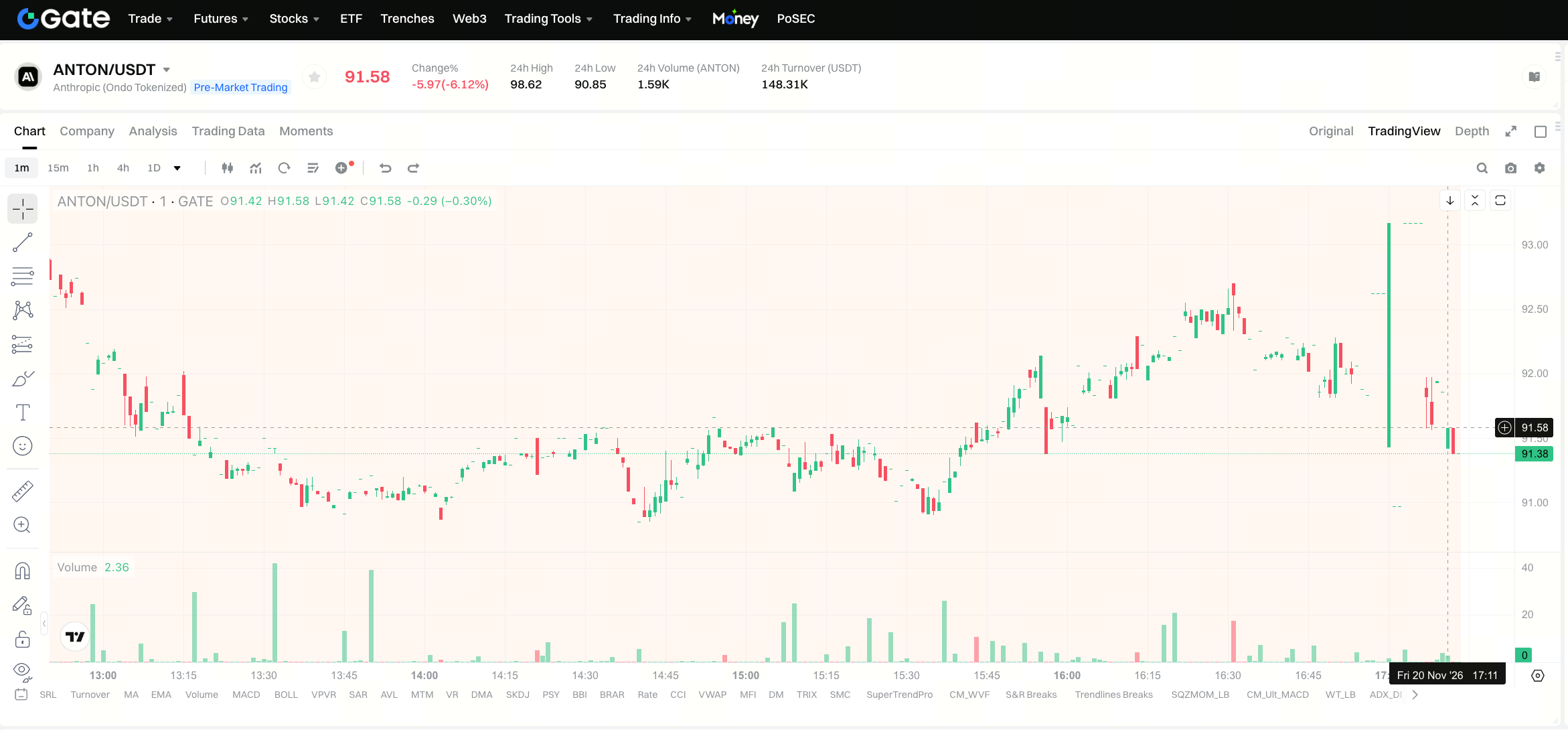
ANTON is issued by Ondo Global Markets and provides price and dividend economic exposure with a $1 minimum subscription.
-
ANTG is Gate’s tokenized securities spot pair, traded as ANTG/USDT.
-
Direct ANT stock is the path that can carry shareholder voting rights and stock-account ownership; tokenized products focus on price or economic exposure.
The Anthropic Post-IPO Asset Map
Anthropic tokenized stock refers to digital representations of Anthropic shares on Gate.com—currently ANTX by Backed Assets, ANTON by Ondo Global Markets, and ANTG by Gate—which track the stock’s price or economic exposure without giving holders the same direct shareholder voting rights as owning ANT stock itself. For crypto traders and investors comparing direct stock ownership, tokenized spot products, and derivatives, the key question is not just how to buy Anthropic exposure, but which structure matches your goals for custody, trading hours, transferability, and risk.
This guide breaks down the post-IPO Anthropic market across direct ANT shares, tokenized spot stocks, and derivative products, then shows how each instrument works on Gate.com, including issuer structure, trading flow, fees, liquidity, and the regulatory and product risks that change what you actually own. That matters if you want 24/7 market access, blockchain portability, or simpler position sizing without losing sight of the trade-off between flexible economic exposure and the rights that come with listed equity ownership.
Anthropic IPO participation can be grouped into four paths. Direct stock exposure exists through the Gate stocks area, where users can search for ANT and place orders under traditional stock-account rules. Tokenized spot exposure exists through ANTX, ANTON, and ANTG, all traded in spot markets but backed by different issuer structures.
Derivative exposure exists through the ANTUSDT perpetual contract and ANT CFDs. These instruments provide leveraged and short-side trading capability. They differ materially from spot holdings because they represent contract exposure rather than ownership of a share or a stock-backed token.
Gate’s IPO Access also connects the pre-listing phase to the listed market, with Anthropic’s IPO priced at $83.00 per share on November 18, 2026. The allocation record shows 92,100 ANT shares and a final allocation ratio of about 5.03%. ANT began trading on Nasdaq on November 19, 2026, before users moved from subscription mechanics to ordinary stock, tokenized spot, or derivative trading.
| Path |
Asset or venue |
Exposure type |
Primary use case |
| Direct stock |
Gate stocks area ANT |
Listed-stock ownership exposure |
Traditional long-term share ownership |
| Tokenized spot |
ANTX, ANTON, ANTG |
Issuer-backed price or economic exposure |
USDT trading, on-chain transfer, smaller positions |
| Derivatives |
ANTUSDT perpetual, ANT CFD |
Leveraged contract exposure |
Shorting, hedging, active trading |
| IPO record |
Gate IPO Access |
Allocation participation history |
Understanding pre-listing versus listed trading |
Direct ANT Stock on Gate
Direct ANT trading is the route closest to owning Anthropic’s listed share for users who want to invest through a traditional stock-account framework. The basic steps are to sign in, complete KYC, open the Gate stocks area, search for ANT, and select a market or limit order. For the full order flow, see how to buy Anthropic ANT stock with USDT. The order flow also requires attention to the settlement currency, trading hours, fees, custody arrangement, and regional access rules.
Direct stock positions can carry shareholder rights such as voting, dividend distribution, disclosure access, and rights associated with the issuer’s corporate actions. Gate publishes the trading rules that govern settlement, custody, and access in the stocks area. This is the major difference from tokenized products, which usually reference the stock price or economic performance through an issuer structure.
Direct stock suits users who want the traditional shareholder-account route and are comfortable with stock-market settlement, broker controls, and regulatory constraints. It also makes corporate actions and disclosure rights easier to evaluate than through an intermediary token.
ANTX: Anthropic xStock by Backed Assets
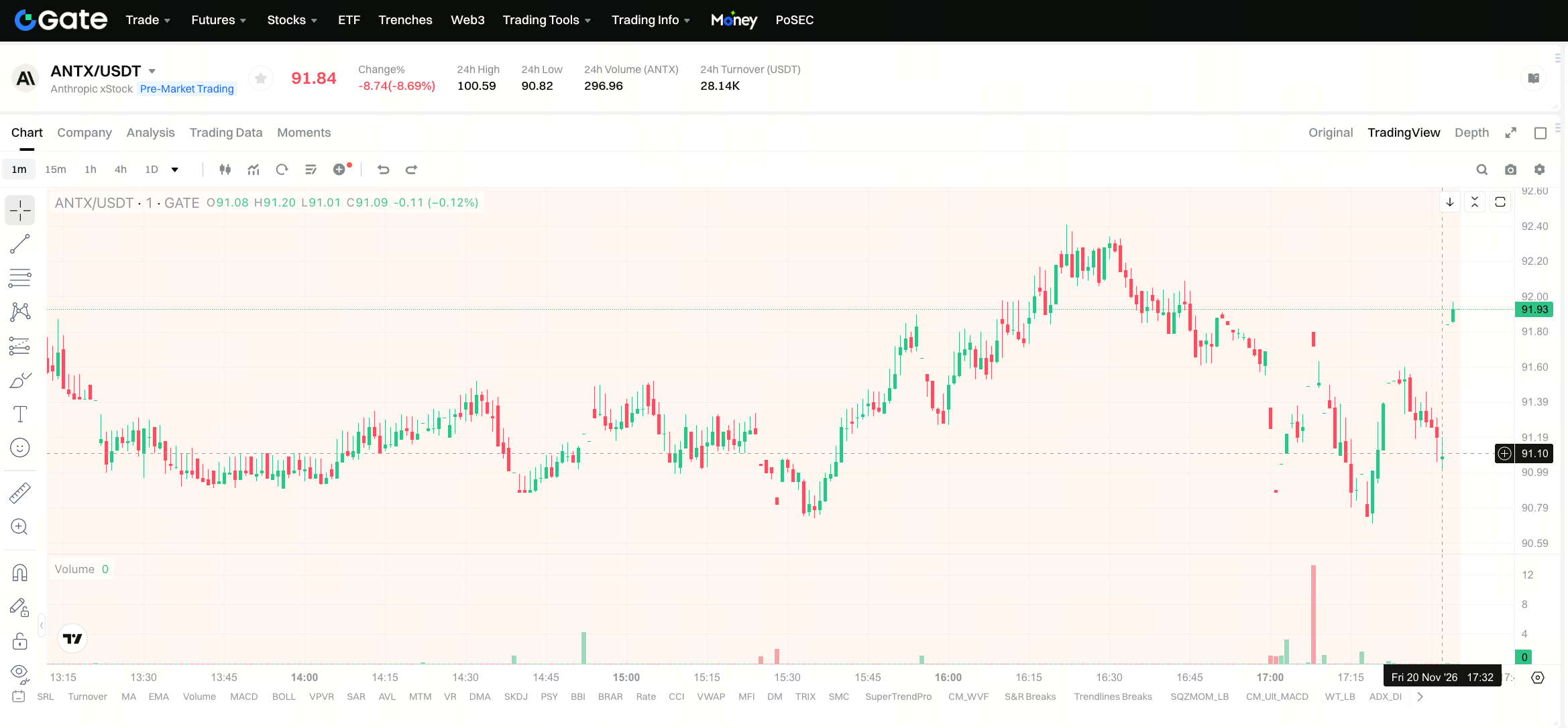
ANTX is Backed Assets’ tokenized Anthropic stock certificate. As part of the xStocks project, which had brought 64 stocks onchain as of August 2025, the product page describes a 1:1 anchor to ANT stock price and support for on-chain transfer and DeFi integration. It operates on Ethereum/EVM and Solana, which makes the token useful for users who want to move exposure across compatible wallets or protocols.
ANTX should be distinguished from AN2 Therapeutics Inc. Common Stock (ANTX), a separate Nasdaq-listed biopharmaceutical company. The ticker collision is important when users search for Anthropic exposure by symbol rather than issuer name.
ANTX does not give the holder direct ownership of Anthropic stock or shareholder voting rights. Token issuers can introduce counterparty risk for holders of tokenized assets. Its economics are built around price tracking. The current fee schedule shows no management fee, with a future annual fee ceiling of 0.25% and an issuance or redemption fee ceiling of 0.5%. These limits come from Backed Assets’ product documentation and should be checked before a transaction.
ANTX is useful when users want a tokenized route to Anthropic exposure with on-chain portability. Although ANTX lives on Ethereum/EVM and Solana, that blockchain presence does not by itself create direct stock ownership. It is less suitable when users specifically require shareholder voting rights or the corporate-law ownership features of a direct stock account.
ANTON: Ondo Tokenized Anthropic
ANTON is Ondo Global Markets’ tokenized Anthropic stock product. Ondo provides price and dividend economic exposure through a custody structure in which a custodian holds or arranges custody of the underlying ANT shares, and token supply should correspond to those shares. The holder does not directly own the underlying stock and does not receive shareholder voting rights. The product instead focuses on economic exposure backed by the underlying shares.
Ondo structures ANTON with bankruptcy remoteness and gives holders a priority secured interest in collateral assets. The structure limits the pathway through which issuer liability can reach the underlying collateral. The product page also provides daily and monthly third-party reserve verification. The minimum subscription amount is $1, making ANTON relevant for investors seeking small-size economic exposure to Anthropic.
ANTON is listed in Gate’s spot market, with Gate’s listing announcement documenting its entry point. Before comparing ANTON with ANTX or ANTG, users should check the current issuer terms, redemption mechanism, fee schedule, network support, and jurisdictional restrictions.
ANTG: Gate Tokenized Stock Securities Spot
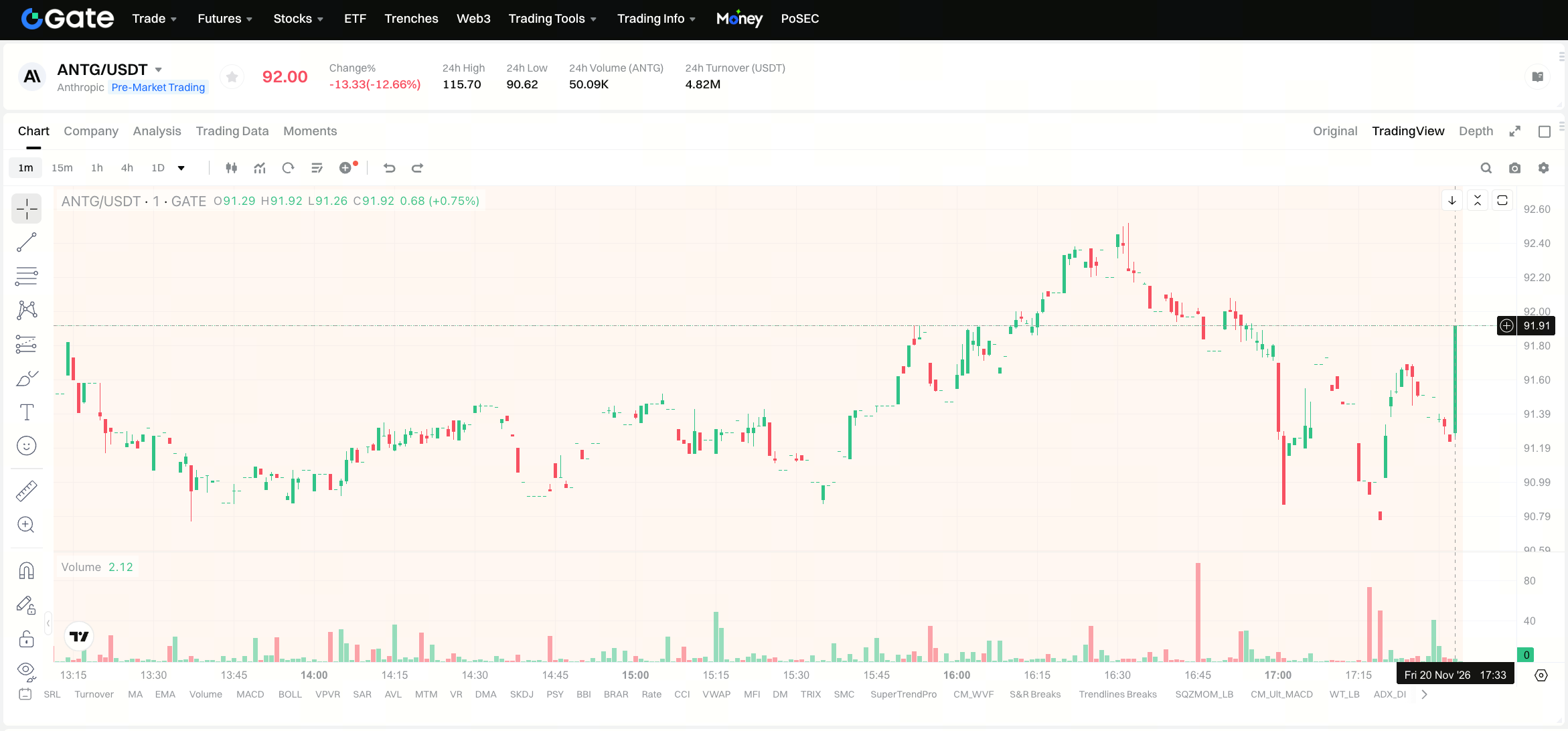
ANTG is Gate’s tokenized securities spot pair and trades as ANTG/USDT. Its trading page is separate from ANTX and ANTON, so it should not be treated as the same product. The practical entry point is Gate’s spot market, where users select the ANTG/USDT pair, review liquidity and order book depth, and place a spot order, keeping in mind that liquidity risk can affect the ability to sell at the desired price.
ANTG belongs to Gate’s gStocks tokenized securities framework rather than the Backed Assets xStocks or Ondo Global Markets structures. That distinction affects issuer, collateral arrangement, redemption, fees, and any rights attached to the product. The product page and Gate disclosures are the reference points for these mechanics, so view the issuer, backing, and listing terms before relying on the token name alone; this is a simple way to distinguish products that may look similar by name and to establish structure or backing.
ANTG is useful for users already operating inside Gate spot markets and wanting a tokenized securities route. It should be compared against ANTX and ANTON by issuer, backing structure, dividend economics, redemption, network support, and regional eligibility.
Other Anthropic Exposure Venues
ANTX also appears across xStocks-compatible venues such as Kraken, Mantle, and Bitrue. Access to some tokenized stocks is limited, and U.S. residents may face regulatory restrictions depending on the venue and issuer. Binance’s bStocks framework introduces ANTB on BNB Smart Chain. Bitget’s rANT was part of its IPO Prime subscription product. These venues provide additional routes, but each venue has its own listing status, access rules, custody model, and fee structure.
Anthropic PreStocks ($ANTHRP) was a Solana token associated with a pre-IPO event product on CoinCatapult. It differed from issuer-backed stock exposure because it tracked an event position rather than a conventional shareholder or stock-backed token structure. Company transfer restrictions can make it hard for third parties to hold pre-IPO shares on behalf of token buyers. Private-market venues can also list unrelated companies such as Extropic, where money may be flowing into separate private funding rounds; those listings are separate private-market exposure and not Anthropic exposure.
Securitize Stocks provides tokenized security entitlements on Solana under an issuance model tied to investor eligibility. Hyperliquid, OKX, and Bybit were active in Anthropic pre-IPO perp markets. MEXC also offers ANTUSDT perpetual futures without share delivery, so traders may get expected or later live share price exposure rather than an actual share. Polymarket provides event-prediction exposure rather than stock ownership or issuer-backed tokenized stock. Event markets answer a different question: they track outcomes, not share ownership.
After listing, formal stock, tokenized spot, and derivative markets replace pre-IPO event structures as the primary exposure routes. A comparison should always distinguish issuer-backed products, exchange-issued products, derivative contracts, and prediction-market positions.
Comparison: Direct ANT Stock, ANTX, ANTON, and ANTG
| Item |
Direct ANT stock |
ANTX |
ANTON |
ANTG |
| Platform |
Gate stocks area |
Gate spot |
Gate spot |
Gate spot |
| Issuer or operator |
Traditional stock account via Gate |
Backed Assets |
Ondo Global Markets |
Gate tokenized securities / gStocks |
| Price relationship |
Direct listed-stock price |
1:1 ANT price anchor |
Exposure through custodied ANT stock |
Per Gate product disclosure |
| Dividend economics |
Follows stock rules |
Per product page |
Yes |
Per product page |
| Voting rights |
Yes |
No |
No |
Per product disclosure |
| Management fee |
Broker rules |
None currently; future ceiling 0.25% per year |
Per Ondo disclosure |
Per Gate disclosure |
| Issuance or redemption |
Broker rules |
Ceiling 0.5% |
Per Ondo disclosure |
Per Gate disclosure |
| Network or venue |
Gate stocks area |
Ethereum/EVM, Solana |
Ondo and Gate spot |
Gate spot |
| Minimum size |
Broker rules |
Trading minimum |
$1 subscription |
Trading minimum |
| Reserve verification |
Stock account system |
Per product page |
Daily and monthly third-party verification |
Per Gate disclosure |
| Regional eligibility |
Broker and regulatory rules |
Issuer and regional rules |
Issuer and regional rules |
Gate and regional rules |
The comparison highlights why “Anthropic exposure” is not one uniform product. A direct share is an ownership instrument. Tokenized stocks are digital representations of company shares on a blockchain, but their value can come from different structures. ANTX is an xStocks certificate. ANTON is an Ondo tokenized stock product. ANTG is Gate’s tokenized securities spot instrument. Derivatives add another category because they contain only contract exposure.
How to Choose and Trade on Gate
Path 1: Buy Direct ANT Stock
Use this short guide to buy direct ANT stock on Gate:
-
Sign in to Gate and complete KYC.
-
Open the Gate stocks area.
-
Search for ANT.
-
Check settlement currency, trading hours, order-entry time, fees, and regional rules.
-
Place a market or limit order.
-
Review position, order history, and corporate-action notices.
Path 2: Buy ANTX, ANTON, or ANTG
-
Open Gate spot in the platform interface or app.
-
Search for ANTX/USDT, ANTON/USDT, or ANTG/USDT.
-
Check order book depth, spread, minimum order size, and trading fees, and ensure the selected market, network support, and issuer terms match the product you want.
-
Place a limit or market order.
-
Decide whether to keep the asset in the Gate account or transfer it to a compatible wallet when network support exists; before holding long term or moving it off-platform, review issuer documentation and reserve or product research. On some platforms, tokenized Anthropic stocks may trade 24/7, and blockchain-based settlement can be faster than traditional stock settlement.
Path 3: Trade ANT Derivatives
-
Open Gate futures for ANTUSDT perpetuals or the stock-derivatives area for ANT CFDs.
-
Select direction, leverage, order type, and margin mode; this sets the trade structure for a long or short derivatives position.
-
Set take-profit, stop-loss, and liquidation buffers.
-
Monitor funding rates, spreads, margin ratio, and market hours, and verify funding times or platform timestamps in utc where relevant.
Risk, Cost, USD Price, and Structure Checklist
Direct stock risk centers on market volatility, settlement rules, broker controls, and regulatory access. Tokenized spot risk adds issuer structure, collateral management, redemption mechanics, chain compatibility, smart-contract risk, and reserve verification, and token issuers can also introduce counterparty risk for holders of tokenized assets, while tokenized stocks may support 24/7 trading outside traditional market restrictions, they still carry those added structure and issuer risks. Derivative risk adds leverage, funding, liquidation, margin calls, and basis risk.
Cost differences also matter. Spot trading fees, issuance or redemption fees, management fees, on-chain transfer fees, CFD spreads, and perpetual funding rates can change the economics of similar-looking exposure. A token with the same ANT price reference may still have a different total cost after fees, liquidity costs, and execution risk, since around-the-clock transactions do not guarantee efficient fills.
Before selecting an asset, investors should verify five items: ownership or economic rights, fees, redemption or settlement, liquidity, and regional eligibility. Issuers should also disclose the content of collateral and reserve reports in a form that can be checked against their published terms. Users should confirm whether the asset supports the desired custody model, such as exchange custody, self-custody wallet, or on-chain protocol use.
Summary
Anthropic IPO turned the company into a tradable exposure theme across several asset types. Gate users can choose direct ANT stock in the stocks area, tokenized spot exposure through ANTX, ANTON, or ANTG, or contract exposure through ANTUSDT perpetuals and ANT CFDs. Direct stock is the shareholder-rights route. ANTX and ANTON are issuer-backed tokenized products. ANTG is Gate’s tokenized securities spot route.
The best choice depends on whether the user prioritizes shareholder rights, USDT spot trading, on-chain portability, small-size access, leverage, shorting, or regional availability. Checking product structure and fees first turns the Anthropic asset map into a practical selection process.
FAQ
What can users buy after the Anthropic IPO?
Gate users can trade direct ANT stock in the stocks area, buy ANTX, ANTON, or ANTG in spot, and trade ANTUSDT perpetual futures or ANT CFDs. Each route has different ownership rights, fees, liquidity, and regional rules.
What is the difference between ANTX and ANTON?
ANTX is Backed Assets’ xStock product, anchored 1:1 to ANT stock price and available on Ethereum/EVM and Solana. ANTON is Ondo Global Markets’ tokenized stock product, providing price and dividend economic exposure through custodied ANT stock.
Is ANTG the same as ANTX or ANTON?
ANTG is Gate’s tokenized securities spot pair, traded as ANTG/USDT. ANTX is issued by Backed Assets, while ANTON is issued by Ondo Global Markets. The three products differ in issuer, structure, rights, and disclosures.
Do tokenized Anthropic products have voting rights?
ANTX and ANTON do not give shareholders voting rights. Direct ANT stock in a stock-account framework can carry voting rights and other shareholder entitlements according to the issuer’s rules.
What is ANTON’s minimum subscription amount?
Ondo lists ANTON’s minimum subscription amount as $1. Actual Gate trading also follows the exchange’s minimum order size and available liquidity.
Which Anthropic asset is closest to direct stock ownership?
Direct ANT stock in the Gate stocks area is closest to traditional stock ownership. Tokenized assets such as ANTX, ANTON, and ANTG provide price or economic exposure through issuer structures rather than a conventional shareholder account. This article is for informational purposes only and is not investment advice.