Unlike a typical corporate listing, an IPO by a mega-cap technology company may attract global mutual funds, hedge funds, sovereign wealth funds, and other institutional investors. When the potential financing size is large and market attention is high, some investors may free up capital for the new stock by reducing existing holdings, adjusting their cash allocations, or reallocating sector weights. AI industry companies such as NVIDIA, Microsoft, and CoreWeave, as well as risk assets such as Bitcoin, could be indirectly affected by expectations of market fund reallocation. However, the diversion of funds does not mean that capital will necessarily flow from one type of asset to another. Nor can a direct causal relationship be established solely because markets decline at the same time.
The discussion surrounding the potential Anthropic IPO actually involves a fundamental question in the capital markets: When a highly valued new company with significant market influence goes public, how does the supply of new shares affect demand for existing assets? This article analyzes the potential short-term fund diversion and long-term capital reallocation effects of a mega-cap technology IPO from the perspectives of IPO fundraising mechanisms, institutional portfolio adjustments, AI sector valuations, and crypto market liquidity.
Key Takeaways
-
Anthropic's IPO plan could become one of the larger new stock offerings in the global capital markets in 2026. Offering documents updated on November 10 show a proposed issuance of 825 million Class A shares at a price range of $70 to $78 per share, corresponding to approximately $57.75 billion to $64.35 billion in gross public offering proceeds. The final offering results remain uncertain.
-
S&P Global
-
IPO fund diversion refers to investors adjusting their allocations to existing stocks, bonds, cash, or other assets to participate in a new stock offering, which may create short-term selling pressure in some markets.
-
The amount raised in an IPO does not equal liquidity that permanently disappears from the secondary market. New share issuance, secondary share sales, underwriting fund arrangements, and subsequent use of funds have different economic effects.
-
AI industry companies such as NVIDIA, CoreWeave, and Microsoft may be affected by valuation comparisons and portfolio adjustments, but the impact will not necessarily appear as a decline in their share prices.
-
Crypto assets such as Bitcoin may be indirectly affected through risk appetite, leverage, and institutional capital allocation. At present, their price movements cannot simply be attributed to the Anthropic IPO.
-
A large IPO may create short-term capital concentration while also attracting new long-term capital to the AI sector. The ultimate impact will depend on market liquidity, offering valuation, and corporate fundamentals.
Why Has the Anthropic IPO Drawn Market Attention to Fund Diversion?
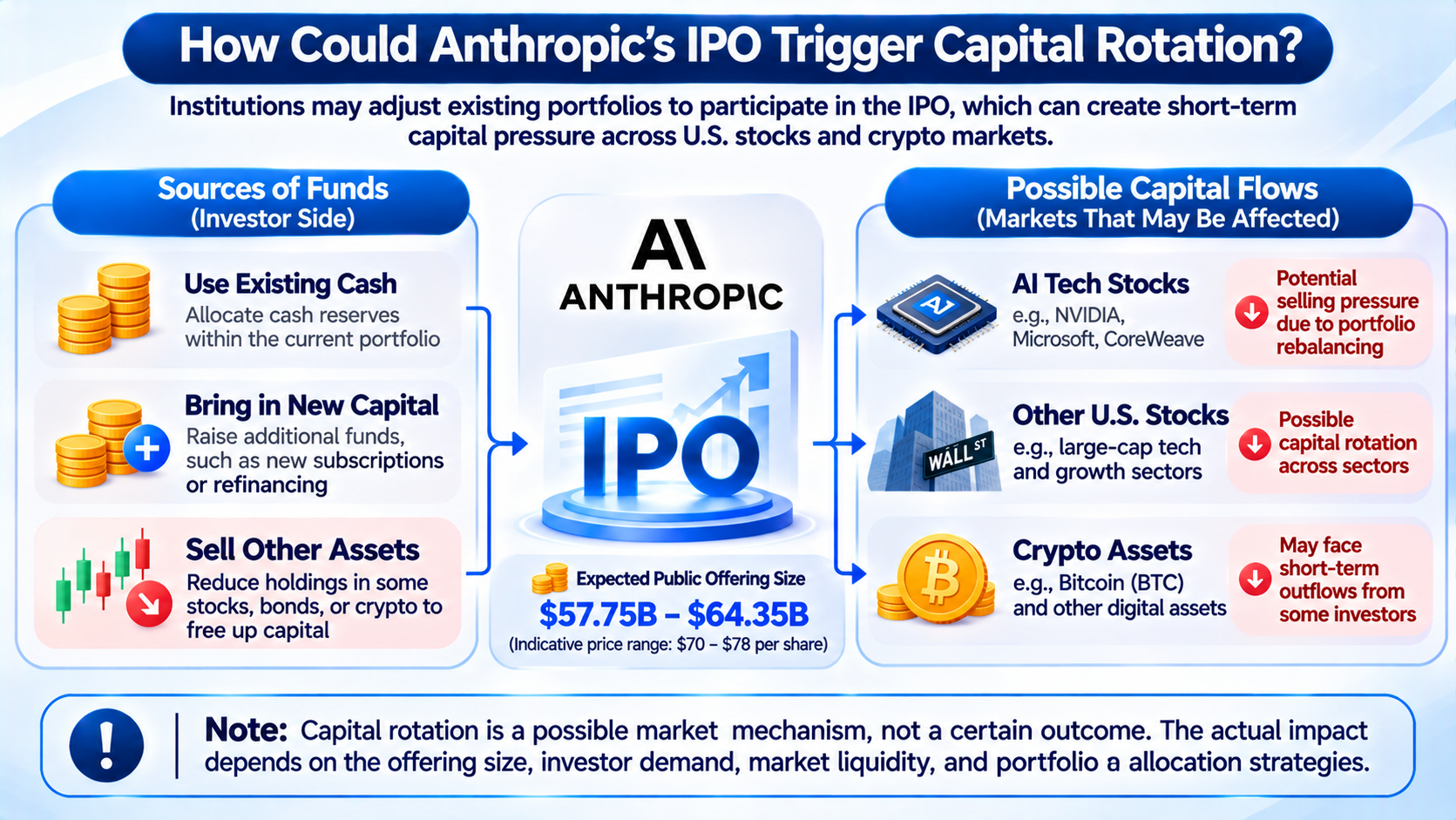
The Anthropic IPO has attracted attention primarily because of its potential financing size. The offering arrangement updated on November 10, 2026, shows that the company plans to issue 825 million Class A shares at an expected price of $70 to $78 per share. Based on the upper end of the range, the public offering could reach approximately $64.35 billion, while the fully diluted valuation could reach approximately $1.4 trillion. The market expects the company to set the offering price on November 18 and begin trading on Nasdaq under the ticker ANT on November 19. However, the relevant timing and offering size remain subject to the final results.
An IPO of this size has special significance for the capital markets. The financing needs of a typical new stock offering can usually be met by some specialized institutions and new-issue investment funds. A public offering worth tens of billions of dollars, however, may require participation from a broader range of investors. Large mutual funds, sovereign wealth funds, hedge funds, and other institutional investors may need to decide whether to increase their Anthropic allocations within limited investment budgets. If existing portfolios already hold a high proportion of technology stocks, adding Anthropic could require reducing the weight of other assets.
However, offering size and actual market funding pressure cannot be equated directly. Anthropic's offering arrangement also includes separate share subscriptions for certain strategic investors. The sources of these funds and the motivations behind their allocation may differ from those of ordinary secondary-market investors. Information released in November shows that AMD, Broadcom, Google, Micron, Microsoft, NVIDIA, and TSMC plan to subscribe for a combined $26 billion of non-voting Class N shares. These subscriptions reflect the connection between AI industry cooperation and capital allocation, but they cannot be directly treated as the amount of other stocks sold in the public market.
The key question is whether the market has enough new capital to absorb these shares and whether investors will sell existing assets to complete their subscriptions. If subscriptions primarily come from existing cash or new capital, the direct selling pressure on the secondary market may be limited. If many institutions need to reduce other assets at the same time, the short-term impact of capital reallocation could be more pronounced.
What Is IPO Fund Diversion, and Why Would Capital Shift From Other Assets to New Shares?
IPO fund diversion can be understood as the process of reallocating capital among different assets to participate in a new stock offering. For institutional investors, investable capital is not unlimited. Even if a newly listed company has strong growth potential, fund managers must also consider sector concentration, individual stock weights, cash reserves, and risk budgets. If they want to increase their allocation to a new stock, they may need to reduce existing holdings or temporarily scale back other investment plans.
For example, suppose a fund manages $1 billion in assets and has allocated 30% to technology stocks. If the fund plans to establish a position in Anthropic equivalent to 3% of total assets after the listing, it would need to prepare approximately $30 million. The funds could come from existing cash, proceeds from selling other stocks, or new subscriptions to the fund. Direct portfolio rebalancing selling pressure would arise only if the fund actually reduced other assets. If the fund has sufficient cash or receives new capital from investors, the impact could be different.
These fund adjustments may also occur before the IPO is priced. Some institutions may increase their cash allocations and reduce short-term risk exposure in advance to ensure sufficient funds for subscriptions. Other investors may decide whether to buy after the stock begins trading, based on its actual price and valuation. Different types of capital do not operate on the same timetable. As a result, the impact of an IPO may be distributed across the pre-offering period, pricing date, initial trading period, and subsequent trading stages rather than concentrated on a single day.
Fund diversion does not mean that investors have become pessimistic about the long-term prospects of the companies being reduced. A fund may still be optimistic about the earnings potential of NVIDIA or Microsoft but reduce its holdings because it needs to control its overall exposure to the AI sector. In terms of price formation, this type of capital reallocation can create genuine buying and selling pressure, but its economic meaning differs from a deterioration in corporate fundamentals. Distinguishing asset-allocation adjustments from changes in earnings expectations is an important prerequisite for analyzing the market impact of a large IPO.
Does a Mega-Cap IPO Really Drain Market Liquidity?
Large IPOs are often described as events that absorb market liquidity, but this description requires a closer look at the path taken by the funds. In a new share offering, investors pay subscription funds, the issuing company receives the corresponding proceeds, and underwriters handle the relevant issuance and settlement arrangements. The funds do not disappear from the financial system. Instead, they move from investor accounts to the company's account. The company may later use the funds for research and development, capital expenditures, debt repayment, acquisitions, or other business activities. These expenditures may then flow back into the financial markets and the real economy.
If an IPO includes secondary share sales, the funds may flow directly to early investors, founders, or employees selling their shares. These shareholders may continue to hold the cash or purchase other financial assets. New share issuance and secondary share sales both absorb subscription funds, but their subsequent fund flows differ. In Anthropic's case, the offering documents cover new share financing as well as arrangements for certain insiders to sell shares. Therefore, not all transaction value should be understood as new financing for the company, and the proceeds should not all be treated as capital that permanently exits the secondary market.
The impact of a large IPO on liquidity is primarily reflected in timing and asset-allocation structure. Before the offering, investors may prepare funds in concentration and reduce demand for other assets. During the offering, some funds enter the new-share subscription and settlement process. After the offering, the funds gradually flow into the company's operations, shareholder accounts, or other investment channels. If the market is also experiencing strong inflows of new capital, the short-term pressure created by the IPO may be partially offset.
It is also necessary to distinguish between IPO proceeds and stock market capitalization. Anthropic's potential trillion-dollar valuation reflects the market value of all its shares. It does not mean that investors must provide an equivalent amount of cash on the listing day. The actual number of shares offered publicly, offering price, strategic subscription arrangements, and post-listing turnover are more directly related to short-term funding needs. Treating the company's total market capitalization as the amount of cash the market must pay would significantly overstate the IPO's liquidity impact.
Why Could Anthropic's Listing Affect AI Stocks Such as NVIDIA and CoreWeave?
After Anthropic goes public, the public market will gain a company directly engaged in the development and commercialization of AI foundation models. Previously, investors seeking exposure to the growth of generative AI often had to obtain indirect exposure through chip suppliers, cloud computing platforms, data center operators, and software companies. NVIDIA, Microsoft, CoreWeave, and other AI-related stocks represent different parts of the industry chain. Anthropic's listing will give investors a more direct investment option in a model company, which could change the structure of existing AI portfolios.
This change will first be reflected in sector-weight allocations. Suppose a fund already holds NVIDIA, Microsoft, and CoreWeave. If the manager wants to add Anthropic but does not want to further increase the portfolio's overall allocation to AI-related assets, the fund may reduce some existing holdings. Such reductions do not mean that these companies' orders will immediately decline. Instead, investors are reallocating capital within the same investment theme. If many institutions adopt a similar strategy, some AI stocks may face short-term valuation pressure.
The second factor is valuation comparison. NVIDIA's business is primarily focused on GPUs, networking, and computing platforms. CoreWeave mainly provides GPU cloud computing infrastructure, while Anthropic commercializes its business through AI models, APIs, and enterprise applications. These three types of companies differ significantly in capital expenditures, gross margins, cash flow, and growth cycles. After Anthropic goes public, investors may more frequently compare model developers with computing suppliers in terms of revenue growth, capital requirements, and long-term profit potential, leading them to reassess the valuations of different parts of the industry chain.
This impact could also be positive. If the Anthropic IPO receives strong demand and the market recognizes its long-term growth potential, investors may increase their attention to the AI industry as a whole. Anthropic's continued expansion could also create additional demand for computing resources, indirectly supporting chip and cloud infrastructure companies. However, strong IPO subscription demand does not mean that future profitability has already been validated. The offering materials released in November show that while Anthropic's revenue is growing rapidly, the company still faces substantial computing infrastructure expenses and operating losses. Investors continue to hold differing views on its long-term margins and competitive advantages.
Could the Anthropic IPO Change the Valuation Framework for the Entire AI Sector?
The impact of a mega-cap technology listing comes not only from its funding needs but also from the new valuation reference point it creates. In industries with few directly listed comparable companies, investors often estimate market values indirectly through related companies in the industry chain. Once Anthropic enters the public market, the revenue growth, customer mix, computing costs, and profitability of model developers will receive more direct market pricing. This could change how investors understand the distribution of value across the AI industry.
The AI industry chain can be broadly divided into chips, data centers, cloud computing platforms, foundation models, and application software. Chip companies generate revenue by selling hardware and systems. Cloud computing companies generate revenue through computing rentals and infrastructure services. Model companies commercialize their businesses through model usage, subscriptions, and enterprise services. Capital requirements, margins, and competitive barriers differ across these segments, so they cannot simply be valued using the same multiples. The market may assign higher valuations to high-growth model companies, or it may demand a larger risk discount because of their computing costs and competitive pressures.
Anthropic's public offering provides an opportunity to observe this valuation divergence. Investor feedback on November 13 showed that the market remains highly attentive to its growth prospects, but debate continues over whether its model leadership can persist, whether Claude can expand from coding scenarios to broader enterprise workflows, and whether high growth can ultimately translate into profits. Strong subscription demand during the offering stage does not mean these questions have been resolved.
If Anthropic receives a high valuation after listing and continues to deliver growth in subsequent financial reports, the market may place a higher value on the commercialization capabilities of model services. Conversely, if revenue growth slows, computing costs continue to rise, or competition causes model service prices to decline, investors may reassess earnings expectations for the entire AI industry chain. For companies such as NVIDIA and CoreWeave, the impact will involve not only whether investors sell their shares to participate in the IPO, but also whether the market reassesses the long-term economic returns of AI computing demand.
Why Could the Anthropic IPO Also Affect Bitcoin and the Crypto Market?
Bitcoin and Anthropic's business models have no direct correspondence, but both may be affected by some of the same investors and macro-financial conditions. As spot Bitcoin ETFs, institutional custody, and other investment channels have developed, Bitcoin has entered a wider range of traditional financial portfolios. Some institutions allocate capital to technology stocks, digital assets, and other high-volatility assets at the same time. When a major investment opportunity emerges or risk budgets change, capital may be reallocated among different assets.
The Anthropic IPO could affect the crypto market through risk appetite. If institutional investors want to increase their allocation to AI stocks while keeping their overall risk exposure unchanged, they may reduce holdings of other high-volatility assets. Bitcoin and some crypto assets could be affected, but the actual adjustment would depend on whether investors hold these assets and whether the relevant portfolios allow cross-category allocations. Large technology stock funds may not have permission to invest in crypto assets, while crypto asset funds may not be able to participate directly in a stock IPO. Therefore, it cannot be assumed that capital can move completely freely between the two markets.
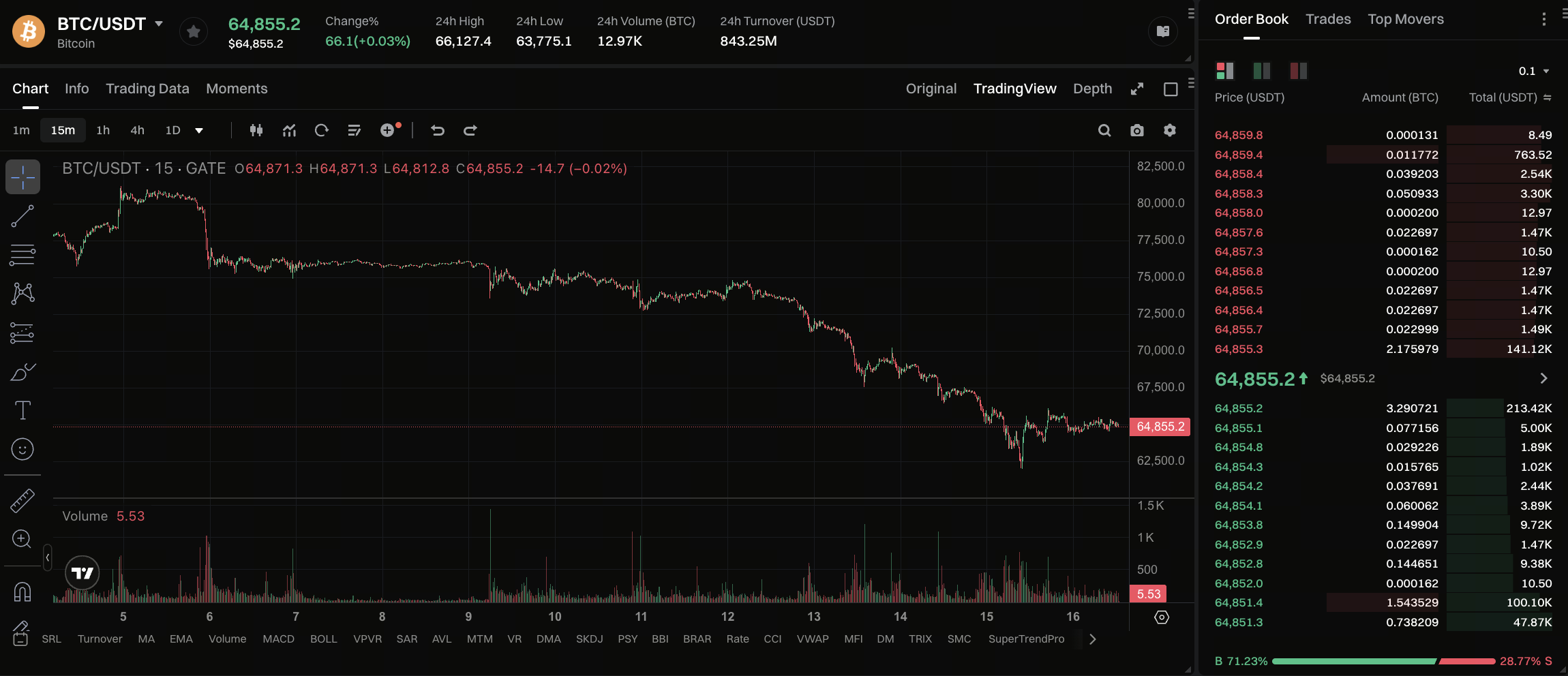
Recent volatility in the Bitcoin price has drawn greater attention to this discussion. On November 13, some market participants linked Bitcoin's drop below $70,000 to the funding needs of the Anthropic IPO, arguing that the listing of a mega-cap technology company could attract some capital previously allocated to the crypto market. However, this remains an interpretation of fund flows by market participants, not a conclusion verified by comprehensive transaction data.
Bitcoin's price is also affected by factors including dollar liquidity, interest-rate expectations, ETF subscriptions and redemptions, derivatives leverage, and the internal fund structure of the crypto market. Even if Bitcoin and technology stocks decline during the same period, they may both be responding to a decline in macro risk appetite rather than capital moving directly from BTC into Anthropic. When analyzing cross-market fund diversion, it is necessary to distinguish temporal correlation from genuine capital transmission.
Can ETF Outflows Prove That Funds Are Moving Into the Anthropic IPO?
ETF fund flows are an important indicator for observing changes in allocations by institutions and other investors, but ETF data alone cannot determine the ultimate destination of the funds. Net outflows from spot Bitcoin ETFs indicate changes in primary-market subscriptions and redemptions for the relevant fund shares, which may reflect some investors reducing their exposure. However, redeemed funds may move into cash, bonds, stocks, or other investment products. They may also be used to reduce leverage or meet liquidity needs. Without further account and transaction data, it is impossible to confirm whether the funds were used to subscribe for Anthropic shares.
Similarly, selling pressure on AI technology stocks does not necessarily mean that institutions are raising funds for the IPO. Investors may adjust their positions because of excessive valuations, weaker-than-expected corporate earnings, rising interest rates, or intensified industry competition. If these factors occur at the same time as the Anthropic IPO, the market may easily attribute price changes caused by different factors to a single event. Such an interpretation could overlook more important macroeconomic and fundamental factors.
Determining whether fund diversion has occurred requires multiple indicators. First, investors should examine the IPO's offering size and actual subscription structure to determine how much of the new funding demand is being borne by public-market investors. Second, they should analyze fund flows in AI-related stock funds and technology stock ETFs to determine whether concentrated selling is taking place. Third, they should examine net subscriptions and redemptions in spot Bitcoin ETFs, crypto market leverage, and stablecoin liquidity to determine whether the crypto market is experiencing independent contraction pressure.
Even if these indicators change during the same period, they can only increase confidence in the assessment that funds are being reallocated. They cannot directly prove that funds are moving from one market to another. A reliable analysis should focus on the timing of fund movements, investor types, and the macroeconomic backdrop rather than establishing a causal relationship solely because two asset prices change at the same time.
Why Could a Mega-Cap Technology IPO Amplify Short-Term Market Volatility?
Large IPOs are often accompanied by high market attention and concentrated trading activity. Before the offering, institutional investors must decide how much to subscribe for. During the pricing process, underwriters must determine the final price based on market demand. During the initial trading period, allocated investors, investors who were not allocated shares, and other traders may adjust their positions at the same time. These actions can change the balance between buying and selling in the relevant stock over a short period, particularly when overall market liquidity is limited or risk appetite is weak.
A mega-cap IPO may also affect expectations for the supply of new shares in the market. If investors believe that more highly valued technology companies will enter the public market in the future, they may adjust existing holdings in advance to reserve capital for potential new-stock investments. Conversely, a successful IPO may improve market confidence and attract new capital to growth stocks. Fund diversion and capital attraction are not entirely opposing outcomes. Both effects may occur at different stages.
The supply of shares after listing also deserves attention. Anthropic's offering documents include arrangements for certain early shareholders and employees to sell shares, as well as provisions related to subsequent lock-up periods. Compared with an offering consisting solely of new shares, these arrangements may affect the number of tradable shares during the initial listing period and in the following months. Research by S&P Global on large technology IPOs shows that post-listing performance varies considerably across companies. Offering size and market attention alone cannot determine the long-term direction of a stock's price.
For the crypto market, short-term volatility may also be amplified by leveraged trading. If declining risk appetite causes BTC to fall, some highly leveraged positions may trigger margin calls or forced liquidations, further magnifying price movements. This mechanism can explain why a relatively limited risk adjustment in macro markets sometimes appears as more severe volatility in the crypto market. However, leverage liquidations are a price-transmission mechanism inherent to the crypto market and cannot be attributed entirely to the listing of a technology company.
What Different Outcomes Could the Anthropic IPO Produce for U.S. Stocks and the Crypto Market?
The Anthropic IPO does not have a single predetermined direction of impact. The actual outcome will depend on the final offering price, investor subscription demand, market liquidity, and expectations for the company's post-listing performance. For the U.S. stock market, a successful mega-cap IPO could demonstrate that institutions remain willing to provide capital to high-growth AI companies. It could also prompt investors to reassess the valuations of model companies and computing infrastructure companies. For the crypto market, the impact would primarily come from cross-asset risk appetite and capital allocation rather than direct business competition between Anthropic and Bitcoin.
| Scenario |
Potential Changes in the U.S. Stock Market |
Potential Changes in the Crypto Market |
| Strong IPO demand and ample market liquidity |
The new stock attracts new capital, improving confidence in the AI sector |
Risk appetite improves, and indirect pressure may be limited |
| Strong IPO demand, but funds mainly come from selling existing holdings |
Some existing technology stocks face portfolio rebalancing pressure |
May be indirectly affected if cross-asset positions are reduced |
| IPO priced too high and performs poorly after listing |
Highly valued AI companies face repricing |
May be affected by declining risk appetite |
| IPO succeeds and subsequent results meet expectations |
Model commercialization receives stronger valuation support |
The impact depends on overall liquidity and capital allocation |
| Macro liquidity tightens at the same time |
Growth-stock valuations and financing conditions come under pressure |
BTC and other high-volatility assets may face simultaneous pressure |
These scenarios are not forecasts of future market performance. They are intended to help investors distinguish between different capital-transmission mechanisms. Strong IPO subscription demand may support Anthropic's offering price, but it does not mean that all AI stocks will rise. A decline in technology stocks does not necessarily mean that investors have abandoned their long-term growth expectations for the AI industry.
From a longer-term perspective, Anthropic's listing could increase public-market attention to the operating data of AI model companies. Investors will be able to observe model companies' revenue growth, customer retention, computing costs, and cash consumption more directly and compare them with companies such as NVIDIA, CoreWeave, and Microsoft. This increase in transparency could change the way capital is allocated, and its impact may extend beyond short-term trading before and after the listing.
Which Indicators Should Investors Monitor to Determine Whether IPO Fund Diversion Is Actually Occurring?
Analyzing the fund-diversion effects of the Anthropic IPO requires an observation framework that covers the offering market, the secondary market, and cross-asset liquidity. Investors should first monitor the final public offering size, offering price, and subscription structure. If the offering is large but is absorbed mainly by long-term strategic investors and new capital, the direct pressure on the existing secondary market may be relatively limited. If many institutions reduce their positions in other stocks to subscribe, more pronounced capital reallocation is likely.
Investors should also monitor the relative performance of AI industry-chain stocks. NVIDIA, CoreWeave, Microsoft, and other related companies may be affected differently because of differences in their business models. A high valuation for the model company could increase market confidence in the commercialization of AI applications, or it could prompt investors to reassess the capital requirements and profit potential of infrastructure companies. The analysis should incorporate financial reports, orders, capital expenditures, and valuation metrics rather than simply comparing share prices before and after the listing.
For the crypto market, investors can monitor fund flows in spot Bitcoin ETFs, the correlation between BTC and the Nasdaq Index, futures open interest, funding rates, and stablecoin liquidity. If technology stocks and crypto assets come under pressure at the same time, investors should also consider the U.S. dollar, Treasury yields, and overall market volatility to determine whether common macroeconomic drivers are present.
More importantly, investors should avoid confusing short-term fund movements with the long-term value of a company. An IPO may cause selling pressure in some assets over a short period, but if the relevant companies' orders, earnings, and cash flow have not changed materially, a short-term price adjustment does not necessarily mean that the long-term investment thesis has changed. Conversely, even if a large IPO attracts substantial capital, that does not mean the new company's valuation is necessarily reasonable. In the long run, investment returns will still depend on whether the company can convert revenue growth into sustainable profits and cash flow.
How to Participate in Anthropic (ANT) Indication of Interest Through Gate IPO Access?
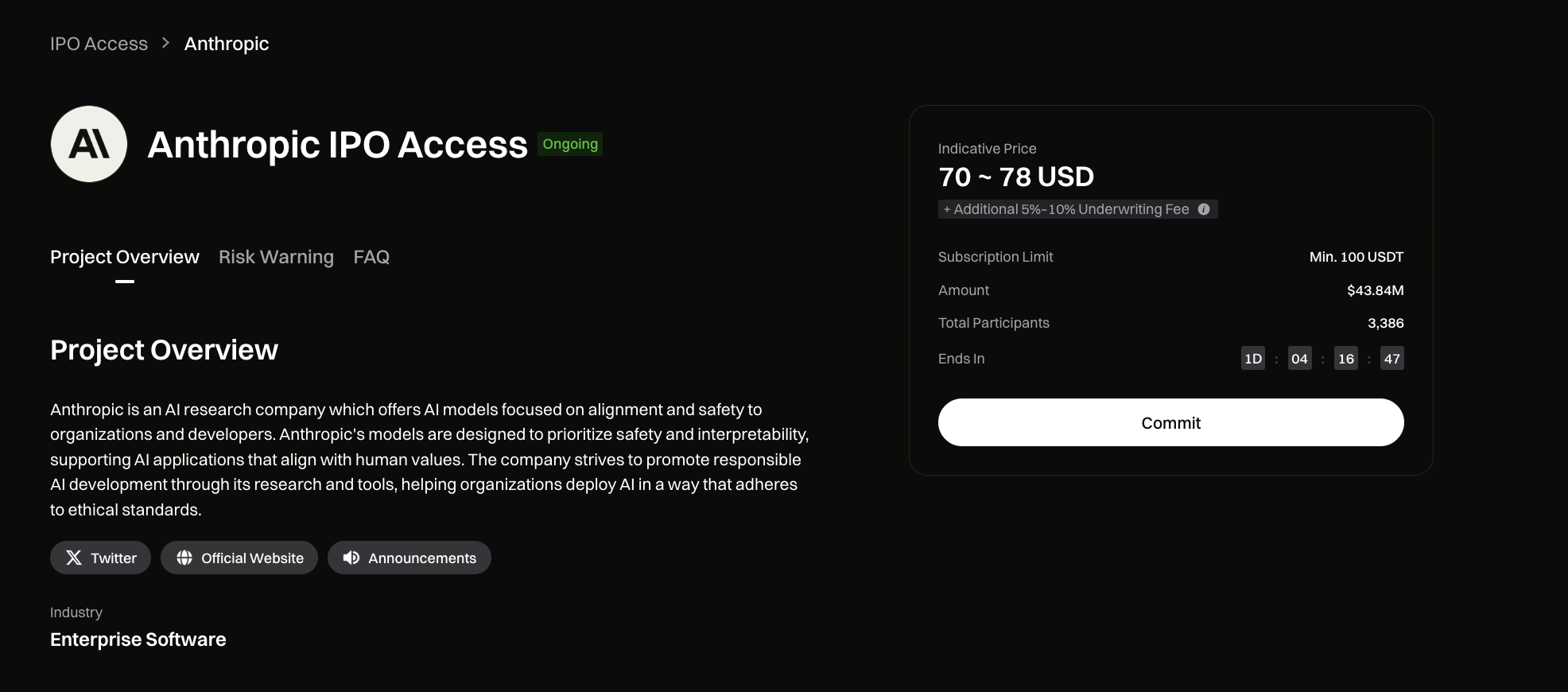
As the Anthropic IPO attracts market attention, investors can not only monitor the stock's performance in the secondary market after listing but also consider participation opportunities during the new stock offering stage. Gate IPO Access Phase 3 is open for Anthropic (ANT) indications of interest. Users can submit subscription applications using USDT and may receive actual shares. Shares allocated successfully will be distributed to users' Gate stock accounts. After the stock is listed, users can trade it through the Gate Stocks section, connecting the indication-of-interest application, share distribution, and secondary-market trading processes.
The reference subscription price for this Anthropic indication of interest is $70–$78 per share. The minimum investment amount is 100 USDT, and the maximum investment amount is 3,000,000 USDT. The subscription period runs from November 12, 2026, at 11:00 to November 17 at 17:00 (UTC+8). The shares are expected to be distributed and opened for trading on November 19. The actual arrangements are subject to the final announcement. Users can access the relevant page through [Finance - IPO Access] on the Gate website or [Finance - New Listings - IPO Access] in the app. Users must complete KYC identity verification before participating.
Please note that an indication of interest does not guarantee a final share allocation. The actual allocation depends on the IPO offering, the allocation amount ultimately received by Gate, and the proportion of each user's subscription amount. Users may receive a full allocation, partial allocation, or no allocation. After a successful allocation, the platform will charge an underwriting service fee based on the user's cumulative investment amount. The fee is 5% on the portion of 50,000 USDT or less and 10% on the excess amount. No corresponding service fee will be charged on the portion that is not successfully allocated, and the funds will be returned according to the applicable rules. If the platform ultimately receives no allocation, it will provide an annualized 10% interest subsidy in accordance with the campaign rules. A subsidy of less than 0.5 USDT per transaction will not be paid.
For investors following the Anthropic IPO, Gate IPO Access provides a channel for participating in a new-stock indication of interest using USDT. However, before participating, investors should fully understand the risks, including fund lockups, allocation uncertainty, underwriting fees, and post-listing share-price volatility. The reference subscription price is not the final offering price. The stock may also experience significant price volatility or insufficient liquidity after listing. Investors should assess whether to participate based on their own risk tolerance.
Conclusion
The discussion of fund diversion related to the Anthropic IPO reflects the potential impact of a mega-cap technology listing on capital allocation structures in the capital markets. A new stock offering worth tens of billions of dollars may prompt some institutional investors to increase cash allocations, reduce existing stock holdings, or reallocate investment weights within the AI sector. However, the amount raised in an IPO does not equal funds that permanently disappear from the financial markets. New share issuance, secondary share sales, and strategic subscriptions involve different fund flows, and the ultimate impact must be assessed in the context of market liquidity.
For U.S. stocks, Anthropic's listing may not only create short-term competition for capital but also change valuation references across the AI industry chain. Investors will be able to compare the business models of foundation model companies, GPU suppliers, cloud computing platforms, and AI application companies more directly. For crypto assets such as Bitcoin, the IPO's impact will primarily be transmitted indirectly through risk appetite, portfolio rebalancing, and macro liquidity. At present, crypto market price movements cannot simply be attributed to Anthropic's financing needs.
Over the long term, a mega-cap technology IPO may both concentrate existing capital and attract new capital to the relevant industry. Assessing its actual impact requires attention to the offering structure, institutional holdings, market fund flows, and corporate operating performance rather than drawing conclusions solely from the IPO size or short-term price movements. What matters about Anthropic's listing is not only how much capital it may attract, but also how the capital markets reassess the long-term profitability of different companies across the AI industry chain.
FAQ
Why Could the Anthropic IPO Trigger Fund Diversion?
Because a large IPO requires investors to prepare substantial subscription funds. Some institutions may sell existing stocks or adjust allocations to other assets to free up capital for the new stock, creating short-term capital reallocation pressure.
How Much Is the Anthropic IPO Expected to Raise?
The offering arrangement updated on November 10, 2026, shows that Anthropic plans to publicly issue 825 million shares at a price range of $70 to $78 per share, corresponding to a potential public offering size of approximately $57.75 billion to $64.35 billion. The final amount has not yet been determined.
Will the Anthropic IPO Cause NVIDIA's Share Price to Fall?
Not necessarily. Some investors may reduce their holdings of other AI stocks to allocate capital to Anthropic, but NVIDIA's share price is also affected by factors such as GPU demand, earnings expectations, valuation, and the macroeconomic environment.
Will the Anthropic IPO Drain Funds From the Bitcoin Market?
Indirect capital reallocation is possible, but there is currently insufficient evidence to prove that Bitcoin funds are flowing directly into the Anthropic IPO. Bitcoin's price is also affected by ETF flows, leverage, and macro liquidity.
Does a Larger IPO Raise Mean a Greater Market Impact?
Not necessarily. The impact depends on the offering size, sources of funds, market liquidity, and subscriber structure. If substantial new capital participates, the direct pressure on the secondary market may be limited.
Does Anthropic's Trillion-Dollar Valuation Mean the Market Must Invest the Same Amount?
No. The company's valuation reflects the market value of all its shares, while the actual amount raised in the IPO depends on the number and price of the shares issued. The two should not be conflated.
Will Anthropic's Listing Change AI Stock Valuations?
It could. Anthropic will provide the public market with a direct valuation reference for a foundation model company, enabling investors to further compare the growth and profitability of model developers, chip suppliers, cloud computing companies, and AI application providers.
How Can Investors Determine Whether IPO Fund Diversion Has Occurred?
Investors can analyze the IPO subscription structure, technology stock fund flows, changes in institutional holdings, net BTC ETF flows, and macro liquidity indicators. However, a single indicator is usually insufficient to prove the ultimate destination of the funds.