On November 3, 2026, AMD reported its third-quarter financial results, with quarterly revenue reaching $13.377 billion, up 45% year over year. Data center revenue reached $8.546 billion, up 97% year over year. The company expects fourth-quarter revenue of approximately $17 billion and emphasized that Instinct GPUs, EPYC CPUs, and Helios rack-scale systems will jointly drive the growth of its data center business. These developments have increased investor focus on whether AMD can capture a larger share of the AI computing market dominated by NVIDIA.
However, competition in AI chips is not simply a comparison of the product performance of two companies. GPU memory capacity, inference throughput, software compatibility, networking, power consumption, and total cost of ownership can all influence procurement decisions by major cloud service providers. This article analyzes the competitive dynamics between AMD and NVIDIA through the technical characteristics of AI inference, as well as what these changes mean for the AI chip industry and related U.S. stock investors.
Key Takeaways
-
AI chip competition is expanding from training compute to inference efficiency. As large language model applications scale, computing costs, response speed, and power consumption during inference are becoming important factors in data center procurement.
-
AMD is expanding its data center AI business. In the third quarter of 2026, AMD's data center revenue reached approximately $8.55 billion, up 97% year over year, driving the company's total revenue to a new high.
-
NVIDIA's competitive advantage extends beyond GPU hardware. Its CUDA software ecosystem, networking, developer tools, and integrated rack systems provide strong system integration capabilities for large-scale AI infrastructure deployments.
-
AMD is seeking to build a comprehensive alternative through Instinct GPUs, Helios, and ROCm. Its competitive focus is gradually shifting from individual chip performance to system-level computing capabilities and total cost of ownership.
-
Growing demand for AI inference does not necessarily mean AMD or NVIDIA shares will rise. Investors should also monitor chip delivery capabilities, profit margins, customer capital expenditures, and market valuations.
What Is AI Inference? How Does It Differ From AI Model Training?
AI inference refers to the computational process in which a trained artificial intelligence model generates predictions, text, images, or other outputs based on user input. For example, when a user asks an AI assistant a question and the model progressively generates a response based on the input, that process is inference. Unlike training, which continuously adjusts model parameters, standard inference primarily uses existing model parameters to perform computations. However, some inference systems may also incorporate retrieval, tool calls, and additional computational steps.
AI training and inference have significantly different requirements for computing resources. Training large models typically requires many GPUs to work together over extended periods, creating high demands for computing performance, memory capacity, and high-speed interconnects. Inference places greater emphasis on request response time, the number of tasks that can be processed per unit of time, and the computing cost required for each request. For applications such as real-time chat and voice assistants, users are highly sensitive to response latency. For batch text processing or data analysis tasks, overall throughput and cost may be more important.
| Comparison Dimension |
AI Training |
AI Inference |
| Primary objective |
Learn and optimize model parameters |
Use the model to generate results |
| Computing characteristics |
Large-scale, long-duration computing |
High-frequency, continuous request processing |
| Key metrics |
Training speed, scaling efficiency |
Latency, throughput, cost per unit |
| Memory requirements |
Parameters, gradients, and training states |
Model weights, KV Cache, and more |
| Business use cases |
Foundation model development |
AI assistants, search, Agents, enterprise applications |
As AI applications scale, inference requests may continue to grow. For example, a model may require only a limited number of large-scale training runs but could serve millions of users over a long period after deployment. This creates the possibility that cumulative inference spending becomes a major source of AI infrastructure costs. However, the ratio of training to inference spending varies significantly across models and applications, so it cannot be assumed that inference costs will always exceed training costs.
Why Is AI Inference Becoming a Focus of Competition Between AMD and NVIDIA?
The AI inference market is gaining attention primarily because AI business models are extending from competition in model capabilities to competition in actual usage costs. For cloud service providers and AI application developers, a model's ability to complete tasks is only a basic requirement. Whether it can continuously provide services to large numbers of users at a reasonable cost also determines whether the product can be commercialized. As the number of users and call frequency increase, even a small reduction in per-inference cost can have a meaningful impact on overall operating expenses.
Inference workloads are not identical. Real-time conversations require low latency, complex reasoning models may need to generate lengthy reasoning processes, and AI Agents may call models, retrieve data, and execute tools multiple times in a single task. Different workloads have different requirements for computing precision, memory capacity, memory bandwidth, and system interconnects. This creates room for competition among different hardware architectures and means it is difficult to determine which chip has an advantage based on a single performance metric.
For AMD, the importance of the inference market lies in its potential to expand AI GPU market share. Major cloud service providers typically seek to avoid excessive reliance on a single supplier while controlling hardware procurement costs. If AMD can offer an alternative that aligns in performance, pricing, software compatibility, and delivery capabilities, it may be able to participate in more data center procurement plans. However, NVIDIA is also continuously optimizing its inference products and software platforms, so growing inference demand does not necessarily mean NVIDIA's competitive position will decline.
How Has AMD's Data Center Business Performed Recently?
AMD's third-quarter results announced in November 2026 show that data centers have become one of the company's most important sources of business growth. Total revenue reached $13.377 billion, up 45% year over year, while data center revenue reached $8.546 billion, up 97% year over year. During the same period, non-GAAP earnings per share reached $2.09, up 74% year over year, reflecting the contribution of data center expansion to overall profitability.
It is worth noting that AMD's data center business includes not only Instinct AI GPUs but also EPYC server CPUs. Therefore, not all data center revenue should be directly treated as AI inference chip revenue. The company's business growth is driven both by demand for AI accelerators and by demand for general-purpose server computing. For investors, determining whether AMD is truly expanding its AI GPU market share requires further observation of product shipments, customer deployments, and the specific business mix.
AMD also expects total revenue of approximately $17 billion in the fourth quarter of 2026, continuing growth from the third quarter. The company is also advancing deployments of Helios rack-scale systems and expanding cooperation with major cloud service providers and AI companies. These developments indicate that AMD is seeking to evolve from a chip supplier into a more comprehensive AI infrastructure provider. However, whether future revenue can continue to grow still depends on customer procurement, supply chains, and product competitiveness.
What Are the Differences Between AMD Instinct and NVIDIA GPUs for AI Inference?
Both AMD and NVIDIA AI GPUs can support model training and inference tasks, but the companies differ in their product roadmaps, software ecosystems, and system integration approaches. AMD's Instinct series primarily targets high-performance computing and AI acceleration in data centers, while NVIDIA has built a more comprehensive AI computing framework through data center GPUs, the CUDA software platform, and supporting networking technologies.
For inference tasks, a GPU's theoretical computing performance is only one evaluation criterion. Models need frequent access to weights and intermediate data, making memory capacity, memory bandwidth, and cache management equally important. Larger memory capacity helps accommodate model parameters and the KV Cache generated by more concurrent requests, while higher memory bandwidth can reduce data-access bottlenecks in certain inference tasks. However, the specific benefits depend on model size, quantization precision, batching strategy, and the level of software optimization.
NVIDIA's advantage lies in its hardware-software coordination capabilities. In addition to GPUs, NVIDIA provides CUDA, TensorRT-LLM, inference serving frameworks, and high-speed interconnect technologies, enabling developers to deploy AI workloads around a relatively mature toolchain. AMD, meanwhile, is improving compatibility and system performance through ROCm, Instinct GPUs, and Helios systems in an effort to reduce the migration costs for customers adopting alternative hardware.
| Comparison Dimension |
AMD |
NVIDIA |
| AI accelerators |
Instinct series |
Data center GPU series |
| Software ecosystem |
ROCm |
CUDA |
| System-level solutions |
Helios |
Rack-scale platforms such as NVL |
| Primary competitive focus |
Open ecosystem, cost, and performance |
Software maturity, system integration |
| Inference optimization focus |
Memory capacity, throughput, software adaptation |
Latency, throughput, hardware-software coordination |
| Main challenges |
Ecosystem compatibility and deployment maturity |
System costs and customer supplier concentration |
It is important to emphasize that the comparison above reflects product and ecosystem positioning rather than a universal performance ranking. Different GPUs may perform significantly differently under different models, precision levels, and deployment conditions. Actual inference efficiency cannot be determined solely by memory capacity or theoretical computing performance.
Why Do CUDA and ROCm Affect the Competitive Landscape for AI Chips?
CUDA is NVIDIA's long-developed parallel computing platform, while ROCm is AMD's software platform for GPU computing and AI workloads. Both provide development tools, computing libraries, and runtime environments that enable developers to use GPUs for complex computing tasks. For large AI companies, selecting GPUs involves more than hardware procurement. It also concerns whether existing model code, training frameworks, inference engines, and operations systems can run reliably.
CUDA's competitive advantage comes from its long-established software ecosystem. Many AI models and development tools have already been adapted and optimized for NVIDIA GPUs, so companies using NVIDIA hardware can often reduce some migration and debugging work. Especially in large-scale cluster environments, software stability, performance analysis tools, and technical support can directly affect computing resource utilization.
AMD is improving the developer experience and support for mainstream AI frameworks through ROCm. In the third quarter of 2026, AMD released ROCm 10, further enhancing related development tools, compilers, computing libraries, and model support. These improvements help expand the range of applications for AMD GPUs, but the release of a new version does not mean all CUDA applications can be migrated to ROCm without modification.
From a commercial perspective, software compatibility affects the actual total cost of ownership of GPUs. If a company purchases lower-priced accelerators but must invest substantial engineering resources to reoptimize models, the hardware cost savings may ultimately be offset by development costs. Therefore, competition between AMD and NVIDIA takes place not only at the chip level but also across developer ecosystems, inference frameworks, and system deployment efficiency.
How Does AMD Helios Change System-Level Competition With NVIDIA?
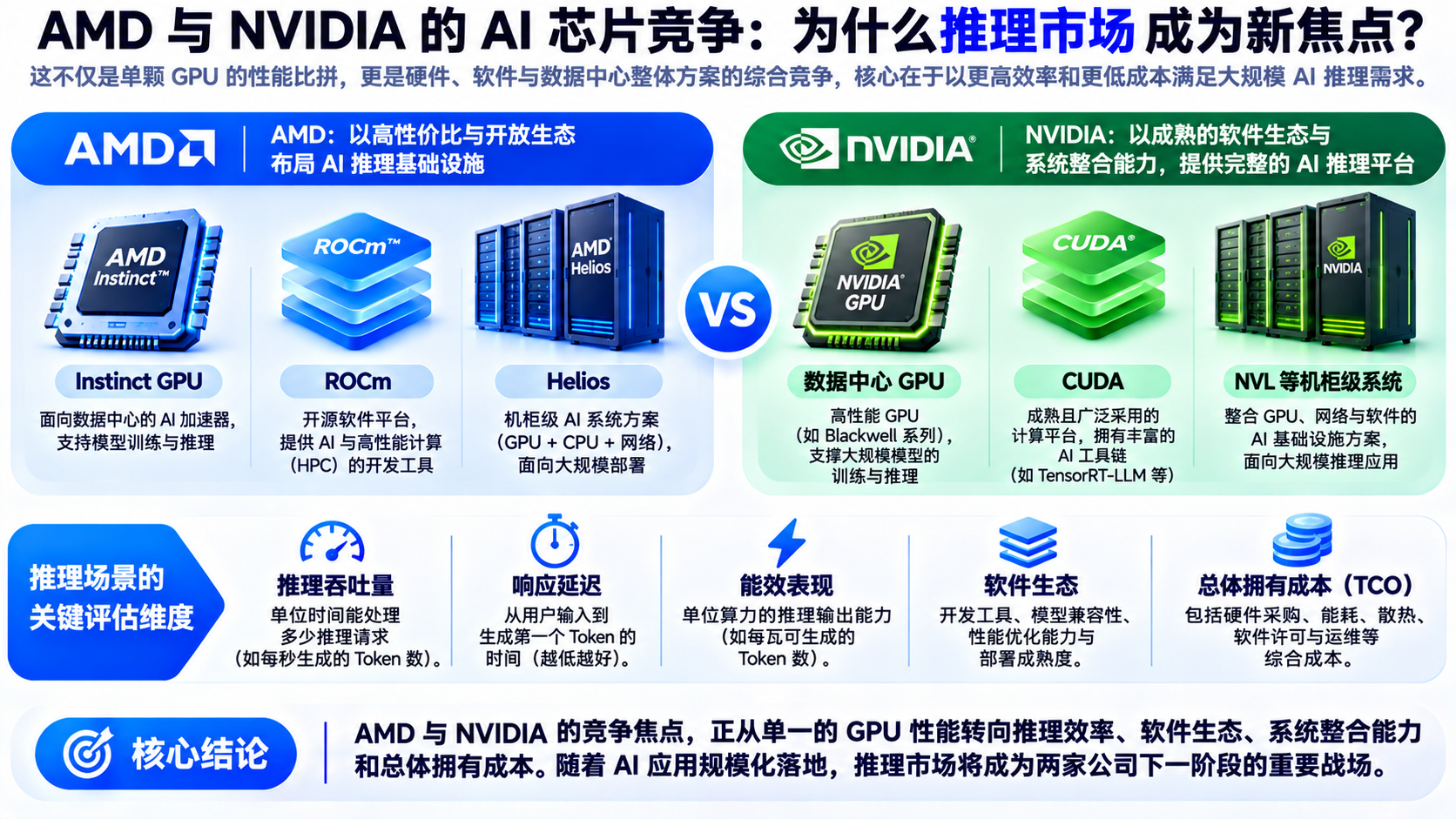
Helios is AMD's rack-scale computing platform for large AI data centers. It combines Instinct GPUs, EPYC CPUs, networking interconnects, and related software components to provide customers with a more complete AI computing system. Compared with purchasing GPUs separately and then integrating systems, rack-scale solutions can optimize computing, communications, and deployment design within a unified architecture.
This shift reflects how AI infrastructure competition is expanding from individual chips to complete computing systems. Large-model training and inference typically require multiple GPUs to work together. Data transfer speeds between GPUs, interconnects within servers, network topology, and cooling capabilities can all affect overall efficiency. Even if an individual chip has high computing performance, actual cluster throughput may still be constrained if system communication becomes a bottleneck.
NVIDIA has already established a relatively complete product lineup through rack-scale AI systems, while AMD aims to offer another option through Helios. In its latest earnings announcement, AMD stated that customers including Anthropic, Meta, Microsoft, OpenAI, and Oracle Cloud Infrastructure are running models or workloads based on the first Helios solutions. These deployments indicate that AMD is advancing the rollout of system-level products, but each customer's deployment scale, procurement amount, and stage of commercialization still need to be assessed separately.
For major cloud service providers, having multiple competitive AI system suppliers can increase procurement flexibility and reduce supply chain concentration risk. However, system-level competition also places higher demands on AMD, including chip supply, networking interconnects, software stability, rack deployment, and long-term maintenance.
Why Are AI Inference Costs More Important Than Individual GPU Performance?
The commercial value of AI inference ultimately depends on whether services can be provided continuously at an acceptable cost. For AI platforms that process large numbers of requests every day, GPU purchase prices are only one part of the cost. Server utilization, power consumption, cooling, networking, maintenance, and model runtime efficiency can all affect total spending.
For example, assume that two GPU systems have procurement costs of $1 million and $1.2 million, respectively. If the latter can process more requests at the same service quality or significantly reduce the energy consumption of each inference, the higher-priced system may still have a lower long-term cost per inference. Conversely, if a system has high theoretical performance but real-world applications cannot fully use its hardware resources, its economics may fall short of expectations.
Therefore, when evaluating AI inference chips, it is important to consider metrics such as the number of Tokens generated per second, time to first Token, concurrent request capacity, and actual processing cost per million Tokens. Different models and workloads place different levels of importance on these metrics. For example, real-time voice interactions prioritize latency, while batch document analysis may place more emphasis on throughput and unit cost.
This shift means AMD does not necessarily need to outperform NVIDIA on every performance metric to gain market opportunities. As long as its products can provide competitive costs and performance for specific workloads while meeting customer requirements for stability and software support, they may become viable alternatives. Similarly, NVIDIA can maintain competitiveness through software optimization and system efficiency rather than relying solely on higher theoretical chip performance.
How Will Competition in the AI Inference Market Affect AMD and NVIDIA Stock Valuations?
AMD and NVIDIA are both important publicly listed companies in the U.S. semiconductor industry, but investors do not apply exactly the same valuation logic to the two companies. NVIDIA has already built a large-scale AI computing business and a relatively mature hardware-software ecosystem, and the market generally focuses on whether it can maintain revenue scale, profit margins, and technological advantages. AMD, meanwhile, has an opportunity to expand its AI market share, so investors are more focused on whether new product deployments, customer orders, and revenue growth can translate into sustained profitability.
Expansion of the AI inference market may benefit multiple chip suppliers at the same time, but growing market demand does not mean every company's profits will increase proportionally. As competition intensifies, product prices, customer bargaining power, and research and development investment may all change. If companies lower prices to gain market share or need to devote more resources to supporting customer deployments, revenue growth may not deliver the same level of profit growth.
In addition, stock prices depend on how much growth expectation the market has already priced in. Even if a company reports strong financial results, its share price may still face pressure if investors had expected more. Conversely, if a company's actual deliveries, profit margins, or outlook exceed expectations, the market may reassess its valuation. Therefore, assessing the investment value of AMD and NVIDIA requires more than comparing which GPU has stronger performance. It also requires consideration of revenue mix, profitability, capital expenditures, the competitive environment, and valuation multiples.
Which AI Inference Market Indicators Should Investors Watch?
Investors seeking to understand movements in AI chip stocks can observe market changes from three perspectives. The first is demand, including AI capital expenditures by major cloud service providers, inference service usage, and actual deployments by enterprise customers. These indicators can help determine whether demand for AI computing power continues to expand, but capital expenditure plans do not equal confirmed revenue for chip manufacturers.
The second is supply, including GPU delivery volumes, high-bandwidth memory (HBM) supply, advanced packaging capacity, and system deployment progress. Even when market demand is strong, chip manufacturers may be unable to complete deliveries as planned if critical component supplies are insufficient. Both AMD and NVIDIA rely on complex semiconductor supply chains, so supply constraints may affect the growth pace of both companies.
The final area is profitability and valuation metrics. Investors can monitor data center revenue, gross margin, operating margin, free cash flow, and changes in market expectations, then use price-to-earnings ratios or forward earnings multiples to assess whether stock pricing is reasonable. It is particularly important to distinguish between financial results already achieved and management's forward-looking guidance, and to avoid treating unfulfilled orders or growth forecasts as certain revenue.
Summary
Competition between AMD and NVIDIA in AI chips is expanding from a pure comparison of computing performance to inference efficiency, software ecosystems, rack-scale systems, and total cost of ownership. As AI applications enter the stage of scaled deployment, data centers need not only stronger computing capabilities but also the ability to continuously process large volumes of user requests at more reasonable costs.
AMD's rapid growth in its data center business in the third quarter of 2026, along with continued development of Instinct, ROCm, and Helios, indicates that it is expanding its AI infrastructure business. However, NVIDIA retains important advantages in CUDA, system integration, and the developer ecosystem. The outcome of future competition will depend on product deliveries, real-world performance, customer adoption, and commercial profitability rather than a single technical metric from one generation of chips.
For stock investors, the AI inference market provides a new perspective for observing the semiconductor industry, but technological competitiveness and stock investment returns are not directly equivalent. Analyzing industry demand, corporate profitability, and market valuations together provides a more comprehensive understanding of the competitive landscape between AMD and NVIDIA.
FAQ
What Is AI Inference?
AI inference is the process of using a trained artificial intelligence model to process inputs and generate outputs, such as AI chat, image generation, speech recognition, and tasks performed by intelligent assistants.
Why Is the AI Inference Market Becoming More Important?
As the number of AI application users and frequency of use increase, companies must continuously bear substantial inference computing costs. As a result, inference speed, throughput, power consumption, and unit costs are becoming more important.
Can AMD's AI GPUs Replace NVIDIA?
For certain supported models and application scenarios, AMD GPUs can serve as an alternative to NVIDIA. However, actual feasibility depends on software compatibility, performance, deployment costs, and customer requirements. The two should not be considered fully equivalent in every scenario.
What Is the Difference Between CUDA and ROCm?
CUDA is NVIDIA's GPU parallel computing platform, while ROCm is AMD's GPU computing software platform. Both support AI computing, but they differ in development tools, ecosystem maturity, and specific compatibility.
What Is AMD Helios?
Helios is AMD's rack-scale AI computing platform that integrates GPUs, CPUs, interconnects, and software components for AI training and inference workloads in large data centers.
Does Growing AI Inference Demand Mean AMD Shares Will Definitely Rise?
Not necessarily. Share prices are affected not only by business growth but also by profitability, the competitive landscape, supply chains, market expectations, and stock valuations.