In early November 2026, the U.S. technology sector experienced significant volatility, with several AI-related stocks facing concentrated selling pressure. The market is grappling with a contradiction: some technology companies continue to deliver strong revenue growth, and management teams have not completely abandoned their long-term optimism about computing demand and AI infrastructure development. However, investors are reassessing high valuations, the payback periods for capital expenditures, and expectations for future earnings growth. Even when a company's business performance remains strong, its stock price can still decline as market expectations shift.
Why has strong earnings growth among AI companies failed to prevent technology stocks from being sold off? Is the market concerned about declining AI demand, or is it reassessing how much future growth should be worth? This article examines recent market developments to explain the relationship between AI stock valuations, earnings expectations, capital expenditures, and market liquidity. It also discusses how investors can distinguish short-term valuation adjustments from deteriorating corporate fundamentals.
Key Takeaways
-
Revenue growth does not guarantee stock price appreciation. Stock prices reflect investors' expectations for future earnings, not just revenue and profits already generated.
-
High valuations raise the bar for growth. Even when AI companies report strong earnings, their stocks may fall if growth comes in below previous expectations.
-
AI capital expenditure represents both demand and risk. Increased investment in data centers, GPUs, and power infrastructure may boost supplier revenue, but it can also reduce the free cash flow of companies making those investments.
-
A broad technology sell-off does not necessarily signal an AI industry downturn. Interest rates, capital allocation, valuation adjustments, and crowded trades can all cause related stocks to decline together.
-
AI companies face different risks. Chip suppliers, cloud service providers, data center operators, and software companies have significantly different business models, capital requirements, and valuation drivers.
Why Did Technology Stocks Face a Wave of Selling in November 2026?
On November 5, 2026, U.S. stocks experienced a sharp correction. The Nasdaq Composite fell 5.52% in a single session, the S&P 500 declined 4.36%, and the Dow Jones Industrial Average dropped 3.44%. Semiconductor stocks came under even greater pressure, with the Philadelphia Semiconductor Index falling more than 12%. NVIDIA lost more than 9% that day, while AMD declined approximately 17%. The Nasdaq also entered correction territory, defined as a decline of more than 10% from its previous peak.
The sell-off was not triggered by a sudden loss of market demand for AI products at any single company. Instead, several risk factors converged.
-
New concerns emerged over the policy environment for AI infrastructure development. Following the U.S. midterm elections, investors began reassessing potential regulatory, permitting, and local community opposition to data center construction. Large AI data centers typically require substantial electricity, land, and cooling resources. Changes in construction timelines could therefore affect chip procurement, server deployment, and demand for power equipment.
-
The scale of AI infrastructure investment continued to expand, prompting closer scrutiny of the relationship between spending and future returns. Major technology companies have continued purchasing GPUs, building data centers, and expanding cloud computing capacity. However, subsequent operating results will need to demonstrate whether these investments can translate into sustainable profits within a reasonable timeframe.
-
Technology stocks had already accumulated elevated growth expectations. Some companies' share prices reflected not only current earnings but also years of anticipated AI demand expansion. As the market began reassessing these expectations, valuations could adjust rapidly even without clear signs of business deterioration.
Therefore, the technology stock sell-off in early November is better understood as a broad repricing of AI investment costs, the pace of growth realization, and policy risks rather than straightforward evidence that the AI industry has entered a downturn.
Why Can AI Companies Report Earnings Growth While Their Stock Prices Still Fall?
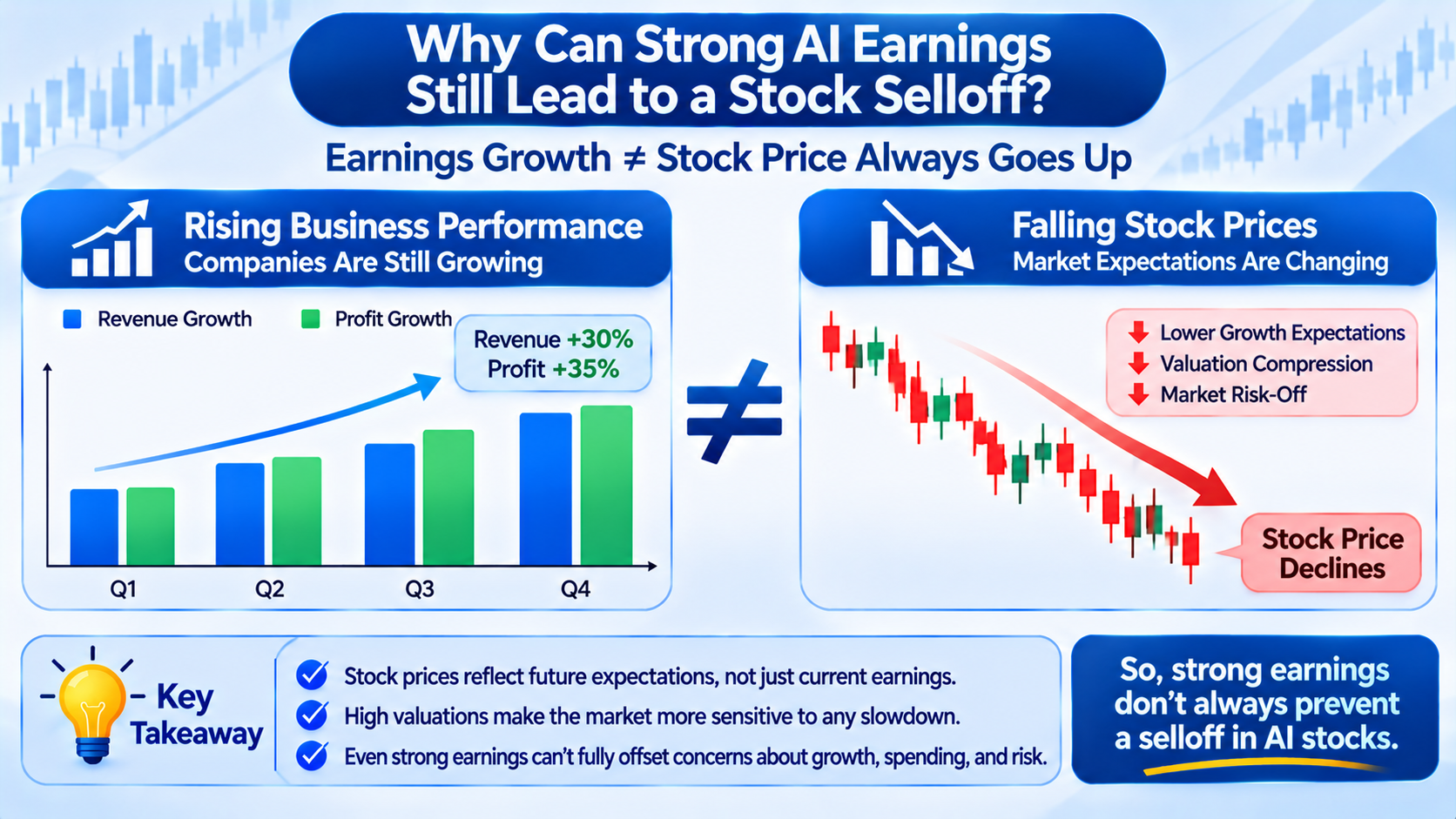
The stock market does not simply trade on companies' reported results. More importantly, it prices in investors' expectations for future earnings.
A company reporting 30% revenue growth may appear to have delivered a strong operating performance. However, if the market had broadly expected growth of 40%, the actual result may still be viewed as disappointing, even though revenue continues to increase.
This difference is commonly referred to as an earnings surprise. It helps explain why stock prices do not always move in line with the growth rates reported in financial statements.
For example, suppose an AI chip company generated $10 billion in revenue in the previous year. The market expects revenue to reach $15 billion in the current year, but the company ultimately reports $14 billion. Although revenue has still increased by 40%, the result falls short of previous market expectations. Investors may consequently revise their future earnings forecasts downward.
More importantly, stock prices also incorporate expectations for growth over multiple future years.
If investors originally believe that a company can maintain rapid growth over the next five years, they may be willing to pay a higher valuation. However, when management indicates that growth may slow, the market needs to recalculate the appropriate price for the company's future earnings.
This adjustment can sometimes matter more than the current earnings report itself.
Therefore, assessing whether an AI stock offers investment value requires more than checking whether revenue is growing. Investors should also examine whether growth exceeds expectations, whether profit margins are improving, and whether management's business guidance for the coming quarters has changed.
Why Are AI Stock Valuations Particularly Sensitive to Changes in Market Sentiment?
AI stock valuations generally incorporate expectations about future technological adoption, market size, and corporate profitability. For companies with established business models, valuations are more heavily influenced by existing earnings and cash flows. For companies still in a rapid expansion phase, valuations may depend much more on assumptions about future growth.
This means that even relatively small changes in the market's assessment of AI's long-term prospects can have a significant impact on certain stock prices.
Consider the forward price-to-earnings ratio (Forward P/E). Suppose a company is expected to generate earnings per share of $10 over the next year. If the market assigns it a P/E ratio of 40, its implied stock valuation is $400.
If the earnings forecast remains unchanged but investors are only willing to pay a P/E ratio of 30, the implied valuation falls to $300.
In this scenario, the company has not experienced a decline in profits, yet its stock price may fall by 25% because of valuation multiple contraction.
For high-growth companies, the market may adjust both earnings forecasts and valuation multiples at the same time. If future growth expectations decline, investors may lower their earnings-per-share forecasts while also reducing the valuation they are willing to pay. This creates pressure from two directions.
This phenomenon is commonly known as valuation compression. Interest rates and risk appetite also influence valuations. When risk-free yields rise or investors demand greater compensation for business uncertainty, the present value of distant future cash flows may come under greater pressure.
Therefore, continued fundamental growth at AI companies and declining valuations for AI stocks are not contradictory. Corporate operating performance and stock prices can move in different directions for a period of time.
Why Can Higher AI Capital Expenditure Make Investors More Concerned?
Capital expenditure (CapEx) refers to spending on the purchase, construction, or upgrading of long-term assets. In the AI industry, this typically includes GPUs, servers, data centers, power equipment, network infrastructure, and related construction projects.
From an industry perspective, rising capital expenditure often indicates that companies are expanding their investment in AI infrastructure. For chip manufacturers, server suppliers, and power equipment companies, this spending may translate into new orders and revenue.
However, the situation is more complicated for companies making these investments. Capital expenditure requires actual cash outlays. Companies purchasing equipment, building data centers, and deploying computing resources may consume substantial amounts of cash in the short term, while the corresponding revenue and profits may take time to materialize.
AI infrastructure also faces rapid technological change. GPUs and servers may experience shifts in performance, cost, and competitiveness as new generations of products are introduced. If companies invest heavily too early but fail to utilize the resulting equipment efficiently, their investment returns may fall short of expectations.
Growing capital expenditure can also reduce free cash flow.
Free cash flow generally measures how much cash a company can generate after making the capital investments required to maintain and expand its business. Even when a company reports strong accounting profits, substantial construction spending may cause its free cash flow to decline.
By late October 2026, the market had already begun focusing more closely on the relationship between AI investment by major technology companies, cash consumption, and financing needs. Some investors were concerned that AI infrastructure expansion could outpace the realization of commercial revenue.
Therefore, capital expenditure is not inherently bullish or bearish. It represents investment in anticipated future demand. What ultimately determines its investment value is whether those expenditures can generate sufficient revenue, profits, and cash flow in the years ahead.
Why Can NVIDIA, AMD, and Data Center Stocks Fall at the Same Time?
The AI value chain includes several different types of companies, including chip designers, semiconductor manufacturers, server suppliers, cloud computing providers, data center operators, and power infrastructure businesses.
These companies have different business models, but their growth expectations may depend on similar industry assumptions: AI computing demand will continue to increase, driving further infrastructure expansion.
For example, part of the growth outlook for NVIDIA and AMD is closely tied to demand for AI accelerated computing. If major technology companies increase their purchases of AI servers, chip companies may benefit.
Data center operators focus more on computing capacity deployment, customer contracts, facility utilization rates, and infrastructure financing conditions. Even if AI demand continues to grow, their profitability may still come under pressure if construction costs rise, project delivery is delayed, or financing conditions deteriorate.
Power equipment and energy companies face a different set of considerations. AI data center construction may increase demand for power infrastructure, but whether related orders translate into revenue on schedule also depends on project approvals, equipment delivery, and customer investment plans.
This means that when the market begins to worry about slower AI infrastructure development, investors may lower growth expectations across multiple parts of the industry simultaneously.
The market adjustment on November 5, 2026, demonstrated this pattern. In addition to chip stocks, some data center operators, cloud infrastructure companies, and power-related stocks also recorded significant declines.
However, synchronized declines across industry stocks do not mean that every company's operating conditions are the same. For example, companies with stable cash flows and diversified customer bases may face very different risks during a market correction from businesses that depend heavily on a single AI-related operation and require continuous external financing.
Therefore, analyzing AI stocks requires distinguishing between risks shared across the industry and risks specific to individual companies. Simply classifying a stock as part of the AI sector is not enough to determine its investment prospects.
Why Is the Market Concerned About Slower Growth Even When AI Demand Has Not Declined?
Growth in AI demand and revenue growth among companies in the AI supply chain do not necessarily move in perfect synchrony.
-
There may be a time lag between end-user demand and infrastructure procurement. Companies deploying AI applications need computing resources, but they do not necessarily increase GPU and server purchases by the same amount every quarter. As previously built computing capacity gradually enters service, some companies may temporarily slow additional equipment purchases and focus on improving utilization of existing infrastructure.
-
Improvements in AI efficiency can change the structure of computing demand. As model inference becomes more efficient, hardware performance improves, and computing resources are scheduled more effectively, companies may be able to complete the same tasks using fewer computing resources. However, lower computing costs per unit may also accelerate AI adoption and increase total computing demand. The ultimate impact of efficiency improvements on hardware procurement is therefore uncertain.
-
AI demand may continue growing, but at a slower pace than the market previously expected. For example, if annual demand growth in an industry slows from 80% to 40%, it is still growing rapidly. However, if related stock valuations were based on the assumption that higher growth rates would persist over the long term, the market may need to reprice those stocks.
In addition, growth in AI commercialization revenue does not necessarily translate directly into higher profits. Companies may cut prices, expand free services, or increase infrastructure investment to compete for market share, creating a gap between revenue growth and profitability improvements.
Therefore, investors need to distinguish among three separate questions: Is AI technology continuing to gain adoption? Are AI companies continuing to grow their revenue? And do current stock valuations already reflect that growth?
Even if the answer to the first two questions is yes, the third may still be open to debate.
Why Can Institutional Portfolio Adjustments Amplify Technology Stock Sell-Offs?
Broad declines in technology stocks can be driven not only by changes in corporate fundamentals and valuations but also by institutional portfolio adjustments.
When an industry performs strongly over an extended period, funds, hedge funds, and other investment institutions may gradually increase their exposure to related stocks. If large amounts of capital become concentrated in similar assets, the market may develop what is known as a crowded trade.
A crowded trade does not mean that the underlying companies lack investment value. Rather, it means that many market participants may be relying on similar investment logic and market expectations. When that logic comes under pressure, institutional investors may reduce their risk exposure simultaneously.
For example, some funds need to control portfolio volatility, certain leveraged traders must meet margin requirements, and other institutions may rebalance their portfolios because their exposure to a particular industry has become too high.
These trading activities can create substantial selling demand within a short period. When market liquidity declines, concentrated selling may further amplify price volatility. Falling stock prices may then trigger additional risk controls and position adjustments, creating a short-term negative feedback loop.
During the technology stock correction in early November 2026, institutional position reductions, hedge fund deleveraging, and concerns about returns on AI investment were among the factors attracting market attention.
However, institutional selling does not necessarily mean that the long-term value of a company has declined. Some transactions may simply reflect adjustments to risk budgets, with no direct connection to the company's future earnings potential.
Investors should therefore distinguish short-term capital movements from long-term changes in business fundamentals rather than interpreting every stock price decline as evidence of deteriorating corporate performance.
Does a Broad AI Stock Sell-Off Mean the AI Bubble Is Bursting?
The AI bubble is a frequently discussed concept in the market. However, high stock valuations or significant short-term price declines alone cannot prove that a bubble has formed or burst.
Assessing whether an asset bubble exists generally requires examining whether prices have become detached from reasonably expected earnings over an extended period and whether investors are relying excessively on optimistic growth assumptions.
In the AI industry, some companies already generate actual revenue through chip sales, cloud computing services, and software subscriptions. AI applications are also expanding across multiple industries. It is therefore difficult to classify the entire AI sector as a speculative market without commercial foundations.
On the other hand, genuine technological progress does not guarantee that every related stock has a reasonable valuation. Historically, new technologies have sometimes transformed economic structures over the long term while the share prices of related companies still experienced severe corrections.
Investors may correctly identify a promising industry trend yet still suffer prolonged losses if they pay too much for the stocks involved.
Differentiation among AI companies is particularly important. Businesses with established profitability, customer bases, and cash flows may be better positioned to withstand changes in market financing conditions. Companies that depend on external financing, have yet to achieve stable profitability, or rely heavily on a single customer may be more sensitive to changes in market risk appetite.
Investors should also examine whether the commercialization of AI can continue supporting infrastructure spending. If infrastructure investment grows significantly faster than related revenue and profits, the market may gradually reduce the valuation multiples it is willing to assign to these companies.
Rather than simply declaring whether the AI bubble has burst, it is more useful to analyze each company's earnings quality, return on capital, financing capacity, and whether its current valuation is justified.
How Can Investors Determine Whether an AI Stock Decline Is a Short-Term Correction or a Sign of Fundamental Deterioration?
For investors, distinguishing a short-term market correction from deteriorating corporate fundamentals is an important step in analyzing technology stock declines.
One approach is to monitor whether earnings forecasts are being revised downward on a sustained basis. If a stock falls sharply while forecasts for future revenue and profits remain largely unchanged, valuation compression may be one of the main factors behind the decline. Conversely, if orders, revenue growth, and profit margins consistently fall short of expectations, the price adjustment may reflect deeper operating problems.
Investors should also examine the relationship between free cash flow and capital expenditure. For major cloud computing companies, it is useful to assess whether investment in AI infrastructure is gradually generating cloud revenue growth, higher customer usage, and improved profitability. For data center operators, construction costs, financing expenses, contract execution, and cash flow coverage are particularly important.
Differences in how the market values various types of AI companies can provide further insight. If technology companies with stable cash flows and growth companies that rely heavily on financing both decline, but the latter experience significantly larger losses, this may indicate that the market is reassessing financing costs and risk exposure.
Macroeconomic conditions also matter. Interest rates, inflation, corporate financing conditions, and overall market liquidity all influence the valuations of growth stocks. Even if AI demand continues to increase, higher capital costs may reduce the valuation multiples investors are willing to pay.
Investors can also examine the quality of any rebound following a market correction. If a recovery is accompanied by improving earnings expectations, broader participation across the industry, and renewed capital demand, it may have a stronger foundation. If prices rise mainly because of short covering or an oversold bounce while fundamental concerns remain unresolved, market performance may continue to be volatile.
The following framework can help investors distinguish between different sources of risk:
Content temporarily unavailable outside the Lark document.
It is important to recognize that no single indicator can accurately predict the bottom of a technology stock correction. For long-term investors, corporate earnings capacity and reasonable valuations are generally more important than price movements on any particular trading day.
How Can Investors Monitor AI Technology Stocks Through Gate Stock Trading?
Volatility in AI stocks reflects not only the operating performance of individual companies but also investors' reassessment of the growth outlook for the broader technology industry.
Users interested in these markets can access supported U.S. stock listings and monitor their price movements through the relevant trading interface provided by Gate Stock Trading. They can then combine this information with corporate earnings reports, valuation metrics, and industry developments to conduct their own analysis.
For example, when AI-related stocks such as NVIDIA and AMD experience significant volatility, investors can compare revenue growth, earnings expectations, and valuation levels across different companies to assess whether price adjustments are consistent with changes in their fundamentals.
Users planning to participate in related trading should also pay attention to the actual trading instruments, trading hours, order types, and fee rules, while confirming the specific asset rights and risk characteristics of the product they use.
In highly volatile markets, limit orders can help investors set an acceptable execution price, but they do not guarantee that an order will be filled. This is particularly important during pre-market, after-hours, or other periods when liquidity may be relatively limited. Stock prices can fluctuate significantly during these sessions, and actual execution prices and bid-ask spreads may change.
Gate Stock Trading provides a channel for accessing relevant markets, but the trading interface itself cannot replace independent investment judgment. Whether investors choose to establish positions during a technology stock correction or wait for earnings expectations and market trends to stabilize further, they should manage position sizes according to their risk tolerance and avoid making trading decisions solely because a stock has fallen sharply in the short term.
The specific supported assets, features, and trading rules are subject to the information displayed on the platform.
Conclusion
In early November 2026, AI-related U.S. technology stocks experienced a concentrated sell-off, reflecting investors' reassessment of the artificial intelligence industry's growth prospects, capital expenditure returns, and stock valuations. Although some technology companies continued to deliver strong revenue growth, the market was becoming more demanding about the pace of future earnings realization and the efficiency of capital investment.
Strong earnings growth at AI companies and declining technology stock prices are not contradictory. Stock prices depend not only on operating results already achieved but also on the market's previous expectations for future growth. When actual results fall short of overly optimistic expectations, or investors become less willing to pay high valuation multiples, stock prices may decline significantly even as profits continue to grow.
At the same time, AI infrastructure development requires substantial capital investment. Although chip, cloud computing, data center, and power equipment companies are part of the same industry value chain, their business models and financial risks differ considerably. Concerns about data center construction timelines, financing costs, and returns on capital may put pressure on multiple parts of the industry simultaneously.
For investors, assessing the investment value of AI stocks requires more than looking at technological prospects or judging whether a stock has become undervalued based solely on the size of its decline. More importantly, investors need to analyze the relationship between earnings expectations, cash flow, capital expenditure, financing capacity, and current valuations.
The long-term growth potential of the AI industry and the short-term investment returns of AI stocks are two separate questions. Technological development may continue creating commercial value, but long-term valuations are more likely to be supported when companies can convert demand into sustainable profits and cash flow.
FAQ
Why can AI stocks fall even when AI companies report earnings growth?
Stock prices reflect expectations for future earnings. If a company's actual growth falls short of previous market expectations, or investors become less willing to pay high valuation multiples, its stock price may decline even if earnings continue to grow.
Why can AI chip stocks such as NVIDIA and AMD fall at the same time?
Part of the growth expectations for these companies is tied to demand for AI computing power. When the market becomes concerned about slower data center construction, lower returns on capital expenditure, or excessive technology stock valuations, related stocks may come under pressure simultaneously. However, their fundamentals and risk profiles are not necessarily the same.
Why can rising AI capital expenditure become a negative factor for stocks?
Higher capital expenditure means companies are committing more funds to infrastructure development. If new investments fail to generate revenue and profits in a timely manner, they may reduce free cash flow, increase financing needs, and weaken investor expectations for returns on capital.
What is valuation compression in AI stocks?
Valuation compression occurs when investors become willing to pay a lower valuation multiple for a company's earnings. For example, even if a company's profits continue to grow, its stock price may still fall if its forward P/E ratio declines from 40 to 30.
Does a broad decline in AI stocks mean the AI bubble has burst?
Not necessarily. A broad sell-off may result from valuation adjustments, institutional position reductions, interest rate changes, or lower earnings expectations. Determining whether a serious valuation bubble exists requires further analysis of the relationship between companies' actual earnings capacity and their stock prices.
How can investors determine whether AI stocks have fallen to reasonable valuations?
Investors can assess future earnings forecasts, valuation multiples, free cash flow, capital expenditure, debt levels, and industry demand together. A large decline in a stock price does not automatically mean its valuation has become reasonable.
Should retail investors immediately buy the dip after a sharp decline in AI technology stocks?
Whether to buy depends on the investment horizon, risk tolerance, and assessment of the company's fundamentals. A sharp short-term market decline may create opportunities, but it may also indicate that earnings expectations and valuations still need further adjustment.