In November 2026, Anthropic completed its widely anticipated initial public offering (IPO), becoming an important case study for understanding how AI company valuations translate into the public markets. The company had previously reached a valuation of approximately $965 billion in private financing. Its IPO price was ultimately set at $83 per share, corresponding to a valuation of approximately $1.5 trillion. On November 19, Anthropic shares opened at $111.50 and later declined to close at $97.17. The stock's price movement on its first day of trading showed that even large AI companies favored by institutional investors are subject to continuous reassessment of their growth expectations and risks in the public markets.
The transition from private financing to the public markets involves more than whether shares can be freely traded. It also involves differences between the rights attached to preferred and common stock, the number of shares issued, lock-up arrangements, the cost of capital, and expectations for converting growth into profits. This article examines these capital market mechanisms, analyzes why AI companies may experience valuation repricing after going public, and explains how investors can distinguish a company's long-term value from its short-term market price.
Key Takeaways
- Private financing valuations are typically derived from the transaction price in a specific financing round and do not necessarily mean that all of the company's shares could be sold at the same price.
- Private preferred stock may include special terms such as liquidation preferences and anti-dilution protections. Its economic rights may differ from those of common stock traded on public markets.
- IPO prices are determined jointly by the company, underwriters, and institutional investors, while post-listing market prices are formed through ongoing buying and selling.
- An AI company's post-IPO valuation may be affected by revenue growth, gross margin, computing-related capital expenditures, cash flow, and the interest rate environment.
- A relatively small public float in the early stages of trading may amplify price volatility. The expiration of the lock-up period may change the supply of shares, but it does not necessarily cause the stock price to decline.
- Valuation repricing does not necessarily mean that the company's operations have deteriorated. It may also occur when the public market assigns the company a higher valuation. The key issue is whether the price is aligned with future earnings expectations.
Why Can AI Companies Receive Such High Private Market Valuations?
In recent years, AI companies have experienced rapid growth in financing and valuation levels. This reflects both expectations for the commercialization of artificial intelligence technology and investors' views on the future structure of the industry. For companies developing foundational models, investors focus not only on current revenue but also on model capabilities, enterprise customers, developer ecosystems, and potential platform effects.
Compared with mature public companies, AI companies in high-growth phases often invest substantial amounts in model training, inference infrastructure, and product development. Short-term profits may be low or the company may continue to incur losses, but private market investors may still assign a high valuation based on the potential market size and long-term competitive advantages.
The investor structure in private markets is also an important factor. Large technology companies, venture capital funds, and sovereign wealth funds may have different investment objectives. Some strategic investors may focus not only on financial returns but also on cloud computing partnerships, technology ecosystems, or long-term commercial relationships. These factors may influence financing negotiations, but they do not mean that all private investments carry the same strategic value.
In addition, private financing transactions occur relatively infrequently. After a company completes a financing round, its valuation may continue to be cited for an extended period, while a public company's stock price changes every day. As a result, the stability of a private market valuation may sometimes reflect a lower pricing frequency rather than an absence of changes in the company's value.
Why Doesn't a Private Financing Valuation Equal the Actual Trading Value of All Shares?
Private financing is typically completed through the issuance of shares in a specific financing round. The post-money valuation commonly cited by the market is often derived from the per-share price in a new financing round and the corresponding fully diluted share count.
For example, suppose an AI company issues shares to new investors at $100 per share and, based on that price, reaches a post-money valuation of $100 billion. This does not mean that there are enough buyers in the market willing to acquire all of the company's shares at the same price. The actual transaction may involve only a very small portion of the company's equity.
More importantly, investors in different financing rounds may receive different rights. Private preferred stock may include liquidation preferences, anti-dilution provisions, redemption arrangements, or other protective mechanisms. Common stockholders generally do not automatically receive these rights. Therefore, the price of preferred stock in a financing round cannot be treated as fully equivalent to the price of common stock.
Suppose an investor holds shares with a specific liquidation preference. If the company is sold at a lower price, the investor may receive a distribution before common stockholders. This right has economic value, but its specific value depends on the company's capital structure and the contractual terms.
Therefore, determining whether a private valuation is a meaningful reference requires an understanding of the financing size, share classes, preferential rights, and share count calculation method. For investors, a financing valuation is an indicator of market expectations, not a uniform price that all shareholders can realize.
Why Does an IPO Change How an AI Company's Valuation Is Formed?
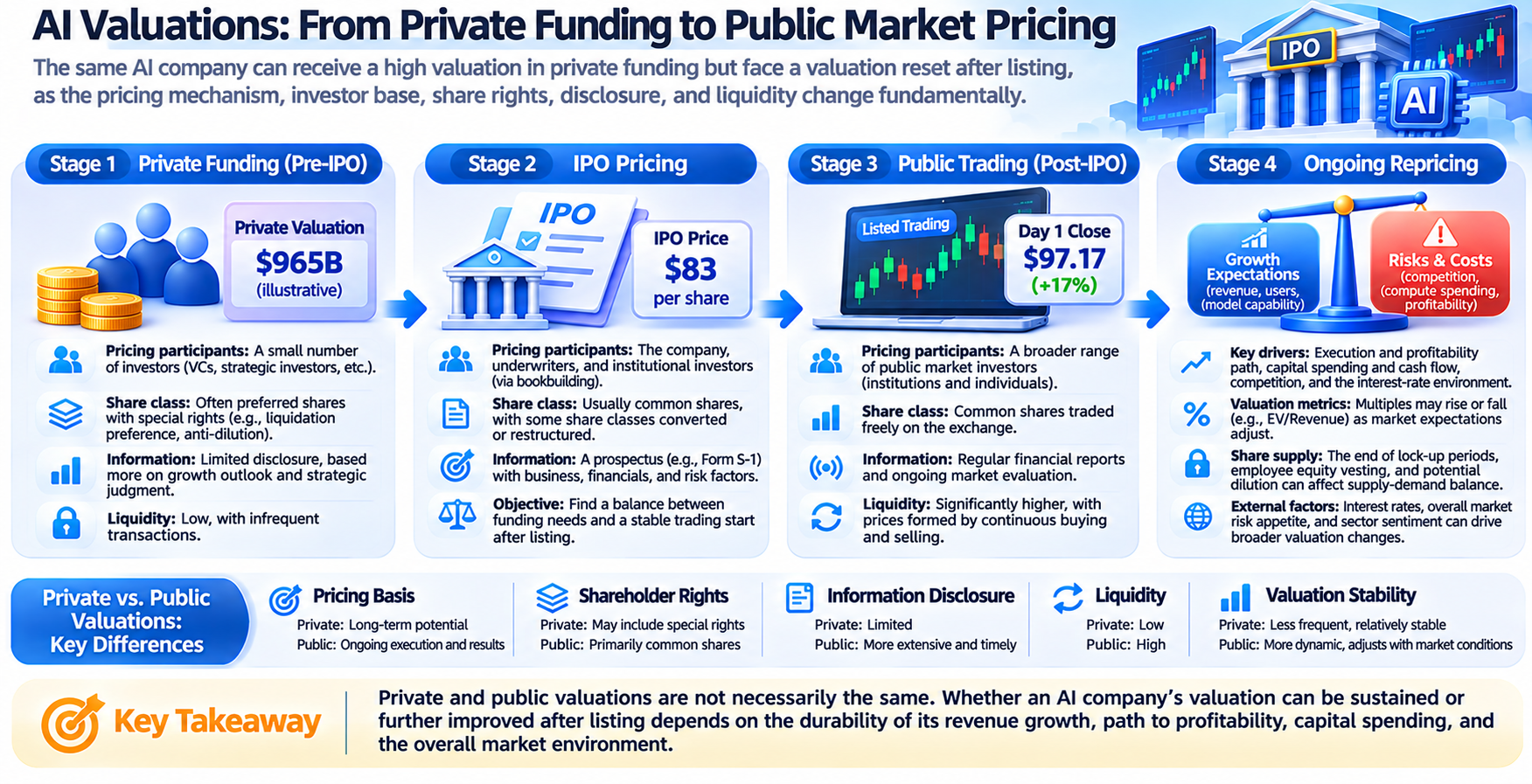
An IPO moves a company from a financing environment that relies primarily on private negotiations into a public securities market with broader investor participation. During the offering process, the company and its underwriters determine the offering price by considering financial performance, comparable company valuations, market conditions, and demand from institutional investors.
This process typically involves soliciting indications of interest and building an order book. Institutional investors can indicate the number of shares they wish to purchase and the price they are willing to pay. The underwriters then assess market demand and negotiate the final pricing with the issuer. The offering price must meet the company's financing needs while also taking into account the sustainability of trading after the listing.
Once the shares begin trading publicly, the pricing mechanism changes further. The market price is no longer determined by a single financing negotiation. Instead, it is continuously influenced by investor buying and selling activity. Different investors may reach different conclusions about AI industry growth, the company's profitability, and valuation risks. These expectations are continuously reflected in the stock price through trading.
Anthropic's 2026 IPO demonstrated this transition. Its initially announced offering price range was $70–$78 per share. The final offering price was raised to $83, and the stock subsequently traded above the offering price on its first day. This shows that the offering price and the public market price are not the same concept.
However, a first-day increase does not mean that the market has completed its long-term valuation assessment. Trading prices during the early stages of an IPO may be affected by share supply, market sentiment, and short-term funding needs. Whether the company can sustain its valuation over the long term will require validation through subsequent financial reports and operating performance.
How Does the Conversion of Preferred Stock into Common Stock Affect a Company's Public Valuation?
During private financing, a company may have multiple series of preferred stock. Investors who participate at different times may have different liquidation, conversion, or other economic rights. Before and after an IPO, these shares generally need to be converted or reorganized in accordance with the company's charter and related arrangements.
For many companies, a qualified IPO may trigger the conversion of preferred stock into common stock. After conversion, some of the original special rights may terminate, and investors' shares enter a more unified public market pricing system. However, the actual conversion ratio and any retained rights must be determined based on the specific prospectus.
This process may change the structure of economic rights among different shareholders and requires investors to reassess the fully diluted share count. In addition to issued common stock, investors must also consider employee stock options, restricted stock units, convertible securities, and other potential shares.
Anthropic's offering documents disclosed relatively complex equity and governance arrangements, including different classes of common stock, a concurrent private placement, and matters related to the settlement of employee equity. These arrangements show that when assessing a large AI company's public valuation, investors cannot simply multiply the stock price by an unverified share count.
For public market investors, understanding the economic interest represented by each share, the fully diluted share count, and governance rights is an important prerequisite for comparing the valuations of different AI companies.
Why Might AI Companies Experience Multiple Compression After Going Public?
Valuation multiple compression refers to a situation in which a company's revenue or earnings continue to grow, but investors are willing to pay less for each unit of revenue or profit. For example, if a company's revenue grows by 40% but the market assigns it a significantly lower revenue multiple, its overall market capitalization may still decline.
For AI companies, valuation multiples are generally affected by growth expectations, profit margins, the competitive landscape, and the cost of capital. During the private financing stage, investors may place greater emphasis on future market share and long-term technological advantages. After a company enters the public markets, quarterly revenue growth, customer retention, cost structure, and cash flow may face more intensive scrutiny.
Suppose an AI company has annual revenue of $10 billion when it goes public, and the market assigns it a 30x revenue multiple, corresponding to an enterprise value of approximately $300 billion. The following year, revenue increases to $15 billion, but the market adjusts the revenue multiple to 15x. The company's enterprise value could then decline to $225 billion.
This example shows that even with 50% revenue growth, a company's valuation could decline by 25%. The key issue is not that the business has stopped growing, but that the market's view of future growth rates, profitability, or risk has changed.
AI companies must pay particular attention to computing-related investment. If rapid revenue growth depends on continued increases in GPU purchases, cloud computing expenses, and research and development costs, investors need to assess how much of the additional revenue can ultimately be converted into profit and free cash flow. Revenue growth alone cannot support any particular valuation level.
Why Do Interest Rates and Market Risk Appetite Affect AI IPO Pricing?
The valuations of high-growth AI companies generally include a substantial portion based on expectations for future earnings. When investors expect a company to generate significant free cash flow several years in the future, changes in interest rates and risk premiums may affect the present value of those future cash flows.
All else being equal, the higher the return required by the market, the lower the present value of distant cash flows is generally expected to be. Therefore, when risk-free interest rates rise or investors demand greater compensation for risk, growth companies that have not yet established stable profitability may face more significant valuation pressure.
Public markets also have strong cross-asset linkages. Institutional investors must allocate capital among technology stocks, bonds, cash, and other assets. When market volatility increases, changes in capital allocation may affect a company's stock price even if its operating data have not changed significantly.
This differs from the private market. Private equity and venture capital funds generally operate on longer investment cycles and are affected by fund terms, exit arrangements, and liquidity restrictions. Public market investors can adjust their positions more frequently, so stock prices may reflect changes in the macroeconomic environment more quickly.
During Anthropic's November 2026 listing, U.S. technology stocks were broadly volatile, while the market also focused on the scale of AI investment, interest rate expectations, and corporate profitability. This shows that the public market valuation of an individual AI company cannot be analyzed independently of the broader financial environment.
Why Can a Small Public Float Amplify Stock Price Volatility in the Early Stages of Trading?
A company's total share count is not the same as the number of shares that can actually be freely traded. After an IPO, some shares held by founders, employees, and early investors may be subject to lock-up agreements or securities resale restrictions. As a result, the public float may be relatively small during the early stages of trading.
When demand is strong but the number of tradable shares is limited, buying pressure may drive the stock price up quickly. However, this increase does not necessarily mean that all shares could be sold at the current market price. The reported total market capitalization is an overall valuation derived from the marginal transaction price, not the cash value that would result if all of the company's shares were actually sold.
Conversely, if demand weakens during the early stages of trading, a smaller public float may also amplify price volatility. For highly valued AI companies, changes in market expectations may trigger significant short-term adjustments.
Therefore, when analyzing an IPO stock, investors need to consider the offering size, public ownership percentage, average daily trading volume, and institutional ownership structure. The first-day gain alone cannot be used to assess long-term investor demand, nor can a short-term trading price be equated directly with a stable intrinsic value.
For a large AI IPO, the offering size may be substantial. However, if the company's overall valuation is even larger, the percentage of shares freely tradable during the early stages may still be limited. Actual liquidity should be assessed using data from the final prospectus and exchange disclosures.
Why Can the Expiration of the Lock-Up Period Become a Point of Valuation Reassessment?
An IPO lock-up period generally restricts certain existing shareholders from selling their shares immediately after the listing. The specific duration and exceptions are determined by the relevant agreements. A period of 180 days is common in the market, but not all IPOs use the same arrangement.
After the lock-up period expires, some previously restricted shares may gradually become eligible for sale. This means that the potential supply of shares increases, and the market must absorb shares that early investors, employees, or other shareholders may choose to sell.
However, the expiration of the lock-up period does not mean that those shareholders will definitely sell. Actual selling decisions are affected by shareholders' investment objectives, tax considerations, trading plans, insider trading restrictions, and expectations for the company's performance. Some long-term investors may continue to hold their shares, while some employees may sell part of their holdings to diversify their assets.
For AI companies, employee equity compensation may be substantial, making lock-up and vesting arrangements important considerations. If a large number of potential shares become tradable around the same time, the market may become more sensitive to changes in supply.
Investors should assess the impact based on the specific number of shares becoming eligible for sale, the conditions for trading, and average daily trading volume, rather than automatically treating the end of a lock-up period as negative. The key issue is the relationship between the additional potential supply and actual market demand.
How Can Investors Distinguish a Declining AI Valuation from Deteriorating Fundamentals?
A decline in an AI company's stock price after its IPO may have different causes. Sometimes it results from operating problems such as slower revenue growth, customer losses, or rising costs. In other cases, it reflects changes in market interest rates, risk appetite, or valuation multiples. These situations require different analytical approaches.
- Investors can assess whether the company's operating metrics are consistent with previous expectations. Revenue growth, gross margin, enterprise customer retention, computing costs, and operating cash flow can help determine whether the business model is improving. If the company continues to grow operationally while its valuation multiple declines, the change may primarily reflect a shift in market pricing standards.
- Investors need to distinguish accounting profit from cash flow. Some AI companies may incur significant expenses or capital expenditures due to equity compensation, research and development, and equipment purchases. Investors should focus on the rate of cash burn, financing needs, and potential future equity dilution rather than relying on a single profit metric to assess the company's value.
- Investors should analyze valuation changes across comparable companies. If multiple AI or cloud computing companies experience valuation compression at the same time, this may reflect a change in industry risk premiums. If only one company deviates significantly, investors should further examine its specific operating risks.
- Investors should also assess whether the company can continue building competitive advantages. AI model capabilities, product pricing, enterprise customer relationships, and the pace of technological iteration all affect long-term earnings expectations. However, these advantages must gradually become evident in verifiable operating data.
Therefore, a valuation decline is neither proof that a company has failed nor an automatic indication that the stock is undervalued. Only by considering future cash flow, the cost of capital, and the competitive landscape can investors determine whether a price change has a reasonable basis.
How Should Investors Build a Valuation Framework for an AI IPO?
For an AI company transitioning from the private market to the public market, investors can build an analytical framework covering capital structure, operating performance, valuation, and market trading conditions.
- Confirm the valuation basis. Investors need to distinguish among the financing-round valuation, IPO valuation, total market capitalization after listing, and enterprise value. They should also review the fully diluted share count, cash, debt, and potential equity compensation. These different valuation measures cannot be compared directly.
- Analyze the quality of financial growth. In addition to revenue, investors should consider revenue growth, gross margin, customer concentration, computing costs, and operating cash flow. For companies that have not yet achieved stable profitability, revenue multiples can be used for an initial comparison, but they must be assessed together with future profit margins and the sustainability of growth.
- Evaluate the public market trading structure. The offering size, public float, lock-up period, institutional ownership, and potential plans for additional offerings may all affect the supply and demand for the stock after listing. For companies with high valuations and significant market attention, short-term prices may not move in sync with changes in fundamentals.
- Develop different operating scenarios. Investors can separately assess valuation under scenarios in which revenue growth remains high, gradually slows, or faces intensified competition, while also considering capital expenditures and financing costs. Scenario analysis does not predict that a particular stock price will necessarily occur. Instead, it identifies the growth assumptions implied by the current price.
- Continue testing whether the company is delivering on the operating expectations established at the time of the IPO. For AI companies, technological progress and user growth can drive revenue expansion, but long-term valuations must ultimately be aligned with sustainable profitability.
Conclusion
The transition from private valuation to public market pricing involves more than a change in financing channels. It is also a change in the mechanism through which an AI company's valuation is formed. Private financing prices may be influenced by investor structure, special equity terms, and long-term growth expectations, while stock prices after listing must continuously withstand the scrutiny of market liquidity, financial disclosures, and risk appetite.
Anthropic's 2026 IPO provides a real-world case study of this process. Its IPO valuation was significantly higher than its previous private financing valuation, but price volatility in public trading also showed that offering pricing and market pricing are not the same process. Whether the valuation can be sustained in the future will still depend on the company's operating performance and the market's assessment of long-term returns.
For investors, the key is not simply to compare the IPO valuation with the previous private valuation. Instead, they need to understand the rights attached to different share classes, the fully diluted share count, the cost of capital, and cash flow expectations. Only by combining capital structure, operating quality, and public market trading mechanisms can investors more accurately assess changes in an AI company's valuation after going public.
FAQ
Why Can an AI Company's IPO Valuation Be Higher Than Its Previous Private Valuation?
This may result from revenue growth, stronger market demand, changes in financing conditions, or greater investor optimism about the company's long-term prospects. However, private and public market valuations may use different bases, so investors need to confirm the share count and related rights when making comparisons.
Does a Private Financing Valuation Equal the Market Value of All the Company's Shares?
Not necessarily. A private valuation is generally derived from the transaction price in a specific financing round. The relevant shares may have special rights, and the actual number of shares traded may be limited.
Does an AI Company's First-Day Gain Mean That Its Valuation Is Reasonable?
No definitive conclusion can be drawn from this alone. The first-day price may be affected by the offering price, public float, and market sentiment. Long-term valuation still requires support from operating data and cash flow.
Why Can an AI Company's Stock Price Decline Even When Its Revenue Is Growing?
If the market lowers the revenue multiple, increases the risk premium, or reduces its expectations for future earnings, the company's market capitalization may decline even as revenue grows.
Does the End of an IPO Lock-Up Period Necessarily Cause the Stock Price to Decline?
Not necessarily. The expiration of a lock-up period increases the number of potentially sellable shares. The actual impact on the price depends on shareholders' willingness to sell, market demand, and trading liquidity.
What Are the Most Important Metrics for Analyzing an AI IPO Valuation?
Investors need to consider the fully diluted market capitalization, enterprise value, revenue growth, gross margin, cash burn, capital expenditures, equity compensation, public float, and lock-up arrangements. They should not rely on a single valuation multiple.