As global AI infrastructure development enters a phase of large-scale expansion, capital markets are shifting their attention from technological innovation and equity valuations to debt financing and financial stability in the artificial intelligence sector. In a recent interview, Arthur Hayes, Chief Investment Officer of Maelstrom, suggested that credit expansion in the AI industry could trigger future financial market volatility and potentially lead to monetary policy adjustments.
This discussion is not based solely on concerns that technology stocks may be overvalued. Data center construction, advanced chip purchases, power infrastructure deployment, and long-term computing capacity contracts are generating substantial capital needs. As technology companies increasingly use corporate bonds, private credit, and structured financing to support infrastructure development, the operating risks of the AI industry are becoming more closely linked to credit markets.
However, AI equity valuation corrections, technology company debt defaults, and systemic financial crises represent different levels of risk. Even if AI investments generate lower-than-expected returns, this does not mean the global financial system will necessarily repeat the 2008 financial crisis. The key issue is what type of debt structures AI infrastructure investment is creating and how related risks may be transmitted through the financial system.
Why Is AI Infrastructure Shifting From Cash Flow Funding to Debt Financing?
Traditional internet companies generally operate with strong economies of scale. After initial development is completed, software products, advertising platforms, and digital services can serve more users at relatively low marginal costs. AI infrastructure expansion has different capital characteristics. Training and operating large AI models requires continued investment in GPUs, servers, data centers, power supplies, network equipment, and cooling systems. These assets require not only significant upfront investment but also ongoing operating, maintenance, and equipment replacement costs.
In the past, large technology companies primarily relied on operating cash flow from advertising, cloud computing, software subscriptions, and e-commerce businesses to support capital expenditures. As AI investment continues to grow, some companies have begun increasing external financing to reduce the use of existing cash reserves for infrastructure construction. At the same time, emerging computing capacity service providers and specialized data center operators also need debt financing to support business expansion.
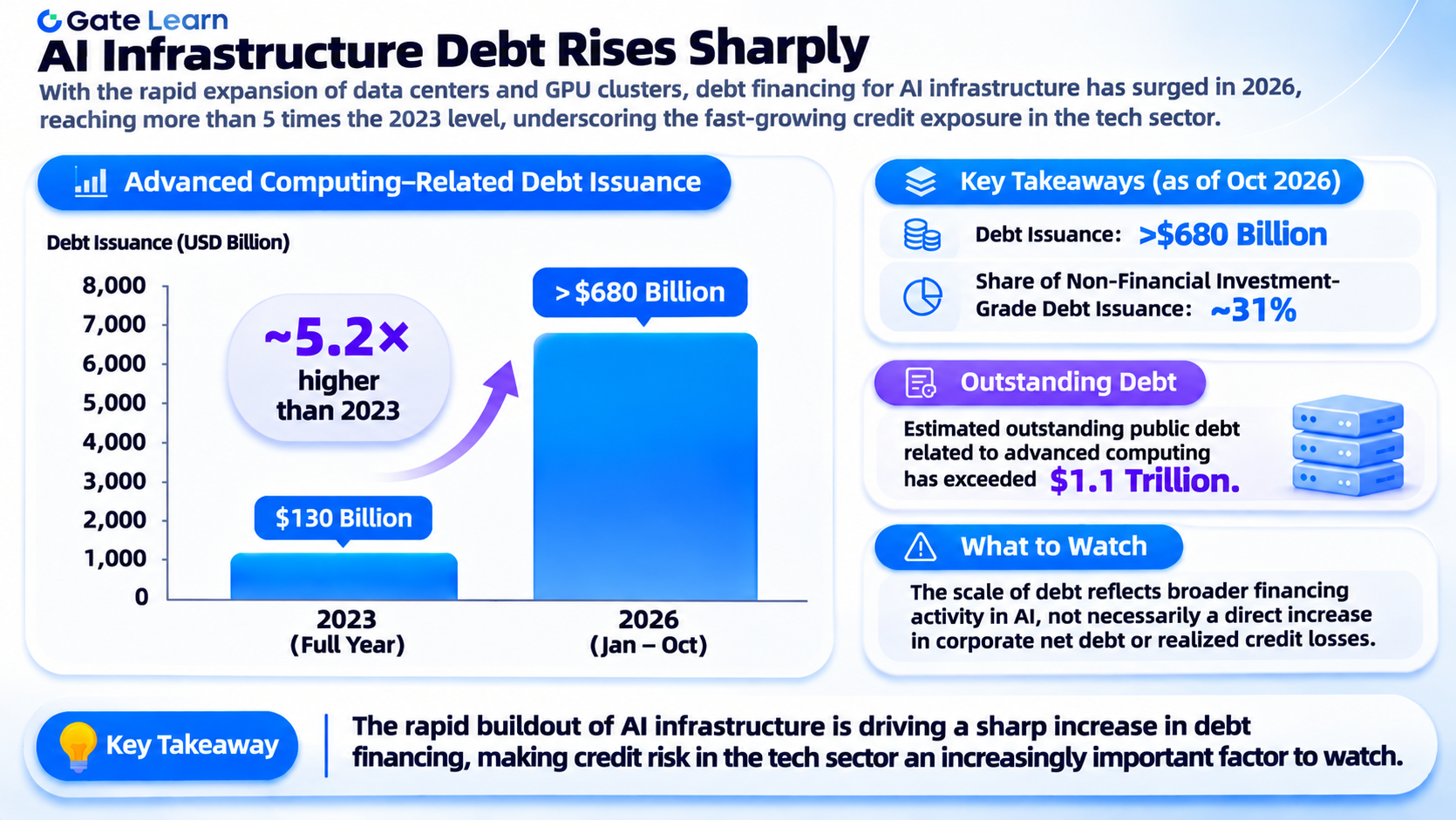
Financing data related to advanced computing in the Federal Reserve's November 2026 Financial Stability Report shows that, as of October of that year, related debt issuance had exceeded $680 billion, compared with approximately $130 billion for all of 2023. Advanced computing-related debt also rose from less than 6% to approximately 31% of investment-grade bond issuance by non-financial companies, while the estimated amount of related outstanding public debt exceeded $1.1 trillion.
These figures show that advanced computing and related infrastructure are becoming an important source of financing demand in credit markets. However, the volume of debt issuance does not necessarily equal net new corporate debt, as it may include refinancing activities. It also should not be viewed directly as potential credit losses.
Debt financing itself is not sufficient evidence of worsening risk. For technology companies with stable revenue, adequate cash reserves, and strong debt-servicing capacity, using long-term financing to support infrastructure construction can be commercially reasonable. The real question is whether future cash flows generated by AI businesses can match rising capital investment and debt repayment obligations.
Where Does the Funding for AI Data Center Construction Come From?
AI infrastructure is not built and owned entirely by large technology companies. With the growth of specialized data center operators, Neocloud computing capacity service providers, and infrastructure investment institutions, the AI industry has developed a multi-layered financing system.
Large cloud computing companies typically have established core businesses and relatively high credit ratings, allowing them to obtain construction funding through operating cash flow and corporate bond markets. In contrast, some emerging computing capacity service providers have not yet developed diversified revenue structures and rely more heavily on bank loans, private credit, equipment-backed financing, and long-term customer contracts.
In addition, some data center projects use standalone project financing structures. Infrastructure investment institutions establish project companies that are responsible for building and holding the related assets, then provide services to technology companies through long-term lease agreements. Creditors assess financing risk primarily based on the project's future rental income, customers' ability to perform under contracts, and asset values.
Different financing methods mean different parties bear the risks. Corporate bonds primarily depend on a company's overall debt-servicing capacity, project financing focuses more on the cash flows of specific infrastructure assets, and GPU-backed financing is affected by both equipment market value and computing capacity leasing income.
As financing channels continue to expand, risks in the AI industry are no longer limited to technology company shareholders. They increasingly involve bond investors, private credit funds, banks, insurance institutions, and other long-term capital providers. Understanding how this capital enters the AI industry and who ultimately bears investment losses is an important prerequisite for assessing potential credit risks.
Why Could GPU Technology Iteration Amplify Debt Risks?
In traditional asset-backed financing, lenders typically determine financing terms based on the value, useful life, and disposal capability of collateral assets. Land, buildings, and certain industrial equipment also face market price fluctuations, but they generally have relatively long physical usage cycles.
AI computing equipment has a strong technology iteration component. The economic value of high-performance GPUs depends not only on whether the equipment can operate normally, but also on its computing performance, energy efficiency, software compatibility, and ability to meet market demand. Even if a group of GPUs remains physically usable, the leasing price and resale value of older equipment may decline if a new generation of chips can provide higher computing efficiency at lower energy costs.
Assume that a computing capacity service provider purchases $1 billion in GPUs through loans and plans to repay the related debt using leasing income over the next five years. If the equipment experiences a significant decline in economic value in the third year and computing capacity rental prices fall below original expectations, the company may face both declining revenue and depreciating collateral.
For the borrowing company, this means the operating cash flow originally intended for debt repayment may be reduced. For creditors, even if they can dispose of the collateralized equipment after a default, they may not be able to recover funds at the value originally estimated.
However, older-generation GPUs do not necessarily lose economic value simply because new equipment enters the market. Model inference, computing capacity demand from small and medium-sized enterprises, and different computing tasks may still provide use cases for older equipment. The core challenge of GPU-backed financing is not that equipment will inevitably depreciate quickly, but that there is substantial uncertainty in forecasting its future economic value.
Why Could AI Infrastructure Face Asset and Debt Maturity Mismatches?
Maturity mismatch is an important concept in financial risk management. In AI infrastructure, attention is needed not only on mismatches between the capital recovery period and debt maturity, but also on differences between the economic useful life of assets and financing terms.
Data center buildings, power infrastructure, and certain network infrastructure can have long usage cycles, while GPUs and servers may face more frequent technology upgrades. If a company uses long-term debt to finance assets with relatively short economic useful lives, it may reach a point where equipment needs replacement while the original financing obligations remain outstanding.
For example, a company may use 10-year financing to build AI infrastructure, with part of the funds used to purchase computing equipment expected to require replacement after several years. When the equipment enters its replacement cycle, the company must not only continue repaying its existing debt but may also need additional financing to purchase new-generation equipment. If financing costs rise or computing capacity leasing revenue declines at that time, the company's financial pressure may increase further.
This issue is also related to technology companies' accounting depreciation policies. Accounting depreciation periods determine how companies allocate asset costs in financial statements, but they do not directly determine the actual economic useful life of equipment. Extending depreciation periods can reduce depreciation expenses recognized in a given accounting period, but it does not directly increase an asset's market value or eliminate debt repayment obligations.
Therefore, analyzing the financial sustainability of AI infrastructure investment requires more than reviewing book profits. It also requires examining equipment replacement cycles, actual capital expenditures, debt maturity structures, and free cash flow.
How Do Off-Balance-Sheet Financing and Circular Financing Increase the Difficulty of Identifying Risks?
As AI infrastructure investment expands, some technology companies are using special purpose vehicles (SPVs), joint ventures, and long-term lease agreements to obtain the computing capacity resources they need.
In a typical structure, an infrastructure investment institution establishes an independent project company that builds and holds data centers, while raising construction funding through equity capital and debt financing. Large technology companies obtain the right to use the related infrastructure through long-term leases or computing capacity purchase contracts, while the project company uses future rental income and customer contracts to support financing.
This model can allocate construction expenditures to specialized infrastructure investment institutions and reduce the funding required for technology companies to directly hold the related assets. However, in economic substance, long-term purchase agreements, minimum payment commitments, and financing guarantees may also create ongoing payment obligations. The fact that some project debt does not appear directly on a technology company's own balance sheet does not mean the company has no financial risk.
A November 2026 financial stability study by the European Central Bank estimated that, as of the second quarter of that year, the combined off-balance-sheet commitments of certain large U.S. technology companies exceeded $4 trillion. This figure includes various contractual commitments and does not equal financial debt already incurred or directly represent the potential scale of defaults. The risk must be assessed further based on contract terms, payment conditions, and guarantee arrangements.
In addition to off-balance-sheet financing, capital and commercial relationships within the AI industry chain also deserve attention. Chip companies may sell equipment to computing capacity operators while also providing capital support through equity investments. Cloud computing companies may also invest in AI model companies, which then use the related funds to purchase cloud computing services.
These partnerships can be commercially reasonable. However, if procurement volumes within the industry chain depend heavily on continued financing rather than business revenue generated by independent end customers, capital ties between companies may become a channel for risk transmission. Once external financing conditions deteriorate, some companies may simultaneously face reduced funding sources, declining customer purchasing capacity, and pressure to perform under contracts.
The key to assessing such risks is not whether companies have investment and procurement relationships, but whether the ultimate cash flows come from genuine, independent, and sustainable market demand.
How Does Private Credit Transmit AI Industry Risks to the Financial System?
Private credit generally refers to debt financing provided to companies or projects by non-bank financial institutions through private markets. Compared with public bond markets, private credit can offer more flexible loan terms tailored to borrowers' asset structures and business characteristics, making it an important financing channel for some computing capacity service providers and infrastructure projects.
Private credit funds may obtain capital from insurance companies, pension funds, sovereign wealth funds, and other institutional investors. Some funds and project financing entities may also improve capital efficiency through bank credit lines or other borrowing arrangements. This means that even if AI companies do not borrow heavily from traditional commercial banks directly, their credit risks may still become connected to the banking system through non-bank financial institutions.
Unlike publicly traded bonds, private credit assets typically lack continuous market pricing. Valuations rely more heavily on periodic assessments and internal risk models. When the operating conditions of borrowers change, adjustments to the value of related assets may be delayed. If multiple infrastructure projects experience deteriorating cash flows at the same time, risk identification, asset impairments, and financing term adjustments may occur in a concentrated manner.
However, private credit does not inherently mean higher systemic risk. Some funds use long-term closed-end capital structures, which can reduce liquidity pressure caused by concentrated short-term redemptions. Loan seniority, collateral arrangements, covenant terms, and investors' own loss-absorption capacity also affect the final allocation of risk.
The real concern is whether related credit assets are overly concentrated in similar business models, customer groups, and collateral assets, and whether financial institutions have leverage and financing relationships that could amplify losses.
Why Does AI Technology Success Not Necessarily Mean Infrastructure Investments Will Generate Returns?
Technological progress and returns on capital investment are two different economic issues. AI can improve productivity in industries such as software development, manufacturing, healthcare, education, and finance, but these socioeconomic benefits do not necessarily translate entirely into profits for AI infrastructure operators.
For example, continued improvements in model inference efficiency may reduce the computing resources needed to complete the same tasks. Lower computing costs may also stimulate demand for more AI applications, allowing total computing capacity usage to continue growing. However, the final outcome still depends on the pace of demand growth, changes in computing capacity prices, and how profits are distributed throughout the industry chain.
For infrastructure projects built through debt financing, companies need to retain sufficient cash flow to repay debt after paying for electricity, operations, equipment upgrades, and other expenses. Even if the number of AI application users continues to increase, project revenue may still fall below initial investment expectations if market competition causes computing capacity service prices to decline rapidly.
The development of the internet provides a similar historical example. The internet ultimately transformed the global economy, but the technology investment boom around 2000 still led some telecommunications network and internet companies to experience excess capacity, asset impairments, and capital losses. A technology having long-term value does not mean all investments built around that technology will generate reasonable economic returns.
This is also an important difference between credit markets and equity markets. Equity investors may seek potential returns from a company's future high growth, while creditors focus more on whether borrowers can make timely principal and interest payments according to their contracts. Even if the market remains optimistic about AI's long-term development, credit markets may reassess financing risk because of deteriorating short-term corporate cash flows.
How Do AI Industry Debt Risks Differ From the 2008 Financial Crisis?
Comparing AI credit expansion with the 2008 financial crisis has some research value, but the two differ significantly in their underlying assets, borrowers, and risk transmission mechanisms.
The core risks in the 2008 financial crisis came from real estate credit, subprime mortgages, and related securitized products. As housing prices declined, loan defaults increased, and credit relationships between financial institutions deteriorated, localized asset losses eventually developed into broad financial system stress.
Current AI credit expansion is mainly centered on technology company capital expenditures, data center projects, computing equipment, and long-term service contracts. The ability to service related debt depends more on corporate operating cash flow, computing capacity leasing income, and customers' ability to perform under contracts. Potential risks are concentrated in equipment depreciation, excess capacity, weaker-than-expected commercialization revenue, and refinancing difficulties.
Another important difference is the financial condition of borrowers. Some large technology companies currently still have established core businesses, strong operating cash flow, and high credit ratings. They may absorb operating shocks by adjusting the pace of capital expenditures, reducing other capital allocations, or using existing financial resources. This differs substantially from high-risk borrowers that lack debt-servicing capacity.
However, this does not mean AI credit expansion has no systemic risk. If financial institutions hold large amounts of highly correlated credit assets, and these assets collectively depend on long-term purchase contracts from a small number of technology companies, adjustments to a single company's business strategy may affect multiple infrastructure projects at the same time.
Industry credit risk can develop into a systemic financial issue only when losses are large enough, financial institutions' exposures are highly concentrated, and financing contraction, forced selling, and liquidity pressure occur simultaneously.
Therefore, determining whether the AI industry could become the source of the next financial crisis requires more than comparing debt levels. It also requires analyzing debt quality, risk concentration, financial institution leverage, and the loss-absorption capacity of the overall financial system.
How Could Expanding AI Credit Risks Affect Global Financial Markets?
Credit risks in the AI industry may first appear as a slowdown in infrastructure investment. If commercialization revenue falls below expectations, large technology companies may reduce new capital expenditures, delay data center construction, or reassess long-term computing capacity contracts. This could further affect orders for chip manufacturing, servers, optical modules, power equipment, and liquid cooling systems.
As the cash flows of computing capacity operators and data center projects decline, creditors may raise financing rates, tighten lending terms, or require companies to provide additional collateral. Deteriorating financing conditions may further limit companies' ability to upgrade equipment and build projects, creating a mutually reinforcing relationship between operating pressure and credit pressure.
If losses from related credit assets spread further to private credit funds, insurance companies, and other financial institutions, overall market risk appetite may decline. To reduce risk exposure or meet liquidity needs, financial institutions may reduce new lending and adjust allocations to equities, bonds, and other financial assets.
This process reflects a potential feedback mechanism for credit risk: industry operating pressure tightens financing conditions, while tighter financing conditions further weaken industry investment and operating capacity.
However, risk transmission is not inevitable. Corporate cash reserves, debt restructuring, capital injections, and new market demand may ease pressure at different stages. The key to assessing systemic risk is determining whether industry operating pressure has exceeded the loss-absorption capacity of the relevant companies and financial institutions.
If the AI Bubble Bursts, Could Monetary Easing Become a New Driver of Bitcoin Growth?
One potential scenario proposed by Arthur Hayes is that expanding credit risks in the AI industry could trigger financial market turbulence, prompting central banks to adopt monetary easing measures and creating a new liquidity environment for Bitcoin.
This logic has some basis in macro-financial transmission, but there is no simple synchronized relationship between credit crises and monetary easing.
In the early stages of expanding credit risk, investors typically need to reduce leverage, increase cash reserves, and meet margin requirements. Bitcoin, as an asset with relatively high liquidity and significant price volatility, may also face capital outflows and concentrated selling pressure. Even investors who remain optimistic about Bitcoin over the long term may reduce their holdings because of short-term funding needs.
If credit risks further affect economic growth and financial market stability, central banks may ease financing pressure through interest rate cuts, liquidity support tools, or other measures. However, whether policy shifts toward easing still depends on inflation levels, employment conditions, financial institutions' risk exposures, and the broader economic environment. If credit risks coexist with high inflation, central banks' policy flexibility may also be constrained.
Even if monetary policy ultimately shifts toward easing, new liquidity may not flow directly into the Bitcoin market. Bonds, gold, equities, and other financial assets will also compete for global capital.
Therefore, a connection between AI credit risk and Bitcoin price gains would need to pass through several stages, including risk release, policy adjustments, improved liquidity, and actual capital allocation. Changes at any stage may cause eventual market performance to deviate from initial expectations.
Which Indicators Can Help Identify Credit Risks in the AI Industry?
Compared with focusing only on technology stock prices and AI company valuations, credit risk analysis places greater emphasis on funding sources, asset quality, cash flow, and contractual obligations. Market participants can assess whether potential risks are accumulating across the following dimensions.
-
Corporate cash flow and debt-servicing capacity: Monitor capital expenditures, operating cash flow, free cash flow, and interest coverage to determine whether companies can meet debt obligations while maintaining infrastructure investment.
-
Credit market risk pricing: Monitor corporate bond credit spreads, CDS spreads, and refinancing costs to assess whether creditors are reassessing the credit risks of technology companies.
-
Infrastructure operating quality: Monitor GPU leasing prices, data center utilization rates, energy costs, and equipment resale market values to assess whether infrastructure can continue generating expected revenue.
-
Customer structure and contractual obligations: Monitor customer concentration, long-term purchase agreements, minimum payment commitments, and financing guarantees to identify risks that traditional balance sheet analysis may overlook.
-
Financial system risk exposure: Monitor the asset quality of private credit funds, leverage levels at financial institutions, and the concentration of related credit assets to assess whether industry risks are spreading into the financial system.
These indicators need to be validated against one another. For example, wider corporate bond spreads may result from increased bond supply or changes in market liquidity and may not necessarily indicate rising corporate default risk. A short-term decline in free cash flow at technology companies may also simply reflect a normal phase of infrastructure construction.
Only when operating cash flow, credit pricing, asset quality, and financing conditions all show sustained deterioration is it necessary to pay greater attention to the possibility that risks may be transmitted from the industry level to the financial system.
Summary
AI infrastructure construction is creating closer links between the technology industry and global credit markets. As corporate bonds, private credit, project financing, and off-balance-sheet funding arrangements continue to expand, the risks of AI investment are no longer limited to changes in equity valuations. They also involve asset economic lifespans, long-term debt repayment obligations, and financial institutions' risk exposures.
AI technology development continues to have broad economic potential, and some large technology companies also have strong operating cash flow and financial buffers. However, technological success does not guarantee that all infrastructure investments will generate reasonable returns. If computing capacity demand, leasing income, and commercialization profitability remain below expectations over the long term, some highly leveraged companies and projects may face credit pressure.
Whether the technology industry becomes the source of the next credit crisis will ultimately depend on the pace of debt expansion, the quality of underlying assets, the concentration of risks in the financial system, and loss-absorption capacity. Rather than predicting when an AI bubble may burst, it is more important to focus on whether current capital investment can gradually be converted into sustainable operating cash flow.
FAQ
Why Do AI Companies Need Significant Debt Financing?
AI infrastructure requires ongoing purchases of computing equipment, construction of data centers, and supporting energy facilities. When capital expenditures exceed the amount of internal funding that companies are willing or able to use, they may obtain external funding through bonds, loans, and project financing.
What Is GPU-Backed Financing?
GPU-backed financing is a funding method that uses computing equipment and related assets as partial financing support. Its risks are related to equipment market value, leasing income, technology iteration, and the ability to dispose of assets.
What Is Off-Balance-Sheet Financing for AI Infrastructure?
Off-balance-sheet financing generally involves obtaining infrastructure resources through structures such as independent project companies and lease agreements. This keeps some project debt from appearing directly on technology companies' own balance sheets, but companies may still bear contractual payment or guarantee obligations.
Will an AI Bubble Burst Necessarily Trigger a Financial Crisis?
Not necessarily. Industry valuation corrections, corporate defaults, and systemic financial crises represent different levels of risk. Whether a financial crisis occurs depends on the scale of credit losses, the degree of interconnectedness among financial institutions, and liquidity pressure.
Why Is Private Credit Worth Monitoring?
Private credit is an important source of financing for some AI infrastructure projects. Its risks may be transmitted to the broader financial system through funds, insurance companies, institutional investors, and bank financing relationships.
What Is a Credit Spread?
A credit spread generally refers to the difference between the yield of a credit bond and the yield of a comparable lower-risk benchmark. It can reflect changes in credit risk, market liquidity, and other risk premiums.
Could an AI Credit Crisis Drive Bitcoin Higher?
Not necessarily. The early stages of spreading credit risk may lead to selling pressure on Bitcoin. Bitcoin may receive corresponding liquidity support only if monetary policy subsequently shifts toward easing and new capital actually flows into the crypto market.