On November 10, 2026, Wells Fargo upgraded its investment view on the U.S. AI infrastructure sector from negative to neutral after a significant correction in semiconductor stocks improved valuations and risk-reward profiles. However, the firm also noted that AI capital expenditures may contribute significantly less to corporate earnings growth by 2028, when slower spending growth and rising depreciation expenses could pressure earnings per share.
This means that building more AI data centers does not necessarily translate into higher future profits for related companies. For investors, the more important questions are: When will the money invested today translate into revenue? How will the depreciation of equipment such as GPUs affect profits? If AI demand continues to grow but at a slower pace than the market expects, how will technology stock valuations adjust? This article examines these questions.
Key Takeaways
-
AI capital expenditures remain elevated. Large technology companies continue to invest in GPUs, servers, data centers, and power infrastructure, driving demand across the supply chain.
-
2028 is a potential risk-monitoring window, not a confirmed industry turning point. The market is concerned about slower capital expenditure growth alongside continued increases in depreciation expenses from earlier investments.
-
There is a timing gap between capital expenditures and profit recognition. Companies experience cash outflows when purchasing equipment, while the related costs are generally recognized gradually in the income statement over the useful life of the assets.
-
The pace of GPU upgrades may affect investment returns. Performance improvements in new-generation chips may shorten the economic useful life of older equipment.
-
Revenue growth from AI data centers does not necessarily mean improved free cash flow. Equipment upgrades, financing costs, and operating expenses may continue to consume capital.
-
Risks differ across companies in the supply chain. Chip suppliers, cloud computing platforms, and data center operators face materially different pressures on earnings and cash flow.
Why Is AI Data Center Investment Still Growing?
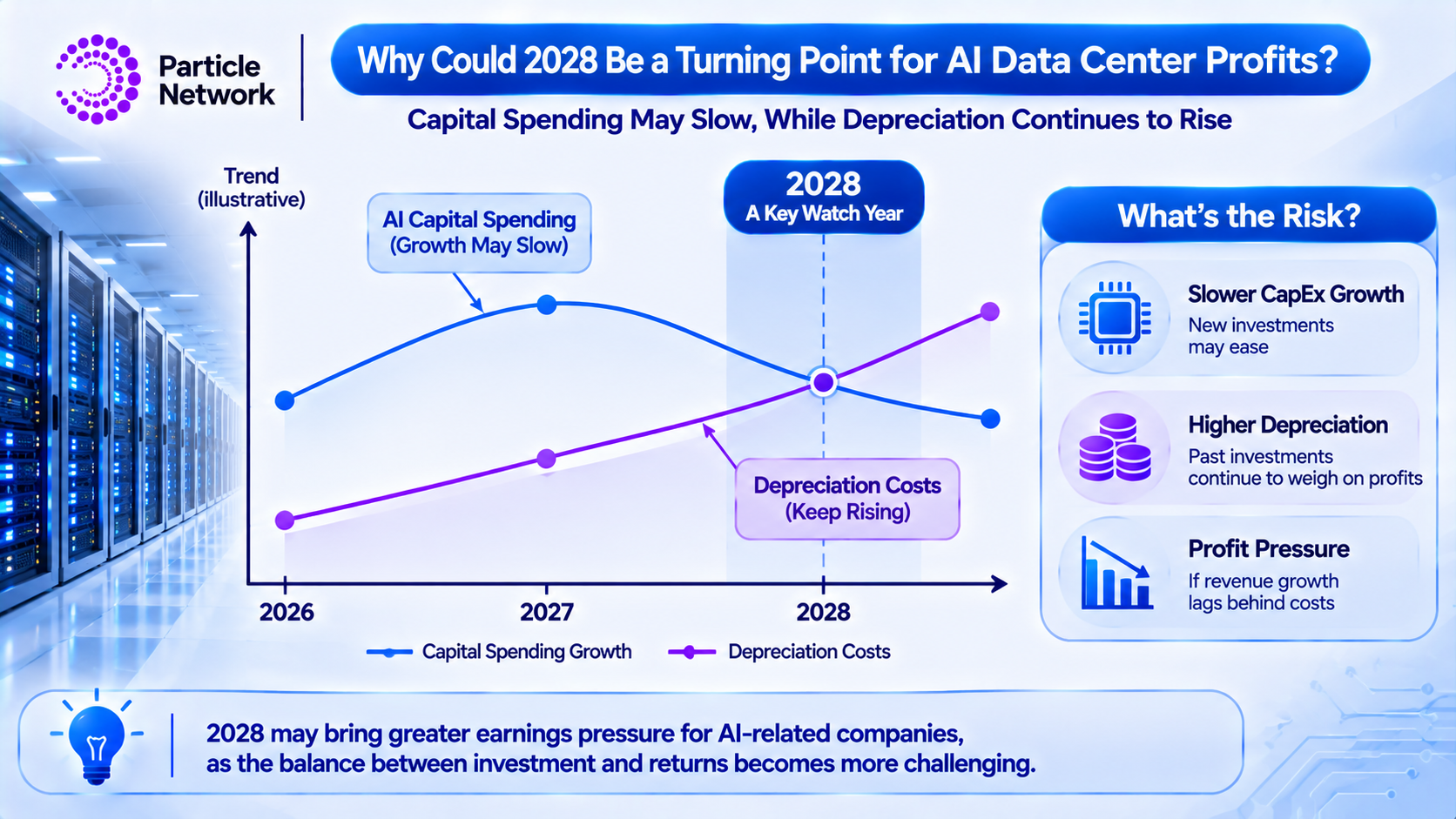
The direct driver of AI data center investment growth is continued demand for computing resources from AI model training, inference, and enterprise applications.
Compared with traditional data centers, AI data centers typically require more high-performance GPUs, accelerators, high-speed networks, and specialized cooling systems. Large-model training depends on substantial parallel computing resources. As AI Agents, enterprise automation, and multimodal applications develop, inference workloads may also continue to expand.
In 2026, AI infrastructure investment remains substantial. Data released by IDC on November 6 showed that global AI infrastructure spending reached $121.4 billion in the second quarter of 2026, up approximately 53% year over year, and raised its full-year forecast to $521 billion. This figure primarily covers infrastructure such as AI servers and storage and is not fully comparable to broader capital expenditures that include land, buildings, power, and other construction projects.
Meanwhile, JPMorgan expects global AI-related capital expenditures to reach approximately $900 billion in 2026. While figures differ across measurement scopes, they all reflect AI's role as an important driver of global technology infrastructure investment.
However, a larger investment scale does not mean that all new computing capacity can generate revenue immediately. Data centers may go through a lengthy process from planning and approvals to construction and operation. Even after GPUs have been purchased, power, networking, cooling systems, and customer workloads must be in place before usable computing capacity can be created. Therefore, AI capital expenditure growth reflects companies' investment expectations for future demand, rather than profits already realized.
Why Could 2028 Become a Turning Point for AI Earnings Pressure?
Attention on 2028 mainly stems from potential changes in the relationship among AI capital expenditure growth, revenue realization, and equipment depreciation.
During the rapid expansion of AI infrastructure, capital expenditures by large technology companies can directly increase orders for chips, servers, network equipment, and data center service providers. These procurement expenses become revenue for upstream companies and support earnings growth across the related supply chain.
However, capital expenditures cannot maintain the same high growth rate indefinitely. After companies complete their first round of large-scale infrastructure construction, additional investment may gradually shift toward equipment upgrades, capacity optimization, and more targeted expansion. Even if total investment remains high, annual growth may slow significantly.
In its November 2026 analysis, Wells Fargo noted that AI-related capital expenditures contributed approximately 8 percentage points to S&P 500 earnings growth over the past year. This contribution is expected to continue in 2027 but may weaken significantly in 2028 as depreciation costs rise.
The core of this view is not a prediction that AI data center construction will stop in 2028. Rather, it reflects concern that two forces may change at the same time: on one hand, new capital expenditures may make a smaller marginal contribution to supply chain revenue growth; on the other hand, equipment purchased previously may begin generating sustained, higher depreciation expenses.
If additional revenue from AI services cannot cover depreciation, operating, and financing costs in a timely manner, profit growth may be constrained.
However, this remains a scenario-based forecast rather than a certain outcome. If AI commercialization accelerates, computing capacity utilization improves, or per-unit computing costs decline, additional revenue may still offset these cost pressures. Therefore, 2028 is better understood as an important monitoring window for the market to test AI investment returns, rather than a confirmed date of industry decline.
Why Do AI Data Center Capital Expenditures Turn Into Depreciation Pressure?
Capital expenditure (CapEx) refers to spending by companies to purchase or build long-term assets, such as GPUs, servers, data center buildings, and power equipment.
Unlike day-to-day operating expenses, expenditures that qualify for capitalization are generally not fully recognized in the income statement in the period of purchase. Instead, they are first recognized as assets and then depreciated gradually over their estimated useful lives. For example, if a company purchases $10 billion worth of server equipment and uses straight-line depreciation over five years with no residual value, it may recognize approximately $2 billion in depreciation expense each year.
This means that equipment purchases create large cash outflows upfront, while their impact on the income statement may continue for years. This timing gap is particularly important for AI data centers.
If companies make large-scale equipment purchases in both 2026 and 2027, depreciation expenses from multiple investment batches may affect the income statement simultaneously by 2028. Even if new capital expenditure growth slows that year, depreciation costs from earlier investments will not disappear immediately.
In addition, AI chips are upgraded rapidly. As new-generation GPUs offer higher computing performance and energy efficiency, the economic value of older equipment may decline, requiring companies to reassess estimated useful lives and impairment risks.
However, useful lives vary significantly across different asset types. Data center buildings, power systems, and cooling facilities generally have longer useful lives, while computing equipment such as GPUs and servers has relatively shorter upgrade cycles. Therefore, the entire investment in a data center cannot be assessed based on the GPU upgrade cycle. The key to depreciation pressure is not only how much was invested, but also which assets were purchased, how long they are expected to be used, and whether the related equipment can generate sufficient revenue over its lifecycle.
Why Does Growing AI Demand Not Necessarily Lead to Higher Profits?
Growing AI demand can increase computing capacity usage, but a company's ultimate profitability also depends on service pricing, operating costs, and asset utilization. For large cloud computing companies, AI revenue mainly comes from computing capacity rentals, cloud platform services, and related software products. If customer demand continues to grow, companies can increase revenue by improving server utilization and expanding service scale.
However, if large volumes of new data center capacity begin operating around the same time, the market may face more intense price competition. Even if computing resource usage continues to grow, revenue per unit of computing capacity may decline.
At the same time, costs for GPU procurement, power, cooling, networking, and maintenance remain. Some companies may also need to pay financing interest or purchase additional computing resources from partners. As a result, AI businesses may experience revenue growth alongside declining profit margins.
Improvements in AI model efficiency may also change the structure of computing demand. New models may lower the computing cost of individual tasks through more efficient inference methods. This can expand the range of AI applications, but it may also affect the pricing power of some computing services.
If demand growth from lower costs is fast enough, companies may still achieve higher profits. If market competition causes prices to decline faster than costs improve, profitability may come under pressure. Therefore, assessing returns on AI data center investments requires observing actual computing resource utilization, service revenue, operating margins, and customer demand rather than simply the number of GPUs deployed.
Why Might Free Cash Flow Be More Important Than Revenue Growth?
Free cash flow (FCF) is commonly used to measure the funds remaining after a company generates cash from operating activities and deducts capital expenditures. For AI data center companies with high capital investment, free cash flow can indicate whether they need to continue relying on external financing to support expansion.
For example, a cloud computing company may experience continued growth in operating cash flow. However, if spending on GPUs and data center construction grows faster, its free cash flow may still decline or even turn negative.
This does not necessarily mean the company has failed operationally. Companies in a rapid expansion phase may deliberately increase investment to pursue greater future market share. However, if high capital expenditures cannot translate into sufficient revenue and cash returns over an extended period, the company may face greater financing pressure.
In an October 2026 report, JPMorgan noted that financing methods for AI infrastructure investment are changing. Some large technology companies are increasingly using debt and equity financing to support construction rather than relying solely on their own free cash flow.
This shift does not affect all companies equally. Large technology companies with established cloud businesses, advertising revenue, and substantial cash reserves generally have stronger financing capabilities. By contrast, data center operators that rely heavily on a single customer, external debt, or continued equity financing may be more sensitive to interest rates and capital market conditions.
For investors, revenue growth is only the first layer of analysis. More importantly, they need to determine whether additional revenue can generate operating cash flow and whether future capital expenditures will still need to increase continuously.
6. What Different Risks Do Chip Suppliers, Cloud Computing Companies, and Data Center Operators Face?
The AI data center supply chain involves multiple segments, but changes in capital expenditures do not affect all companies in the same way.
| Company Type |
Representative Companies |
Main Revenue Sources |
Key Risks |
| AI chip suppliers |
NVIDIA, AMD |
Sales of GPUs, accelerators, and related products |
Slower customer procurement growth, competition, and changes in gross margin |
| Cloud computing platforms |
Microsoft, Amazon, Alphabet |
Cloud computing and AI services |
Capital expenditures, depreciation, service pricing, and investment returns |
| Data center and computing service providers |
CoreWeave, IREN, and others |
Computing capacity rentals, data centers, and related services |
Financing costs, equipment upgrades, and customer concentration |
| Power and infrastructure suppliers |
Power equipment, cooling, and networking companies |
Equipment supply and engineering services |
Project delays, order cycles, and changes in construction demand |
For chip companies such as NVIDIA and AMD, capital expenditures by major customers directly affect demand for product purchases. If cloud computing companies slow the growth of new GPU procurement, revenue growth for chip suppliers may slow.
However, chip suppliers generally do not bear depreciation costs for all of their customers' data center equipment. Their risks are therefore mainly reflected in orders, product pricing, competition, and inventory. For cloud computing platforms such as Microsoft, Amazon, and Alphabet, AI investment supports cloud business development on one hand while also creating continued capital expenditures and depreciation expenses on the other.
These companies need to demonstrate that additional investment can generate sufficient returns by improving computing capacity utilization, expanding AI service revenue, and increasing operating efficiency. For computing service providers such as CoreWeave, the risk structure may be more complex. Companies need to build or lease infrastructure first and then recover their investments through long-term customer contracts. If equipment deliveries are delayed, customer demand changes, or financing costs rise, cash flow may be affected.
Therefore, growth in AI capital expenditures is not a shared benefit for all companies. It is a source of revenue for upstream suppliers while also representing an investment cost for downstream purchasers.
Why Could Power, Financing, and Construction Cycles Affect Earnings in 2028?
The pace of AI data center construction depends not only on GPU supply but also on power, land, approvals, and financing conditions. Large AI data centers require stable power supply and high-density cooling facilities. Even if companies have secured GPUs, they may be unable to begin operations on time if grid connections, substation construction, or cooling systems are not yet complete.
This timing gap may delay revenue realization. For example, a data center may have been scheduled to begin operations in 2027 but be delayed until 2028 due to postponed power connections. If some equipment and construction expenditures have already been incurred, the company may face a longer period of capital being tied up, higher financing expenses, and a delayed investment payback period.
JPMorgan noted that power supply, equipment shortages, construction permits, and public opposition to data center expansion are all major constraints on AI infrastructure construction. Some projects may have construction cycles of 18 to 30 months.
At the same time, financing costs can affect project economics. If companies use debt to support data center construction, higher interest rates may increase interest expenses. For operators that need to continuously upgrade GPUs, future equipment procurement may also create new funding needs.
However, construction delays may also reduce actual capital expenditures during a given period and do not necessarily increase depreciation immediately. The specific impact depends on whether assets have reached their intended usable condition, the accounting treatment of related costs, and contractual and financing arrangements. Therefore, earnings risks in 2028 may arise not only from depreciation but also from mismatches among project commissioning schedules, financing costs, and customer revenue realization.
Does Slower AI Data Center Investment Mean Technology Stocks Will Definitely Decline?
Slower growth in AI capital expenditures does not necessarily mean technology stocks will decline. For chip and equipment suppliers, reduced new customer procurement may affect future order growth. However, for large cloud computing companies, slower capital expenditure growth may also improve free cash flow.
For example, if a company has completed large-scale data center construction and can serve more customers using existing computing resources while reducing new equipment purchases, its cash flow and return on capital may improve.
Therefore, slower capital expenditures can have two different effects at the same time: upstream suppliers may face pressure on order growth, while downstream purchasers may have opportunities to improve cash flow. How the market ultimately prices these outcomes depends on revenue growth, cost changes, and prior valuation expectations.
In November 2026, Wells Fargo upgraded its view on AI-related semiconductor stocks after a significant pullback, reflecting that some concerns about slower future growth may already be reflected in valuations. However, the firm still cautioned that potential earnings pressure in 2028 may not yet be fully priced in.
This shows that corporate earnings risk and stock investment risk are not exactly the same. Even if a company's earnings growth slows in the future, its valuation may still be attractive if its share price has already declined significantly. Conversely, even if a company continues to grow, it may face valuation compression if its stock price reflects overly high earnings expectations. Therefore, investors need to assess both a company's future earnings potential and its current market price rather than judging stock performance based solely on changes in capital expenditures.
How Can Investors Assess Whether AI Data Centers Are Approaching an Earnings Turning Point?
Assessing whether the AI data center investment cycle is changing requires a comprehensive review of capital expenditures, revenue, cash flow, and asset utilization efficiency.
-
Investors can monitor capital expenditure guidance from large technology companies. If companies continue raising investment budgets while cloud business revenue and earnings forecasts do not improve at the same pace, the market may become more concerned about investment returns.
-
Investors need to monitor the relationship between depreciation expenses and operating profit. If depreciation continues to rise while additional AI service revenue cannot cover the related costs, profit margins may come under pressure.
-
Investors can observe changes in free cash flow. For companies that are continuing to expand, a short-term decline in free cash flow is not necessarily a negative signal. However, if operating cash flow cannot cover necessary investments over the long term, reliance on financing may increase.
-
Investors need to monitor data center utilization and customer contracts. Whether computing equipment can maintain high utilization after entering operation, whether customers continue to pay fees, and whether contract terms can cover the equipment investment payback period can all affect long-term returns.
-
Investors can assess market expectations alongside stock valuations. If forecasts for a company's future earnings are revised downward while its share price still reflects high growth expectations, there may be a risk of further adjustment.
These indicators need to be analyzed in the context of a company's position in the supply chain. For chip suppliers, orders and customer procurement plans are more important. For cloud computing companies, AI revenue and free cash flow are more critical. For computing capacity rental companies, contract performance, equipment utilization, and financing capability may directly affect operating stability.
How Can You Follow the AI Data Center Supply Chain Through Gate Stock Trading?
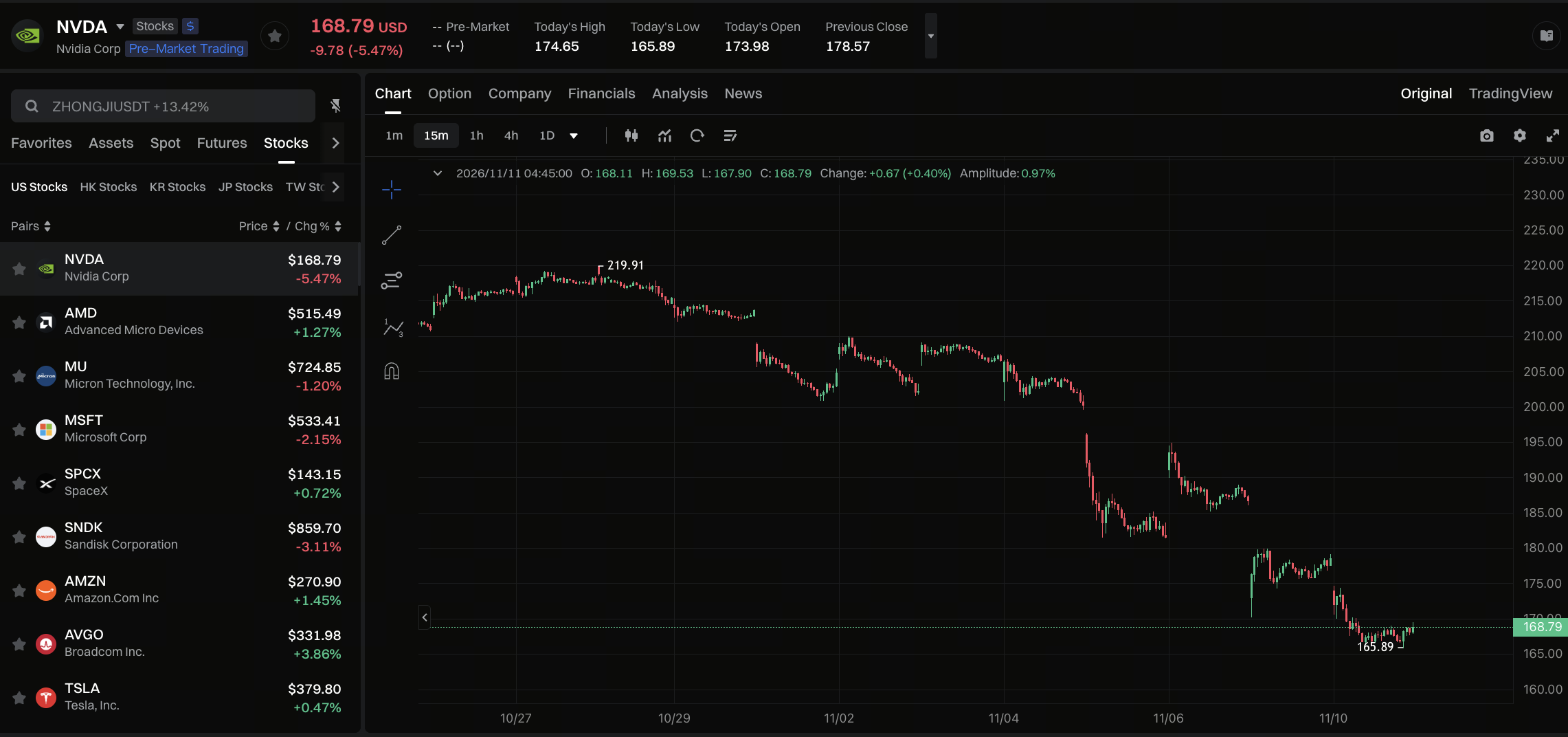
The AI data center investment cycle spans multiple industries, including chip manufacturing, cloud computing, computing capacity rentals, and infrastructure. Investors who want to follow related markets can use the relevant options provided through Gate Stock Trading to view the U.S. stock instruments actually supported by the platform and analyze market changes alongside financial reports, valuations, and industry information.
For example, investors can monitor revenue growth and customer orders for chip companies such as NVIDIA and AMD; observe capital expenditures and cloud business performance at Microsoft, Amazon, and Alphabet; and review financing costs, customer contracts, and cash flow conditions at computing service providers such as CoreWeave.
Although different companies are all connected to AI data center construction, their profit models and sources of risk differ. Investors should not assume that a company's share price will move in line with the entire industry simply because it is part of the AI supply chain.
In actual trading, investors also need to confirm the trading instruments supported by the platform, trading hours, fee rules, and the nature of asset rights. Stocks may experience significant price gaps and changes in liquidity, especially during earnings releases and periods of heightened market volatility.
Gate Stock Trading provides users with a way to follow and participate in related markets, but it cannot replace independent investment judgment. Investors should still make decisions based on company fundamentals, valuation levels, and their own risk tolerance. Specific product rules are subject to the platform's actual display.
Summary
Continued investment in AI data centers reflects the long-term demand for computing resources in the artificial intelligence industry. However, there is no necessary direct relationship between expanding capital expenditures and improved corporate profitability.
The reason 2028 has become a potential turning point for market attention is that depreciation expenses resulting from earlier large-scale investments may continue to increase, while the contribution of new capital expenditures to supply chain earnings growth may gradually weaken. If AI service revenue and computing capacity utilization do not improve at the same time, some companies may face declining profit margins and free cash flow pressure.
However, 2028 is not a confirmed point of decline for the AI industry. For companies with stable customer demand, high equipment utilization, and sufficient cash flow, slower capital expenditure growth may also indicate that investment returns are beginning to improve.
For investors, the key issue is not how many more AI data centers will be built, but whether these assets can generate sufficient revenue, profit, and cash flow over their useful lives. The long-term development prospects of AI technology and investment returns from related stocks still need to be assessed separately.
FAQ
Why Could 2028 Become a Turning Point for AI Data Center Earnings Pressure?
Depreciation expenses from earlier large-scale investments may continue to rise, while the contribution of capital expenditure growth to supply chain earnings may weaken. However, this is only a potential risk scenario, not a certain forecast.
Does Building More AI Data Centers Always Lead to Higher Corporate Profits?
Not necessarily. Profits also depend on customer demand, computing capacity utilization, service pricing, operating costs, and equipment depreciation.
Why Does GPU Depreciation Affect Technology Company Profits?
The purchase costs of equipment such as GPUs are generally recognized gradually in the income statement over their expected useful lives. If depreciation expenses increase faster than related revenue, corporate profits may be reduced.
Is Slower AI Capital Expenditure Growth Negative for NVIDIA?
It may affect demand for new GPU purchases, but the specific impact depends on customer orders, product upgrade cycles, market share, and earnings expectations. Slower capital expenditure growth does not necessarily mean procurement amounts will decline.
Why Do AI Data Center Companies Need to Focus on Free Cash Flow?
Data center construction and equipment upgrades require substantial capital. Even if a company grows revenue, capital expenditures that remain higher than operating cash flow may increase the need for external financing.
Will AI Technology Stocks Definitely Decline in 2028?
Not necessarily. Share prices depend on corporate earnings, valuations, and market expectations. If related risks are already reflected in share prices, or if AI commercialization progresses beyond expectations, market performance may differ.