As demand for generative AI model training and inference grows, CoreWeave, Nebius, and major cloud computing companies continue to expand their investments in GPU infrastructure. Unlike standard pay-as-you-go cloud services, some AI computing contracts are structured around specific GPU clusters, long-term capacity reservations, and minimum purchase commitments. Customers may assume certain payment obligations before they have fully used the computing capacity. This arrangement helps computing providers recover upfront construction costs, but it may also expose customers to idle capacity, changing demand, and limited contractual flexibility.
Take-or-Pay does not mean that all AI computing contracts require customers to pay all fees unconditionally. Nor does it mean that customers must continue paying when GPUs have not been delivered or the provider has failed to perform. Specific obligations depend on the contract's provisions regarding capacity delivery, service availability, minimum payments, default remedies, and termination. Understanding this mechanism requires analyzing why computing providers need long-term commitments, why customers are willing to lock in GPU capacity in advance, and how contracted revenue affects the financing and valuation of AI infrastructure companies.
Key Takeaways
- Take-or-Pay arrangements typically require customers to assume minimum payment obligations when the conditions specified in the contract are met, even if their actual GPU usage is below the committed capacity.
- GPU procurement and data center construction require substantial upfront capital investment. Long-term payment commitments can help computing providers reduce some demand uncertainty.
- Take-or-Pay, reserved capacity, and pay-as-you-go are different commercial arrangements. Not all long-term GPU contracts should be treated as strict Take-or-Pay contracts.
- For customers, locking in computing capacity over the long term can improve resource availability, but it may also create idle capacity costs and minimum purchase obligations.
- For computing providers, contractual commitments can improve revenue visibility, but they do not mean cash has already been received and cannot fully eliminate customer credit risk.
- Lenders may consider long-term customer contracts and GPU assets together when evaluating financing, but the total contract value is not equivalent to cash flow that can be used directly for debt repayment.
- Investors need to distinguish between contracted backlog, actual revenue, operating cash flow, and debt obligations when assessing whether AI computing expansion is sustainable.
What Is Take-or-Pay? Why Do AI Computing Contracts Require Minimum Payment Commitments?
Take-or-Pay can be understood as a commercial contract arrangement based on a minimum purchase commitment. The customer and provider agree on a certain quantity of products, services, or available capacity, and the customer commits to paying the corresponding fees when the conditions specified in the contract are met. Even if actual usage falls below the agreed level, the customer may still need to pay the minimum committed amount. These arrangements are common in industries that require long-term investment and capacity to be built in advance, such as natural gas supply, liquefied natural gas transportation, and large-scale energy facilities. For providers, minimum payment commitments can reduce some of the revenue risk caused by insufficient future demand. For customers, long-term contracts can provide relatively stable supply.
AI computing rentals have similar economic characteristics. High-performance GPU clusters are not standardized digital services that can be expanded without limit at any time. Cloud service providers need to procure equipment in advance, build data centers, configure network and storage systems, and ensure that power and cooling facilities meet operational requirements. If customers pay only when they use the resources, providers may still face the risk of idle capacity after making large-scale investments. Through long-term capacity commitments, providers can obtain relatively clear indications of customer demand before procuring equipment and can plan capital expenditures more effectively.
CoreWeave's business model provides a specific example. Its public filings divide its services into long-term committed contracts and on-demand usage contracts, and clearly state that long-term committed contracts generally use a Take-or-Pay structure. Customers receive the right to use reserved computing capacity during the contract term, and payment obligations generally do not depend on actual utilization. Its 2025 annual report shows that these contracts generally have initial terms of one to six years, with related revenue typically recognized over the service period.
Therefore, the core of Take-or-Pay is not requiring customers to keep running GPUs continuously. Instead, it shifts the basis for payment from actual computing volume to the agreed available capacity. Customers are purchasing not only the GPU hours they have already consumed, but also the right to access specific computing resources during the agreed period.
Why Might Customers Have to Pay for Computing Capacity They Have Not Used?
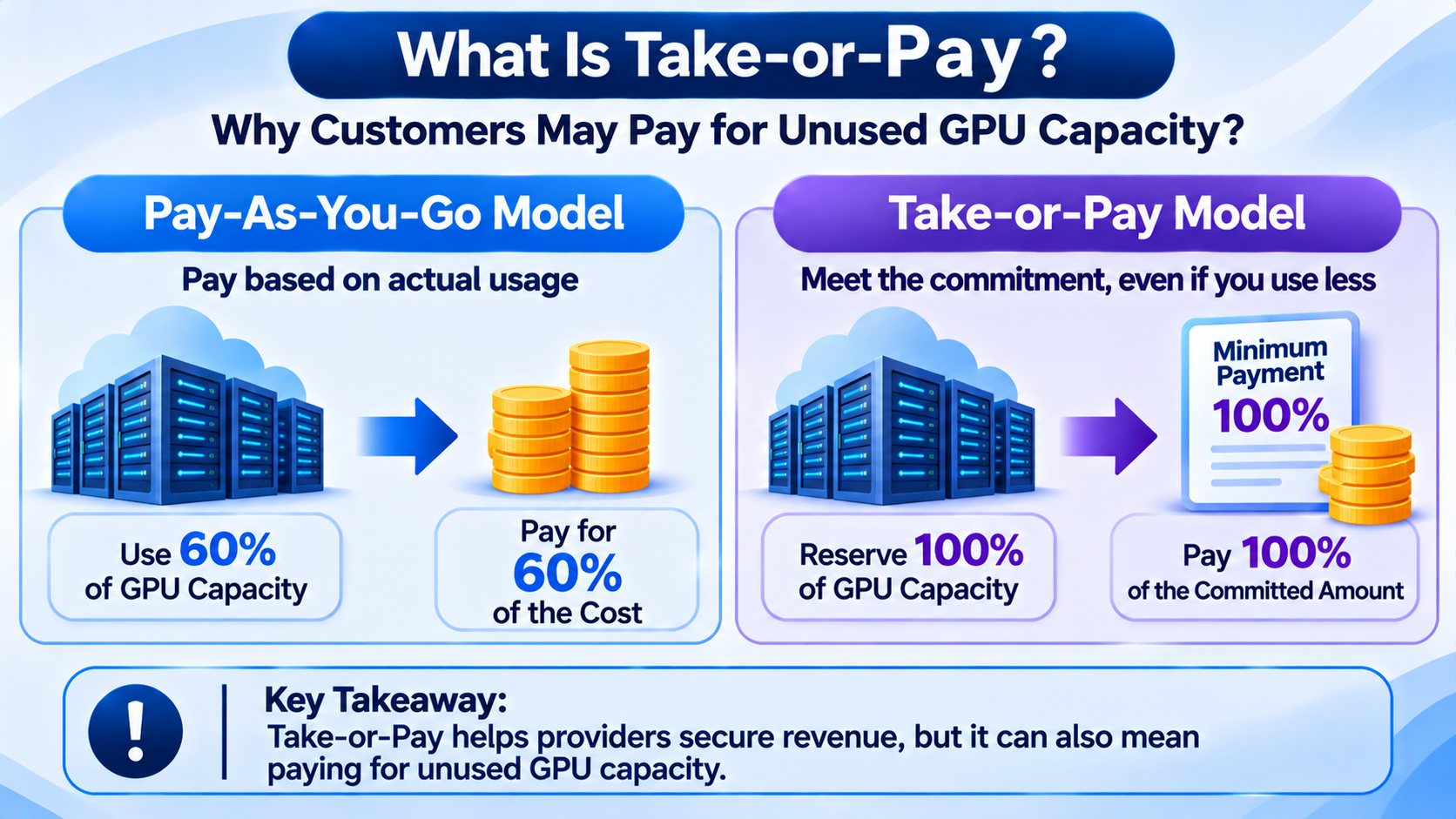
Under a pay-as-you-go model, customers generally pay based on their actual GPU computing time. If a project temporarily stops, customers can reduce or stop using the relevant resources and lower their computing costs. Take-or-Pay uses a different cost allocation method: The provider reserves a certain amount of computing resources for the customer, and the customer assumes the related costs based on the contractual commitment. Even if the customer does not fully use the resources because of changes to its model training plans, delays to internal projects, or insufficient demand, the minimum payment obligation may continue as long as the provider has supplied qualified capacity as agreed.
For example, suppose an AI company signs a one-year contract with a computing service provider to reserve 1,000 GPUs per month and pay based on an assumed price of $3 per GPU per hour. For illustrative purposes, assume 720 hours per month. The corresponding monthly commitment would be approximately $2.16 million. If the customer uses only 60% of the computing capacity in a given month, it may still have to pay the full agreed amount under a strict fixed-capacity Take-or-Pay clause, rather than settling solely based on the GPU hours actually run. This example is for illustrating the mechanism only. Actual contracts may also include discounts, minimum usage thresholds, service credits, or other adjustment provisions.
Customers accept this arrangement mainly to reduce the risk of being unable to obtain sufficient computing capacity in the future. Training large AI models requires large numbers of GPUs to run simultaneously, and computing tasks may continue for weeks or even months. For companies with tight training schedules and clear product launch plans, securing GPU capacity in advance can reduce the uncertainty of procuring resources on short notice. Long-term contracts may also help customers obtain more stable pricing and avoid higher spot rental costs when market supply is tight.
However, the fact that customers must pay when they do not use the GPUs does not mean that providers can charge unconditionally without performing their obligations. Contracts generally specify requirements for capacity delivery, service availability, acceptance, and fault handling. If GPUs are not deployed on time or the service does not meet the agreed standards, customers may have rights to defer payment, receive service credits, or pursue other remedies. The key distinction is between a customer voluntarily leaving delivered capacity idle and a provider failing to deliver the agreed service.
How Does Take-or-Pay Differ From Pay-as-You-Go and Reserved Capacity?
The AI cloud services market includes multiple pricing models. Pay-as-You-Go generally charges based on actual resource consumption and is suitable for customers with highly variable demand or uncertain project timelines. Reserved Capacity emphasizes reserving specific resources for a customer for a certain period, but the reservation itself does not necessarily imply a strict minimum payment commitment. Some reserved-capacity plans can be canceled in advance, some offer discounts but require a certain spending amount, and others use noncancelable long-term contracts. Take-or-Pay is an arrangement with relatively clear payment obligations. Its key feature is that insufficient actual usage generally does not automatically eliminate the minimum payment obligation.
| Comparison |
Take-or-Pay |
Pay-as-You-Go |
General Reserved Capacity |
| Payment basis |
Contractual minimum commitment |
Actual resource usage |
Depends on the reservation agreement |
| Computing capacity assurance |
Usually reserves the agreed capacity |
Affected by immediate resource availability |
Usually provides some reservation assurance |
| Idle capacity costs |
Minimum fees may still be payable |
Generally no charges for unused computing capacity |
Depends on the contract |
| Contract flexibility |
Usually lower |
Usually higher |
Varies significantly |
| Applicable scenarios |
Long-term, large-scale AI workloads |
Short-term testing and elastic demand |
Projects with relatively stable demand |
For large AI labs that need to train models continuously, long-term Take-or-Pay contracts can provide relatively stable computing capacity. For startups, research teams, or application developers with unstable demand, pay-as-you-go may be more suitable. The choice depends on whether the customer can predict future computing needs and is willing to assume a long-term capacity commitment. Even if a Take-or-Pay contract has a lower unit price, its actual unit computing cost may be higher than a pay-as-you-go plan if the customer ultimately uses only a small portion of the capacity.
CoreWeave's public filings clearly distinguish between the two business models: Long-term committed contracts generally recognize revenue based on reserved capacity and the contract term, while on-demand services charge based on actual consumption. In the second quarter of 2026, long-term committed contracts contributed approximately 98% of the company's revenue, indicating that its revenue is highly dependent on long-term capacity commitments rather than temporary demand for computing rentals.
How Does Take-or-Pay Help CoreWeave Obtain GPU Financing?
Building GPU infrastructure requires substantial upfront capital investment. Computing service providers must not only purchase high-performance chips from suppliers such as NVIDIA, but also pay for servers, networking, power, cooling, and data center construction. After equipment is put into service, the related revenue is generally realized gradually over multiple years under the contract term. The timing gap between upfront expenditures and future revenue means that companies need equity, debt, or customer prepayments to fund construction.
Take-or-Pay contracts can improve this financing structure. Suppose a computing company plans to build a new GPU cluster and has signed a long-term minimum payment contract with a customer in good financial standing. Lenders can use the contractual terms to assess future cash flow. Compared with a project for which customer demand has not yet been established, equipment supported by long-term payment commitments makes it easier to build a revenue forecast model. Lenders can further analyze the contract term, customer creditworthiness, equipment value, and project operating costs to determine whether future cash flow will be sufficient to support loan repayment.
In its 2025 annual report, CoreWeave explicitly disclosed that it primarily uses asset-level debt financing supported by Take-or-Pay customer contracts to build infrastructure, supplemented by equity and debt financing at the corporate level. This shows that long-term computing contracts affect not only the revenue model but also the formation of the financing structure for GPU assets.
However, a long-term contract is not the same as a risk-free guarantee for a loan. Financial institutions still need to assess whether customers can continue to perform, whether equipment can be delivered on time, and whether GPUs will retain sufficient economic value during the loan term. Even if a contract requires the customer to pay, the provider may still face the risk that receivables cannot be collected if the customer experiences severe financial difficulties. Take-or-Pay improves revenue predictability; it does not eliminate all credit risk.
What Is the Relationship Between Customer Prepayments and Take-or-Pay?
Take-or-Pay and customer prepayments often appear together, but they are not the same concept. Take-or-Pay establishes a minimum purchase or payment obligation, while a customer prepayment concerns the timing of payment. A company can sign a Take-or-Pay contract and pay monthly or quarterly. It may also require the customer to pay part of the amount before GPU delivery to support equipment procurement and project construction. Whether the prepayment is refundable, how it is credited against future service fees, and how it is handled upon contract termination all depend on the specific agreement.
For computing providers, customer prepayments have direct cash flow value. If a company needs to invest tens of billions of dollars to build a GPU cluster and the customer is willing to pay part of the contract amount before services begin, the provider can reduce its immediate reliance on external financing. Compared with future contracted revenue, prepayments already received can more directly support current capital expenditures. However, a prepayment does not mean that the company has completed the corresponding service obligations. Financial statements generally classify the portion related to services not yet performed as deferred revenue and recognize revenue as the services are provided.
CoreWeave's public filings show that long-term committed contracts generally include customer prepayments. Its 2025 annual report disclosed that the weighted average prepayment level for its active contracts was approximately 15%–25% of total contract value. As of the end of 2025, the company had approximately $8.2 billion in deferred revenue and approximately $60.7 billion in remaining performance obligations (RPO). These metrics respectively reflect service revenue that has been collected but not yet recognized and future contractual obligations that remain to be performed. They should not be treated as the same type of cash asset.
This arrangement also creates a closer financial relationship between customers and providers. Customers use prepayments to secure future computing capacity, while providers use the funds to purchase equipment and build infrastructure. Both parties may benefit from stable long-term cooperation, but they also become more dependent on the progress of contract performance. If a project is delayed, the provider may have to bear additional construction costs, while the customer may face the risk of having prepaid funds tied up and computing capacity delivered late.
How Does Take-or-Pay Affect the Revenue and Financial Statements of AI Computing Companies?
Long-term Take-or-Pay contracts can improve revenue visibility, but total contract value, revenue recognition, and cash inflows are different financial concepts. Total Contract Value (TCV) reflects the transaction amount within the agreed scope of the contract. RPO reflects the transaction price corresponding to contractual obligations that have not yet been performed. Recognized revenue depends on whether the company has completed the corresponding services under applicable accounting standards. Operating cash flow also needs to account for the timing of actual customer payments, operating costs, and other cash receipts and expenditures.
Using CoreWeave as an example, its long-term committed contracts generally recognize revenue over the agreed service period rather than recording the entire amount as revenue when the contract is signed. Even if customers do not fully use the reserved GPUs, the provider may recognize revenue over the service period as long as it supplies the agreed available computing services and meets the relevant revenue recognition conditions. This reflects the economic substance of capacity services: The provider is delivering continuously available computing resources, not merely completed computing tasks.
However, long-term contracts may also create misunderstandings about financial metrics. The market may assume that a company's future revenue is sufficiently secured because an AI cloud service provider reports a contracted backlog worth tens of billions of dollars. But the contracts still need to be fulfilled through equipment delivery, service operations, and customer payments. The related revenue must also be offset by equipment depreciation, energy, personnel, financing, and other costs. Even if the company completes all of its contracts, this does not necessarily mean that the contracts will generate high profits.
For investors, it is more meaningful to observe the pace at which RPO converts into actual revenue and whether revenue growth improves operating cash flow. If the contracted scale continues to expand but equipment construction falls significantly behind schedule, future revenue recognition may be affected. If revenue grows rapidly while the company continues to require larger capital expenditures, it may still face financing pressure. Take-or-Pay can reduce some demand uncertainty, but it cannot replace analysis of profitability and cash flow quality.
Why Can Take-or-Pay Also Create Risks for AI Customers?
Long-term computing commitments can secure resource supply, but they also reduce a customer's flexibility to adjust its procurement scale. AI model development is highly uncertain. Companies may change their computing needs because of improvements to training algorithms, changes in model architecture, or adjustments to product strategy. If a customer originally planned to use large numbers of GPUs to train a new model but later finds that a more efficient algorithm can reduce computing consumption, its existing minimum payment contract may not be reduced accordingly. For customers subject to strict Take-or-Pay terms, improved computing efficiency may not immediately translate into lower procurement costs.
GPU technology updates are another important risk. High-performance computing chips advance rapidly, and a new generation of GPUs may offer significant improvements in performance, memory, and energy efficiency. If customers lock in specific equipment models for the long term, they may find during the contract term that newer hardware better suits their workloads. Even if older equipment can still complete computing tasks, customers may have to choose between continuing to perform under existing contracts and procuring next-generation computing capacity. Whether the contract allows equipment upgrades, price adjustments, or capacity substitutions will affect the practical extent of this risk.
In November 2026, reports emerged that Microsoft was adjusting some external AI computing procurement arrangements, involving its cooperation with Oracle and the suitability of older GPU models. This event shows that the computing procurement strategies of large technology companies may also change as technology needs evolve. However, these reports do not prove that all long-term GPU contracts can be canceled early, nor do they support the conclusion that the payment obligations under any specific Take-or-Pay contract have been released.
Customers also need to consider their ability to bear the financial burden. Long-term contracts can secure computing capacity, but they may also create procurement commitments lasting several years. If revenue from an AI product grows more slowly than expected, minimum payment obligations may reduce budgets available for other research, development, and operating activities. For large technology companies, these expenditures may represent only one part of overall capital allocation. For AI startups that rely on external financing, long-term computing commitments may become a significant cash flow burden.
Can Take-or-Pay Amplify Risks in the AI Infrastructure Industry?
Take-or-Pay can reduce some demand risk faced by computing providers, but it does not eliminate the risk from the broader industry. Long-term contracts transfer some idle capacity risk to customers while making providers more dependent on customers' ability to continue making payments. If customers remain financially sound and computing demand remains stable, the parties can use long-term contracts to coordinate investment and usage plans. If customers experience financial difficulties or their technology needs change significantly, contract disputes, renegotiations, and credit risks may spread through the supply chain.
This risk is particularly important for AI computing companies that rely heavily on debt financing. A computing service provider may obtain a loan based on long-term customer contracts and then use the loan to purchase GPUs. After the equipment is delivered, customer payments become an important source of debt repayment. If the customer fails to perform, the provider may not only lose future revenue but may also continue to bear equipment depreciation, data center lease expenses, and loan interest. Lenders then need to assess whether the GPUs can be rented to other customers and whether prevailing market prices will be sufficient to cover the remaining debt.
The AI computing industry also features interconnected customer, supplier, and financing relationships. Large technology companies may simultaneously be chip purchasers, cloud service customers, computing providers, or infrastructure investors. Some transaction arrangements also involve prepayments, financing support, and long-term capacity purchases. These relationships can accelerate infrastructure development, but they may also increase the industry's dependence on a small number of large customers and capital providers. When analyzing related contracted revenue, it is necessary to determine whether the demand comes from applications capable of generating sustainable economic returns, rather than assuming that final market demand will necessarily materialize based only on growth in contract value.
Over the longer term, the sustainability of Take-or-Pay also depends on supply and demand in the computing market. If GPUs remain in short supply, customers may be willing to accept higher minimum payment commitments to secure critical computing resources. As GPU supply increases, model inference becomes more efficient, and competition among cloud services intensifies, customers may prefer flexible pay-as-you-go or short-term reserved-capacity models. CoreWeave also cautioned in its public filings that if the market shifts from Take-or-Pay toward more on-demand usage arrangements, the company's ability to forecast cash flow, profit margins, and operating performance may be affected.
How Should Investors Evaluate the Actual Value of Take-or-Pay Contracts?
For investors focused on AI infrastructure companies such as CoreWeave, Nebius, and Oracle, long-term contracts are an important starting point for analyzing revenue visibility, but they should not be the only metric. First, investors need to confirm the actual payment terms, including the minimum commitment amount, service term, capacity delivery schedule, prepayment percentage, and termination and default provisions. A longer contract term does not necessarily indicate lower risk. If the customer's credit quality is weak or project delivery depends on a data center that has not yet been built, future cash flow may still be highly uncertain.
Second, investors need to analyze how the contracts align with capital expenditures. GPU assets generally need to be purchased before the contract begins, and equipment depreciation, loan maturities, and customer payment schedules may not align completely. If a company can cover construction, operating, and financing costs with contract revenue during the equipment's economic life, it is more likely to have a sustainable business model. Conversely, if the equipment has significantly depreciated when the contract expires while the company still has substantial outstanding debt, refinancing and asset disposition pressures may increase. The revenue assurance provided by long-term contracts needs to be analyzed together with the actual returns generated by the equipment.
Finally, investors should monitor customer concentration, the conversion rate of contracted backlog, and free cash flow. A small number of large customers may provide significant long-term revenue to a computing service provider, but they may also make the company more dependent on specific customers' capital expenditure plans. Investors can monitor how much capacity is actually put into operation after contracts are signed, how much revenue has been recognized, and whether customer payments can support debt repayment. For publicly traded stocks, valuations may also be affected by interest rates, expectations for capital expenditures in the AI industry, and overall risk appetite. Even if the Take-or-Pay contract structure remains unchanged, stock prices may fluctuate as the market's assessment of future growth and financing costs changes.
The key to understanding the value of Take-or-Pay is to connect contractual commitments with real economic activity. A customer's willingness to pay for computing capacity over the long term indicates that it has some expectation of demand for computing resources. However, that demand is more likely to translate into long-term economic value only when the computing capacity is put to use and supports sustainable business revenue. For providers, the larger the contract scale, the more they need to demonstrate that they can deliver equipment on time, provide stable services, and convert accounting revenue into actual cash returns.
Conclusion
Take-or-Pay is an important commercial contract arrangement in the AI computing infrastructure industry. Its core feature is that customers assume minimum payment obligations as agreed, rather than paying entirely based on actual GPU usage. For cloud service providers that need to procure large amounts of computing equipment in advance, this model can improve the predictability of future revenue, help companies plan capital expenditures, and provide a degree of cash flow support for asset-backed financing. CoreWeave's long-term committed contracts illustrate this logic, with GPU equipment, customer contracts, and debt financing collectively supporting its business expansion.
However, Take-or-Pay does not mean that computing providers can unconditionally collect all contracted revenue. Equipment delivery, service availability, customer creditworthiness, and contract termination provisions all affect actual payment obligations. For customers, locking in GPU capacity over the long term can secure computing resources, but it may also create risks related to idle capacity costs, technology updates, and changes in demand. For providers, minimum payment commitments can mitigate some demand uncertainty, but they cannot eliminate the pressure from capital expenditures, debt repayment, and equipment depreciation.
As the AI computing market develops, the balance between long-term committed contracts and flexible pay-as-you-go arrangements may continue to change. When analyzing AI infrastructure companies, investors need to consider contracted backlog, actual revenue, cash flow, equipment utilization, and financing structure together. Take-or-Pay can make future revenue more predictable, but its long-term value ultimately depends on whether demand for computing capacity remains sustainable and whether contract revenue can cover infrastructure construction and operating costs.
FAQ
What does Take-or-Pay mean in AI computing rentals?
Take-or-Pay is a minimum payment commitment arrangement. The customer reserves a certain amount of GPU computing capacity under the contract and may have to pay the minimum committed fee even if actual usage is low, provided that the provider meets the agreed delivery conditions.
Does a customer have to pay if it does not use the GPUs at all?
Under a strict Take-or-Pay contract, the customer may have to pay the minimum fee even if it does not use the GPUs, provided that the provider has supplied the agreed capacity. However, if the provider fails to deliver on time or the service does not meet requirements, the payment obligation may be affected by the contract terms.
How does Take-or-Pay differ from pay-as-you-go?
Take-or-Pay generally charges based on the contractually committed capacity and minimum payment requirements, while pay-as-you-go generally settles based on actual GPU hours consumed. The former is more suitable for stable long-term demand, while the latter generally provides greater usage flexibility.
Does Take-or-Pay mean that customers must pay in advance?
Not necessarily. The minimum payment obligation and the payment schedule are different concepts. Customers may pay monthly or quarterly, or they may pay part of the amount in advance as specified in the contract.
Why does CoreWeave use so many Take-or-Pay contracts?
CoreWeave needs to procure GPUs and build data centers in advance. Long-term committed contracts help improve revenue visibility and support its expansion of computing infrastructure through asset-level debt financing.
Does the value of a Take-or-Pay contract equal revenue that has already been realized?
No. The contract value may correspond to services provided over multiple years, and the company generally recognizes revenue gradually after performing the related service obligations. A signed contract also does not mean that all payments have already been received.
Can Take-or-Pay increase financial risks in the AI industry?
Potentially. Long-term contracts can reduce some demand risk for providers, but they may also increase customers' minimum payment burdens. If a provider also uses substantial debt financing, customer defaults, equipment depreciation, or project delays may further amplify financial pressure.