As demand for generative AI and cloud computing continues to grow, technology companies such as Microsoft, Alphabet, Amazon, and Meta are continuing to expand their infrastructure investments, driving rapid development across the chip, server, and AI cloud computing supply chains. However, entering the second half of 2026, the market has begun focusing more closely on one question: Now that AI investment has reached a relatively high level, can capital expenditure continue growing at the same pace, and can these investments generate sufficient revenue and cash flow?
This concern does not mean that AI investment has broadly contracted. In July 2026, annual capital expenditure expectations for Microsoft, Alphabet, Amazon, Meta, and Oracle were still being revised upward, with the combined estimate reaching approximately $730 billion. At the same time, the pressure that massive investments place on free cash flow is becoming increasingly apparent. Even with relatively strong revenue growth, some companies must absorb rising equipment, construction, and financing costs.
For AI computing companies such as CoreWeave and IREN, investors need to distinguish between the scale of capital expenditure, actual computing capacity delivery, and long-term earnings quality. This article explains how to assess the potential risks of AI infrastructure stocks by examining capital expenditure, depreciation, cash flow, and valuation metrics.
Key Takeaways
-
Slower AI capital expenditure growth does not mean that total investment is declining, nor does it necessarily mean that demand for AI computing capacity is shrinking.
-
Capital expenditure growth may drive future revenue, but new equipment must go through construction, deployment, and customer delivery before it can generate actual returns.
-
GPU depreciation, financing costs, and equipment replacement cycles affect the long-term profitability of AI cloud computing companies.
-
For capital-intensive companies such as CoreWeave and IREN, observing only revenue growth or contract value is not enough to determine whether their valuations are reasonable.
-
Investors need to conduct a comprehensive analysis based on free cash flow, return on invested capital, computing capacity utilization, customer concentration, and debt structure.
1. What Does Slower AI Capital Expenditure Growth Mean?
Capital expenditure (CapEx) is the money a company invests to purchase, build, or upgrade long-term assets. In the AI infrastructure industry, these assets mainly include GPUs, servers, data center buildings, power supply and distribution facilities, network equipment, and cooling systems.
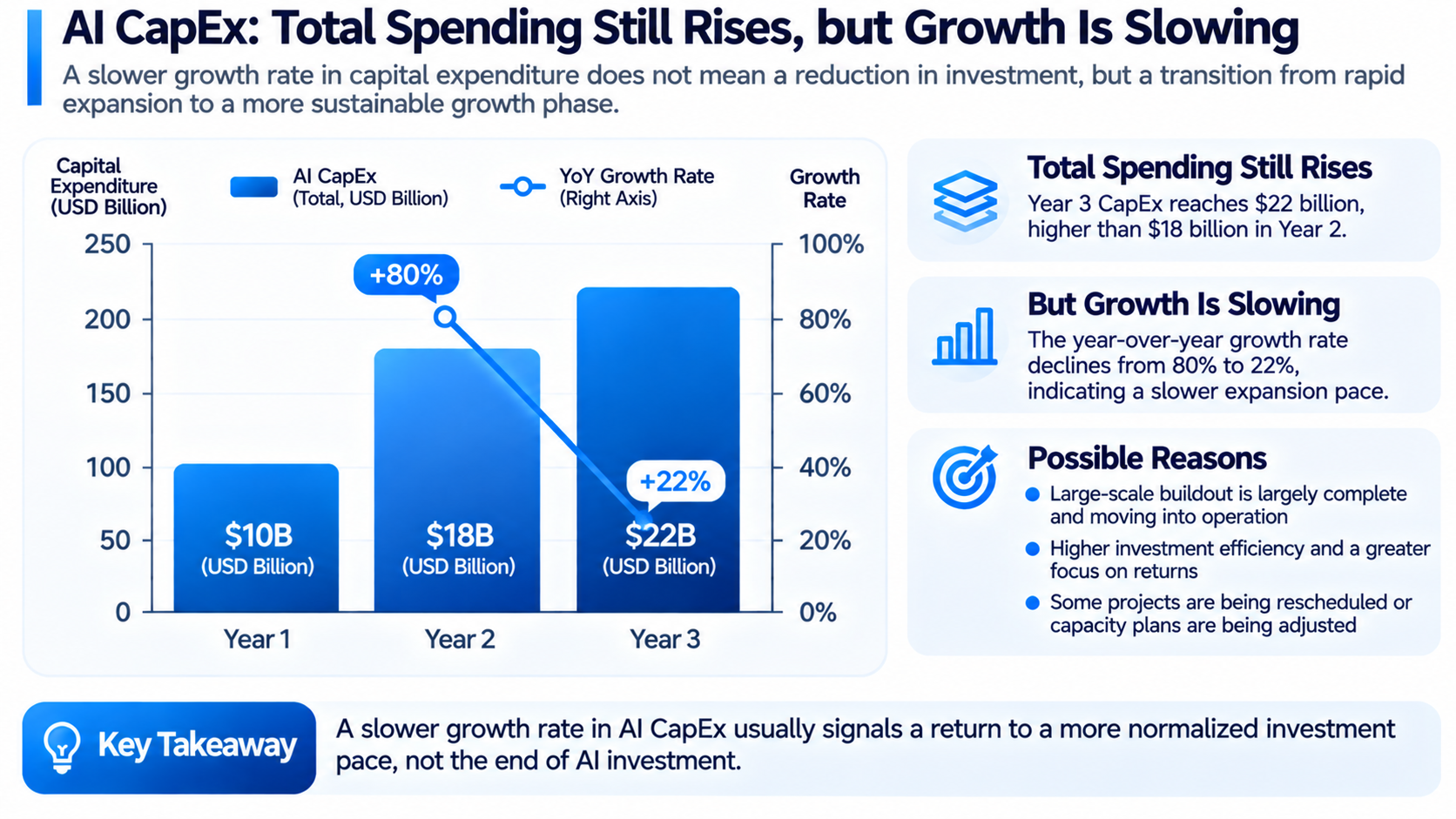
When assessing AI investment trends, it is important to distinguish between total capital expenditure and the capital expenditure growth rate. Suppose a company invests $10 billion in the first year, $18 billion in the second year, and $22 billion in the third year. Although investment reaches a new high in the third year, the annual growth rate has already declined from 80% to approximately 22%. This means that investment is still expanding, but at a slower pace.
Therefore, slower AI CapEx growth should not be interpreted directly as a reduction in AI investment. For companies that have already completed part of their infrastructure buildout, slower investment growth may simply mean that large-scale construction in the early stages is gradually transitioning into operations. On the other hand, if a company reduces new investment because of insufficient customer demand, rising financing costs, or lower-than-expected project returns, this may reflect deeper operating pressure.
Capital expenditure is also clearly cyclical. A company may concentrate data center construction in one year and focus primarily on equipment deployment and operational optimization in subsequent years. Therefore, changes in capital expenditure during a single quarter may not accurately reflect long-term demand across the AI industry.
Investors should focus more on whether a company has lowered its full-year investment guidance, delayed planned projects, or reduced future equipment procurement commitments, rather than making a judgment based solely on year-over-year growth in a particular quarter.
2. Why Could AI Capital Expenditure Growth Pressure Technology Stock Valuations?
During the early stages of AI infrastructure investment, the market typically focuses more on whether a company can obtain GPUs, build data centers, and secure customer contracts. Once the industry enters a period of large-scale expansion, investors may shift their focus toward returns on capital.
The reason is that capital expenditure does not equal current-period profit. When a company purchases GPUs and builds data centers, it must first spend substantial amounts of money. These assets are generally recognized as expenses gradually through depreciation over multiple future accounting periods. Only when newly purchased equipment becomes operational, attracts customer orders, and generates sufficient revenue can the initial investment potentially produce an economic return.
The financial performance of technology companies in 2026 already reflects this tension. For example, Meta achieved approximately 28% revenue growth in the second quarter, but its free cash flow declined approximately 91% year over year to $784 million. During the same period, Meta adjusted its full-year capital expenditure forecast to $130 billion–$145 billion.
This shows that revenue growth and cash flow performance can diverge significantly during periods of high investment. For stock valuations, market prices often incorporate expectations for future earnings growth. If a company continues increasing capital expenditure but the growth of new revenue, profit margins, and cash flow falls below expectations, investors may lower their future earnings forecasts and, in turn, reduce the valuation multiple they are willing to pay.
Conversely, if a company can demonstrate that its AI investments are increasing revenue, customer retention, and long-term profit margins, the market may continue to assign it a relatively high valuation even if free cash flow is under pressure in the short term.
Therefore, the key factor affecting technology stock prices is not simply whether capital expenditure is increasing, but whether investors’ expectations for the returns on that capital expenditure have changed.
3. How Can Free Cash Flow Be Used to Assess Investment Pressure on AI Computing Companies?
Free cash flow (FCF) is commonly used to measure how much cash a company can retain after maintaining operations and making necessary capital investments. For capital-intensive AI companies, free cash flow helps investors assess whether business growth requires continued reliance on external financing.
A company may have high operating revenue and accounting profit, but if it must continuously purchase GPUs, build data centers, and upgrade network facilities, its actual discretionary cash may still be limited.
For example, suppose an AI cloud computing company generates $5 billion in operating cash flow in one year and spends $7 billion on equipment purchases and data center construction. Without considering other adjustments, its free cash flow would be approximately negative $2 billion. This does not necessarily mean that the company is operating unsuccessfully, because the new equipment may generate revenue in the future. However, it does mean that current expansion still needs to be supported by cash reserves, debt, or equity financing.
When reviewing free cash flow, investors also need to distinguish between growth investment and maintenance investment. Growth investment is used to expand future service capacity, such as building new GPU clusters. Maintenance investment is used to replace aging equipment and keep existing operations running normally.
This distinction is especially important for GPU-intensive companies. If a company must frequently replace hardware to remain competitive, some investments that appear to be for expansion may actually be necessary long-term operating expenses.
In addition, companies may obtain computing assets through finance leases, operating leases, or equipment financing. Different financing arrangements may be presented differently in capital expenditure figures and cash flow statements. Therefore, a company’s actual investment burden cannot be assessed based solely on one financial metric.
Investors can combine operating cash flow, cash capital expenditure, lease liabilities, and future equipment procurement commitments to analyze funding requirements under different growth scenarios.
4. Why Does GPU Depreciation Affect AI Cloud Computing Company Valuations?
GPUs are important operating assets for AI cloud computing companies. Unlike land or certain building facilities, however, GPUs face rapid technological updates and performance improvements. New-generation chips may improve computing efficiency, energy consumption, and computing cost per unit, potentially changing the commercial competitiveness of previous-generation equipment.
After purchasing GPUs, a company typically does not recognize the entire cost as an expense on its income statement at once. Instead, it depreciates the cost over the expected useful life of the equipment. Assuming all other conditions remain unchanged, a longer depreciation period generally results in lower annual depreciation expense, while a shorter depreciation period results in higher annual depreciation expense.
For example, suppose a group of GPU servers costs $60 million and has no residual value. Under straight-line depreciation over six years, annual depreciation expense would be $10 million. If the actual economic useful life is only four years, annual depreciation expense under a four-year depreciation schedule would be $15 million.
This difference affects accounting profit but does not change the purchase cost that the company has already paid. Therefore, when analyzing GPU depreciation, investors need to consider both the accounting useful life and the actual economic useful life.
It is important to note that an asset’s economic useful life does not necessarily equal the product cycle for new-generation products. Previous-generation GPUs may continue to be used for inference, enterprise computing, or cost-sensitive workloads. Their actual value depends on performance, energy consumption, customer demand, and rental prices.
In its fourth-quarter fiscal 2026 earnings presentation, Microsoft disclosed that quarterly capital expenditure totaled $41 billion, approximately two-thirds of which was allocated to shorter-lived assets, primarily CPUs and GPUs. The company also adjusted the estimated useful lives of long-term assets such as data center buildings, but this is not the same concept as the depreciation period for GPUs.
For AI cloud computing companies such as CoreWeave, investors should closely monitor GPU asset depreciation policies, equipment replacement plans, and whether older-model equipment can continue generating sufficient rental revenue.
If the actual economic useful life is significantly shorter than the depreciation period used in the financial statements, the company may face a higher risk of future asset impairment. If the equipment can maintain high utilization over an extended period, it may generate more cash flow during its useful life.
5. How Can Investors Determine Whether AI Computing Capacity Utilization Is Sufficient to Support Revenue?
Computing capacity utilization is an important indicator of the efficiency of AI infrastructure investment. For AI cloud computing companies, purchasing GPUs is only the first step in creating service capacity. The equipment must also be installed, connected to the network, tested, and delivered to customers before it can begin generating revenue.
Even if a company owns a large number of GPUs, low actual utilization may prevent it from covering equipment depreciation, electricity, operations and maintenance, and financing costs. For example, suppose a GPU cluster can theoretically provide 100,000 hours of computing services per month, at an average rate of $3 per hour. If all computing capacity could be sold under ideal conditions, monthly revenue would reach $300,000. If actual billable utilization is only 50% and pricing remains unchanged, monthly revenue would fall to $150,000.
This means that profitability is affected simultaneously by computing capacity, actual utilization, and revenue per unit of computing capacity. Even if the number of GPUs increases, new equipment may reduce the overall return on capital if customer demand grows more slowly than expected.
However, computing capacity utilization should not be understood simply as GPUs operating at full load at all times. Some companies use long-term capacity reservation contracts. Even if customers do not fully use their reserved resources, service providers may still collect fees under the contracts. Other companies charge by the hour or based on usage, making their revenue more closely tied to actual utilization. Therefore, investors need to consider the company’s business model and monitor the number of deployed GPUs, billable capacity, contract coverage, revenue per unit of computing capacity, and customer delivery progress.
If a company’s computing capacity is growing rapidly but its revenue growth is significantly slower, investors need to determine whether the new equipment has not yet become operational, customer contracts have not yet begun generating billable revenue, or actual market demand is insufficient.
6. How Do the Valuation Risks of CoreWeave and IREN Differ?
CoreWeave (CRWV) and IREN (IREN) both participate in the AI computing infrastructure market, but their business foundations and expansion paths differ. Therefore, the same valuation assumptions cannot be applied directly to both companies.
CoreWeave primarily provides cloud computing services for AI workloads. Its business model depends on GPU cluster deployment, customer demand for computing capacity, and long-term service contracts. Investors need to focus on whether the company can convert contracted orders into actual revenue and whether the construction of new computing capacity requires it to bear high financing costs.
For CoreWeave, contracted revenue backlog can help indicate future revenue visibility, but it cannot be treated directly as realized cash flow. Contract delivery typically depends on equipment deployment, service availability, and customer acceptance. Related revenue may also be recognized over multiple future accounting periods.
IREN, by contrast, has a business background that includes expansion from Bitcoin mining into AI cloud computing. Its existing data center development experience and power resources may provide a foundation for its AI business, but mining infrastructure and high-performance AI cloud facilities are not identical.
IREN’s valuation analysis needs to distinguish between its Bitcoin mining business and AI cloud business. Investors should pay particular attention to the cost of deploying new GPUs, the progress of data center upgrades, and whether AI cloud revenue can generate sustainable profit and cash flow.
| Evaluation Dimension |
CoreWeave (CRWV) |
IREN (IREN) |
| Primary focus |
AI cloud computing scale and delivery capabilities |
AI cloud expansion and business model transition |
| Revenue risks |
Customer contract execution and computing capacity delivery |
AI business growth and mining business volatility |
| Capital expenditure risks |
GPU procurement and data center expansion |
GPU deployment and infrastructure upgrades |
| Financial risks |
Debt, leases, and financing costs |
Expansion financing, return on capital, and cash flow |
| Key valuation considerations |
Contract conversion rate, profit margin, and cash flow |
AI revenue share, deployment progress, and capital efficiency |
Both companies may benefit from growing demand for AI computing capacity, but high business growth expectations do not necessarily mean that their stock valuation risks are low.
For example, if the market has already priced a company based on a high-growth scenario for the next several years, its stock may still face a correction even if actual revenue continues to grow, as long as the growth rate falls below market expectations.
Therefore, when comparing AI computing companies, investors need to consider operating performance together with market expectations, rather than determining which company is more attractive solely based on revenue growth.
7. Which Valuation Metrics Should Investors Monitor for AI Computing Stocks?
Traditional stock analysis often uses the price-to-earnings ratio (P/E) to evaluate company valuations. However, for AI cloud computing companies that are still in a period of high capital investment and have volatile profits, a single P/E ratio may not fully reflect their operating conditions.
Investors can combine the following five metrics in their analysis.
| Valuation Metric |
Primary Use |
Key Considerations |
| Price-to-sales ratio (P/S) |
Measures the relationship between market capitalization and revenue |
Revenue growth does not equal profit growth |
| Enterprise value-to-EBITDA (EV/EBITDA) |
Compares enterprise value with operating profitability |
EBITDA does not fully reflect capital expenditure and depreciation burdens |
| Free cash flow yield |
Assesses valuation relative to cash generation |
FCF may remain negative for an extended period during expansion |
| Return on invested capital (ROIC) |
Evaluates the efficiency of invested capital |
Newly constructed projects may not have begun generating returns |
| Net debt-to-EBITDA ratio |
Assesses debt burden and debt repayment capacity |
Interest, leases, and debt maturity schedules must also be considered |
EV/EBITDA requires particular caution when used for AI infrastructure companies. Because EBITDA excludes depreciation and amortization, a company that purchases large amounts of GPUs may have high EBITDA while also facing substantial equipment replacement expenditures.
For example, two AI cloud computing companies may each have EBITDA of $1 billion, but one may need to invest only $200 million annually to maintain its existing equipment, while the other needs to invest $800 million. If all other conditions are the same, the two companies may have significantly different long-term cash-generating capabilities.
In addition, enterprise value (EV) generally takes factors such as debt and cash into account. For companies that rely heavily on finance leases and external funding for expansion, comparisons based solely on equity market capitalization may underestimate their overall capital burden.
Therefore, a more reasonable approach is to first analyze revenue growth and profit margins, then examine free cash flow, debt structure, and future capital expenditure, and finally determine whether the current valuation already reflects these risks.
8. How Can Investors Determine Whether Slower AI Capital Expenditure Growth Will Trigger a Valuation Adjustment?
Slower AI capital expenditure growth does not necessarily cause AI computing stocks to decline. The key factors are the reason for the slowdown and the growth expectations that the market had previously priced into the company.
If capital expenditure growth slows mainly because earlier construction has been completed and the company begins increasing equipment utilization, expanding customer revenue, and improving free cash flow, slower investment growth may instead indicate that the business model is gradually maturing.
By contrast, if a company delays investment because of insufficient customer demand, increased financing pressure, or declining project economics, the market may reassess its long-term growth potential.
Investors can evaluate the situation in three steps.
-
Observe whether capital expenditure is aligned with revenue growth. If a company’s capital expenditure continues to increase while the growth of new revenue slows significantly, investors need to analyze whether the new facilities have not yet become operational and when the related investments may begin generating returns.
-
Observe changes in profit margins and cash flow. If revenue continues to grow but gross margin, operating cash flow, and free cash flow continue to deteriorate, business expansion may be accompanied by increasing cost pressure. However, investors also need to distinguish temporary construction investment from a decline in long-term profitability.
-
Observe whether the valuation relies excessively on high-growth assumptions. If a company’s current valuation is based on expectations of sustained high growth over the next several years, even a modest reduction in growth expectations may cause the valuation multiple to contract, even if operating conditions have not materially deteriorated.
For example, suppose a company originally expected revenue to grow 60% annually over the next three years but later revised its expectation to 35%. A 35% growth rate is still relatively high, but if the market had previously priced the stock based on a 60% growth trajectory, the stock could still experience significant volatility.
Therefore, investors need to distinguish between deteriorating fundamentals and adjustments in market expectations. A decline in the stock price does not necessarily mean that demand for the AI industry has disappeared. It may simply mean that investors are beginning to require clearer evidence of profitability and cash flow.
9. How Can Individual Investors Build a Risk Assessment Framework for AI Computing Stocks?
Individual investors who want exposure to AI infrastructure can build a risk assessment framework around four areas: business growth, capital investment, cash flow, and valuation.
-
Identify the company’s primary sources of revenue. Chip manufacturers, cloud computing service providers, data center operators, and power infrastructure companies may all belong to the AI supply chain, but their profit models and risk structures differ.
-
Analyze the company’s capital expenditure plans for the next one to two years and assess whether assets that are already operational can generate sufficient revenue. For large data center projects, investors should pay particular attention to power connections, construction permits, GPU deployment, and customer delivery progress.
-
Assess the company’s sources of funding. Large technology companies with stable operating cash flow generally have a stronger capacity to absorb investment than growth companies that rely heavily on external financing. However, even for large technology companies, excessive capital expenditure may affect stock buybacks, dividends, and other capital allocation plans.
-
Conduct scenario analysis based on the current stock valuation. Investors can consider different scenarios, including sustained high revenue growth, gradual normalization of growth, and project delivery delays, and assess how the company’s profitability, financing needs, and valuation may change.
The purpose of this framework is not to accurately predict the next stock price adjustment. Instead, it is to assess whether the current market price demands overly optimistic future growth from the company and whether the company has the ability to meet those expectations.
Summary
Slower AI capital expenditure growth does not mean that the AI infrastructure investment cycle has ended. For data center and cloud computing companies that are still expanding, a decline in the capital expenditure growth rate may be a normal sign that the investment cycle has entered a new stage. It may also indicate changes in demand, costs, or the financing environment.
As AI infrastructure investment expands, the market’s evaluation criteria are gradually shifting beyond GPU counts, data center capacity, and contract value toward actual revenue, equipment utilization, free cash flow, and returns on capital.
For AI computing companies such as CoreWeave and IREN, the potential for high revenue growth needs to be evaluated together with GPU depreciation, financing costs, and project delivery risks. For upstream suppliers such as NVIDIA, investors need to monitor whether changes in customer capital expenditure plans affect the pace of equipment procurement.
Over the long term, the investment value of AI computing stocks depends not only on how much capital a company can invest, but also on whether that capital can consistently generate economic returns above the cost of capital.
FAQ
What Does AI CapEx Mean?
AI CapEx refers to capital expenditure on artificial intelligence. It primarily includes long-term investments in AI data centers, GPU procurement, and the expansion of server and network infrastructure.
Does Slower AI Capital Expenditure Growth Mean That the AI Bubble Has Burst?
Not necessarily. Slower capital expenditure growth may result from a higher investment base, projects entering the operational stage, or improved investment efficiency. It may also reflect demand and financing pressure. Investors need to assess the situation based on specific operating data.
Why Can AI Cloud Computing Companies Grow Revenue Quickly Yet Still Report Losses?
GPU procurement, data center construction, equipment depreciation, and financing costs can be high. Even if revenue grows rapidly, a company may still report accounting losses or negative free cash flow because of the scale of its prior investments.
Should CoreWeave and IREN Use the Same Valuation Method?
Not entirely. The two companies differ in business structure, asset base, and revenue sources. Their contract delivery, capital expenditure, cash flow, and business transition risks need to be analyzed separately.
Is EV/EBITDA Suitable for Evaluating AI Computing Stocks?
It can be used as a reference, but it should not be used alone. Because EBITDA does not fully reflect GPU depreciation and equipment replacement expenditures, investors also need to monitor capital expenditure, free cash flow, and debt burdens.
What Are Common Signs That an AI Computing Stock Is Overvalued?
Common risks include a valuation that relies heavily on future high growth, capital expenditure that remains above cash-generating capacity, high customer concentration, insufficient equipment utilization, and continually increasing debt or equity financing needs. These signals should be assessed comprehensively in the context of the company’s stage of development.