Introduction
In the past two years, enterprise AI deployment has centered on model selection, knowledge bases, Copilot, and individual Agents. However, as Agents begin to execute tasks, the challenges for organizations evolve: the crucial issue shifts from whether an Agent can respond to queries, to what it can accomplish, whom it represents, which systems it accesses, the associated costs, and who is accountable in the event of failures.
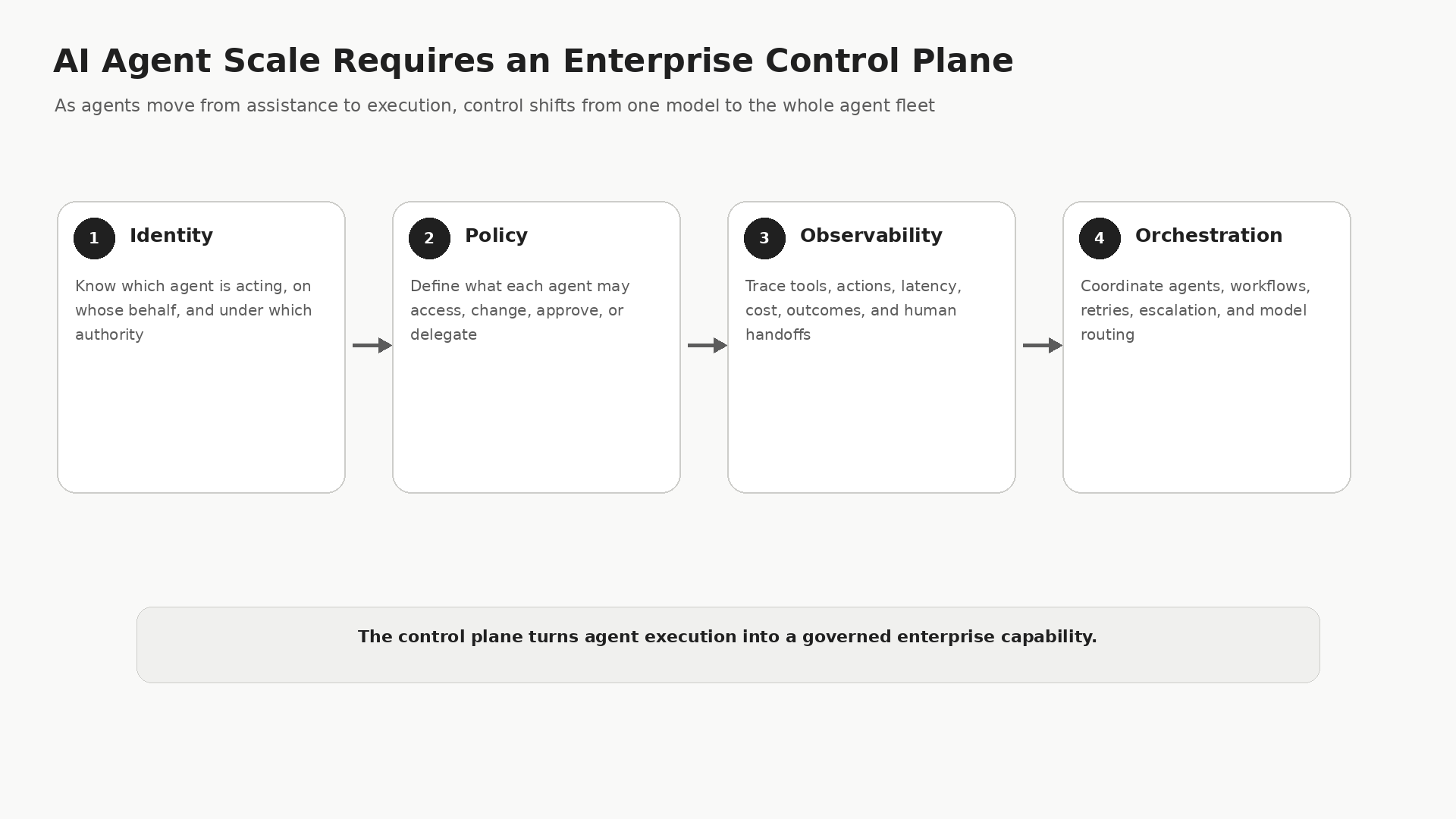
When Agents progress from content generation to tool invocation, data modification, workflow execution, and collaborative decision-making, identity, permissions, policy, auditing, observability, and cost management become foundational requirements. In 2026, BCG introduced the Enterprise AI Control Plane concept, and leading platforms like Microsoft and IBM started consolidating Agent observability, policy, and governance within control planes.
Therefore, the next phase of enterprise AI competition may not solely revolve around model capabilities. True, sustainable differentiation could emerge from the control layer that integrates enterprise identity systems, business permissions, data, tools, and Agent runtime environments.
Core Points
- As Agents shift from answering questions to executing tasks, enterprise governance expands from model outputs to a complete chain of actions
- Increasing Agent numbers magnify identity, permission, observability, cost, and auditing issues, making single-point governance inadequate for the entire Agent fleet
- The Enterprise AI Control Plane is not yet another chat interface, but a unified platform for observation, control, authorization, and accountability
- The model layer is increasingly replaceable; long-term enterprise engagement is more likely to be anchored by control infrastructure deeply integrated with identity, workflow, and system connectivity
Why Agent Scaling Changes the Problem Landscape
A single Copilot's risks are relatively straightforward: users pose questions, models provide answers, and humans retain final authority. However, once Agents acquire tool invocation privileges, software evolves from information provider to active participant. An Agent may access client records, create tickets, modify databases, send emails, execute code, or subdivide tasks and delegate them to other Agents. Enterprises then must manage not just a single response, but an entire chain of execution.
The concept of an Agent fleet differs from traditional SaaS user metrics. Enterprises may deploy numerous Agents across disparate business systems, built by various teams on different frameworks. Multiple platforms breed inconsistent permission standards, fragmented logs, and difficult cost attribution. Enterprises face not merely whether AI can be used, but whether AI remains manageable.
This evolution mirrors cloud computing’s shift from server procurement to cloud management. As server counts rise, focus pivots to identity, scheduling, monitoring, policy, and resource management. Agents may undergo similar transitions: models are compute resources, while the control layer determines the safe integration of these resources into enterprise production systems.
Identity and Permissions: The New Infrastructure of the Agent Era
Traditional software permissions are structured around people and applications. Agents introduce a third principal: autonomous software entities capable of task execution. Enterprises must know which identity an Agent operates under, its granted permissions, the duration of those permissions, and whether they can be transferred to other Agents or tools.
A major challenge lies in the need for more granular Agent permissions than permanent human credentials. For example, a finance Agent may access invoices but not authorize payments; a sales Agent can update CRM but shouldn't alter contracts arbitrarily. Future organizations will require dynamic, context-sensitive authorization combining task, context, risk, and time windows.
Once Agent identity becomes a formal IT entity, identity management, security policies, and business workflows converge. The control layer must tightly bind actors and actions, creating auditable trails for critical operations.
Observability: The Foundation of Agent Operations
Traditional monitoring targets latency, error rates, and availability, but Agent failure modes are more complex. Agents may call inappropriate tools, misinterpret context, make poor execution choices, or complete tasks with unacceptable business outcomes.
Agent observability must track not only inputs and outputs, but also tool invocations, permission states, costs, delays, task completion rates, and intervention points. Microsoft's Foundry Control Plane offers end-to-end tracking of Agent runs—inputs, tool calls, outputs, delays, and costs—while emphasizing ongoing evaluation of task adherence and tool invocation accuracy in production.
Crucially, observability merges with governance. Enterprises log Agent activity not just to see what was done, but to enable interruption, rollback, re-authorization, or manual intervention during anomalies. Observability thus becomes the entry point for effective system control.
Policy and Orchestration: Gateways to Core Business Functions
As Agents enter key workflows—finance, procurement, customer service, R&D, operations—organizations need to define which tasks can be automated, which require approval, and which must be assigned to humans. This demands a policy engine, not merely a prompt mechanism.
Complex tasks may involve multiple Agents collaborating: one retrieves data, another analyzes it, a third interacts with systems, and the process concludes with human or Agent review. Enterprises must clarify these collaborative patterns, final authorities, recovery strategies, and cost allocation. IBM’s 2026 Agentic Control Plane merges operations, governance, visibility, reuse, and scheduling into unified management.
Ultimately, orchestration will become integral to enterprise workflows—determining which tasks are suitable for automation, model-based judgment, or deterministic software. This evolution shifts the Agent platform beyond AI tools toward a new execution layer for business operations.
Why Model Capability Is Not the Greatest Moat
While model performance is significant, the competitive logic for the control layer is fundamentally different. Models are interchangeable; the same task may utilize different models based on cost, speed, quality, and compliance. Deep integration with a single model vendor poses lock-in risks for enterprises.
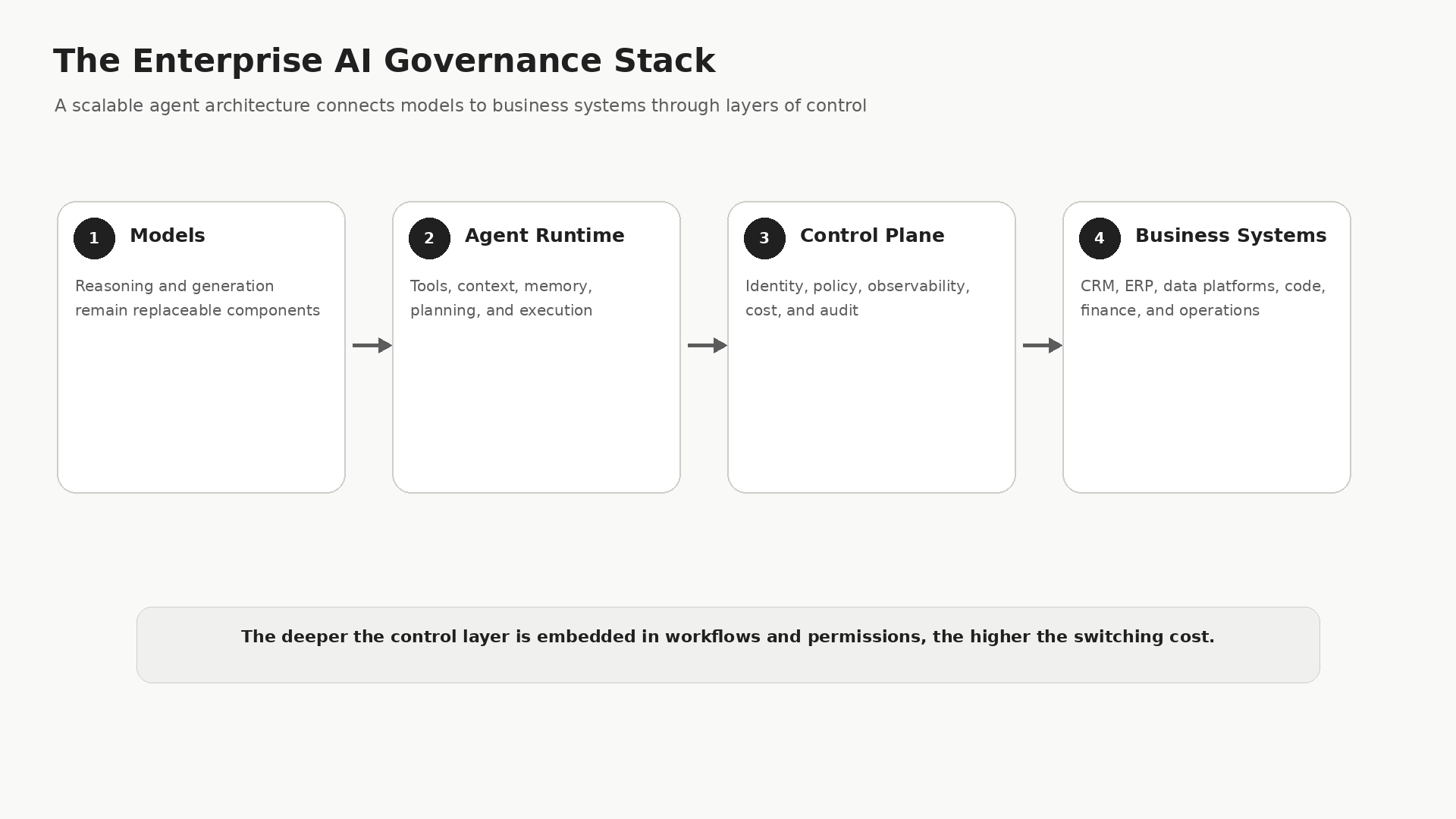
Conversely, identity, permission, business system integration, and audit histories entail higher migration costs. If enterprises build Agent rules, permissions, and workflows atop a specific control layer, replacing it means redesigning governance structures. The true moat is found in embedding within enterprise processes rather than model size.
The future AI software value chain may be stratified: model and compute form the base, Agent runtime, tool integration, and orchestration constitute the middle, business applications reside at the top, and control planes govern identity, policy, observability, and governance throughout.
What Enterprises Actually Need: Not Just More Agents
Enterprises often focus on Agent count as a progress metric. However, more Agents can mean permission chaos, rising costs, and duplicated efforts, rendering sheer quantity meaningless. The real focus should be unit task cost, automation ratio, manual handover rate, error rate, and business value.
Procurement strategies will likely shift: instead of buying individual Agents, organizations will invest in infrastructure for secure, scalable Agent operations. Essential capabilities include Agent directories, identity management, permission control, versioning, operational cost tracking, performance measurement, and standardized onboarding/offboarding.
From an industrial standpoint, the true winners of the Agent era may not be those with the best Demos, but those who command identity, data, workflows, development platforms, and enterprise integration. As Agents proliferate, the value of the control layer only grows.
Next-Gen AI Agents: From Capability to Operability
Previous AI competition focused on whether models could complete tasks. The new priority is whether organizations can trust AI to reliably execute tasks long term. The missing piece is robust infrastructure, and the control plane addresses this gap.
Not every organization will need a comprehensive Control Plane. Cloud providers, AI platforms, security vendors, identity providers, and enterprise software firms may embed elements of these capabilities. Competition will revolve around standards, ecosystems, and preferred integrations.
Rather than tracking how many organizations deploy Agents, the inflection point is when organizations establish unified identity, permissions, monitoring, policies, and audit systems. When these functions become production necessities, Agents truly become enterprise infrastructure.
Scaling Demands New Organizational Capabilities
Agent scaling also prompts changes in organizational structures. Traditionally, IT manages stability, business teams drive adoption, and security handles risk. Agents, however, function as software, workforce, and automation, spanning multiple departments. Mature enterprise AI systems must redefine responsibility: who creates Agents, who grants permissions, who monitors outcomes, and who bears business accountability. These shifts intensify as Agents permeate business functions.
In product design, control systems will alter how organizations evaluate Agents. Criteria will shift from answer quality toward deployment standardization, rapid permission revocation, task cost comparison across models, and comprehensive audit chains for exceptions. Evaluation will move from Demo experiences toward production-grade reliability. Model capability remains relevant, but increasingly serves as a modular component.
If this trend unfolds, the commercial tipping point for AI Agents will be when organizations are willing to invest in secure Agent operation. Once identity, policy, observability, orchestration, and auditing become standard capabilities, AI will truly become foundational enterprise software infrastructure. This market potential could exceed that of single Copilot products, as the control layer serves all operational AI entities.
Standardization is critical. As Agents enter production, enterprises require unified identity models, permission management, operational logs, evaluation criteria, and onboarding processes. Tight standardization simplifies switching among models and Agents, and enables the replication of successful automation workflows across departments. Conversely, fragmented frameworks and rules drive up maintenance costs as scale increases. The long-term value of control systems lies in consolidating this complexity into reusable enterprise standards.
FAQ
Why do enterprises need an AI Agent Control Plane?
Because once Agents have execution privileges, organizations must centrally manage identity, permissions, policies, operational status, costs, and audits—challenges that cannot be solved by a single model.
How does a Control Plane differ from a typical AI platform?
Conventional AI platforms focus on model invocation, development, and deployment; a Control Plane prioritizes unified identity, policy, observability, governance, and operational control across all Agents.
Does more Agents automatically mean more valuable enterprise AI?
No. The true metrics are task completion rates, manual intervention ratios, unit task costs, error rates, and business outcomes. Agent count alone merely reflects scale.