This IPO boom has clear structural characteristics. On the one hand, Anthropic and SpaceX set new capital markets financing records through their mega-sized offerings, making AI, aerospace, semiconductors, and energy infrastructure key areas of market attention. On the other hand, the post-listing performance of different new stocks varied significantly: Some companies attracted strong demand on their first day of trading but later faced valuation adjustments.
IPOs are not only an important channel for corporate financing but also reflect the capital market's assessment of industry growth, business models, and future profitability. This article examines representative IPO cases from 2026, reviews the financing logic, valuation characteristics, and market performance of different industries, and analyzes how investors should understand the opportunities and risks behind popular IPOs.
Key Takeaways
-
U.S. IPO financing reached a record high in 2026, but funds were highly concentrated in a small number of mega-sized companies, including Anthropic and SpaceX.
-
Anthropic and SpaceX represent the generative AI and commercial aerospace industries, respectively. Their listings highlight the financing needs of capital-intensive technology companies.
-
Cerebras and Quantinuum demonstrate the trend of AI chip and quantum computing companies entering the public markets, but their commercialization stages and valuation logic differ.
-
BitGo and PayPay represent digital asset infrastructure and digital payments, respectively, reflecting the increasing diversity of fintech IPO business models.
-
Energy companies such as Fervo Energy attracted attention, highlighting the connection between AI data center expansion and investment in power infrastructure.
-
The offering sizes, first-day gains, and long-term investment returns of popular IPOs vary. Investors need to analyze profitability, valuation, and stock liquidity together.
Why Did the Global IPO Market See Mega-Sized Financing in 2026?
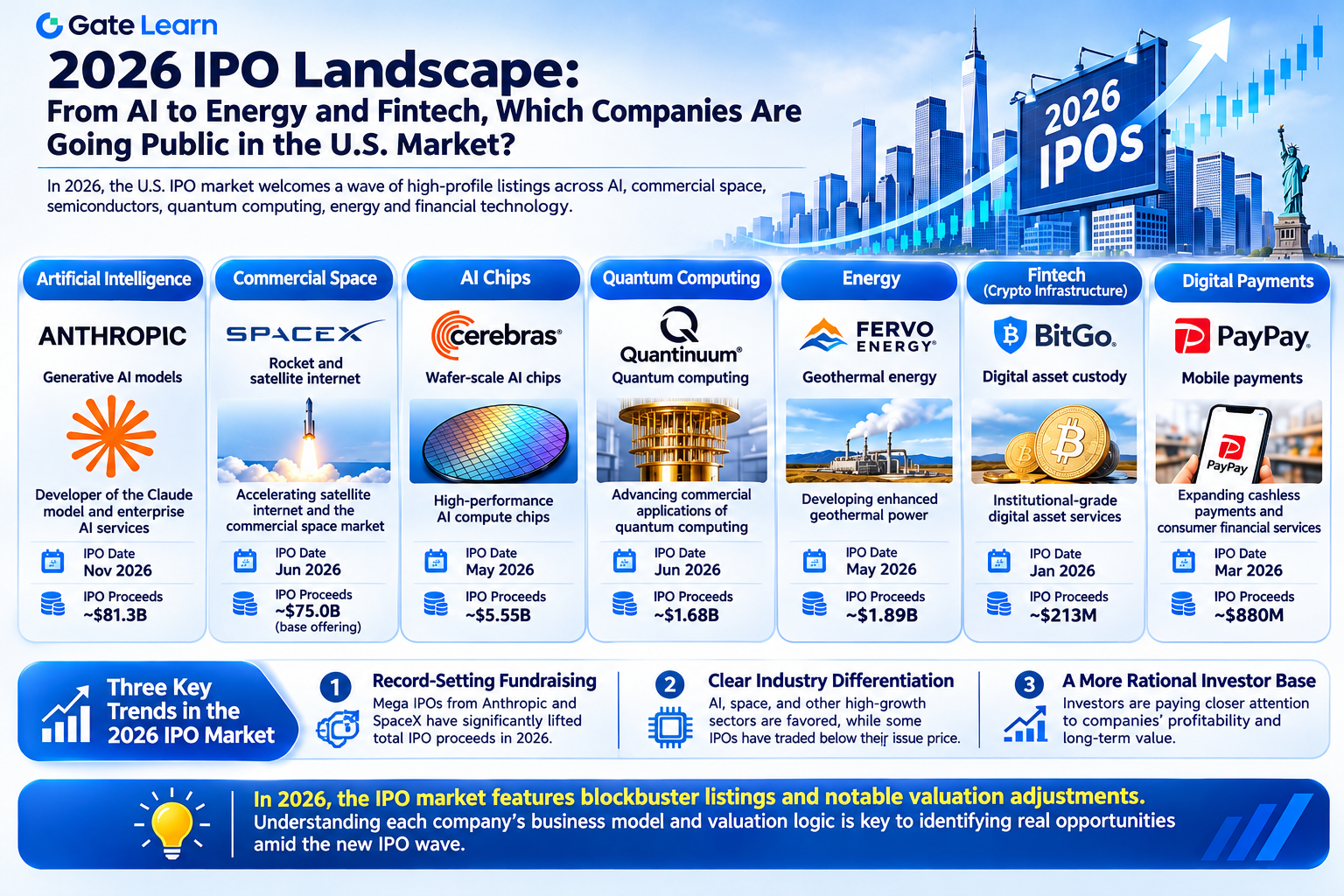
The most prominent change in the 2026 IPO market was that a small number of large technology companies significantly increased overall financing volumes. In November, Anthropic raised approximately $81.3 billion through a public offering, exceeding SpaceX's approximately $75 billion base offering in June and becoming the new record holder for the largest IPO financing in the world.
The emergence of mega-sized IPOs is related to the growing capital requirements of technology companies. Generative AI companies need to make continuous investments in model training, inference infrastructure, and research and development, while commercial aerospace companies need to build launch systems, satellite networks, and related infrastructure. For these companies, the public markets provide not only a financing channel but also new liquidity opportunities for early investors.
At the same time, growth in IPO financing does not mean that listing activity was strong across the board. In 2026, U.S. market issuance was highly concentrated in a small number of companies, while the listing environment for companies in other industries and small and midsize companies remained affected by interest rates, valuations, and investor risk appetite.
Therefore, when examining the annual IPO market, it is necessary to distinguish among total financing, the number of listed companies, and post-listing stock performance. When a small number of companies set financing records, this reflects the capital market's recognition of specific business models and industry prospects. It does not mean that all new stocks have the same financing capacity.
Why Did Anthropic and SpaceX Become the Year's IPO Focus?
Anthropic and SpaceX represent two major technology industry themes that attracted capital market attention in 2026: artificial intelligence and commercial aerospace.
Anthropic is a generative AI company whose Claude models and related services target enterprise and developer markets. As AI applications increasingly enter enterprise software, programming, and business automation, the market is paying closer attention to whether model capabilities can translate into recurring revenue and whether computing costs and research and development investments are economically viable over the long term.
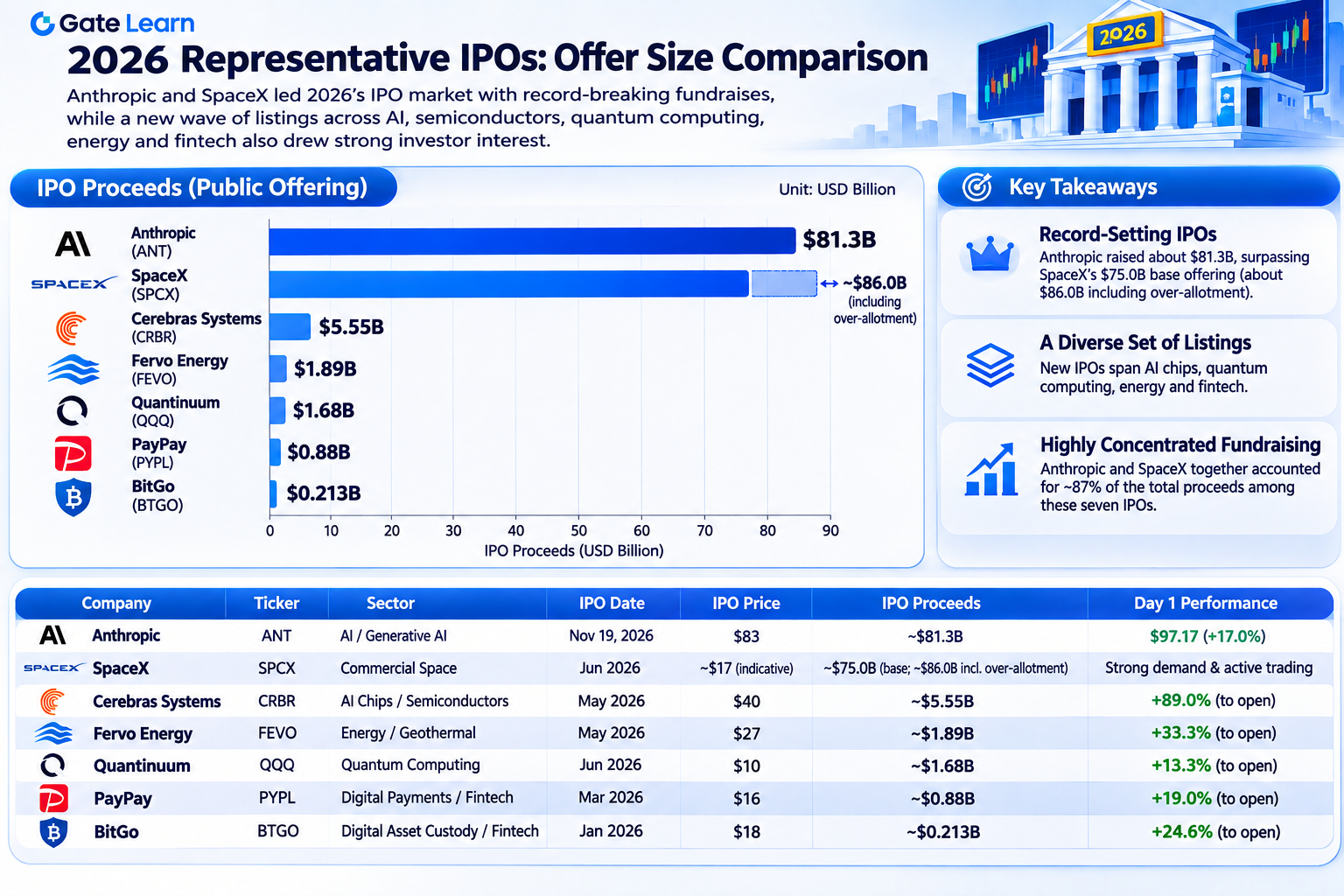
Anthropic listed on Nasdaq on November 19 under the ticker ANT. Its offering price was $83 per share, and it raised approximately $81.3 billion through the public offering. Its stock closed at $97.17 on the first day of trading, up approximately 17% from the offering price. This performance reflected market demand for large AI companies, but subsequent valuation still needs to be supported by operating data.
SpaceX operates businesses including rocket launches and satellite internet. Its business model involves long-term investment in research and development, manufacturing, and infrastructure. The company completed a base offering of approximately $75 billion in June. Including exercised overallotments, total financing was approximately $86 billion.
Although the two companies operate in different industries, they share characteristics including substantial capital requirements, high technological barriers to entry, and valuations that incorporate significant long-term growth expectations. However, the core metrics for analyzing Anthropic relate more to AI service revenue, customer demand, and computing costs, while SpaceX needs to be evaluated based on launch services, satellite networks, capital expenditures, and long-term operating cash flow.
How Do Cerebras and Quantinuum Represent the Listing Trend Among Frontier Technology Companies?
In addition to large AI model companies, several companies in frontier technology fields entered the public markets in 2026. Cerebras Systems and Quantinuum are particularly representative examples.
Cerebras is an AI computing chip company that has attracted attention for its wafer-scale computing architecture. Compared with the widely adopted GPU computing model, its technology approach attempts to meet the needs of high-performance AI computing through a different chip architecture and system design.
Cerebras completed an IPO of approximately $5.55 billion in May, and its stock opened approximately 89% above the offering price on its first day of trading. This market performance shows that investors are not only focused on established AI chip companies such as NVIDIA but are also seeking newly listed companies that may offer differentiated computing solutions.
However, the long-term competitiveness of AI chip companies cannot be determined solely by their technology architecture. Investors also need to analyze software ecosystems, customer concentration, product delivery capabilities, and ongoing research and development investment. Even if a chip has technological advantages, that does not mean it can immediately secure a stable market share.
Quantinuum represents the quantum computing industry. The company raised approximately $1.68 billion through its IPO in June, and its stock opened approximately 13.3% above the offering price on its first day of trading.
Compared with mature technology companies that have already established substantial commercial revenue, the value of quantum computing companies depends more on technological progress, commercialization pathways, and long-term market demand. Therefore, when researching Quantinuum, investors should focus on research and development investment, actual customer contracts, technology use cases, and the rate of cash consumption.
The listings of Cerebras and Quantinuum show that the public markets are providing financing channels for companies at different levels of technological maturity. However, there remains a lengthy validation process between technological prospects and investment returns.
What Fintech IPO Opportunities Do BitGo and PayPay Represent?
Representative fintech IPO cases in 2026 included digital asset custody platform BitGo and Japanese digital payments company PayPay. The two companies correspond to institutional digital asset services and consumer payments, respectively, demonstrating the diverse revenue models of fintech companies.
BitGo completed an IPO of approximately $213 million in January. Its offering price was $18 per share, and its stock opened approximately 24.6% above the offering price on its first day of trading. Its business includes digital asset custody and related institutional services.
Unlike businesses that rely primarily on rising crypto asset prices to generate revenue, the long-term development of institutional custody services depends more on customer growth, demand for asset custody, service fees, and compliance operating costs. For BitGo, growth in the digital asset market may create business opportunities, but the company still needs to demonstrate that this demand can translate into stable revenue.
PayPay is a major participant in Japan's digital payments market. It listed in the United States in March at an offering price of $16 per share, raised approximately $880 million through its IPO, and opened approximately 19% above the offering price on its first day of trading.
The valuation logic for digital payments companies differs significantly from that of digital asset custody companies. For PayPay, key areas of analysis include user scale, transaction activity, payments revenue, and the development of financial services.
The listings of these two companies show that fintech IPOs now cover a range of areas, including payment networks, digital asset custody, and institutional financial services. Investors should not compare valuations based solely on the fintech industry label. Instead, they should analyze each company's actual revenue sources, profit margins, and regulatory costs.
Why Have Energy Companies Such as Fervo Energy Attracted Capital Market Attention?
The expansion of AI data centers is increasing demand not only for GPUs and servers but also for power supplies, cooling equipment, and energy infrastructure. As computing clusters grow, reliable power supply is becoming an increasingly important factor affecting the pace of data center construction.
Fervo Energy is an enhanced geothermal energy development company. It completed an IPO of approximately $1.89 billion in May at an offering price of $27 per share, and its stock opened approximately 33.3% above the offering price on its first day of trading.
The investment logic for geothermal power generation differs from that of AI chips. Chip companies primarily generate revenue through product sales and technological competition, while energy developers need to complete resource assessments, project construction, financing, and electricity sales. They also typically have longer capital recovery periods.
Other energy and infrastructure-related IPOs in 2026 included gas engine company Innio and nuclear energy technology company X-Energy. These companies involve different energy technologies and business models, but both reflect market attention to power supplies and related equipment.
However, growth in data center power demand does not mean that all energy projects will generate the same returns. A project's ability to generate stable cash flow still depends on construction costs, electricity sale prices, long-term contracts, regulatory conditions, and actual operating efficiency.
For investors, the key question for energy IPOs is not whether a company belongs to the AI value chain but whether it can convert infrastructure demand into executable projects and sustainable profitability.
Why Can First-Day IPO Performance Differ From Subsequent Stock Performance?
The IPO offering price is usually determined by the issuer and underwriters based on investor demand, company valuation, and market conditions, while the stock price after listing is formed through continuous trading.
Several popular IPOs in 2026 received strong market reactions on their first trading days. For example, the opening prices of Cerebras, Fervo Energy, Quantinuum, BitGo, and PayPay were all above their respective offering prices.
However, a first-day gain does not mean that the stock price will maintain the same trend. During the early post-listing period, shares held by certain founders, employees, and early investors may be subject to lockup restrictions, leaving a relatively limited number of shares available for trading. When buying demand is concentrated, the stock price may experience significant volatility.
As listed companies release more financial data, the market reassesses revenue growth, profitability, and future capital requirements. If a company's actual performance falls short of previous expectations, its valuation multiple may decline even if the business continues to grow.
In addition, the offering price differs from the trading price on the first day of listing. Investors who receive shares at the offering price may have a completely different return profile from investors who buy at a higher price after listing.
Therefore, when evaluating a popular IPO, investors need to clarify whether the offering price, first-day opening price, or subsequent market price is being used as the comparison benchmark. This helps avoid interpreting the first-day gain directly as a long-term investment return.
Why Doesn't Record IPO Financing Mean That All New Stocks Performed Well in 2026?
The 2026 IPO market showed a clear concentration of financing volume. The mega-sized offerings from Anthropic and SpaceX drove up total annual financing, but the performance of other new stocks did not improve in tandem.
As of November 16, among the 52 U.S. companies that had listed that year with offering valuations of $1 billion or more, 37 had closing prices below their offering prices, accounting for approximately 71% of the sample. This statistic excludes Anthropic, which listed later, and does not represent the overall performance of all U.S. IPOs.
This divergence shows that the capital market assigns significantly different risk premiums to different companies. Companies with strong market recognition, established customer bases, or important technological positions may find it easier to attract institutional capital. Companies with unstable revenue, unclear paths to profitability, or weaker liquidity may face stricter valuation requirements.
The macroeconomic environment is also important. When bond yields are high and investor risk appetite declines, growth companies that have not yet achieved stable profitability may be affected more significantly. Even if an industry has strong long-term growth potential, its stock valuation may adjust as the cost of capital changes.
Therefore, record financing and divergent new-stock performance are not contradictory. The former reflects the financing capacity of a small number of large companies, while the latter reflects the public market's ongoing screening of different business models, valuation levels, and operating risks.
How Should Investors Analyze the Valuation, Float, and Profitability of Newly Listed Companies?
When analyzing IPO companies, investors first need to clarify the valuation basis. IPO financing is the capital raised through the issuance of shares by a company or the sale of shares by its shareholders, while market capitalization at issuance reflects the equity value of the company at the offering price. The two should not be conflated.
Financial metrics should be selected based on the business model. For AI service companies such as Anthropic, investors can focus on revenue growth, computing costs, and future cash flow. For chip companies such as Cerebras, key areas include customer orders, gross margin, and research and development investment. For energy companies such as Fervo Energy, investors need to evaluate project capital expenditures, construction timelines, and long-term electricity sales revenue.
Investors should also examine the share float structure. The number of shares issued in an IPO, lockup periods, employee equity incentives, and potential follow-on offerings can all affect the supply and demand of the stock after listing. A smaller float may amplify short-term price volatility, but it does not necessarily mean that the company has a higher long-term valuation.
It is also necessary to compare a company's actual operating performance with market expectations at the time of listing. A high valuation usually means that investors have high expectations for future growth. If revenue or profitability develops more slowly than expected, the stock price may adjust even if the company continues to expand.
Therefore, IPO research should not focus only on first-day performance. Instead, investors should establish a comprehensive analytical framework covering the business model, capital structure, valuation, and cash flow.
How Can You Follow Listed Popular Companies Through Gate Stock Trading?
Popular IPOs in 2026 provided investors with new listed-company examples across AI, semiconductors, commercial aerospace, fintech, and energy infrastructure. The stock prices of these companies are influenced by industry growth expectations as well as financial performance, market liquidity, and valuation changes.
Gate Stock Trading services provide users with a channel for following the U.S. stock market. Investors can visit Gate's TradFi stock section to view the supported stocks, market data, and trading rules, and conduct research using prospectuses, quarterly financial reports, and market information.
At the same time, stock spot trading, stock perpetual contracts, and other stock derivatives differ in terms of asset rights, fee structures, and risks. For leveraged products, users also need to pay attention to margin requirements, funding fees, and liquidation risks.
The market attention surrounding popular IPOs may lead to significant short-term volatility, but long-term investment value still depends on whether a company can translate industry growth into sustainable revenue, profitability, and cash flow.
Conclusion
The 2026 IPO market displayed distinct industry characteristics. Anthropic and SpaceX set new financing records through mega-sized offerings, Cerebras and Quantinuum demonstrated the listing trend among frontier computing technology companies, BitGo and PayPay reflected the diversification of fintech business models, and companies such as Fervo Energy highlighted the impact of AI infrastructure expansion on the energy industry.
Although these companies come from different fields, they all face the public market's evaluation of growth quality, capital investment, and profitability. An IPO can provide development capital for a company and allow investors to participate in emerging industries, but offering size and first-day gains do not equal long-term investment returns.
For investors, the value of the popular IPOs of 2026 lies not only in becoming familiar with newly listed companies but also in understanding how the capital market values different industries. As companies release more post-listing operating data, revenue growth, cash flow, valuation levels, and market competitiveness will become important factors in assessing long-term value.
FAQ
Which Company Had the Largest IPO Financing in 2026?
As of November 20, 2026, Anthropic had surpassed SpaceX with approximately $81.3 billion in public offering proceeds, becoming the IPO with the largest financing amount in the world. When comparing figures, it is necessary to distinguish among base offerings, overallotments, and concurrent private placements.
Why Did Anthropic and SpaceX's IPOs Attract Attention?
The two companies represent the generative AI and commercial aerospace industries, respectively. They have high technological barriers to entry, substantial capital requirements, and long-term growth expectations.
Which AI Chip IPOs Were Worth Watching in 2026?
Cerebras Systems was one representative company. Its wafer-scale computing architecture offers a technology approach different from traditional GPUs, but its commercial competitiveness still needs to be assessed based on orders and operating data.
Are BitGo and PayPay the Same Type of Fintech Company?
Both operate in the fintech sector, but BitGo primarily focuses on digital asset custody and institutional services, while PayPay centers on digital payments and related financial services. Their revenue models and valuation methods differ.
Why Did Energy Companies Become an IPO Focus in 2026?
The construction of AI data centers increased market attention to power supplies and energy infrastructure. However, whether a specific company can benefit still depends on project construction, contract execution, and profitability.
Does a First-Day IPO Gain Mean the Stock Is a Good Long-Term Investment?
Not necessarily. Early post-listing prices may be influenced by the float and short-term market sentiment. Long-term performance still requires support from revenue, profit, and cash flow.